
Caleb Davis: A Unionist Black Sheep in Civil War Lawrenceburg
By Clint Alley
A County Divided
Not all Lawrence Countians supported the cause of the Confederacy during the Civil War. For a variety of reasons, many native southerners chose to remain loyal to the Union despite the prevailing sympathies of their neighbors. Although the majority of those sympathies were enthusiastically pro-Confederate when Tennessee voted to leave the Union after the shelling of Fort Sumter,[1] many early supporters of the secession movement began to question their loyalties when the realities of war began crashing down around them.[2]
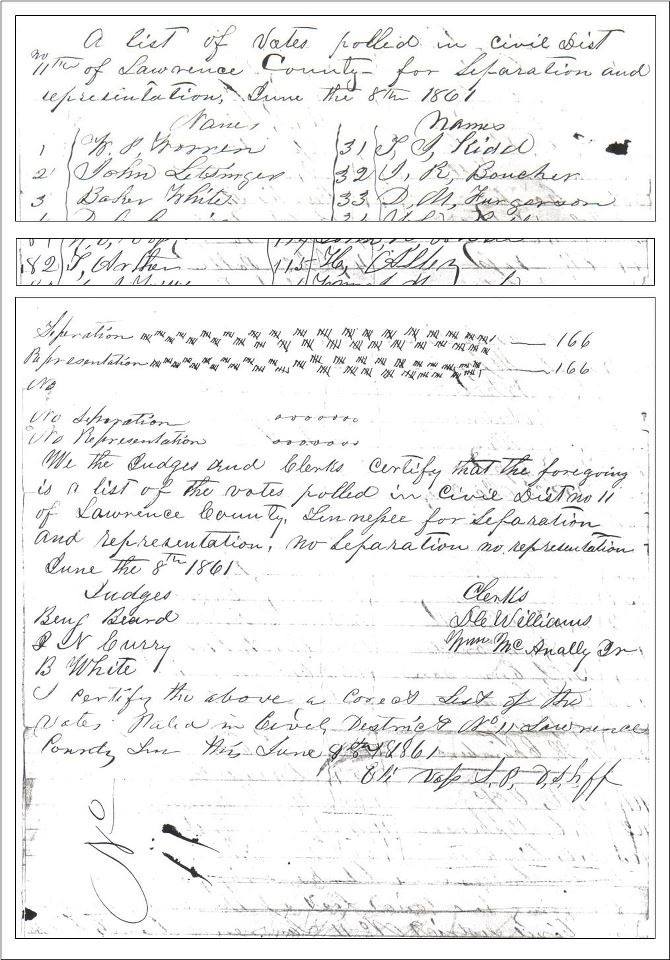
Secession Referendum Return From Lawrence County’s 11th District. Source: Lawrence County, TN Archives.
For others, their loyalty to the United States government was never in doubt, only their outward expression of it. According to Alfred O. Williams, a closet unionist and owner of the Marcella Falls cotton mill during the Civil War, many of Lawrence County’s loyalists voted for secession because “it was unsafe to vote otherwise.”[3] In his Southern Claims Commission testimony, Williams related the tale of the only man in his district who openly voted against secession. “There was only one vote against separation,” said Williams, “and that man was so threatened that he had to finally leave and join the Federal Army.”[4]
A Slaveholding Unionist?
One prominent local unionist was Caleb B. Davis. Before the Civil War, Davis was an attorney who lived “on a hill at the west end of town.”[5] He was 44 years old in the 1860 census.[6] He had a law firm in Lawrenceburg with partner Thomas H. Paine (who would go on to serve in Tennessee’s Confederate legislature, raise a company of Lawrence Countians for the Confederate cavalry and, after the war, become a pioneer of public education in Tennessee).[7] And it may come as a shock to some that Davis—despite his self-ascribed strong unionist sympathies—was also a slaveholder. In 1860, Davis was the owner of a 43-year-old female and a 7-year-old male slave, respectively.[8]

This is the Lawrenceburg Square as it looked during Davis’s time, with the David Crockett Courthouse crowning the center. Source: Facebook album of the Old Jail Museum, Lawrenceburg, TN.
Davis’s position as a slaveholder underlies the complex nature of the Civil War. For the sake of curricular expediency, most Americans have been conditioned by elementary school textbooks to believe that all slave-owners were supporters of the Confederacy and all non-slave-owners were supporters of the Union. However, as the life of Caleb Davis proves, the Civil War was not always a matter of black and white. Just as many non-slaveholding northerners supported the Confederacy’s efforts to leave the Union, many slaveholding southerners (like Davis) supported the Union’s efforts to keep the South as part of the United States. In his Southern Claims Commission deposition, Davis explained that, at first, although he did not vote for secession, he was “a rebel and made fine speeches for the rebellion.”[9] While he felt that the southern states had legitimate grievances with the Federal government, he believed that, rather than commence an armed revolution, they should have fought “for their rights in the Union under the Constitution.”[10]
The Lawyer Takes the Oath
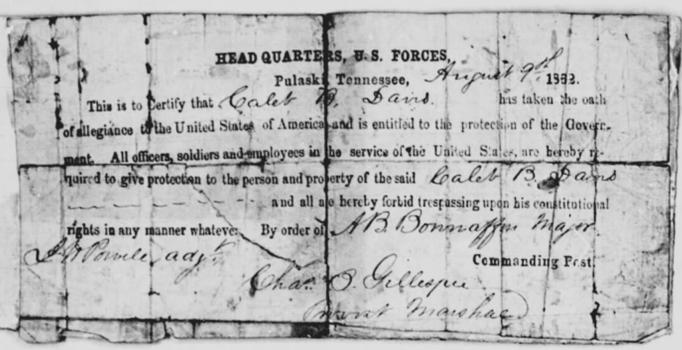
This torn and tattered page is a copy of Caleb Davis’s original Oath of Allegiance to the Union, as sworn before Union officers in Pulaski on August 9, 1862. Source: Caleb B. Davis Southern Claims Commission file.
The courts of Lawrence County continued to operate as normal from the time of secession until the coming of Union troops disrupted the normal dispensation of law and order. Davis the attorney became Davis the blacksmith when the war closed the courts. By December 1861, Davis had a change of heart about the rebellion, and—despite his wartime retirement from the bar—his neighbor, William P.H. Turner testified that Davis continued to make occasional public speeches which became increasingly “in favor of peace and the Union” at that time, and that he became known in the county as a “Union man.”[11] After the United States Congress approved the administering of the Ironclad Oath of allegiance to the Union in July 1862, Davis was quick to comply. On August 9, 1862, he traveled to the Union army headquarters in Pulaski to take the oath, becoming one of the first residents of Lawrence County to do so.
Loyalty Displayed and Rewarded
Turner, his neighbor, testified that Davis suffered at the hands of local authorities and Confederate officers for taking the oath. Davis, himself, claimed that he was forced to hide in the woods near Lawrenceburg for three days in 1863 while being hunted by men under the command of Confederate captain—and fellow Lawrence Countian—Lewis M. Kirk, a guerilla leader whose fierce treatment of Unionists was infamous among his enemies. Davis also claimed to have adamantly refused to do blacksmith work for a group of Confederate soldiers who tried to force him. [12] But Davis’s loyalty to the Union cause extended beyond acts of defiance to his Confederate neighbors. According to his Southern Claims Commission deposition, Davis and his wife spent seven weeks nursing a sick Union soldier in his own home and at his own expense. When the soldier succumbed to his illness, Davis built the coffin and buried the man, himself, presumably on his own property.[13]

General Andrew Jackson Smith, of the Union Army’s XVI Corps. Davis claimed that Smith’s men were responsible for requisitioning $1,300 worth of property from his home in January 1865, when they encamped on his land. Source: Civil War Trust.
However, in a move that many local Confederate sympathizers no doubt found wrought with poetic justice, Union troops under command of General A.J. Smith confiscated over $1,300 worth of Davis’s property—500 cords of wood, a seven-year-old mare, and 200 pounds of bacon, to name some of it—when a force of 15,000 of them camped in Lawrenceburg and on his land on January 10, 1865 while pursuing General Hood after the Battle of Nashville.[14] His neighbors watched as unhusked corn was taken from his corn crib, his new fence rails were burned for fuel in the brisk January cold, and his gray mare was taken from his stable. According to the Westegg Inflation Calculator, a loss of $1,300 in 1865 would be akin to losing $19,000 today. The loss represented 1/3 of Davis’s total 1860 property value.[15]
Postwar Activities
At the war’s end, according to testimony from his friend T.H. Gibbs, Davis “sought and accepted a position as Freedmen’s Bureau agent.” But, after all that he had suffered in the name of the Union, the Federal government refused to repay him the $1,300 he lost to them in 1865. His claim file says simply “as he was not loyal throughout the whole war—claim rejected.”[16]
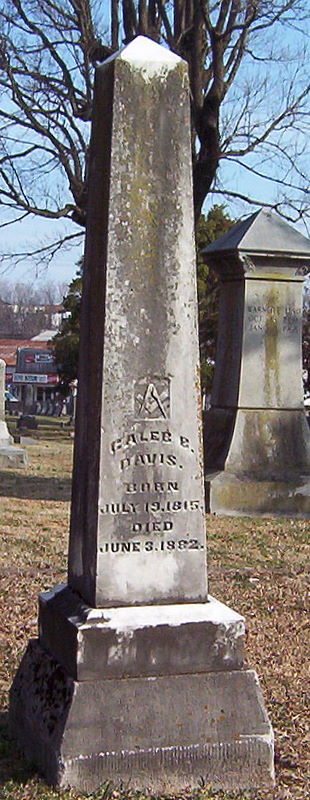
Caleb B. Davis is buried in Riverside Cemetery, in McMinnville, Tennessee. Source: Findagrave Memorial #88201230.
Davis’s wartime activities illustrate the truth that the Civil War was perhaps at its worst on the local level, where entire communities were torn apart. Despite Davis’s prior good standing in the community, no doubt many of his Confederate neighbors were loathe to forgive him for his wartime position. And so, despised by his neighbors and abandoned by the government he loved, Davis moved to McMinnville in Warren County, Tennessee, where he lived out his days until his death on June 3, 1882.[17]
Sources
Carpenter, Viola, and Mary M. Carter. Our Hometown: Lawrenceburg, Tennessee, The Crossroads of Dixie. Lawrenceburg, TN: Bobby Alford, 1986.
Davis, Caleb B. (Lawrence Co., Tennessee) claim, office no. 737, case no. 13130, Barred and Disallowed Case Files, Southern Claims Commission, 1871-1880; digital images, “Southern Claims – Barred and Disallowed,” Fold3.com [accessed 17 Feb 2014].
Derby, George, and James Terry White. The National Cyclopedia of American Biography. Vol. 8. New York: James T. White & Company, 1898.
Find A Grave, “Memorial Page for Caleb B. Davis (19 Jul 1815-3 Jun 1882).” Last modified April 07, 2012. Accessed 17 February 2014. Findagrave Memorial #88201230.
Tennessee. Lawrence County. Separation and Representation referendum returns, 8 June 1861; Lawrence County Archives, Leoma, Tennessee.
Tennessee. Lawrence County. 1860 U.S. census, population schedule. Micropublication M653_1260, pg. 451, image 245. Washington: National Archives. Digital image, Ancestry.com [accessed 17 Feb 2014].
Tennessee. Lawrence County. 1860 U.S. census, slave schedule. Micropublication M653, 8th civil district, page 4. Washington: National Archives. Digital image, Ancestry.com [accessed 17 Feb 2014].
Williams, Alfred O. (Lawrence Co., Tennessee) claim, office no. 1431, case no. 13983, Barred and Disallowed Case Files, Southern Claims Commission, 1871-1880; digital images, “Southern Claims – Barred and Disallowed,” Fold3.com [accessed 17 Feb 2014].

 Lawrence County History Trivia
Wow, I continue to just love this blog and FB page on Lawrence County History. I have a loose end, a 3rd great grandfather James W Davis b abt 1815 in TN, died 1910 in Prentiss Co MS. He married Elizabeth Boren in Lawrence in 1837 where they raised their family until around they time she died (sometime after the 1850 census but before he remarried in Jan 1857). Anyway, in trying to figure out who James’ father was, I considered all the nearby Davis males in Lawrence of the right age to be his parent or, if too close in age with James, I would consider whether the man could be a brother. Caleb was in that latter number of possible brothers or cousins. (Of course, Davis a very common name too.) After reading this story, I’m pretty sure I can write Caleb off as a relative and just consider he has the same last name. Coincidentally, James W Davis was a blacksmith shoeing horses for the confederacy, and James & Elizabeth Boren Davis’ son-in-law (Thomas Jefferson Azbell) was under the command of Capt Lewis Kirk.