By Clint Alley
A Sordid Tale
One of the most infamous murders in Lawrence County’s history was committed in broad daylight, in front of more than forty witnesses. Friends of the killer said that it was a matter of honor, while friends of the slain insisted that it had nothing to do with honor and everything to do with bacon.
While not the household name that he once was, the killer in this case is well-known among local historians in Middle Tennessee. Lewis Kirk, the Confederate cavalryman, is the stuff of legend. In fact, his exploits are so astonishing, it is hard to distinguish which parts of his life are fact and which are fiction.
The Man
Kirk’s enemies accused him of a laundry list of atrocities both during life and after his death, including—but not limited to—the assassination of an injured Union general as he lay in an ambulance, the murder of countless contraband slaves, and the shooting death of a civilian who refused to cheer for Confederate president Jefferson Davis.[1] The stories told about him by his supporters are equally as raucous. According to local lore, Kirk—a captain in the 9th Tennessee Cavalry—taught his men to fight with reins in their mouths, pistol in one hand, and throwing-axe in the other.[2]
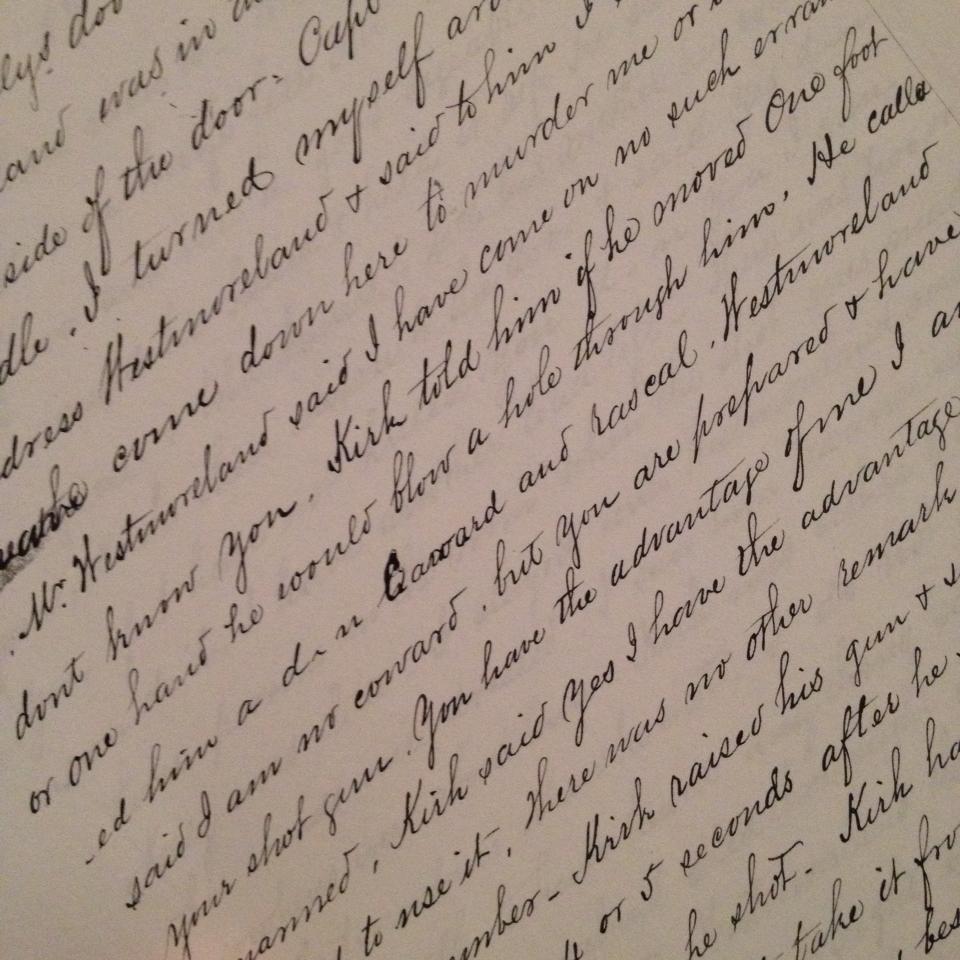
The case file for Kirk’s murder trial is available at the Tennessee State Library and Archives. Photo by Clint Alley
While it is tempting to dive into the particulars of his military career, that will have to wait for another day. This article will focus on a prewar episode of Kirk’s life that is equally as dramatic. But first, some background information about the man, himself. Before he was a Confederate officer, Kirk was a blacksmith, operating a modest shop next to his home just west of the Public Square in Lawrenceburg.[3]
Kirk was a veteran of the Mexican War, having joined the ‘Lawrenceburg Blues,’ in 1846. The Blues were the local infantry company raised as part of Tennessee’s overwhelming response to the president’s call for volunteers for the Mexican War.[4] Kirk was one of the few men in the company who did not fall ill or die in combat at the Battle of Monterrey.
After his company mustered out of service at New Orleans on May 23, 1847, Kirk returned to Lawrenceburg, and married first to Martha Glover on December 28, 1847,[5] and second to Ann Green on October 17, 1852.[6]
The Murder
Although the witness accounts of the slaying differ somewhat on the facts of the case, the events as reconstructed here represent a consensus of what most witnesses agreed was the truth. The recollections of the witnesses were clouded by alcohol, as most of those present at the time of the killing confess to having had “a drink or two” at the Drug Store (as state witness Willis James said, “The liquor was pretty good.”)[7] Curiously, none of the men remember themselves as being drunk that day, but many of them recollect the others as having been drunk.
On the afternoon of November 9, 1858, at around 3 p.m., Kirk entered the Public Square in Lawrenceburg on foot, carrying a double-barreled shotgun on his shoulder. It was a Tuesday afternoon, and the Square was crowded with people going about their day-to-day business. Kirk went first to Chaffin’s Grocery, which stood at the west side of the Square. He next went to Kelly’s Grocery, which was about 50 yards north of Chaffin’s, in the northwestern corner of the Square. At Kelly’s Grocery, Kirk began arguing loudly with Thomas J. Westmoreland.[8]
Westmoreland was a farmer from Giles County, and was in Lawrenceburg—so the prosecution asserted—to see if he could find a man named P.M. Wright, who had bought $4.25 worth of bacon from him before. It was Westmoreland’s aim that day—as his friends would later say in court—to either collect on the note, or to sell more bacon to Wright. But in addition to the note for Wright’s bacon, Westmoreland also had a hunting knife with a four-inch blade in his pocket, which he had borrowed from his friend Willis James, with whom he had stayed the night before at his James’s farm seven miles outside of Lawrenceburg.[9]
When James and Westmoreland arrived in Lawrenceburg, it was about noon, and they decided to stop at Richardson’s Tavern for dinner. Also in the tavern that day was John Morrison, a blacksmith. According to Morrison, Westmoreland asked if he was Kirk, and when he told him that he was not, Westmoreland replied, “It makes no difference. Damn Kirk and all his friends! If he darkens the door, he will darken a damned dark hole!” According to Morrison, Westmoreland’s tirade against Kirk went on, saying that he would like to meet ‘Cotton Bale’s’ brother. ‘Cotton Bale’ Kirk was an alias given to Lewis Kirk’s brother Frank, who was known throughout the countryside as a cotton thief.[10] Morrison goes on to say that Westmoreland had had some difficulty with Frank, which he mentioned at the tavern but upon which he did not elaborate.
After Westmoreland left the tavern, Morrison said that he saw him walk to Kirk’s house and shop, looking for him. When he saw no one there, he came back to the Square and went about his business in town.
When Kirk learned that there was a man looking for him about town and using his name in a most unsavory manner, he loaded his double-barreled shotgun and went to the Square to find him. He found Westmoreland at Kelly’s Grocery. As Kirk approached, Westmoreland stepped halfway outside the door, with one half of his body concealed behind the door frame.
Kirk asked if he was the man who had been using his name around town. Westmoreland, clearly addled, denied it. Kirk pressed his case, calling him a “damned liar, a scoundrel, and a coward.” Westmoreland shouted back, “You have your shotgun; you have the advantage of me!” To which Kirk angrily replied, “I do have the advantage of you, and I intend to use it, if necessary!” Kirk then added, “If you’ll lay down your weapons, I’ll whip you with the weapons God gave me!”
Westmoreland made a sudden move toward Kirk, and Kirk fired one barrel of his shotgun into the right side of Westmoreland’s abdomen. Westmoreland fell in the doorway. Ephraim Crabtree testified that he saw a ‘large knife’ opened in Westmoreland’s hand when he fell, and that Westmoreland closed it and put it in his pocket in the chaos that ensued.
While he was being restrained by the men standing nearby, Kirk coolly said that he had a barrel left for Westmoreland’s “damned friend,” that Westmoreland should suffer for what he had done, and that he was going to “cut the damned rascal’s throat.”
As there was no jail in Lawrence County at that time, the sheriff placed Kirk under armed guard in a nearby hotel for the night. Westmoreland struggled for his life for a few hours, but eventually succumbed to his wounds. The testimony of Willis James—who had served in Mexico with Kirk for a short time—indicated that he judged Dr. Wann, the attending physician, to be “about half-drunk after the shooting.”[11]
Westmoreland was buried in Pisgah Cemtery in Giles County. His headstone bears the inscription “Assassinated in Lawrenceburg, Tennessee.”[12] In a twist of fate, Kirk’s brother Frank was, himself, murdered in Pulaski on December 18, 1858.[13]
The Trial
Kirk was initially to be tried for first-degree murder in the Lawrence County courthouse. However, when word got out that the sheriff was attempting to find jurors to try Kirk’s case, the men of Lawrence County suddenly became very hard to find. The sheriff testified that he rode across three districts, and could not find a single man at home when he went to round up a jury.[14] As a result, the trial’s venue was changed to Columbia.
Because eyewitness accounts disagreed about whether the knife was in Westmoreland’s pocket or in his hand during the shooting, Kirk’s lawyers seem to have hinged the bulk of their case on the fact that Westmoreland had come to town with the intention of starting trouble. This is a safe assumption because Kirk’s lawyers objected at every mention of Westmoreland’s bacon note. Indeed, the bacon note made Westmoreland seem more like a victim of circumstance than an aggressor, and it can be said with a reasonable degree of certainty that the bacon note almost sent Kirk to prison.
The Pardon
Kirk was found guilty of second-degree murder and sentenced to fifteen years in the state penitentiary. By the time the verdict came, Tennessee was on the cusp of revolution. It was to Kirk’s great luck that, while he sought a new trial, the secession crisis of 1861 had reached a fever pitch in Tennessee. Although the documentation of his pardon request has been lost to time, it is known from contemporary newspaper accounts that Kirk pledged to join the Confederate army if the governor would grant him a pardon.
Governor Isham G. Harris was an unrepentant Confederate sympathizer, and no doubt Kirk’s veteran status played handily into his pardon request. Kirk was pardoned, and joined the Confederate Army. Oral tradition states that he first joined the ‘Lawrenceburg Invincibles.’
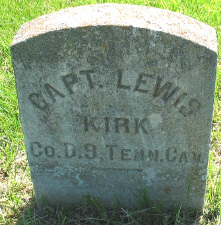
Lewis Kirk’s headstone in Lynnwood Cemetery. Source: Findagrave Memorial # 39538535.
In 1862, he returned to Lawrence County to raise a Confederate cavalry company, of which he served as captain for the duration of the war. At a later date, I hope to elaborate on Kirk’s military career.
Kirk’s Descendants
Kirk’s descendants live on among us today as members of not only the Kirk family, but also in the blood of some of the Williams, Crook, Massey, Abernathy, Moore, Gibbons, and Talley families of Lawrence and surrounding counties in Tennessee.[15]
Sources
Alford, Bobby. History of Lawrence County: Book Two. Lawrenceburg, TN: Bobby Alford.
Ancestry.com. Tennessee State Marriages, 1780-2002 [database on-line]. Provo, UT, USA: Ancestry.com.
Brewer, A L. “The Era of Rebel Atrocity.” The New York Times, August 20, 1865. Accessed February 6, 2014. http://www.nytimes.com/1865/08/20/news/the-era-of-rebel-atrocity.html.
Compiled Service Records of Volunteer Soldiers Who Served During the Mexican War in Organizations from the State of Tennessee. Micropublication M638, RG 94. Washington: National Archives. Digital image, Fold3.com (http://www.fold3.com/image/245/272385639/ : accessed 11 Feb 2014).
Find A Grave, “Memorial page for Thomas J. Westmoreland (4 Dec 1830-9 Nov 1858).” Last modified 30 March 2008. Accessed 15 April 2014. Findagrave Memorial #25633971.
McDonald, William L. Civil War Tales of the Tennessee Valley. Florence, AL: Heart of Dixie Publishing, 2003.
“Murder.” Nashville Union and American, , sec. page 3, column 1, December 28, 1858. http://chroniclingamerica.loc.gov/lccn/sn85038518/1858-12-28/ed-1/seq-3/
Tennessee. Tennessee State Library and Archives. Nashville. State Supreme Court Records, 1860.
[1] A.L. Brewer, “The Era of Rebel Atrocity.” The New York Times, 20 Aug 1865, online.
[2] William L. McDonald, Civil War Tales of the Tennessee Valley (Florence, AL: Heart of Dixie Publishing), 59.
[3] 1850 Industry Schedule, Lawrence Co., Tenn., Schedule 5, p. 174.
[4] Lewis M. Kirk, compiled military record (private, Company M, 1st Tennessee Infantry Regiment), Compiled Service Records of Volunteer Soldiers Who Served During the Mexican War in Organizations from Tennessee, M638 (Washington: National Archives), RG 94. Digital image, Fold3.com (http://www.fold3.com/image/245/272385639/ : accessed 11 Feb 2014).
[5] Marriage record of Lewis M. Kirk to Martha Glover, Ancestry.com. Tennessee State Marriages, 1780-2002 [database on-line]. Provo, UT, USA: Ancestry.com.
[6] Marriage record of Lewis M. Kirk to Ann Green, Ancestry.com. Tennessee State Marriages, 1780-2002 [database on-line]. Provo, UT, USA: Ancestry.com.
[7] Lewis Kirk v. State of Tennessee, State Supreme Court Records, 1860, Box 311: Range 32, Section E, Shelf 2, Tennessee State Library and Archives, Nashville. Deposition of Willis James, pg. 63.
[8] Lewis Kirk v. State of Tennessee, State Supreme Court Records, 1860, Box 311: Range 32, Section E, Shelf 2, Tennessee State Library and Archives. Deposition of Joseph E. Bailey, pg. 47.
[9] Lewis Kirk v. State of Tennessee, State Supreme Court Records, 1860, Box 311: Range 32, Section E, Shelf 2, Tennessee State Library and Archives. Deposition of Willis James, pg. 63.
[10] Bobby Alford, History of Lawrence County: Book Two. Lawrenceburg, TN: Bobby Alford, 53.
[11] Lewis Kirk v. State of Tennessee, State Supreme Court Records, 1860, Box 311: Range 32, Section E, Shelf 2, Tennessee State Library and Archives. Deposition of Willis James, pg. 63.
[12] Find A Grave, “Memorial page for Thomas J. Westmoreland (4 Dec 1830-9 Nov 1858).” Last modified 30 March 2008. Accessed 15 April 2014. Findagrave Memorial #25633971.
[13] Nashville Union and American, 28 Dec 1858.
[14] Lewis Kirk v. State of Tennessee, State Supreme Court Records, 1860, Box 311: Range 32, Section E, Shelf 2, Tennessee State Library and Archives.
[15] I have done a great deal of research attempting to locate Kirk’s descendants. For more information about the families of his children, please leave your name and e-mail address with the Lawrence County Archives and I will contact you.

 Lawrence County History Trivia
I have noticed you don’t monetize lawcohistory.com, don’t waste your traffic, you
can earn additional cash every month with new monetization method.
This is the best adsense alternative for any type of
website (they approve all websites), for more details simply search in gooogle:
murgrabia’s tools