By Clint Alley
Second Time’s a Charm?
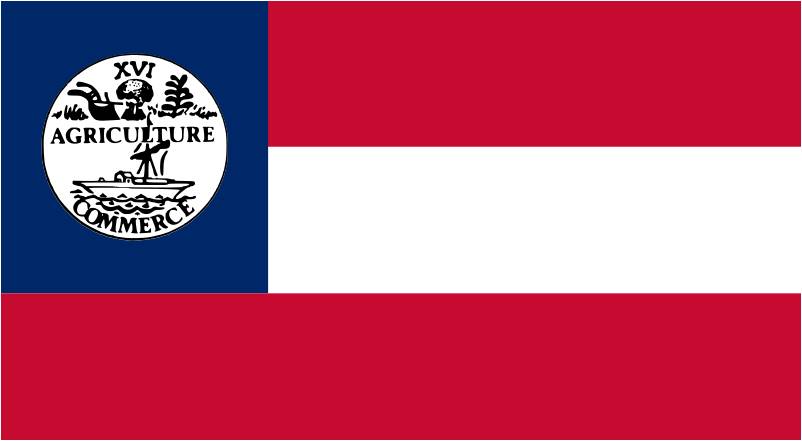
This flag was proposed as the new state flag to the Tennessee Legislature by State Senate Speaker Tazewell B. Newman on 25 Apr 1861. Because the state had not yet seceded from the Union, it was voted down. Information source: ‘Flags of Tennessee’ by Devereaux D. Cannon, Jr. Image Source: Wikimedia Commons.
On June 8, 1861, almost 1,200 Lawrence County men–as well as thousands of others across the state–went to the polls to decide if the state of Tennessee would remain in the Union or join the Confederacy.
The state had held a secession referendum for the first time on February 9, 1861, and the issue had been soundly rejected by a whopping 80% of the state’s voters. However, after the Confederacy bombarded Fort Sumter and Lincoln issued a call for volunteers to suppress the rebellion in the South on April 15, the issue gained new traction and Tennessee’s legislature voted to secede from the Union on May 6. However, to give this decision the appearance of the blessing of the people, the legislature of Tennessee ordered a second referendum on June 8, which, in most of Middle and West Tennessee, affirmed the decision to leave the Union and join the nascent Confederacy. Tennessee was the last state to secede. [1]
That is why, when Lawrence County went to the polls to decide the issue, it had already sent a full company of men off to war on the side of the Confederacy almost a month before. The Lawrenceburg Invincibles marched off to join the Confederate army on May 16, 1861.[2]
The Returns
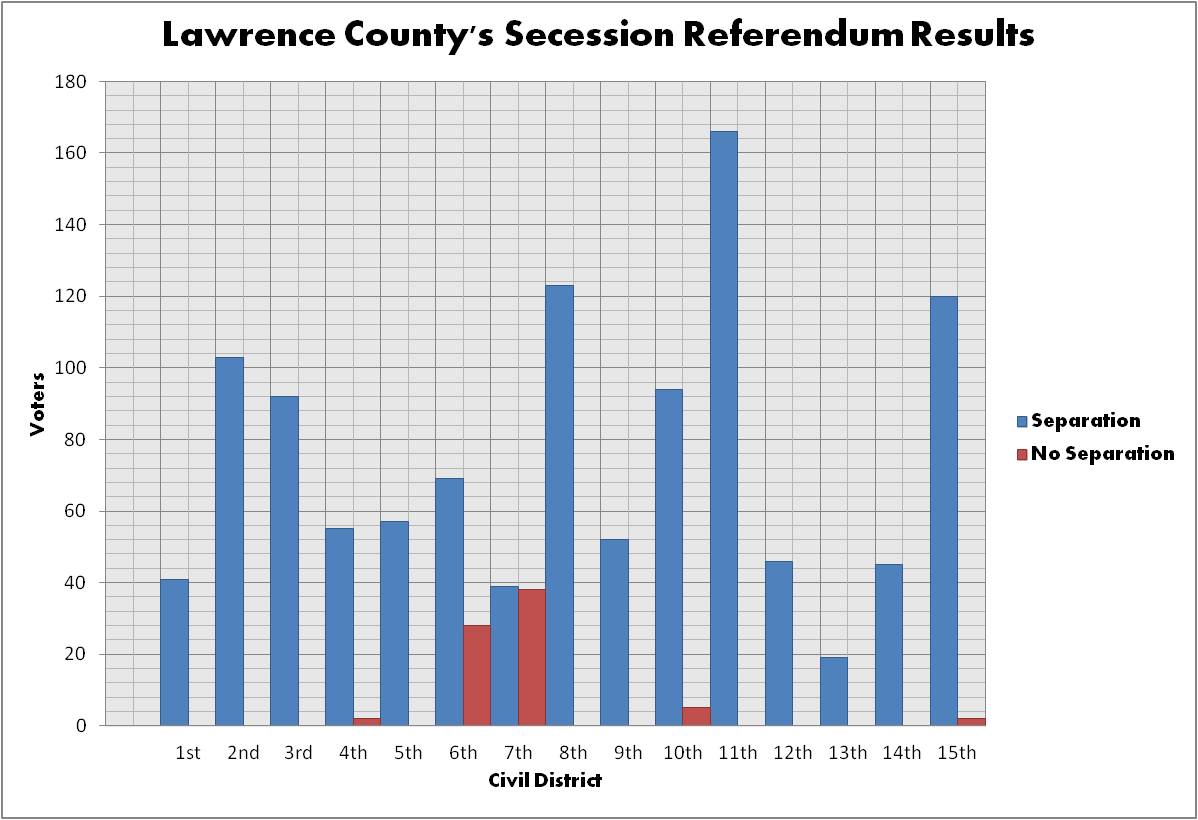
Lawrence County’s secession referendum results from 8 Jun 1861. Data source: Lawrence County (TN) Archives.
The results of the election are preserved at the Lawrence County Archives. Each return is broken down by district. The question on the ballot gave voters four questions to consider. Should the state:
1. Separate from the Union
2. Not separate from the Union, and
3. Be represented in the Confederacy, or
4. Not be represented in the Confederacy.
Of the votes cast, 1,121 voted to secede from the Union, and 1,119 voted to be represented in the Confederacy. Only 75 voted to remain in the Union, and 64 voted not to be represented in the Confederacy.[3]
But why four options instead of two?
A Varied Political Spectrum
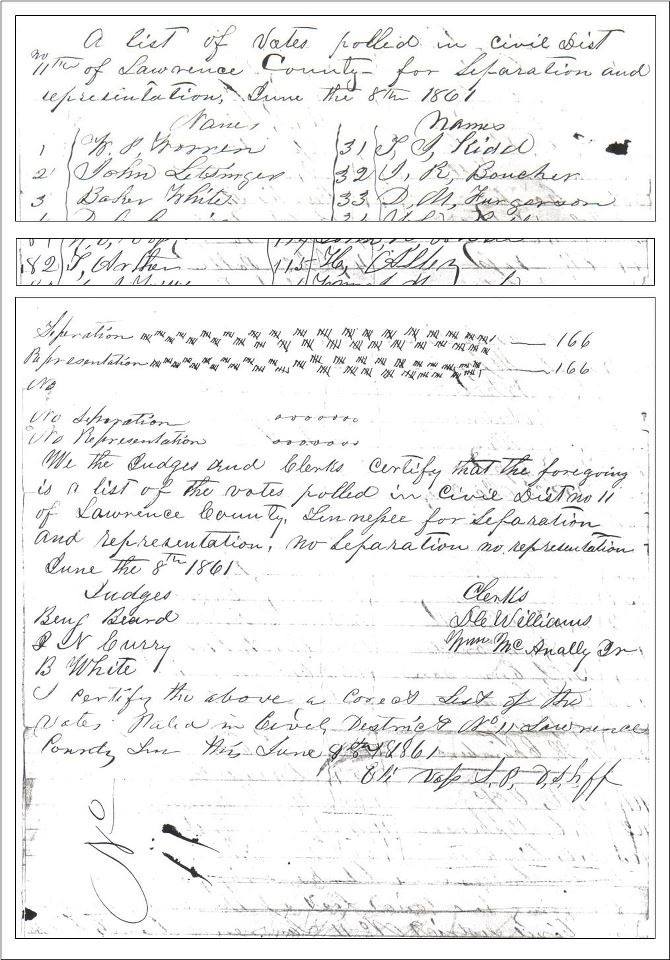
Secession Referendum Return From Lawrence County’s 11th District. Source: Lawrence County (TN) Archives.
While most secessionists favored the two-step process of leaving the Union and joining the Confederacy, the issue was not quite as clear-cut as that. Other secessionists favored Tennessee’s leaving the Union, but remaining an independent republic instead of joining the Confederacy. Still others hoped to stay in the Union, but remain officially neutral in the conflict, much like Kentucky and Missouri.
As the results show, however, the most popular course of action in Lawrence County in 1861 was leaving the Union and joining the Confederacy, which is what Tennessee did. A whopping 94% of the county favored secession, while only 6% wanted to stay in the Union. Ten of Lawrence County’s fifteen civil districts voted unanimously for secession. The most opposition for the secession movement came from Lawrence County’s 6th and 7th districts, which voted 29% and 49%, respectively to stay in the Union.[4]
Alfred O. Williams from Marcella Falls, one of the county’s Unionists, later said that excitement was so high in favor of secession that summer that no man dared speak openly about his loyalties to the Union. One man near in Williams’s district who did so was threatened so much for speaking out against secession that he finally left the county and joined the Federal Army.[5]
[1] Dwight Pitchcaithley. “When Tennessee Turned South.” New York Times. http://opinionator.blogs.nytimes.com/2011/06/01/when-tennessee-turned-south/?_php=true&_type=blogs&_r=0 [accessed 8 Jun 2014].
[2] Viola Carpenter, and Mary M. Carter, Our Hometown: Lawrenceburg, Tennessee, The Crossroads of Dixie, (Lawrenceburg, TN: Bobby Alford, 1986), 27.
[3] Election Returns, 8 Jun 1861. “Separation and Representation.” Lawrence County Archives, Leoma Tenn.
[4] Ibid.
[5] Alfred O. Williams (Lawrence Co., Tennessee) claim, office no. 1431, case no. 13983, Barred and Disallowed Case Files, Southern Claims Commission, 1871-1880; digital images, “Southern Claims – Barred and Disallowed,” Fold3.com [accessed 8 Jun 2014].

 Lawrence County History Trivia