
Did an Indonesian volcano help to launch David Crockett’s political career in Lawrence County? You’ll be surprised that the answer is probably ‘yes.’
The year 1816–the year that Lawrence County was first opened to legal white settlement–was one of the coldest years in recent history. In fact, it was known colloquially at the time as “The Year Without a Summer,” “Poverty Year,” “The Summer That Never Was,” and “Eighteen-Hundred-and-Froze-to-Death.”
According to Allen R. Coggins’s book ‘Tennessee Tragedies,’ the high temperature for the 4th of July that year in Savannah, Georgia, was only 46 degrees. Birds in New England froze to death in their nests in summertime, and severe frosts occurred at least once EVERY month that year in that region. Around the world, temperatures plummeted, precipitation skyrocketed, and famine ravaged entire pockets of the globe as crops failed.
But why?
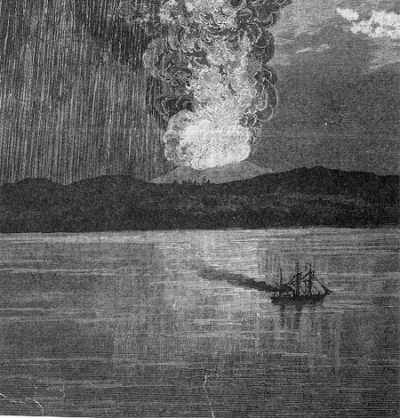
We know now that the cause of the ‘Year Without a Summer’ was three separate volcanic eruptions from different parts of the earth. The final and most cataclysmic of these was the eruption of Mt. Tambora in Indonesia, which, in April 1815, experienced the largest volcanic eruption that the earth had seen in 1,300 years. The explosion ejected tons of ash into the upper atmosphere of the earth. Ice core samples have revealed that enough of this ash entered the atmosphere that, over the course of several months, the entire earth was cloaked in it.
In New England, this ash was recorded as a ‘dry fog,’ which couldn’t be dissipated by anything, even heavy rains. The ash cloud, combined with a rare low level of solar activity, disrupted global weather patterns, causing intense floods, lost harvests, and an increase in epidemic disease.
Also in the Fall of 1816, after the land that would become Lawrence County was ceded to the United States by the Chickasaw, David Crockett left home and began to seek out new land; a journey which would lead him to Shoal Creek in Lawrence County.
Before he settled in Lawrence County, Crockett and his family had lived on Beans Creek in Franklin County, Tennessee for several years. In his autobiography, Crockett described his reason for leaving Beans Creek thusly: “The place on which I lived was sickly, and I was determined to leave it.”
But, perplexingly, as Crockett biographer Bob Thompson found out when he visited Crockett’s Franklin County homestead site in 2010, the land on which Crockett had lived on Beans Creek is even today fertile and well-watered, a veritable farmer’s paradise.
Thompson came to the conclusion after visiting Crockett’s so-called ‘sickly’ land that Crockett simply was not a very good farmer.
However, Crockett’s last harvests at Beans Creek would have occurred in the autumns of 1816 and 1817, in the peak of ‘The Year Without a Summer.’ With heavy rainfall, persistent cold, and little sunlight, Crockett’s land on Beans Creek no doubt would have seemed extremely ‘sickly.’
When Crockett left his ‘sickly’ land and came to Lawrence County in the fall of 1817, it was a lawless and unorganized territory. He developed a reputation among his neighbors as a fair and just man, and was instrumental in establishing law and order, and served as a leader in the new county’s government. His presence in this specific place, at that specific time, launched his political career.
Had his land in Beans Creek not been ‘sickly,’ in 1816 and 1817, it’s possible that he would have stayed on for several more years, missing his window of opportunity to ‘take a rise’ in Lawrence County, as he put it in his autobiography. His election as magistrate lead to his election as colonel of the militia, which lead to his appointment as commissioner of Lawrenceburg, which lead to his election as state representative, which eventually lead him to Congress, a dramatic political falling-out with Andrew Jackson, and a journey to Texas to start again; a journey which met a hero’s end at the Alamo.
So, did the Mt. Tambora eruption launch Crockett’s political career? Not directly. But it may well have ensured that he was in the right place, at the right time.

 Lawrence County History Trivia