
A century ago, Lawrenceburg got its very own version of Dr. Quinn: Medicine Woman in Dr. Ivadell Rogers.
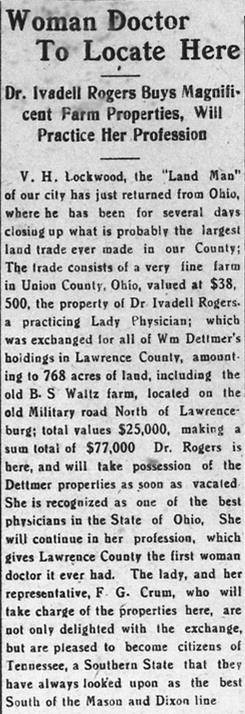
As can be seen from this front-page story from the March 4, 1914 edition of the Lawrence ‘Democrat,’ Dr. Rogers, who came here that spring, was Lawrence County’s first female doctor.
An 1898 graduate of the Eclectic Medical Institute of Cincinnati, Dr. Rogers was a well-respected physician in her own region when she decided to relocate to Lawrence County that spring.
Eclectic medicine was a movement that was extremely popular in the United States in the mid-to-late 19th century. It relied heavily on botanical and herbal remedies, many of which were learned from Native Americans in the late 18th century and taught from one physician to another. Its preference for herbal remedies over the older traditions of bleeding and mercury-based remedies made eclectic medicine a forerunner to modern homeopathic treatments.
To give you an idea of how Dr. Rogers practiced medicine, she reported to the North American Journal of Homeopathy in 1920 that she successfully treated a 70-year-old woman who had contracted erysipelas. Dr. Rogers’s primary treatment in this case was apis, which is dried and powdered honey bees. Dr. Rogers also treated the patient with “full strength iodine” and “ichthyol combined with flexible collodion.” Dr. Rogers recorded the treatment as a “good success.”
Dr. Rogers’s expertise as a physician was well-established among traditional physicians as well as practitioners of eclectic medicine. In 1907, Dr. Rogers was elected the chief of staff of the Delaware County (Ohio) Medical Society, which was comprised of every doctor in that county. Her position as such was recognized by the Ohio State Medical Journal.
Dr. Rogers did not stay in Lawrence County for very long. From the large farm north of town mentioned in this article, she moved to the W.H. Neal House on Pulaski Street in Lawrenceburg in 1916 (the house is still standing to this day, just east of the railroad, on the north side of the street). Dr. Rogers sold the house in 1917, and by 1920, she had moved to Pryor, Oklahoma.
Despite her brief residence in Lawrence County, Dr. Rogers was here long enough to shatter barriers that had been in place since the county’s founding. The city’s welcome to Dr. Rogers as a serious practitioner speaks well to the progressive attitude of Lawrence Countians of that period.

 Lawrence County History Trivia