
With everything in the press about statues and monuments lately, you may have caught yourself wondering, “Why doesn’t Lawrenceburg have a statue of a Confederate soldier on the courthouse square like most of the other counties in Tennessee?”
The answer reveals something about our county’s unique history.
By some estimates, there are more than 1,500 statues in the United States which commemorate the Confederacy or the men of the Confederate armed forces. It is very common to see these marble Johnny Rebs eternally standing guard, muskets at parade rest, their stony eyes gazing southward in front of courthouses in county seats across the former Confederate States.
Most of these statues were erected during the monument-building craze which swept the nation some thirty or forty years after the Civil War, with funds largely raised by the children and grandchildren of Confederate veterans seeking to honor the service of their forebears.
Lawrence County certainly sent its share of young men to fight for Confederate independence, and many of those young men made the ultimate sacrifice in the service of the Confederacy. So why isn’t there a marble Johnny Reb on our Public Square today like there is in Florence, Pulaski, Franklin, or any number of nearby county seats?
When the monument-building craze began, it happened to coincide with another craze which swept Lawrence County in the late nineteenth century: Crockett Fever, which was no doubt fed by the arrival of what would have been the pioneer’s 100th birthday in 1886.
Lawrence County has a long history of emphasizing its ties with the king of the wild frontier. Our first countywide celebration of Crockett’s birthday happened in 1890, and it drew a crowd of about 5,000 people to Lawrenceburg, which at the time was a city of only about 600 souls.
At that time, a local group known as the David Crockett Memorial Association laid the cornerstone for a monument to Crockett in what is today the Rosemont section of Lawrenceburg. Although that part of town was largely woods and pastureland in 1890, the owners of the Lawrenceburg Land Company envisioned the neighborhood as a pleasantly grand addition to the city, with the monument to Crockett serving as the focal point of a small city park to be known as “David Crockett Park” (not to be confused with the state park of the same name, which stands on the other side of the city today).
Unfortunately for the Land Company, their plans ran aground in a stormy sea of lawsuits and the vision they had for Rosemont never materialized. We don’t know what became of that cornerstone, either, but we do know that it contained a small tin time capsule into which were placed issues of local newspapers.
The plans for that original monument to Crockett were much grander than the statue that we now have of him. It was to be “carved in Italy from pure white marble and shipped to Lawrenceburg in time to be unveiled at the Annual Celebration of Crockett’s birthday in 1891.”
Despite these high hopes, the idea of a marble statue to David Crockett in Lawrenceburg never materialized, and the idea of an annual celebration of Crockett’s birth didn’t take off until David Crockett State Park began hosting Crockett Days in the 1980s.
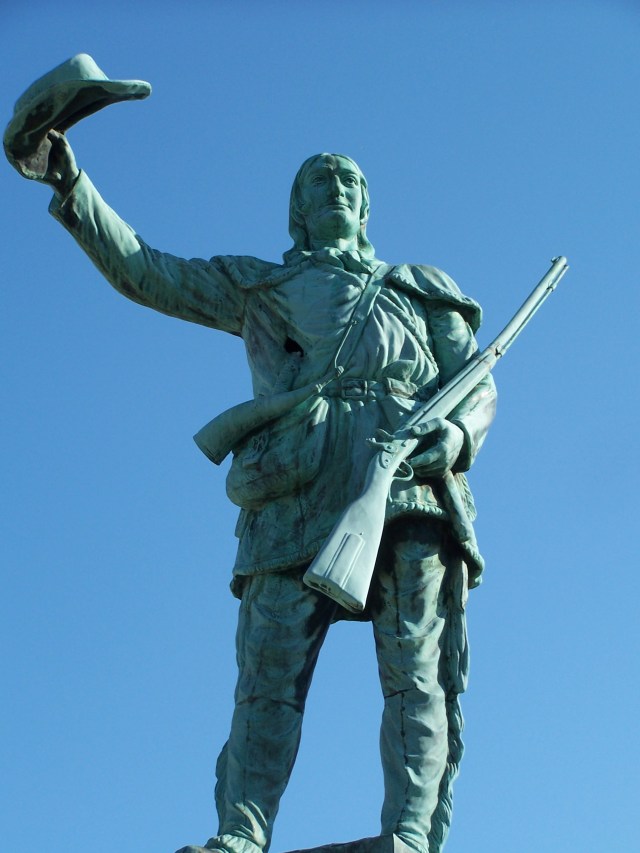
Although we don’t know why that first statue proposal fizzled, we do know that the idea of memorializing Crockett persisted. On November 7, 1921, a mass meeting was held in Lawrenceburg for the purpose of raising money for a new bronze statue of Crockett, to be placed on the southern side of the courthouse.
Work began on this project in earnest. The W.M. Dean Marble Company of Columbia created the bronze statue for the cost of about $3,000. Today, that amount would be almost $44,000.
Finally, after many years of waiting and several stops and starts, the statue of Crockett that stands on the southern end of our Public Square was unveiled with great fanfare on September 14, 1922.
So it was that, while Lawrence County was without a doubt just as proud of its Confederate veterans and their service as surrounding counties were, Lawrenceburg’s connection to David Crockett superseded its desire to raise a memorial for the Civil War. And this was despite the formation of the county’s chapter of the United Confederate Veterans in 1891, and the organization of Lawrence County’s first Sons of Confederate Veterans camp in Lawrenceburg in 1904. Such organizations usually took the lead in the construction of such monuments.
As a result of that unique connection we have to Crockett’s life and rise to prominence, Lawrence County is home to one of the oldest and only full-body statues of David Crockett in the country instead of the standard marble Confederate soldier that became so common throughout the South at that time.


 Lawrence County History Trivia