

Melba Scott recently asked:
What year or years was the county fair located in Leoma on either Fair Street or Avenue?
That’s a great question, Melba!
The Middle Tennessee District Fair is Lawrence County’s biggest annual event. And while COVID-19 may have cancelled it for 2020, the Fair has been a staple of community life in Lawrence County for more than a century.
In modern times, the fair sprawls across nearly 30 acres of modern facilities in Lawrenceburg’s Rotary Park, including a new 4,600-seat grandstand and arena, three exhibit halls, a 23,000 square-foot livestock pavilion, and a 7-acre midway with a paved sidewalk.
Normally, the last week of September sees thousands of people entering the gates of these massive fairgrounds. But the fine modern facilities enjoyed by fair-goers today are a far cry from the event’s humble origins.

The Beginning
Lawrence County held a small fair in 1860, near the site of the modern water filtration plant on West Gaines Street in Lawrenceburg. This event was strictly agricultural and, although turnout was good, the Civil War and Reconstruction dampened any desire to repeat it in the following years.
What we now know as the Middle Tennessee District Fair began as a county fair in 1910. And, like Melba said, it was held in Leoma, a community just a few miles south of Lawrenceburg.
Aside from the agricultural exhibits and the general atmosphere of celebration, that first fair bore little resemblance to its modern descendant.
In 1910, Leoma was a bustling community served by both a major highway and a railroad depot. And, true to the community’s rural roots, the fair began as a unique celebration of the harvest.
The first fair was a combined farmer’s fair and farmer’s institute held on October 20, 1910 in Leoma. To answer Melba’s question, it appears that the Fair was held in Leoma from 1910 to 1915.
A fair, in the original sense of the word, was a public show of agricultural products, equipment, and livestock. These shows were often accompanied by contests where the best agricultural product in each category was judged and prizes or “premiums” were awarded. This aspect of the fair survives today in the agricultural, home economics, and livestock contests held at the Middle Tennessee District Fair.
But what on earth is a ‘farmer’s institute?’
Modeled on a similar event held for teachers, a farmer’s institute was a meeting of local farmers to hear lectures from experts about certain agricultural topics. The speaker at the Leoma event in 1910 was commissioner of agriculture Col. John Thompson. And, although we don’t know what lectures were delivered at that farmer’s institute in Leoma, we do know that a similar event featuring Commissioner Thompson in Goodlettsville later that year featured lectures about the benefits of clover, the science of keeping a good orchard, and one lecture entitled simply, “Weed Seed.”
From this modest event sprang a tradition that is a major part of our local identity.

Image courtesy of the Lawrence County Historical Society.
After the 1910 event, the Fair added elements of entertainment and education with each successive year, making each year’s event bigger and better-attended than the one before. Those first fairs were very different from the Fair we know now.
In addition to the standard agricultural exhibits which formed the core of the event, the Leoma Fair included some exciting–and eccentric–community events. The 1911 fair saw what may be the first recorded Fair Day in the Lawrence County school calendar, when school superintendent Jesse McArtor “ordered a suspension of all public schools in the county” on October 6 to encourage attendance of the Fair’s educational exhibits. The superintendent urged every school to attend the fair in Leoma, and took the opportunity to declare it a school “rally day.”
In 1912, Fair organizers issued a unique challenge to the school system. The largest wagonload of students and teachers from a single school which passed through the gate would get free admission. Second place was awarded with half-price admission, and third place was awarded with one-third-price admission. These awards were given in the form of refunds, which would not be issued until 4:00 p.m.
In addition to the special speakers invited for the education rally, the exhibits that Mr. McArtor may have wanted the students to see probably included things like the stereopticon lecture about hookworm presented at the 1912 Leoma Fair. Or perhaps the “Library Round Table” discussion. All, of course, while being serenaded by the Leoma Cornet Band.
The Switch to Lawrenceburg
In 1914, while the Leoma Fair was drawing large crowds and hosting a variety of events, a separate, more-modest “corn and pumpkin show” consisting solely of agricultural displays had begun on the Square in Lawrenceburg. In 1916, the Fair Association decided not to hold the popular event in Leoma, and the Lawrenceburg fair took over as the county’s main event.
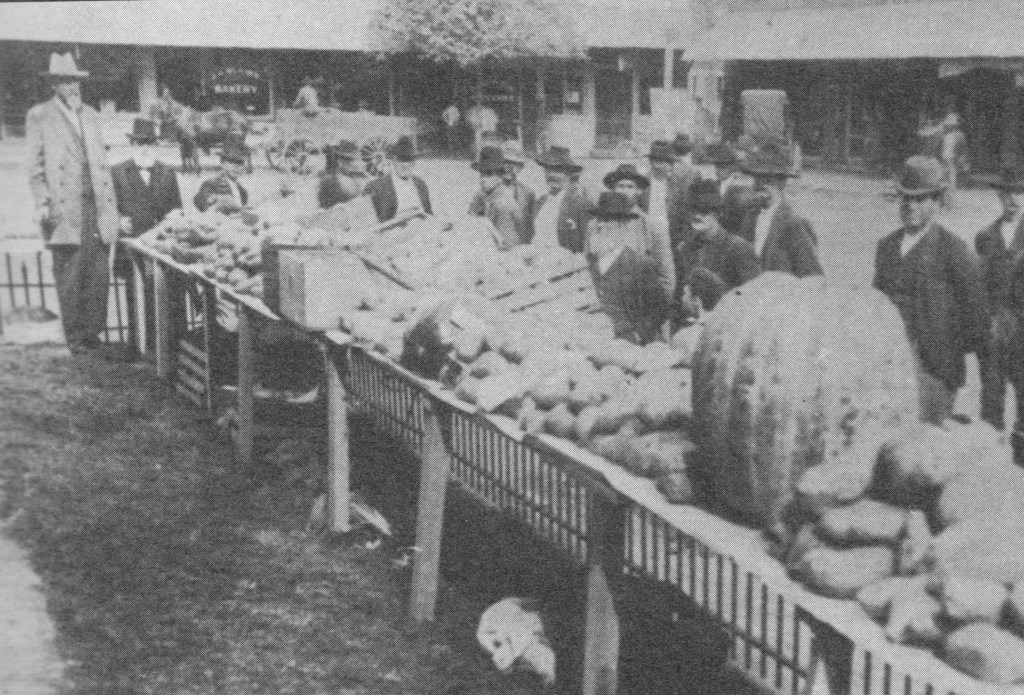
Image courtesy of the Lawrence County Historical Society.
The Fair quickly outgrew the Square in Lawrenceburg. For several years, it was held on Lafayette Avenue before the construction of Fairview Park, which is still the home of the Fair today.
In 1931, the Lawrence County Fair was officially designated the “Middle Tennessee District Fair” by an act of the Tennessee General Assembly. Also in 1931, due to cutbacks caused by the Great Depression, the Middle Tennessee District Fair was said to have been a larger event than the Tennessee State Fair in Nashville.
The City of Lawrenceburg purchased Fairview Park from the Lawrence County Fair and Park Association in 1950 for $57,000. Later that year, the Fair and Park Association dissolved and the Lawrenceburg Rotary Club adopted the Fair. Six decades later, the Rotary Club is still performing this function.
The decision to cancel the Fair this year was no doubt a difficult one. We will miss the Fair this year. But I, personally, am very grateful to the Rotary Club for taking such proactive steps to protect the health and wellbeing of our community. And while it may not feel like Fall this year without the Fair in town, the Fair is an event with a rich pedigree and a long legacy of thriving despite adversity. Here’s hoping that the Fair will return in 2021, better than ever.
Thanks for your great question, Melba! If you have a question about local history that you would like me to answer, send me a message or leave a comment at Lawrence County History Trivia!
Special thanks to Lawrence County Archivist Ashley Armstrong for her assistance in locating some of the documents needed to write this post.

 Lawrence County History Trivia