
By Clint Alley
A Crockettesque Town
There is no escaping it if you grew up in Lawrenceburg. The town has a school, a theater, a street, a cinema, a state park, a motel, a hospital, a waterfall, a festival, a pediatrician’s office, a bank branch, and a stretch of highway named after David Crockett. His name is everywhere around town. One of the only full-sized statues of him in the United States stands on the south side of the Public Square.

The sign at David Crockett State Park. Source: Lawrence County, Tennessee Web Page
And yet, many lifelong residents still may not be quite sure why Lawrenceburg cares so much about Crockett. Confused by Fess Parker’s skipping over the town in the 1955 Disney miniseries that gave an entire generation Davy fever, many locals have some lingering questions about Crockett’s time here. Why did he come to Lawrenceburg? What did he do here that was such a big deal? Have we overblown his legacy?
David Crockett’s time in Lawrenceburg was a turning point in his life, and it can be argued that the impact the town had on Crockett was even greater than the legacy he left on the town. Here are three reasons why we are obsessed with Crockett in Lawrenceburg, and why we should remain so.
1. He began his political career here.
Fred Thompson isn’t the only native son who launched his career of public service in Lawrenceburg.
As the base of his statue downtown will tell you, Crockett was a big deal to early Lawrenceburg. Magistrate, commissioner of the town, lieutenant-colonel of the county militia, and member of the state legislature. That’s quite a laundry list of accomplishments—especially for a man who, by his own admission, could barely write his own name when he first moved into the area.[1]

This image of Crockett is a familiar one to natives of Lawrenceburg. It’s from a painting of the famous frontiersman done by John Gadsby Chapman. The same painting inspired the statue of Crockett on the Square. Source: The Washington Post
If that isn’t impressive, then consider that he achieved the first of those only two months after his September, 1817 arrival in the area.[2] He had originally come to the untamed country because game was plentiful. Crockett’s rise to power in early Lawrence County was fueled by two things: his reputation for “common justice…honesty…and natural-born sense” and his self-deprecating sense of humor, which both endeared him to the voters and shielded a sharp mind.[3]
Crockett’s story would not have been possible a generation earlier. He began his rise to power at the right time—when poor, white men were being given the right to vote all over the state, regardless of their ownership of property or payment of taxes—and at the right place—early Lawrence County was a backwoods district full of tough men who were distrustful of wealthy elites and wanted to see one of their own representing them in the legislature.
2. He gained a famous nickname while representing Lawrence County in the legislature.
All of his life, Crockett seems to have been somewhat self-conscious about his limited education. He had gone to school for only four days as a boy, and had worked for a schoolteacher for six months as a young man in exchange for four lessons per week on basic reading, writing, and arithmetic.[4] It wasn’t until the state ordered him to keep better records as a magistrate in Lawrence County that he would learn how to write more than just his name.
When he attended his first session of the Legislature, Crockett’s lack of education and eloquence was pointed out on the floor, when a fellow-representative named James C. Mitchell referred to Crockett as ‘the gentleman from the cane.’[5] Crockett was infuriated by this insult. As luck would have it, later that day, he found a cambric ruffle lying on the ground like the one Mitchell wore on his fine shirt. So, pinning the ruffle to his own “coarse shirt,” Crockett took the floor in a most dramatic way. Mitchell was laughed out of the room by the other members of the legislature, and ‘the gentleman from the cane’ got both a moral victory and a nickname that would stick.[6]
3. He built a diversified industrial operation on Shoal Creek.
Crockett came very close to escaping his lifelong cycle of poverty and debt while he lived in Lawrence County. After borrowing the monumental sum of $3,000, he built “an extensive grist mill, and powder mill, all connected together, and also a large distillery” on his 160-acre property on Shoal Creek, at the location that is now known as Crockett Falls in David Crockett State Park.[7]
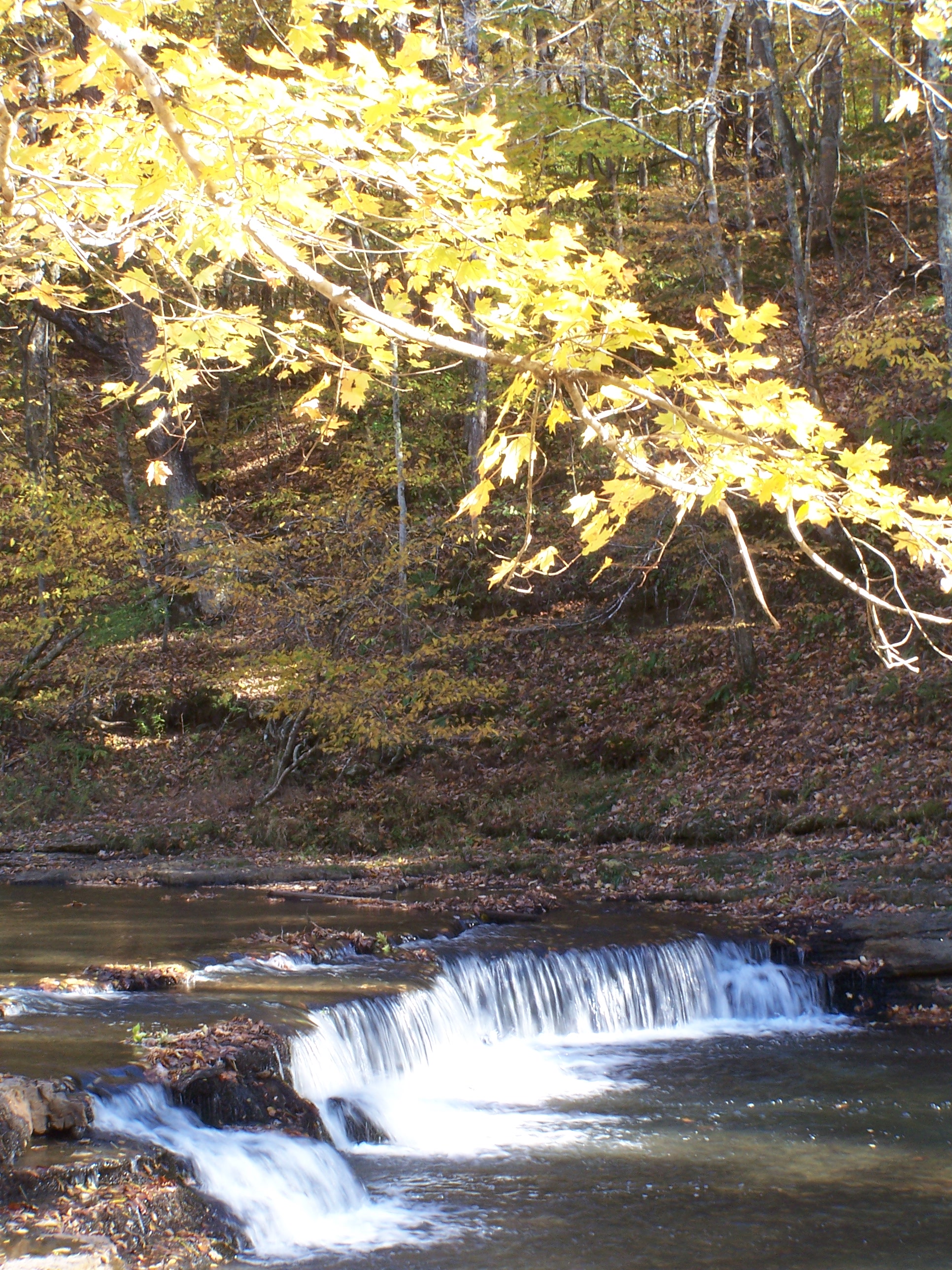
Crockett Falls, the location of David Crockett’s extensive milling and distillery operation, is today a popular place to enjoy a beautiful day in the state park that bears Crockett’s name. Photo by Clint Alley
Crockett’s mills and distillery were built to address the most pressing needs of a frontier community in those days. Gunpowder, of course, was a necessity for hunters and for military preparedness. Also, farmers needed a place to grind their corn, and they needed to turn most of that corn into whiskey, which would not spoil and could be traded for other goods. By constructing a grist mill alongside his distillery, Crockett set himself up to be the ‘one-stop shop’ for Lawrence County’s early farmers.
However, it was not to last long. Twelve days after arriving at the first session of the legislature in 1821, Crockett got word that a flood of Shoal Creek had destroyed both of his mills, rendering his distillery useless.[8] Left greatly in debt, and with no option but to sell his extensive land holdings, Crockett said that “the misfortune just made a complete mash of me.”[9] He was comforted, however, by the fact that he had “an honest wife” who told him that they would “scuffle for more.”[10] And so Crockett sold his land to satisfy his debts and set out to find a new home in West Tennessee.
Sources
Crockett, David. A Narrative of the Life of David Crockett of the State of Tennessee. Philadelphia: E.L. Cary and A. Hart, 1834.
Shackford, James Atkins. David Crockett: The Man and the Legend. Lincoln, Nebraska: University of Nebraska Press, 1994.
[1] David Crockett, A Narrative of the Life of David Crockett of the State of Tennessee, (Philadelphia: E.L. Cary and A. Hart, 1834). 70.
[2] James Atkins Shackford, David Crockett: The Man and the Legend, (Lincoln, Nebraska: University of Nebraska Press, 1994). 38.
[3] Crockett, 71.
[4] Crockett, 21.
[5] Shackford, 52.
[6] Shackford, 52.
[7] Crockett, 75.
[8] Shackford, 50.
[9] Crockett, 76.
[10] Crockett, 76.

 Lawrence County History Trivia