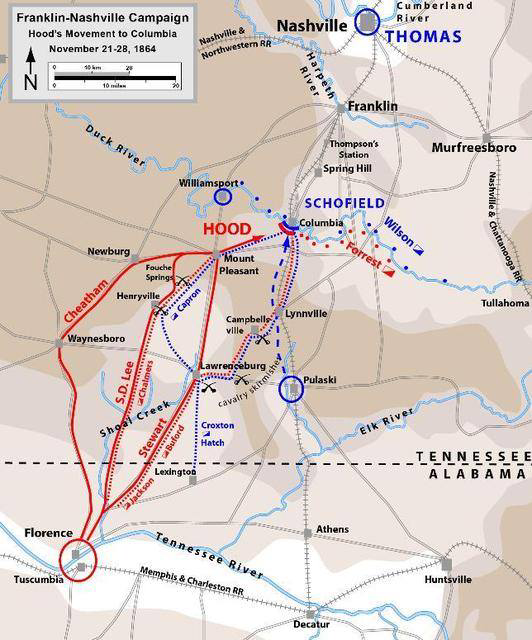
To continue with our observance of the 150th anniversary of the Army of Tennessee’s push into Lawrence County, here is General Nathan Bedford Forrest’s account of this weekend’s actions at Henryville and Summertown (Summertown is referred to in his account as Foust’s Springs or Fouche Springs, as it was not yet an established community in 1864). At Summertown, Forrest, himself, accompanied only by his escort, charged Union cavalrymen and forced their retreat toward Mt. Pleasant.
“I bivouacked my command at Shoal Creek [near modern St. Florian, Alabama] until the morning of the 21st, when, in obedience to orders from General Hood, I commenced a forward movement. My command consisted of three divisions–Chalmers’, Buford’s, and Jackson’s. I ordered Brigadier-General Chalmers to advance via West Point, Kelly’s Forge, Henryville, and Mount Pleasant. Brigadier-Generals Buford and Jackson were ordered to move up the military road to Lawrenceburg, and thence southeastward in the direction of Pulaski. Both these divisions had several engagements with the enemy, and were almost constantly skirmishing with him, but drove him in every encounter.
At Henryville, Brigadier-General Chalmers developed the enemy’s cavalry and captured forty-five prisoners. At Fouche Springs the enemy made another stand. I ordered General Chalmers to throw forward Rucker’s brigade and to keep up a slight skirmish with the enemy until I could gain his rear. I ordered Lieutenant-Colonel Kelley to move by the left flank and join me in rear of the enemy. Taking my escort with me I moved rapidly to the rear. Lieutenant-Colonel Kelley being prevented from joining me as I had expected, I made the charge upon the enemy with my escort alone, producing a perfect stampede, capturing about 50 prisoners, 20 horses, and 1 ambulance. It was now near night, and I placed my escort in ambush. Colonel Rucker pressed upon the enemy, and as they rushed into the ambuscade my escort fired into them, producing the wildest confusion. I ordered Colonel Rucker to rest his command until 1 a.m., when the march was renewed toward Mount Pleasant…”
–‘Official Record of the War of the Rebellion’, Series 1, Vol. 45, Part I, pg. 752.
Forrest’s men provided a screen for advancing Confederate infantry. His men were probably at ease moving through the backroads of western Lawrence County because many of the cavalrymen under his command were actually from Lawrence County. According to local tradition, Hood Road in Deerfield was one of the roads used by the Army of Tennessee in their push toward Nashville 150 years ago this weekend. The road is named in honor of Confederate commander General John Bell Hood.