
Spencer Hand recently asked us:
When was the dam built, when was it decommissioned, and why is it still there?
Excellent question, Spencer!
The Lawrenceburg Hydroelectric dams are located on Shoal Creek, around 1.8 miles apart. The first dam, known simply as “Lawrenceburg No. 1,” was completed in 1907, two years after the city of Lawrenceburg held a special election which approved the sale of municipal bonds to finance the project (Our Hometown, Carter and Carpenter, p. 93).
The first decade of the twentieth century saw a slough of progressive initiatives put into action by the people of Lawrence County, initiatives which improved the quality of life for every citizen and which played a key role in Lawrence County being the fastest-growing county by population in Tennessee between 1900 and 1910. In 1905, the county court ordered the construction of a beautiful and elegant new courthouse, which was wired for electricity before it was available in Lawrence County. This was followed in rapid succession by the decision to build the first hydroelectric dam (1905), the decision to build the county’s first tuition-free public high school (1908), and the construction of the first municipal water tower (1908).
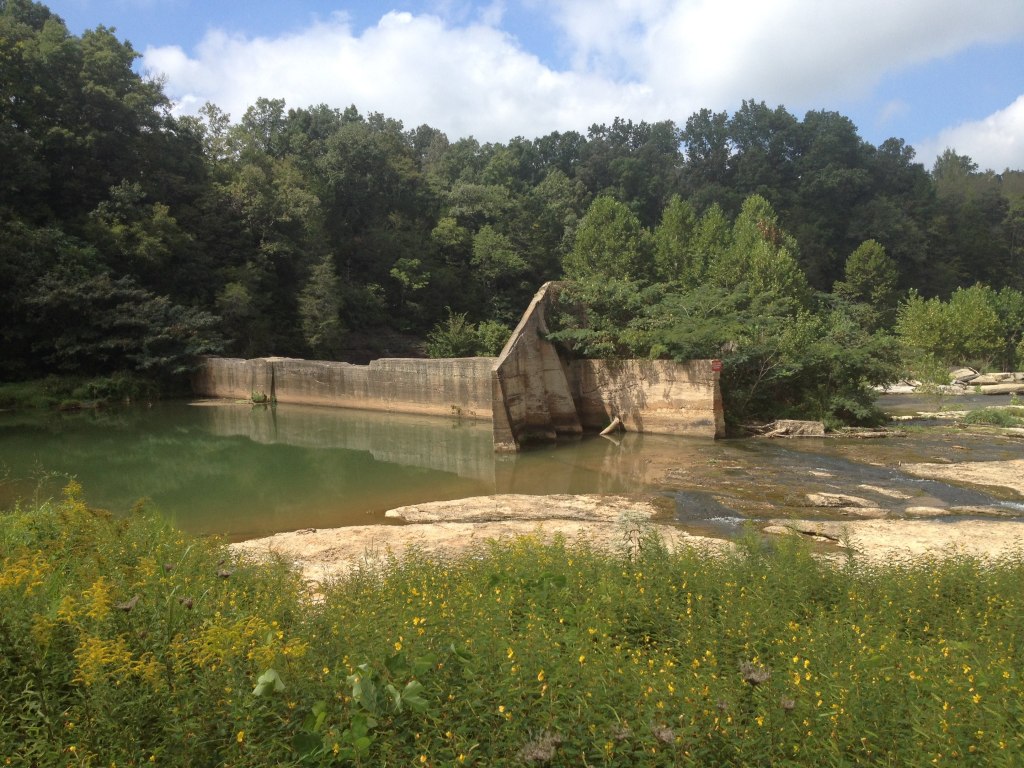
The first dam provided the people of Lawrenceburg with cheap electricity for several years. Local lore has it that the Garrett House on South Military Street was the first private residence in Lawrenceburg built with electrical wiring installed at the time of construction (‘About Our Cover,’ Lawrence County Heritage, Kathy Niedergeses Vol. 6, No. 4, p. 154).
By 1915, the first hydroelectric dam was unable to produce the amount of electricity to meet the demand of the rapidly-growing city of Lawrenceburg. A second plant was planned 1.8 miles downstream. This facility was completed in 1924 and is known as Lawrenceburg Dam No. 2 (National Register of Historic Places Nomination Form, Lawrenceburg Dam No. 2).

In 1922, the Lawrenceburg power plant was making a profit of $15,000 per year, a local windfall which not only improved the lives of local people and drew new businesses to the area, but which also allowed the city to engage in a number of public improvement projects–paving streets, erecting electric street lights, and funding the city’s nascent fire department–without having to raise taxes. The Knoxville Sentinel reported that year that residents of Lawrenceburg were paying “only four cents a kilowatt-hour and down for their electric current,” compared to nearby Florence, Alabama, which was paying “sixteen cents and more for its current.” (‘Lawrenceburg’s Hydro-Electric Plant Supplies Street Paving, Lighting, Fire Protections Free,’ Knoxville Sentinel, Knoxville, Tenn.: 5 Nov 1922, p. 18)
The two dams provided for Lawrenceburg’s electrical needs until the creation of the Tennessee Valley Authority in 1933. According to the National Register of Historic Places Nomination form for Dam No. 1, the dams ceased operation as hydroelectric plants in 1939.
Now to address Spencer’s question as to why the dams are still there. I, personally, am certainly glad that these historic landmarks are still with us to the degree that they are, but let’s approach the question from the standpoint of local economy.
The dams represent a significant capital investment by the city of Lawrenceburg that at various times throughout the late 20th century contained the promise of making a return on that investment beyond the dividends paid to the early-20th-century inhabitants of Lawrenceburg. While Dam No. 1 and the 31 wooded acres comprising the peninsula of the horseshoe bend of Shoal Creek is still owned by the city, Dam No. 2 was sold to the Union Carbide company in 1957.
During a study conducted by TVA in 1981, it was estimated that Lawrenceburg Dam No. 1 could generate 2.2 million kilowatt hours of electricity per year if it were reactivated, an amount that fell just short of providing the 2.6 million kilowatt hours then needed by the city in 1981. At that time, TVA was considering reactivating ten small dams throughout the state of Tennessee in order to ease the burden of electricity output on larger dams (‘TVA looks to small dams for electricity,’ Johnson City Press-Chronicle, Johnson City, Tenn: 28 Aug 1981, p. 2).
Dam No. 1 and its powerhouse have been heavily damaged by flooding in the years since that 1981 TVA study. Dam No. 2, however, is still in relatively good shape.
The dams are also valuable from a cultural and historical perspective, as reflected in their inclusion on the National Register of Historic Places in 1990. They represent one of the most progressive and forward-thinking eras of our local history, and they also stand as a monument to the fact that Lawrenceburg is a place that values innovation.
Thanks to Spencer Hand for reading and asking these great questions! I will answer more reader questions in coming days!

 Lawrence County History Trivia
Thanks for the information, Clint. My Grandfather and his brother (Thomas and Ernest Fox, respectively) owned the Raven Bluff property for several years, which is just upstream from Dam No. 2. I remember as a very young child, my Dad and I would go sit and look out over the bluff when we went squirrel hunting. The most amazing sight was being able to see the dam and hear that massive sound of water rushing over it. Great memories!