The General Richard Allen Home of Ethridge

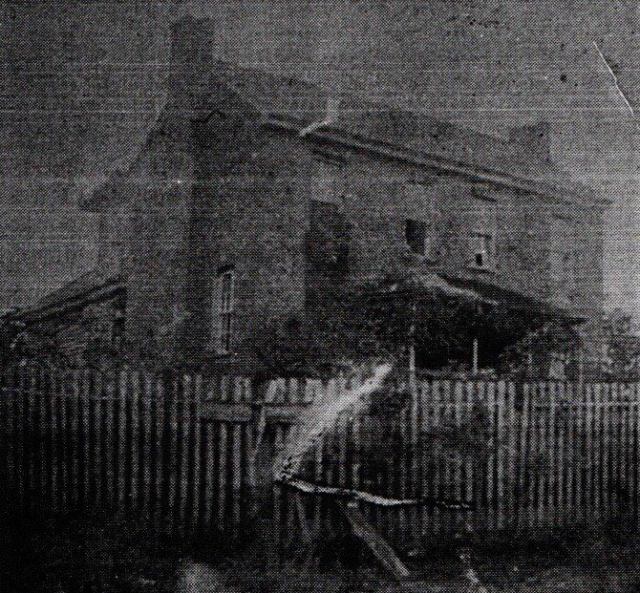
Have you ever noticed the empty lot between Rick’s of Ethridge and Ethridge Church of Christ? Did you know that one of the most well-known buildings in the county once stood on that spot?

The building in this grainy black-and-white photo stood in that now-empty lot for most of the 19th century. General Richard Allen, a veteran of the War of 1812, built a stand here along the Military Road, where weary travelers could stop and get a good meal and a place to stay the night.

Allen’s Stand was a well-known gathering point for local people, too. When Lawrence County’s first Confederate soldiers left for training in the spring of 1861, a going-away dinner was held in the field across from the Stand.

No doubt the saddest day this old house ever saw was when General Allen’s talented young son, Captain William B. Allen, was laid to rest in his early twenties in a garden on the back side of the property. William B. Allen was cut down in his prime, leading the Lawrenceburg Blues into battle at the Siege of Monterrey during the Mexican War. More than 1,000 people showed up at Allen’s Stand for his funeral.

Today, the garden-turned-cemetery is all that’s left of Allen’s Stand. The old home was demolished in the early 20th century.

12512343_1007926155964378_1395415729962357894_n

Posted in Uncategorized | 1 Comment

The Lawrenceburg Military Academy

Did you know that Lawrenceburg once had its own military academy, and that the school’s baseball team was coached by a former outfielder for the New York Yankees?

The Lawrenceburg Military Academy enjoyed a very brief existence on a sprawling campus on East Gaines Street, just across the highway from the modern location of the Lawrence County Public Library. The campus was part of the spacious old Sowell property.

The school held its open house on November 3, 1920. Subsequent newspaper articles indicate that the school had an early enrollment of at least 40 boys and young men, and their sports teams were very active in local secondary school athletics.

Students at LMA took regular secondary school courses, with an added emphasis on military drill and outdoor survival skills.

LMA’s baseball coach was Luther “Doc” Cook, who played 288 games as an outfielder for the New York Yankees between 1913 and 1916. The Military Academy squared off against local schools in athletics, including LCHS.

The school closed rather abruptly. On January 1, 1923, the academy reopened in Florence, Alabama as the Florence Military Academy, taking twenty students with it as boarders. The campus of the Lawrenceburg Military Academy was gradually developed into the modern Admiral Circle neighborhood.

Posted in Uncategorized | Leave a comment

The Old Lawrence County Public Library

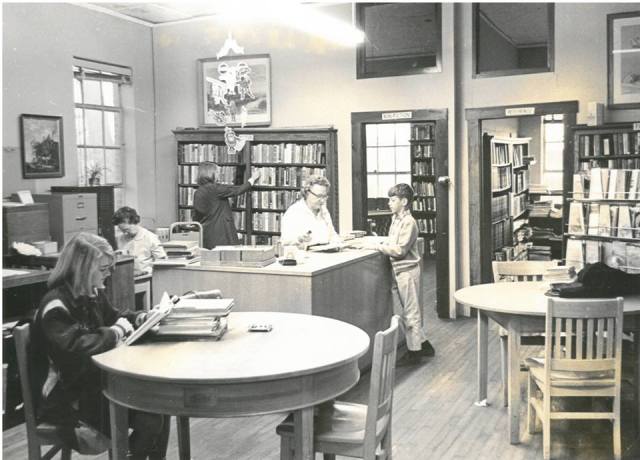
Have a look at this gem from the files of the Lawrence County Public Library! This photo is from around 1965, when the library was on the second floor of the old City Hall building.

260556_460747787452865_3740593916490942764_n

Posted in Uncategorized | Leave a comment

A Drunk History of Lawrenceburg

The city of Lawrenceburg voted for total prohibition of alcohol sales almost twenty years before the United States passed a Constitutional amendment to do the same, and the action sparked the outrage of Lawrence County’s German population.

Lawrence County has had a complicated history with the issue of alcohol sales.

For the first eighty years of the county’s history, alcohol–mostly in the form of whiskey–could be obtained easily and drank freely in our streets. County father David Crockett distilled his own brand of whiskey at Shoal Creek, and some early pastors were even said to have been sometimes paid in whiskey by their congregations. Indeed, it was not uncommon in those early days for jugs of whiskey to be used as currency in Lawrence County.

Throughout the nineteenth century, saloons, taverns, pool halls, and grocery stores in Lawrence County stocked and sold liquor with relative ease. People also gathered in grocery stores to drink at all hours of the day.

When the blacksmith Lewis Kirk shot and killed Giles County farmer Robert Westmoreland on the Square in Lawrenceburg in 1859, it was a Tuesday afternoon, but Kirk, himself, may have well been the only sober person on the Square at the time. Many of the witnesses testified that they had spent most of the afternoon drinking at the grocery stores around the Square. Many of those witnesses also recalled seeing other witnesses drunk or near-drunk, including the town’s doctor, who apparently operated on Westmoreland after spending the afternoon drinking with the other bystanders.

Public intoxication, as might be imagined, was a serious problem in those days. It was not uncommon to see men–even public officials–passed-out drunk in the streets for days at a time.

Clerk and Master W.T. Nixon recorded in his journal on at least one occasion in the 1880s that he was unable to have a deed recorded at the courthouse because the Register of Deeds was drunk in his office that day.

Most accounts of violent crime recorded in local newspaper articles and county court minutes at that time began with drunkenness and ended with tragedy.

Although an organized temperance movement existed in Lawrence County as early as the 1840s, it apparently was not enough to curb the thirst of the county’s drinkers. By the turn of the 20th century, a group of Lawrenceburg citizens had had enough.

On the week of March 20, 1901, a large crowd assembled at First Methodist Church and voiced their desire for Lawrenceburg to be reincorporated with a new charter that declared alcohol sales within the city limits to be illegal.

A week later, a majority of Lawrenceburg’s voters chose to make Lawrenceburg a “dry” city, and the city’s charter was abolished and reincorporated by the state legislature later that summer. Under the new city government, saloons were shut down and the sale of alcoholic beverages was put to an end.

But not everyone was pleased with the demise of alcohol sales in Lawrenceburg.

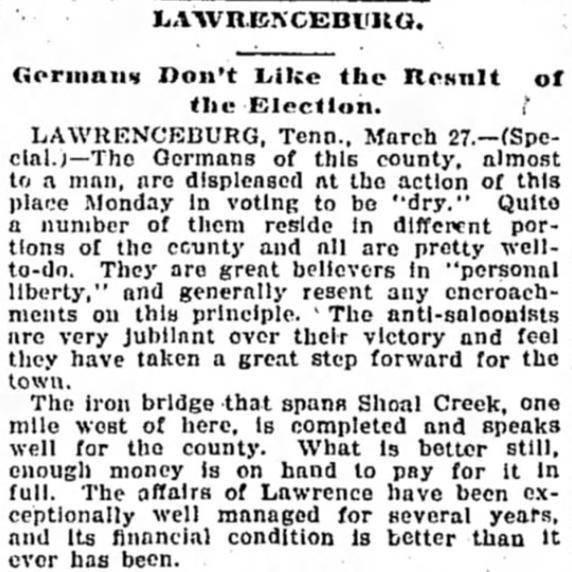
According to a brief article in The Nashville ‘Tennessean’ of March 28, the county’s many German immigrants were greatly “displeased” by the results of the referendum. The paper cites the German citizens’ love for individual liberty as the reason for their displeasure. However, it should also be noted that many of these German immigrants brought their cultural affinity for alcohol with them when they came to Lawrence County, and we have evidence that a great number of them found success making wine and brewing beer on their farms.

The prohibition of alcohol was one of the earliest progressive causes to take hold in Lawrence County and throughout the South. In most of these cases (although we can’t be sure locally, due to lack of written evidence), the most outspoken champions of prohibition were women.

12745796_973254146098246_6974563845268529749_n

Posted in Uncategorized | 1 Comment

Librarians of Yesteryear

When the Lawrence County Public Library was first established in 1941, it was situated in a room on the second floor of City Hall. The current library building was built in 1970 and expanded in the 1990s.

Do you have any memories of that first library in City Hall? Let us know in a comment!

12654626_448384758689168_1329422365173016068_n

Posted in Uncategorized | Leave a comment

A Parade of Long Ago in Downtown Lawrenceburg

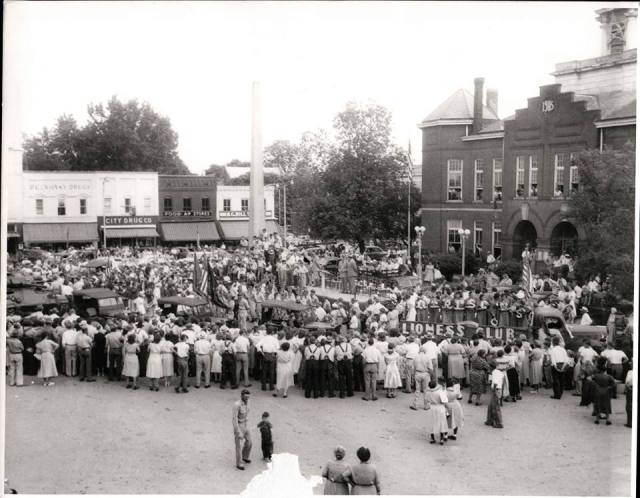
This photo is of a downtown event in the 1940s or 1950s on the north end of the Public Square in Lawrenceburg.

The photo can be dated by several clues, one of which is the presence of the 48-star flag in the color guard near the review stand. That design of U.S. flag was retired in 1959 when Alaska became the 49th state.

Do you have any fond memories of downtown events like this one?

12573694_955155334574794_8994710760655060094_n

Posted in Uncategorized | Leave a comment

Happy Amish Christmas!

Happy Amish Christmas!

You may notice today that many Amish businesses are closed for Christmas. That’s because many of Lawrence County’s Amish people observe the holiday known as ‘Old Christmas.’

Old Christmas is the name given to the date celebrated as Christ’s birthday in the days when all of Europe used the Julian calendar. When the Gregorian calendar was introduced in 1582, it bumped Christmas back 12 days.

Because the Amish and some other religious groups believed that the date of Christ’s birth was a holy day and should not be changed, they continued to observe the holiday 12 days after the new calendar specified.

In Lawrence County, the Old Order Amish continue this 400-year-old tradition each January 6 by fasting and reading Scripture together in the morning, and by visiting family members in the afternoon.

Posted in Uncategorized | Leave a comment

The Good Friday Freshet of 1902

This past week will be remembered for many years as one of the warmest, stormiest Christmas seasons in local history. The tragic tornadoes which tore through northern and western Lawrence County on December 23 were followed soon after by historic flooding, particularly in North Alabama and areas close to the state line.

The unusual ferocity of this year’s Christmas tornadoes and flooding brings to mind a topic which I wrote about in ‘Lawrence County History Trivia’ the book, when severe weather struck our region on another holiday.

Known as the ‘Good Friday Freshet’ by those who survived it, the Flood of Good Friday 1902 brought a great deal of destruction to our area. Below is my previous post about the topic, combined with further research pulled from the newspapers of neighboring Lauderdale County, Alabama.

March 1902 was a devastating month for Middle Tennessee. Massive thunderstorms dumped almost a foot of rain on the region in less than four days. The ground, already saturated from melting snow, was unable to absorb the excess water, resulting in record-breaking deadly floods across the mid-state which would claim dozens of lives and cause millions of dollars in damages. These rising waters culminated into the Good Friday Freshet on March 28, 1902.

The Cumberland River left its banks in Nashville, rising 13 feet in one day. According to a contemporary newspaper account posted on the Bedford County Genweb site, all but one of the steel bridges erected over the Duck River near Shelbyville washed away as the river crested at a depth of over 43 feet. Homes were flooded to their second stories. The water in the streets of Shelbyville was deep enough “to float the largest steamboat.”

Closer to home, the Elk River and Richland Creek in Giles County claimed lives and homes as those bodies of water reached their highest-ever crests. The Elk River, alone, reached a depth of almost 41 feet. And in Lawrence County, the waters of almost every creek and stream escaped their banks and caused an immense amount of damage, as can be seen in this picture of men repairing damage done to the railroad at Raven’s Bluff, where it crossed Shoal Creek and Coon Creek.

Shoal Creek reached a depth of 28 feet, which is 14 feet above flood stage. Those who survived the deluge never forgot it. W.W. Rhodes was ten years old and living on Sugar Creek near Mount Zion when the March 1902 flood occurred. Rhodes wrote the editor of the Democrat-Union late in life that he remembered the flood destroying the rail fencing on his father’s land, and how hard he and his family had to work to pull the rails from drifts in the ensuing weeks to rebuild the fences.

Cora Norman Renfro was a thirteen-year-old girl living in Maury County when the flood occurred. Later in life, after having moved to Lawrence County, she wrote the editor of the D-U that she recalled seeing only the roofs of houses sticking out of the water.

Thomas Kilburn was nine years old when the March 1902 flood happened. His family was living on Knob Creek, near West Point, when the water began to rise. Kilburn said that the water rose inside his grandfather’s barn to the point that they had to move the livestock to higher ground. The family’s supply of corn was soaked and had to be dried when the waters receded. Kilburn’s family watched as debris from miles around floated down the creek.

Kilburn said that, when the waters finally receded, his uncle Wild Kilburn found a barrel of molasses in the yard. The molasses was the property of Gus Kelley, and it had floated down the flooded creek from Piney. According to Kilburn, Kelley “came and got his molasses. They were still good.”

In Florence, the rainstorm reached its peak at around 2 p.m. At that time, the Florence ‘Times’ reports that the rain came down ‘in sheets’ on the already-saturated ground. Some area streams crested at 10 to 15 feet above their previously highest-ever recorded flood levels.

The floodwaters washed away six steel bridges in Lauderdale County; namely those which spanned Cypress Creek on Gunwaleford and Waterloo Roads, the two spanning Shoal Creek at Huntsville Road and Military Road, one crossing Bluewater Creek on Huntsville Road, and one which crossed Butler Creek at Pruitton. These six iron bridges alone are estimated to have cost $30,000 to replace.

In addition to the bridges, three mills and two school houses were destroyed in the deluge. Shoal Creek crested ten feet higher than it had ever before risen, destroying a $30-50,000 aqueduct. Along this creek, trees as thick as four feet in diameter were uprooted and washed, roots and all, down the raging waterway to the Tennessee River, which the Army Corps of Engineers reported as rising “higher than it ever has before.”

The March 1902 flood took the lives of eight people in Lauderdale County, all of the Brahan family who lived at the mouth of Cypress Creek.


1929991_946468372110157_6876371442694047564_n

Posted in Uncategorized | Leave a comment

Lawrence County Letters to Santa from 1926

Merry Christmas, friends!

Who doesn’t love a good letter to Santa? The following letters to Santa were written by Lawrence County children in 1926 and published in the ‘Democrat-Union’ that December.

“Dear Santa Claus:
I am 7 years old. Please bring me a set of dishes and a baby doll. Also a pair of skates and apples, nuts and candy.
Your friend,
Mary Emily Davis”

“Dear Santa Claus:
Please bring us a group of Sunday School lessons already studied.
With many thanks,
Tom Spencer
Alma McMurtrey
Louise Stutts
Elizabeth Spencer
Pauline Springer”

“Dear Santa Claus:
I am in the 2nd grade. I am ten years old. Please bring me a pair of skates and a pair of leggins and a 22 rifle.
Your friend,
Delton Moore”

“Dear Santa Claus:
I want a box of colors and some apples. Please bring me a doll bed.
Your friend,
Ludie Peppers”

“Dear Santa Claus:
I am a good girl. I want you to bring me a embroidery set and a pair of house slippers, and apples, nuts and candy.
Your friend,
Bonnie Belle Brown”

“Dear Santa Claus
I have been a good boy all the year. Please bring me a cap pistol and a wagon.
Your friend,
Claud Edward Smith”

“Dear Santa Claus:
I am in the 2nd grade and I have been a good boy all the year. Please bring me a banjo and some nuts, oranges, and book matches.
Your friend,
Teddy Spain”

“Dear Santa Claus:
I am in the 2nd grade. Please bring me a train and a story book and a banjo.
Your friend,
Thomas Liles”

“Dear Santa Claus:
I am nine years old and in the 2nd grade. Please bring me a banzo and a clock and a bylo baby.
Your friend,
Imogene Stutts”

“Dear Santa Claus:
I am a little girl nine years old and in the 2nd B grade. Please bring me a rain coat.
Your friend,
Virginia Harwel”

“Dear Santa Claus:
I am eight years old. Please bring me a doll and a set of dishes and a story book. Please bring my mother a big set of dishes and a new coat. I am in the 2nd B grade.
Your friend,
Opal Phillips”

10245490_941021202654874_6092209602570371448_n

Posted in Uncategorized | Leave a comment

Happy Birthday, E.O. Coffman!

Happy birthday today to Professor E.O. Coffman, who was born on this day (December 6) in 1882.

Professor Coffman served the Lawrence County Schools System for an astonishing 52 years, including 38 years as the principal of Lawrence County High School. Lawrenceburg’s middle school, E O Coffman Middle School, is named in his honor.

But Professor Coffman didn’t just work at LCHS, he was also heavily involved in the fight to create it.

Not only was he one of the school’s first teachers, and one of its longest-serving principals, but he also was present at most–if not all–of the organizational meetings which resulted in the school’s creation.

However, despite his many years of dedication to LCHS and education in general, Coffman’s true passion was for the Gospel. He was baptized in 1900 and began preaching at local churches of Christ in 1909. Professor Coffman held Gospel Meetings throughout Lawrence County and also in Lauderdale County, Alabama.

Many of the students who were educated under his tenure in the Lawrence County School System remember Professor Coffman as a strict disciplinarian with no tolerance for misbehavior or anything which he saw as a distraction from academics. In fact, in the early days of LCHS, Coffman had it published in the local newspaper that he would personally deal with students who were seen loitering around the Public Square in Lawrenceburg or attending movies at the Princess Theater after school was dismissed for the day.

Do you have any memories of E.O. Coffman?

12295481_931348110288850_981990078133859934_n

Posted in Uncategorized | Leave a comment