
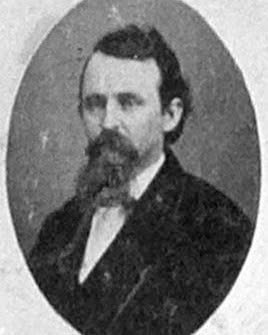
Captain Thomas D. Deavenport of Lawrence County had an illustrious career of public service that was cut tragically short by his personal demons.
Deavenport was born on September 18, 1837. He began life working on his father’s Lawrence County farm. He attended Jackson College in Columbia, completing all but his final session there due to his father’s death in 1844.
Deavenport went to Kansas after his father’s death. While in Kansas, he witnessed the period of that state’s history known as ‘Bleeding Kansas,’ when proslavery and antislavery partisans shed blood over the issue of whether Kansas would enter the Union slave or free.
He returned to Tennessee in 1857, and began reading law in Florence, Alabama the same year. In 1858, he taught school in Lawrenceburg until he was admitted to the bar and began practicing law.
When the Civil War began in 1861, Deavenport helped to raise a company of men from Lawrenceburg to serve in the Confederate army. When the company was mustered into the 32nd Tennessee Infantry, Deavenport was commissioned as a lieutenant, and was promoted to captain on November 4, 1861.
Deavenport was taken prisoner at the fall of Fort Donelson in 1862, and exchanged several months later. Although he fought bravely with his company throughout the war, his military career was effectively ended in late August 1864, when he was shot through the lungs with a Minié ball at the Battle of Jonesborough, Georgia.
He survived his wounds and continued practicing law in Lawrenceburg after the Civil War. He was elected to serve as Lawrence County’s delegate to the State Constitutional Convention of 1869, and then to the State Senate in 1877. Deavenport was a man of unquestionable talents and leadership ability.
Unfortunately, despite his stellar record of public service, Deavenport was also a heavy drinker. He was frequently publicly intoxicated, and had at least one public confrontation with his wife while drunk (his wife, interestingly enough, was the daughter of a Union veteran). His law partner, W.T. Nixon–whose unshakeable sobriety no doubt made the firm an odd pairing–recorded Deavenport’s frequent drunkenness in his journal.
Nixon mentions Deavenport 104 times throughout the journals, and many of those references mention Deavenport’s struggle with alcoholism.
On January 25, 1880, Nixon wrote:
“Capt Deavenport is still drinking and they say he was drunk on the square again today. This is shameful and I regret it so much for there is no finer man when sober.”
On August 23, 1880, Nixon wrote:
“Had a trial of trying to reconcile Capt & Mrs D. Capt drunk again – bad drunk. “
On March 17, 1881, Nixon wrote:
“I am out done with Deavenport & Love who have now been drunk for nearly three
weeks. I do not see how they stand it.”
On March 9, 1884, Nixon wrote:
“Capt Deavenport and Bill Love [the Register of Deeds] are down town drunk as fools. Tried to make some arrangement to get Capt’n a place to
sleep but failed only for Pete Smith who says he will not let him lie out. If anybody thinks whiskey will not utterly ruin a man, body and soul, let him look at Captn D.”
Despite his troubled personal life, it cannot be denied that Deavenport was a patriotic public servant, and Nixon seemed to place total trust in him as a business partner.
Captain Deavenport passed away on February 11, 1889 at the age of fifty-two, leaving a wife and five children. He is buried in the Old City Cemetery on Waterloo Street in Lawrenceburg.


 Lawrence County History Trivia
Pingback: Bringing Local History to the Classroom | Lawrence County History Trivia