
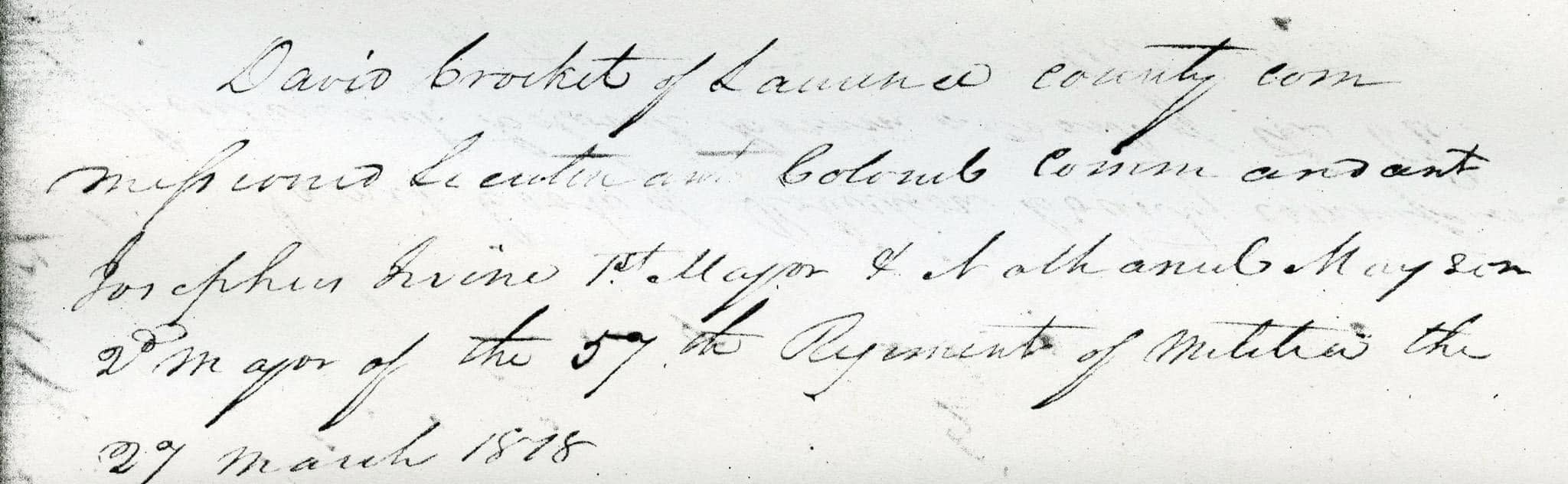
On this day in 1818, David Crockett was commissioned as the Colonel of Lawrence County’s 57th Tennessee Militia Regiment. Elected not long after the county was organized in the fall of 1817, Crockett was the first commander of Lawrence County’s militia.
In those days, each county had a militia regiment. In theory, the militia system was there to safeguard the early republic against invasion and uprising without the cost of equipping and training a standing army. By state law, most able-bodied men were required to meet at certain times of the year to train for militia duty. Officers, like Crockett, were elected.
As military exercises, however, these musters were often great comical failures that began with mostly-unarmed companies performing sloppy maneuvers in an open field and ended with most of the men getting drunk and fighting each other, which is why the militia system was gradually replaced over time.
We aren’t sure how Crockett drilled his regiment, but we do have descriptions of how the militia trained in the surrounding area in Crockett’s time.
James Simpson described muster days he saw in his childhood in nearby
Florence, Alabama like so: “In the early days of Florence we had what we called ‘Muster days’ and the men felt that they must come and train. Some carried guns, some big sticks on their shoulders. They had musters about two or three times a year. It was always a jollification and more fights than you could think of. In those days they had plenty of good whiskey at 10 cents a quart.”
Crockett described his election to the office in his autobiography. According to Crockett, an early Lawrence Countian named Matthews attempted to trick Crockett into running
against his son for major of the regiment, believing Crockett would be easy to defeat for the post. When he learned about the plot at a corn-husking given by Matthews, Crockett announced to the crowd that he was, instead, running for Colonel against Matthews. He won the contest handily.
Crockett continued to use the title of ‘Colonel’ for the rest of his life.
Image courtesy of Tennessee State Library and Archives, Commission Book 4, page 96.


Pingback: Bringing Local History to the Classroom | Lawrence County History Trivia