
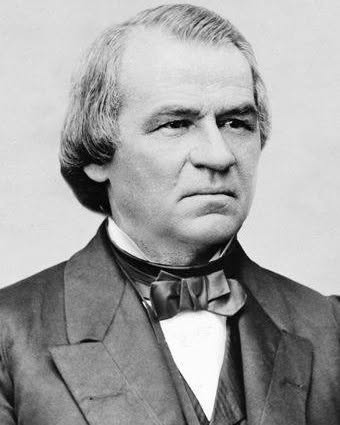
On June 10, 1853, twelve years before he became President of the United States, Andrew Johnson was on a different campaign trail in Lawrenceburg.
That summer, Johnson was running for governor of Tennessee against Gustavus A. Henry. The two men engaged in a whirlwind debate circuit across the state in the months leading up to election day, Johnson on the Democratic ticket and Henry on the Whig ticket. Johnson won the election by a little over 2,000 votes.
He would go on to serve a second term as governor, and was serving as a senator from Tennessee when the Civil War broke out. He was the only southern senator who refused to leave his post at the outbreak of the war, and his loyalty earned him a place as the Union military governor of Tennessee after Union forces gained control of most of the state by mid-1862. He was elected as Lincoln’s Vice President in 1864 and became President of the United States upon Lincoln’s assassination in 1865.
Although nothing of any great historical consequence came of the Lawrenceburg debate in the summer of 1853, it is possible that Johnson may have first become acquainted with Lawrenceburg planter and attorney L. Mino Bentley during his brief stop in town. A decade later, when Johnson was serving as the Union’s military governor of Tennessee, Johnson appointed the Unionist Bentley as a judge in Clarksville.
Bentley fled to Clarksville mid-war when his outspoken Unionist sentiments endangered him and his family in heavily pro-Confederate Lawrenceburg. Bentley would retain his Johnson-appointed position as judge in Clarksville until he returned to Lawrenceburg at the end of Reconstruction.
And if Gustavus Henry sounds familiar to you Civil War buffs, it’s probably because he went on to serve as one of Tennessee’s Confederate senators during the Civil War. As a young man, he had attended law school with a young Jefferson Davis. Also, Fort Henry, which fell to Union forces in early 1862, was named in his honor.


 Lawrence County History Trivia
Pingback: Bringing Local History to the Classroom | Lawrence County History Trivia