
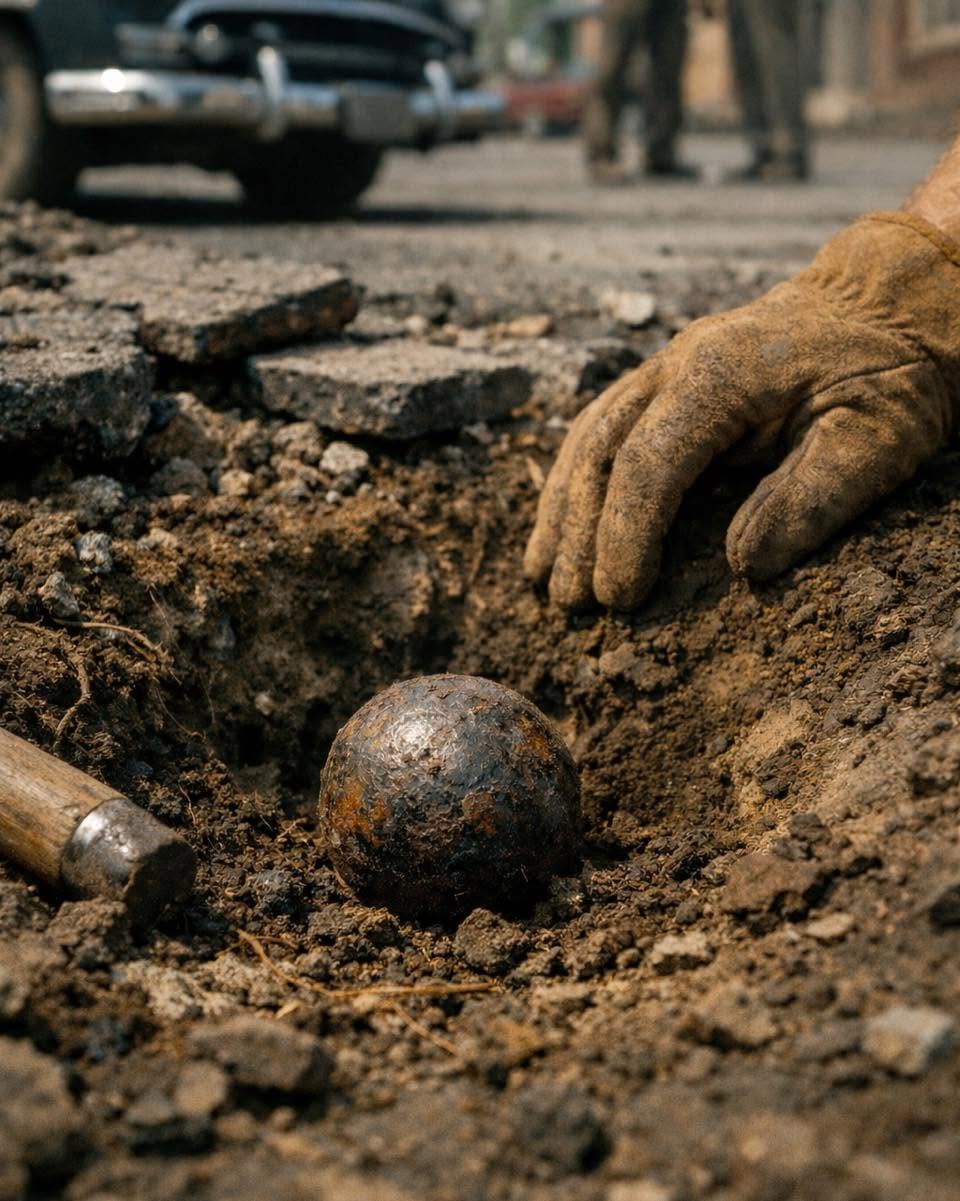
In 1956, a crew from the Lawrenceburg Street Department found something unusual buried beneath downtown Lawrenceburg.
After the crew dug it up, foreman Ira Johnson examined it and determined that it was a cannonball.
Beyond this, we know maddeningly little about the cannonball. Neither the article published about the cannonball in the May 25, 1956 edition of the ‘Democrat-Union’ nor the article about it in the Historical Society’s newsletter of the time mentions where, exactly, the cannonball was unearthed. It also does not provide specifics about the size of the ball or its appearance, all of which could be useful clues in understanding how and when it came to be embedded in the streets of Lawrenceburg.
We do know that, a week later, Ira donated the cannonball to the Lawrence County Historical Society, who had set up a display of local antiquities in the “large double windows of Richardson Hardware Company” at the time. The president of the society speculated at the time that it could be “the only cannonball ever fired at the courthouse.” The president provided the ‘Democrat-Union’ with a version of the events of November 3, 1863.
He explained at the time that “the Yankees were set to shell the Courthouse and town. One shot was fired at the Courthouse then an officer ran in and shouted: ‘Stop! Nearby is a monument to the Mexican heroes’ and so not another shot was fired.”
The one problem with the president’s explanation is that the Federal unit preparing to destroy the courthouse probably did not have a cannon. Indeed, the sole account we have of the event from Thomas Fitzgibbon, the Union commander, says that his men burned the jail, but “The citizens begged that I would spare the court-house, as its destruction would disfigure and perhaps mutilate and destroy a monument close by, erected in memory of those of its former residents who died on the plains of Mexico defending the Republic.”
It is unlikely–though not impossible–that Fitzgibbon’s mounted infantry unit carried an artillery piece during the fight at Lawrenceburg. If so, he never mentions it. Fitzgibbon was outnumbered and away from his base of operations, and seemed intent on accomplishing his mission in Lawrenceburg with all speed.
However, Lawrenceburg was, indeed, shelled before the Civil War was over, in November 1864–but it was shelled by Confederate artillery. As Robert L. Morris of the 21st Tennessee Cavalry described it: “…the attack was sufficient to check the advance of the enemy, and they retired to Lawrenceburg. With the appearance of Jackson his artillery was favorably stationed and fire opened on the town. In the afternoon, with the troops dismounted, an assault was made. The Twenty-first Tennessee and Twenty-eighth Mississippi, occupying the center of the line, bore the brunt of the engagement. So swiftly and hardly were the enemy pressed that their camp was taken and a good deal of valuable material and much-needed rations captured.”
Colonel Datus Cooon, the commander of the Union cavalry which fought Morris and his comrades in Lawrenceburg that day summarized the skirmish at the time in these terms: “…in compliance with orders I immediately put my command in line of battle on north side of town. The enemy soon opened with one section of artillery when my battery replied. An hour was spent in firing by artillery on both sides with no result, when we were ordered to fall back on Pulaski road, Second Brigade to take the rear. My pickets and command withdrew in good order, though heavily pressed by superior force. Halted and camped seven miles east of Lawrenceburg.”
According to these accounts, Lawrenceburg was the scene of an hour-long artillery duel on November 22, 1864. While we can’t be sure, this would seem to be a more likely source of the road crew’s mysterious cannonball than Fitzgibbon’s 1863 sparing of the courthouse.


 Lawrence County History Trivia
Pingback: Bringing Local History to the Classroom | Lawrence County History Trivia