
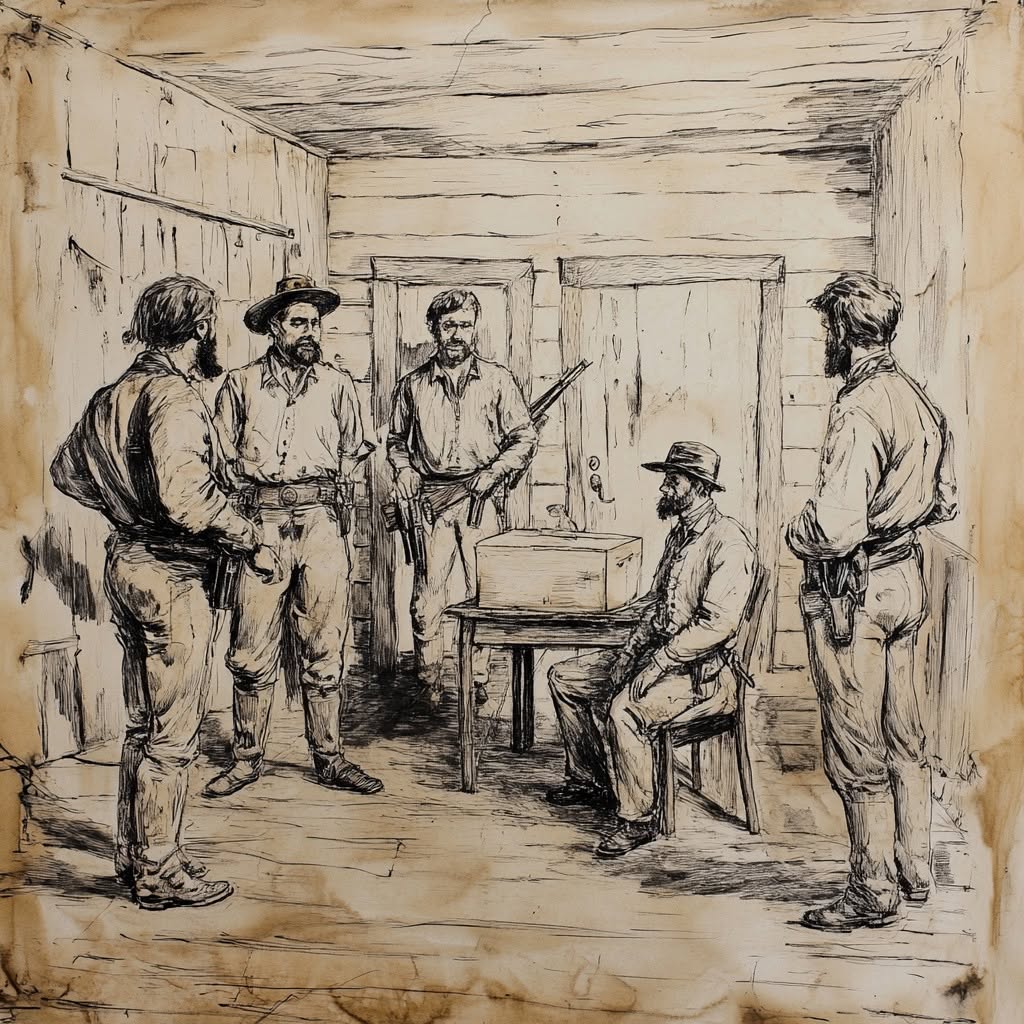
Today is the 160th anniversary of the end of slavery in Tennessee. And, according to one source, the men of Lawrence County who turned out to vote for its abolition had to arm themselves at the ballot box for fear of attack.
The Emancipation Proclamation freed slaves in areas controlled by the Confederate government on January 1, 1863. As a wartime action, it encouraged enslaved people to flee towards approaching Union armies. In this way, the Proclamation undermined the Confederate economy and destabilized the Southern war effort from within. But as a wartime executive action, it would cease to be in effect by the war’s end, and it did not take effect at all in areas controlled by the Union army, which at that time included Tennessee as well as the border states and the parishes around New Orleans.
To ensure the demise of slavery, a constitutional amendment was necessary. After a hard-fought campaign in Congress, the 13th Amendment passed the Senate on April 8, 1864 and the House of Representatives on January 31, 1865. It was then sent to the states, where it required a ¾ majority for ratification. By the end of February 1865, it had the approval of 18 of the required 27 state legislatures necessary for ratification.
In the meantime, on February 22, 1865–while the Civil War continued to rage and many of Lawrence County’s native sons were still away fighting–the Unionist government of Tennessee called for a referendum to decide the fate of slavery in the state. But it wasn’t as simple as showing up to the polls and casting a ballot. Tennessee was very much a state divided, and in order to vote, one had to first swear a complex 189-word oath that pledged unwavering loyalty to the United States Constitution and government, denounced the Confederacy, and committed to the suppression of the rebellion until complete restoration of the Union.
This oath aimed to disenfranchise Confederate soldiers and sympathizers. On the day of the election, 275 Lawrence County men–only about 3% of the county’s 1860 population–swore this oath and voted in favor of the abolition of slavery in Tennessee.
Statewide, the motion passed with overwhelming support (only 45 votes were cast against the measure in the entire state). The results of this referendum have been criticized because much of the measure’s opposition was disenfranchised by the pro-Union oath.
Still, the referendum accomplished what the Unionist state government wanted it to do: Tennessee became a free state nine months before the ratification of the 13th Amendment.
Lawrence County’s voters were singled out in a speech made by State Representative S.M. Arnell, who praised the courage of the county’s Union men, who went to cast their vote that day armed in case of pro-Confederate guerrilla attacks. Such attacks were a very real possibility, as Lawrence County saw frequent guerilla activity during the Civil War.
Tennessee’s state legislature became the twentieth to ratify the 13th Amendment on April 7, 1865, and it became law with Georgia’s ratification on December 6, 1865. Mississippi–whose legislature rejected the amendment in 1865 but voted to ratify it in 1995–officially completed the process on February 7, 2013, meaning that the 13th Amendment eventually received the approval of all 36 states which existed at the time of its proposal.


 Lawrence County History Trivia
Pingback: Bringing Local History to the Classroom | Lawrence County History Trivia