
On this day in 1786, the people of Nashville were afraid. And they were taking up arms.
But what connection does that long-ago militia mobilization have to downtown Lawrenceburg? It’s a long story, but an interesting one.
A confederacy of Native American tribes in the Northwest Territory (modern Ohio, Indiana, Illinois, Wisconsin, and Michigan) renewed hostilities with the United States in 1785. At issue, among other things, was who controlled the land north of the Ohio River.
The British had ceded that land to the United States after the Revolutionary War, but they still maintained forts and trading posts there, and supplied the Indians with weapons. Many of the tribes in the region had sided with the British during the Revolution, and still held unbending hostility toward the United States for the brutality of Washington’s army against their villages during that war.
Adding to the tension was the westward flood of settlers seeking new land. As these settlers continued to encounter hostile Indians, the number of skirmishes and raids between the two groups increased. In 1785, members of several of the northwestern tribes met at Fort Detroit and formed the Western Confederacy, proclaiming the boundary between their land and American land to be the Ohio River. This subsequently led to an increase in the frequency and violence of the raids conducted by both sides.
Eventually, after a series of defeats in which thousands of poorly-trained American militiamen were killed, George Washington sent a well-trained regular force of American soldiers into the area under General “Mad” Anthony Wayne. This army dealt the Indian Confederacy a crushing blow at the Battle of Fallen Timbers in 1794, bringing an end to Native dominance in the region.
Although Davidson County was far from most of the heavy fighting during this war, it was still a frontier outpost surrounded–and vastly outnumbered by–potentially hostile Indians. Many of the Cherokee Indians in what would become East Tennessee supported the tribes of the Western Confederacy during this conflict, and some Cherokee leaders actually sent warriors to support their efforts.
In response to the fears of the people of Davidson County, on November 18, 1786, the North Carolina legislature authorized the county to raise “two hundred and one men” to be “enlisted and formed into a military body, for the protection of the inhabitants of Davidson County.” These 201 men were to rendezvous at the “lower end of Clinch mountain” and remain enlisted for two years.
The purpose of this small force was to defend settlers in Davidson County from the same types of Indian raids that were occurring north of the Ohio River, and to attempt to stop the Cherokee from rising up in support of their allies in the north.
One of the men who enlisted in that force was Private John Thompson.
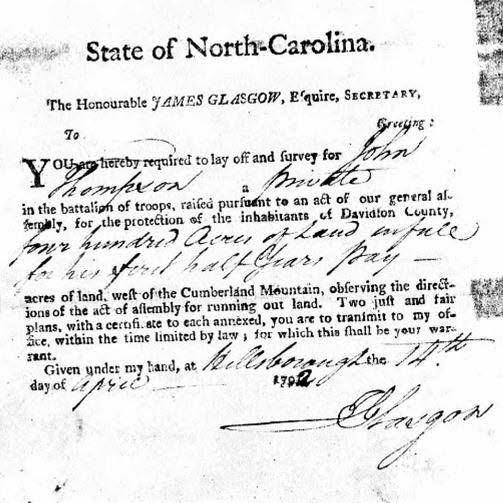
We know extremely little about John Thompson, other than he served his time in the defensive force and was rewarded with a land grant of 400 acres for his service. It was a land grant that he would never claim.
The warrant pictured here was made to Thompson on April 14, 1792. It was an order to survey 400 acres which, for whatever reason, was never surveyed. Because Thompson never claimed his land, the claim reverted to the state.
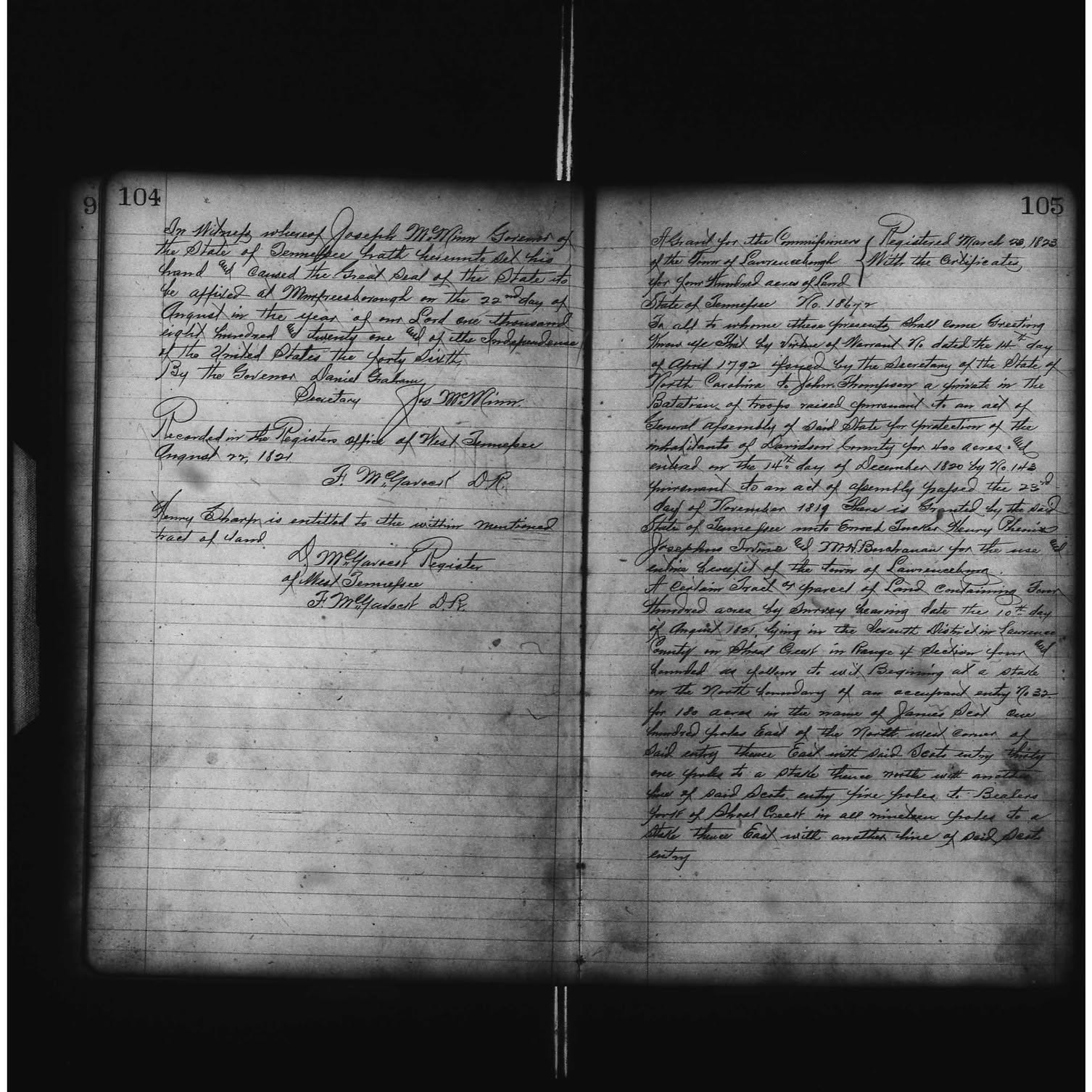
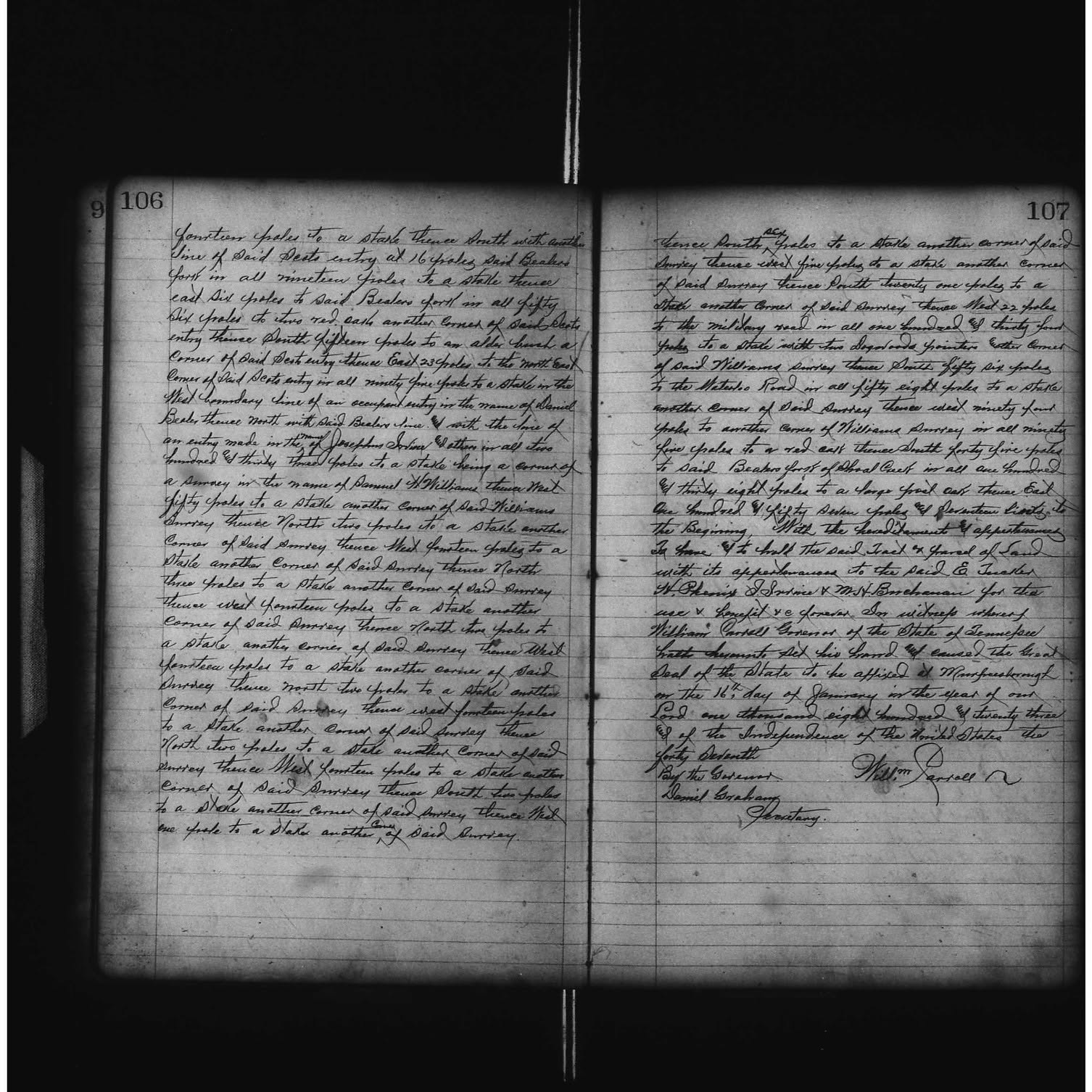
On December 14, 1820, the state granted the warrant for Thompson’s 400 unclaimed acres to the commissioners of the new town of Lawrenceburg, who surveyed part of that land into the lots that we now know as the Public Square of Lawrenceburg. Although the survey was completed less than a year later, the General Assembly of Tennessee did not officially deed the land to the commissioners until January 16, 1823. The commissioners were responsible for striking the lots off to any who would purchase them, and to use the funds raised by the sale to build a courthouse, jail, and public stocks.
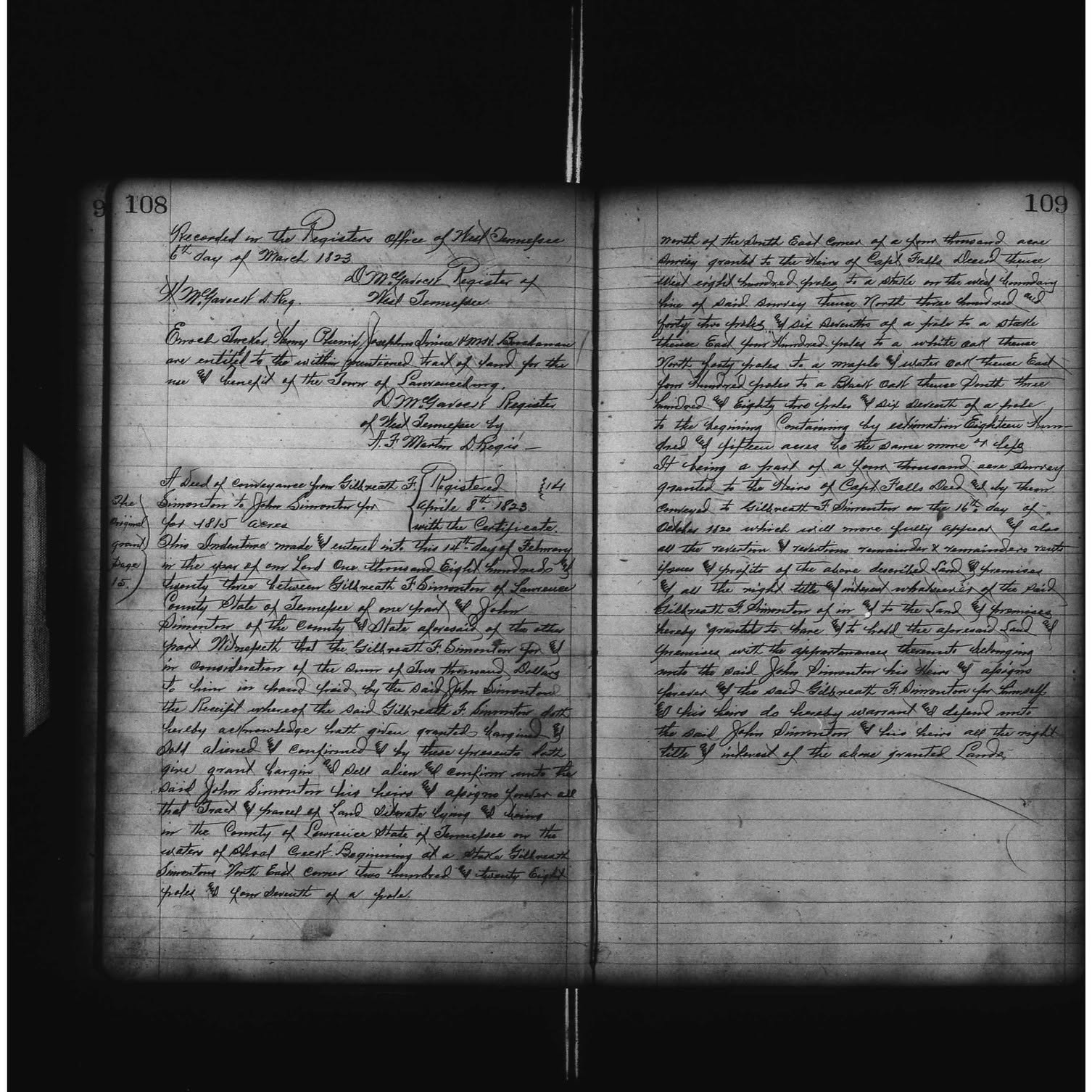
In addition to the land grant, the deed pictured is the deed showing that the state granted Private Thompson’s land grant to the first commissioners of Lawrenceburg. It is recorded in Deed Book A in the office of the Lawrence County Register of Deeds.


Pingback: Bringing Local History to the Classroom | Lawrence County History Trivia