First Baptist Lawrenceburg Celebrates Three Decades on Springer Road

Congratulations to First Baptist Church of Lawrenceburg as they celebrate 31 years at their Springer Road location.

FBC Lawrenceburg was organized at the Opera House on the Public Square in 1896, and held its first baptism in Shoal Creek that May.

The church’s first sanctuary was built in 1898, at the corner of Columbia Avenue and Highway 64. That building was replaced by a larger sanctuary built at the corner of Mahr Avenue and West Gaines Street in 1927.

The current sanctuary on Springer Road was completed on this day in 1984.

Photo credit: First Baptist Church Lawrenceburg Facebook Page

Posted in Uncategorized | Leave a comment

The Day Lawrence County Woke Up in a Different Country

One-hundred-and-fifty-four years ago today, Lawrence Countians awoke in a different nation than the one in which they had gone to bed.

On June 8, 1861, Tennessee voters went to the polls to approve or disapprove of the legislature’s May decision to secede from the Union and join the Confederacy.

This referendum was a paradox in Lawrence County for a number of reasons. At the time the vote was held, Lawrence County’s first company of Confederate volunteers was in Camp Trousdale for basic training.

Not long after the legislature voted to secede from the Union on May 6, this company of volunteers, their families, and many of the people of Lawrenceburg, had gathered in what is now Ethridge, near the current location of Rick’s, and held a grand going-away feast with patriotic speeches and songs celebrating the new Confederacy. They had also been presented a new banner made by the ladies of the town to take into battle–an American flag, which had to be sent home when the company arrived at Camp Trousdale.

Another paradox concerning Lawrence County’s vote to secede from the Union is that, among those men training for Confederate service at the time of the secession referendum on June 8, at least one Lawrence County soldier voted against secession, despite having already been sworn into the service of the Confederacy.

At home, support for secession was relatively concrete. As one Unionist wrote many years after the Civil War ended, it was dangerous during that time to publicly express any pro-Union sentiments in Lawrence County. One man who voted against secession and let everyone know about it was threatened so often that he was forced to leave the county and join the Union army.

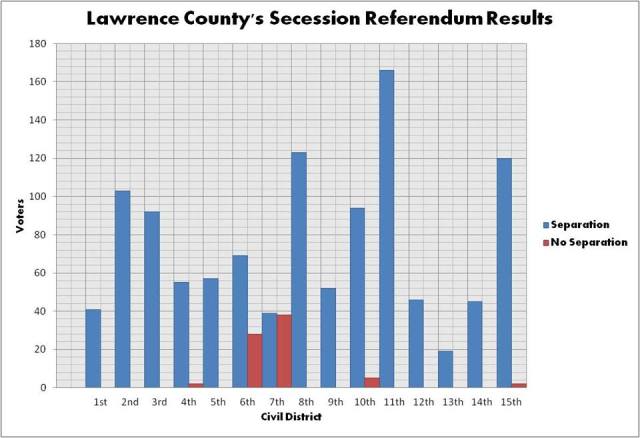
We are fortunate to still have the returns for that secession referendum–showing who showed up to vote, and how each district voted–preserved in the Lawrence County Archives. As this chart shows, most of Lawrence County’s civil districts voted unanimously to secede from the Union, with the strongest opposition to secession coming from the 6th and 7th civil districts, which was a swath of western Lawrence County covering roughly the area between West Point and Laurel Hill.

Overall, 2,240 Lawrence County men (94% of the electorate) voted in favor of secession on June 8, 1861, while 139 (6% of the electorate) voted against it.

10256960_839145309509131_7585489913747295189_n

Posted in Uncategorized | Leave a comment

Is This the Oldest Image of Lawrenceburg?

This woodcut of the Public Square in Lawrenceburg may be one of the oldest images of the city in existence. Although the picture’s origin is unclear, it has made appearances in several books about local history.

The image is not dated, but it gives us several clues as to its possible age.

The Mexican War Monument is shown in the foreground, with the county’s first permanent courthouse standing behind it. Absent from the courthouse is the bell-tower on the roof placed there after the Fire of 1898. But the fact that the courthouse stands a full three stories tells us that this image was created after 1850, when court minutes indicate that the third story was added to the building by the local masonic lodge.

This gives us a date range of between 1850 and 1898. If you take a closer look at the image, you can see details in the dress of the people there that give us yet another clue. The bustles on the dresses of the ladies are of a style which makes me think that this picture probably dates from the 1870s or 1880s. I could be wrong, as I am not an expert in historic clothing, but that is my best guess.

Regardless of the exact age of the image, it is a real treasure, and I hope you enjoy it as much as I do!

11390088_832770750146587_4291507493145293036_n

Photo Credit: Lawrence County Historical Society

Posted in Uncategorized | Leave a comment

Labor of Love: The Birth of Lawrence County High School

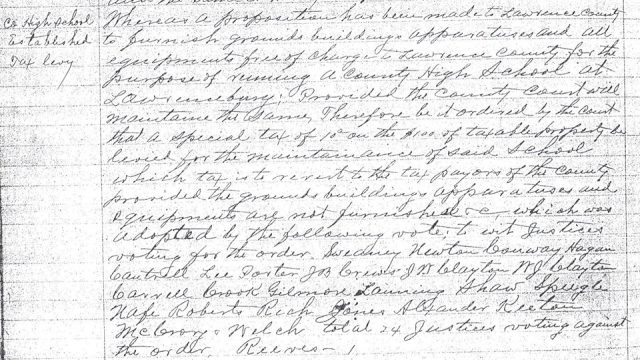
If schools had birth certificates, this is what Lawrence County High School’s would look like.

On January 6, 1908, the County Court of Lawrence County voted 24-to-1 to establish a government-funded, tuition-free high school in Lawrenceburg for the students of Lawrence County.

LCHS was not the first secondary school in the county’s history; previous institutions of higher learning had existed in the county, but they had all been private schools which charged tuition. Those schools all shared a similar fate in that they all eventually ceased operation due to financial constraints.

The creation of LCHS was a labor of love for a dedicated group of individuals, all of whom shared what was then the radical notion that the county’s children, regardless of class or condition, deserved a quality education and a chance at a bright future.

When the county court voted to levy a tax to pay for the operating costs of the new school, it was the result of many months of hard work and action by some of the county’s most noteworthy people, including James D. Vaughan (the father of Southern Gospel music), J.H. Stribling, and Professor E.O. Coffman.

The text of the entry (found in Lawrence County Court Clerk Minutes Vol. T, page 28) reads as follows:

“Co High School
Established
Tax Levy

Whereas a proposition has been made to Lawrence County
to furnish grounds, buildings, apparatuses, and all
equipments free of charge to Lawrence County for the
purpose of running a County High School at
Lawrenceburg; Provided the County Court will
maintain the same, Therefore be it ordered by the court
that a special tax of 10 c on the $1.00 of taxable property be
levied for the maintenance of said School
which tax is to revert to the taxpayers of the County
provided the grounds, buildings, apparatuses, and
equipments are not furnished &c which was
adopted by the following vote, to wit Justices
voting for the order: Sweaney, Newton, Conway, Hagan
Cautrell, Lee, Porter, J.B. Crews, J.W. Clayton, W.J. Clayton
Carrell, Crook, Gilmore, Lanning, Shaw, Speegle,
Nafe, Roberts, Rich, Jones, Alexander, Keeton,
McCrory & Welch total 24. Justices voting against
the order, Reeves – 1.”

1506589_829797087110620_7315627258870257841_n

Posted in Uncategorized | Leave a comment

The Deerfield-Ethridge Tornado of 1995

Today (May 18) is the 20th anniversary of the 1995 Deerfield-Ethridge Tornado.

On May 18, 1995, an F-4 tornado cut a huge, 29-mile path of destruction across Piney, Deerfield, Brace, and Ethridge, killing three and injuring 32.

The massive twister damaged or destroyed fifty houses and a dozen house trailers in Lawrence County. First responders had to temporarily shut down a full 1/3 of Lawrence County’s roads in the aftermath of the storm. Ethridge Elementary School was opened as a shelter to those left homeless by the tornado.

The same system of thunderstorms which spawned the Lawrence County tornado was responsible for the 5th largest tornado outbreak in Middle Tennessee history, with at least 14 other confirmed tornadoes in Middle Tennessee that day. These pictures are of the home of Doug and Martha Alley in Deerfield.

Their home–which was pushed from its foundation by the May 18 tornado and later had to be demolished–was one of the dozens of Lawrence County homes that suffered extensive damage from the tornado.

Photos from the collection of Clint Alley

Posted in Uncategorized | 3 Comments

The Deerfield School Basketball Teams of 1936

In the days when each community had its own school, there was no lack of ballgames–or friendly community rivalry–in Lawrence County.

This picture shows the Deerfield School basketball teams of 1936.

From left, first row: Coach T.D. Rayfield, Edith Clayton Kidd, Virginia West Boyd, Virginia Whitehead Shivers.

Second row: Emona Burks Whitehead, Gwendolyn Bradley Peirson, Olen Clanton, Nettie West Barnett, U.V. Pennington George, Hillard Thigpen, Earnestine Kennedy Thornton.

Third row: Euell Burks, Auis Truitt Baker, Neal James, Pearline Dixon Methvin, Travis Orton, and Coach Emma Beard.

11165313_828347680588894_968509568059324848_n

Posted in Uncategorized | Leave a comment

Old Ladder 2

Thanks to Ben Carpenter, one of our Alabama readers, for sending us these great photos.

This antique fire truck once belonged to the Lawrenceburg Fire Department, but is currently sitting in a field between Mt. Hope, Alabama and Moulton, Alabama.

Expert sources tell me that this particular fire engine was once known as ‘Old Ladder 2,’ and that it is a 1953 model.

Photo Credit: Ben Carpenter


Posted in Uncategorized | Leave a comment

The Lawrenceburg Postmaster Who Was Fired by the President

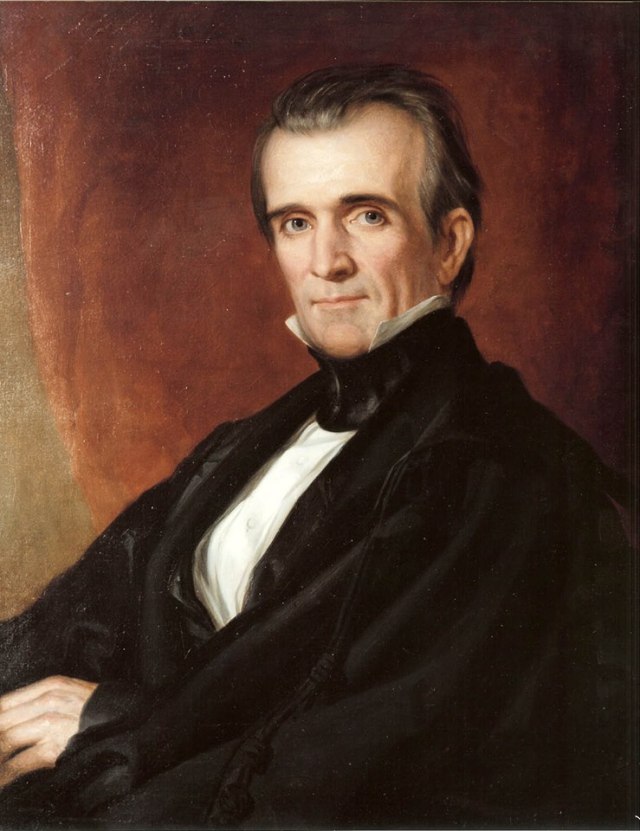
A few months ago, I mentioned a local legend concerning President James K. Polk’s squabble with a local postmaster. Tonight, I have an update about the validity of that legend.

Polk was no stranger to Lawrence County. Although he lived in Columbia, he was admitted as a practicing attorney at the Lawrence County Court of Pleas and Quarter Sessions on October 2, 1820, and over the next two decades, his vocation brought him frequently to court in Lawrenceburg.

The story goes that, when Polk was elected President of the United States in 1844, one of his first official acts as president was to fire Stephanus Busby, the postmaster of Lawrenceburg, because the two were somehow political enemies, or because Busby had somehow insulted Polk at one time.

The old legend, it is said, is particularly popular among Busby’s descendants.

As it turns out, the legend is probably true.

Polk took the oath of office as president of the United States on a stormy March 4, 1845. By April 19, just a month-and-a-half after Polk’s inauguration, Roberson D. Parish had replaced Stephanus Busby as the postmaster of Lawrenceburg, a job which Busby had held since 1839.

But there’s more.

On February 18, 1844, Polk was in Lawrenceburg for court. While he was there, he wrote a letter to two political allies in Nashville, instructing them to publish some particular speeches in the Nashville ‘Union’ as soon as possible. Nothing very unusual for a politician gearing up for a presidential race.

What was unusual about Polk’s letter on that day is that he added a postscript which said:

“P.S. There being a Whig Post master here & my hand-writing being known as well as my face, I will send this, under cover to Genl. Armstrong. J.K.P.”

This small note tucked away in Polk’s personal correspondence validates the fact that Polk was certainly distrustful of Busby, whose political leanings were apparently so passionate that Polk suspected him of losing or destroying mail to hurt Polk’s chances of election.

In fact, Polk was so suspicious of Busby that he had to get someone else to address the envelope, and he had to have it sent to a proxy recipient simply to ensure its delivery.

Having to go to such extraordinary lengths to get his mail through no doubt stuck with Polk, so we should not be surprised that a new postmaster was appointed for Lawrenceburg so quickly after Polk’s inauguration.

10410652_825883094168686_6993037299055421115_n

Posted in Uncategorized | Leave a comment

Raash Sowell: The Freed Slave Who Wasn’t Afraid of the Klan

It took a lot of guts for a black man to stand up to the Klan in the uncertain days of Reconstruction. But that’s exactly what one of Lawrence County’s newly-freed slaves did in the late 1860s.

Reverend Payton Sowell (1849-1932) was a frequent writer for the Lawrence ‘Democrat.’ His editorials were almost always reminiscent of olden times and people who had passed away or moved away. Today, Reverend Sowell’s editorials are a treasure trove of information for local historians, as they preserve stories of Lawrence County’s early days that would have otherwise disappeared with the passing of Sowell’s generation.

One such story, published in the ‘Democrat’ on January 17, 1917, recalled several tales of Raash Sowell, one of the Sowell family’s former slaves, with whom Payton maintained a lifelong friendship.

When the Klan first organized in Lawrence County, which probably happened sometime in 1866, Raash had only been a free man for a brief time, and he still lived with the Sowell family on what Payton called “the old home place.”

Still, Raash was not afraid of the Klan. He frequently told anyone who would listen, “If the Klan comes to see me, I will tell them to pull that rag from their faces and show who they are.”

One night the Klan decided to pay Raash a visit. Payton, who would have been a teenager at the time, recalled the scene at his home place. He said that “their horses seemed tall as elephants…they looked weird and frightful with high hats and faces hidden behind masks.”

The men rode up to Raash’s door and called him out. Although Payton could see that Raash was clearly afraid, Raash neither ran nor hid, but stood his ground with dignity and faced the men hidden behind their masks.

What happened next was a common Klan scare tactic. One of the riders asked Raash to bring him a bucket of water. When he did, the rider drank the entire bucket at one gulp (a similar incident recorded in Pulaski at about the same time revealed that the secret to this trick was that the rider had a rubber bucket or bladder of some sort hidden beneath his robe, and the dumping of the water into that container made it seem as though he had drunk the entire thing in one gulp).

The rider ominously said, “That is the first drink of water I have had since I was killed at the Battle of Shiloh,” in an attempt to reinforce the idea that the Klan was composed of the ghosts of Confederate soldiers killed in action during the Civil War.

Payton says that before the riders disappeared into the woods, they called Raash aside and “spoke something to him in slow, solemn tones.”

Although Raash was shaken by this encounter, and never would tell anyone what they said to him, Raash did not let his fear get the best of him, and he did not let the fools hidden behind their masks win. He rarely spoke of the Klan after that encounter, but he also didn’t run or allow them to scare him off. In fact, not long afterward, Raash “set up housekeeping on the ridge not far from Crawfish Creek” and became a landlord in his own right.

Raash’s victory was a dignified, well-lived life as a free man with a good sense of humor and a kind heart. Payton wrote that Raash always “bowed his head and gave thanks over his food before eating,” and that Raash would always come to hear Payton preach when Payton’s itinerary brought him to Pleasant Grove Church, waiting until the end of the service to approach him and say, “God bless you, Patus.”

Posted in Uncategorized | Leave a comment

Murray Ohio Scholarships

Murray Ohio not only employed thousands of people from Lawrence and surrounding counties, it also helped many local students pay for college.

In addition to the massive amount of scholarship money the company awarded to Lawrence County’s students, the company also donated money directly to the financial aid office of the University of North Alabama, which usually paid tuition for a semester for two or three students at that university.

How many of you were recipients of Murray scholarships? If you were, tell us what you are doing now!

Posted in Uncategorized | 1 Comment