School’s Out For…Epidemic?

Cancelling classes due to widespread illness is nothing new to Lawrence County.

In fact, almost a century ago, the county government ordered a lot more than the schools to close their doors in order to help combat a deadly epidemic.

In the fall of 1918, the Spanish Influenza epidemic claimed the lives of untold hundreds–possibly thousands–of Lawrence County residents. The disease is believed to have killed 3 to 5% of the world’s population (an estimated 50 to 100 million people), making it one of the worst pandemics in human history.

We will probably never know exactly how many people succumbed to the Spanish flu in Lawrence County, but we do know that entire families were stricken with it, and some lost as many as four or five loved ones within a month. It was serious enough that the county decided to impose harsh restrictions on public gatherings in an attempt to curb the disease’s spread.

On October 7, 1918, the Lawrence County Board of Health voted unanimously to adopt the following resolution:

“It is…ordered that all public schools and all private schools in the County of Lawrence be at once closed; that all public soda fountains and public drinking places be closed; that all picture shows, theatricals, and places of public amusement be closed; and that all public meetings and gatherings of the people in the County, be and the same are hereby forbidden…A strict compliance with this order must be observed, and any violation hereof will be punished as provided by law.”

This sweeping order was originally planned to be in place for just two weeks, but because the epidemic continued to rage throughout the county, the order was not officially rescinded until more than a month later, on November 11, 1918.

Included in this order, though not explicitly mentioned, were local churches, most of whom seemed to have complied with the order by cancelling their regular worship services.

Although the initial plan was to simply dock the pay of the teachers for time missed due to the Spanish flu closures, the state eventually did reimburse Lawrence County’s teachers for that month of work missed.

Posted in Uncategorized | Leave a comment

The Judgment at Gipson’s Spring

Less than a day after a local woman called down fire from God upon him, a cold-blooded bandit king took his last drink from a clear spring in Lawrence County, leaving his name behind as his only memorial.

In southwestern Lawrence County, near the old health resort community of Wayland Springs, and not far from the Wayne County line, a little tributary bursts from the earth and flows through the woods in relative tranquility. This little branch is known as Gipson’s Spring, and despite its calm demeanor, it has a tumultuous and violent history.

In the latter months of 1864, the Civil War was still in full swing in Middle Tennessee. Confederate soldiers poured through Lawrence County in those months on their way to General John B. Hood’s ill-fated gamble to liberate the city of Nashville, and the people who lived in this area continued to fend for themselves in the vacuum of law and order created by the constant movement of the two warring armies.

Lawrence and Wayne Counties were a haven for bushwhackers during the Civil War. A bushwhacker, unlike a regular soldier, had questionable allegiances and fought in unconventional ways. By war’s end, most of the gangs of bushwhackers roaming through western Lawrence County had given up all pretense of fighting for a cause and openly made war on the inhabitants, stealing and killing at their pleasure and for their own benefit.

One such gang was lead by a cruel and heartless man named Frans Gipson, who had the misfortune to meet with an old Christian soldier and accomplished prayer warrior named Judith Pettus in the last days of 1864.

That day, Gipson’s gang raided Mrs. Pettus’s home near West Point. No doubt terrified as these strange men looted her home, Judith’s three-year-old granddaughter Alice Pettus began to cry. Gipson, enraged at little Alice’s wailing, told her that if she didn’t hush, he would sling her head against the wall and bash her brains out.

Judith was incensed at such talk. She looked Gipson in the eye, no doubt moving protectively between him and Alice, and said threateningly, “I can’t reward you for speaking to a little child like that, but there is a Higher Power who can.”

We don’t know what Gipson said to that. But we do know that, according to local lore as preserved by Imogene Hagan, the next day, Gipson and his men stopped at the spring that today bears his name.

As Gipson lay at the spring to take a drink, he was killed by one of his own men. Although the reason for Gipson’s murder has been lost to us, the place where he died is named for him to this day.

And we can only speculate as to whether or not he remembered Judith Pettus’s prophetic threat to him as he breathed his last in that tranquil little spring.

Posted in Uncategorized | Leave a comment

A Family Feud

The quarrel between George Anthony and his brother-in-law Charles Nunnelly finally boiled out of control on a cool winter’s afternoon in the outskirts of Lawrenceburg.

It began some years before over a disputed tract of land, and, for reasons that have been lost to us, on that afternoon in 1905, the two men decided to go outside the city limits of Lawrenceburg and settle the argument once and for all.

Anthony was married to Nunnelly’s sister, and in 1900, they lived on a farm on the western edge of town among the city’s sparse Norweigan population.

As tempers began to flare between the brothers-in-law that afternoon, they decided to settle the matter like men. According to the subsequent article describing the event in the Nashville ‘Tennessean,’ “they accordingly chose referees, surrendered their knives, pulled off their coats and went away from town and fought for ten minutes.”

Both men knew that it was illegal to fight in town, so they carefully chose a spot that they thought was outside the jurisdiction of the law.

By the end of the fist-fight, the brothers-in-law were bruised and bloody, but Nunnelly was pinned quickly, and so he cried out first and lost the contest.

However, the two had made one serious miscalculation. They weren’t actually outside of the city limits of Lawrenceburg. After the fight was over, they were greeted by the city marshal, who arrested and fined them both for their crime.

The men did not hold grudges, it seems. The Tennessean reports that “each seemed perfectly satisfied with the settlement.”

About a year later, Anthony’s family sold almost everything they had and moved to Texas, and then eventually to Oklahoma, where Anthony and his wife are buried.

Posted in Uncategorized | Leave a comment

Jeff Davis is Coming For Your Guns?

Has the government ever conducted a mass-confiscation of guns in Tennessee?

You might be surprised to learn that the answer is yes. But what might surprise you even more is that the government responsible for this mass-confiscation was not the United States government at all.

As it turns out, President Jeff Davis, in a manner of speaking, was the one “coming after their guns” in Tennessee at the beginning of the Civil War.

During the American Civil War, most of southern Wayne County and parts of southwestern Lawrence County formed a hive of Unionist sympathy. Indeed, Wayne County harbored so many pro-Union men that a majority of the voters there voted to remain in the Union when Tennessee seceded in the spring of 1861, and hundreds of Wayne County men joined the Union army when the war began.

Why such an enclave of southern-born Union sympathizers existed in that area at that time is not an easy question to answer. It stems from a complex web of reasons including terrain, wealth, proximity to the Tennessee River, family allegiances, and even religious affiliation.

In the fall of 1861, the Tennessee General Assembly passed legislation entitled “An Act to Establish an Ordnance Bureau and For Other Purposes,” Section 18 of which required all citizens of the state to surrender their firearms to the captain of the local militia company for use of the Confederate war effort. An independent board of three local men was set up to determine the value of each firearm, and each gun owner was then supposed to be given a receipt for that value and paid by the state. If anyone were caught with a firearm that had not been turned over for confiscation, they could be fined between $25 and $50.

Confederate authorities began this confiscation process soon after the bill was passed. Thomas J. Cypert, a prolific Wayne County Unionist and later a celebrated Civil War hero, wrote of this confiscation in his book “Tried Men and True, or Union Life in Dixie.”

According to Cypert, “In my own county, we [the Unionists] at first determined to resist [the confiscation of arms], but our old men advised us against resistance, saying that such a course would bring immediate destruction on ourselves, our families, and the country. The result was that very soon the Confederates had possession of all the arms in our county of any value, and had them locked up in a room at Waynesboro, the county seat of Wayne.”

The confiscation of their arms seemed to particularly infuriate local Unionists, and it can be argued that such drastic measures by the state government helped to turn a great many moderate Unionists into Union soldiers, as it did Cypert.

Posted in Uncategorized | Leave a comment

The Northeast Corner of the Square

This photograph of Lawrenceburg from 1920 shows the north end of the Public Square, focusing on the old First National Bank building and the Gibbs-Belew building.

Notice the large number of frame residential buildings in the background. Until the mid-20th century, most of Lawrenceburg’s homes and businesses were concentrated within just a few miles of the Square.

Do you see anything in this photo that interests you?

15420938_1220494074707584_7838322662647321127_n

Posted in Uncategorized | 1 Comment

What They Found Buried Under the Shoal Creek Bridge Will Surprise You

In the waning months of 1954, the city of Lawrenceburg was busy replacing the old iron bridge on Old Waynesboro Road near the entrance to David Crockett State Park. In its place, they were erecting one of three new modern concrete bridges.

But bridge construction stopped when workers found something extraordinary buried deep in the mud of Shoal Creek that winter. In fact, no work was able to be done at all until special heavy equipment was brought in to remove what the crews found.

Lawrence County has exceptional roads for a county its size. The completion of the U.S. Highway 64 bypass last year was a major milestone in the history of the county’s infrastructure. It was also, in a way, the culmination of a sixty-year road improvement project.

The approach to Lawrenceburg from the west on U.S. Highway 64 was once a dangerous, two-lane route, full of dizzying curves and hairpin turns, much of which survives today as “Old Waynesboro Road” in the vicinity of the city’s water filtration plant. In 1953, the State Highway Department decided to straighten a mile-long segment of that highway between Glenn Springs Road and Waterloo Street.

To build a modern, straight stretch of highway between these two points required the construction of three bridges with deep concrete piers. One bridge was built on Crowson Creek, and two were built across Shoal Creek. The central of those three bridges is where workmen made a fascinating discovery.

M.E. Walker, the contractor who built those bridges, told the Lawrence County Historical Society at that time that his crews were “excavating for a pier on the west bank of Shoal Creek, between the [old] iron bridge and Hope Springs,” when they suddenly unearthed “a portion of an old dam” buried fourteen feet in the ground.

And what’s more, the remnants of that dam were made completely of wood and joined together with wooden pegs, without the benefit of a single nail.

According to Edward G. Parkes, the dam remnants were built by his great-great-uncle, William Parkes for operation of Hope Cotton Mills, which William established shortly after arriving in Lawrenceburg in the mid-1820s.

Despite roughly 130 years of exposure to the elements, the dam section was still remarkably structurally sound, and it did not yield without a fight. Walker was forced to bring special machinery to the job site in order to pry the old dam from the earth.

Posted in Uncategorized | Leave a comment

Lawrenceburg’s Oldest Buildings: The Gibbs-Belew Building

The lot was home to a timber-frame saloon and pool hall in the 1890s—one of many such seedy establishments that dotted the Square before Lawrenceburg voted to go “dry” in the early 20th century. But, after that burned, a brick building was raised that became a dry goods store and served for many years as the Lawrenceburg post office. But what other stories can a building that was probably built in the ashes of one of our greatest local manmade disasters tell us?

Perhaps more than any other element, fire has shaped the way that our Square looks today. The buildings on the Square have burned so many times that none of the structures now standing on the Square were there when the city was founded in 1819. In fact, although it is difficult to determine exactly how old some of those buildings are, there is probably not a single standing structure on the Square that wasn’t built in the 20th century.

Throughout the first century of Lawrenceburg’s existence, major fires gutted the shoddily-constructed timber frame buildings of the early Square with shocking regularity. Particularly in the era before the Civil War, brick was a luxury reserved for publicly-owned buildings and the homes of the wealthy, and the pot-bellied stoves and drafty flus that served to heat Lawrenceburg’s early frame buildings often spawned uncontrollable flames that could engulf entire blocks in a matter of a few minutes. The problem was exacerbated by a chronic lack of fire insurance and the total absence of a fire department.

In those days, the city relied on the old method of ringing church bells and shouting for the men of the city to bring their buckets and come running to drown out the flames of housefires.

That all changed in 1898.

On October 6, 1898, the worst fire in Lawrenceburg’s history leveled a huge area of downtown. The blaze burned through homes and businesses almost unchallenged as the people of the city almost-helplessly scurried about with buckets, trying to find ladders and struggling on rooftops to beat flames back with sheets and pillowcases and feed sacks.

When the smoke finally cleared, more than half of the businesses in Lawrenceburg had been destroyed and a good many houses, too. On top of that, merchants lost a great deal of their salvaged inventory to looting as it sat in the street overnight. All told, more than $75,000 in damage was done, only $9,000 of which was covered by insurance. In today’s money, that would be the equivalent of losing $2.1 million in property and carrying only $260,000 in insurance. Although there were no serious injuries suffered during the fire, the financial loss was devastating, and—as though a giant meteor had slammed into the earth at the spot—the flames had carved out a ragged, smoking cavity in the center of the city’s commercial district.

The cause of the fire, while never officially determined, was said by the Florence Times to have been an errant cigarette, tossed to the wrong place at the wrong time in the middle of that October night.

Practically all of the buildings on the northeastern corner of the Square had been reduced to ashes when the sun rose on October 7, as well as most of the buildings between the northern end of the Square and Gaines Street. The people of Lawrenceburg decided three things in the immediate aftermath of the fire: the city needed a professional fire department, cisterns must be dug to the north and the south of the courthouse, and the buildings of the Square needed to be built of brick, when at all possible.

Although we can’t be sure exactly when it was built, the old White’s Department Store, also known as the Gibbs-Belew building on the northern end of the Square in Lawrenceburg, was probably one of the first brick structures to arise from the ashes of that terrible fire. We know for sure that the old pre-fire saloon and pool hall had been destroyed by the fire—one of three such saloons lost to the flames. In an 1899 insurance map of Lawrenceburg drawn by the Sanborn Company, the lot was vacant.

We know that the current brick building was built sometime between 1899 and 1903. By late 1903, according to newspaper advertisements, a grocery store known as Gibbs and Belew’s Grocery had set up shop on the premises, and the store would soon lend its name to the name of the building, itself.

In the meantime, the city went to work with great haste to secure the equipment needed to form a volunteer fire company. Tall ladders were purchased, and local businessmen were charged with the duty of determining the cost of a mobile fire pump and a huge alarm bell to be hung over the courthouse. These preparations were the birth of the Lawrenceburg Fire Department, which is now in its 118th year.

The Gibbs-Belew building and the structures rebuilt around it would prove the wisdom of these fire preparations soon after they were made. On the night of August 10, 1904, a trash fire began on the back steps of the neighboring Simms Grocery, and spread soon to the First National Bank and then to the Gibbs-Belew building.

This fire, however, ended much differently than the one in 1898.
Soon after the flames were spotted, the fire department was alerted. In a little over two hours, the flames had been extinguished. According to the Lawrence Democrat, disaster was averted because “the pump, manned by willing hands, kept steady streams of water playing upon the fire, and paid for itself many times over…the wisdom of keeping the cistern in front of the court house filled with water was never better shown.”

Three different buildings in that corner of the Square were damaged by that fire, but none were destroyed, owing in part to their brick construction. The 1904 fire did about $3,000 worth of damage, all of which was covered by insurance. The Gibbs-Belew building suffered minor fire and water damage, but was nonetheless intact when the flames were extinguished. The paper gives special praise to the Lawrenceburg Fire Department, saying, “a serious calamity was but narrowly averted by the equipment, cool courage and promptness of our fire laddies, who deserve the thanks of our people.”

The Gibbs-Belew building suffered much more extensive damage in a fire on July 18, 1909. Early that morning, flames were seen coming through a skylight in the center of the building. At that time, Gibbs & Belew’s Grocery in the eastern half of the ground-level had recently been transformed into the Two Johns Theater.

Since the 1909 fire, the building has served a number of purposes. The second floor was office space for several local attorneys in the early-20th century. Some readers may remember it as the home of Arlo Peppers’s grocery in the mid-20th century, but practically all of us recall the not-too-distant past when it was White’s Department Store.

In November 2015, the property was purchased by Mr. Blake Grooms. The second floor and façade are currently undergoing an extensive renovation process. The ground level is home to JB tumble, a business owned by Jon and Jamie Hyatt-Brewer. Mrs. Hyatt-Brewer teaches tumble and cheer there to many young people of our area, a field in which she has 28 years of experience, including more than 17 years as an instructor.

Also fitting for this building which has risen from the ashes so many times is that Jamie’s husband Jon Brewer serves as a fireman in the Lawrenceburg Fire Department.

15027696_1181645061925819_359604712688525694_n

Posted in Uncategorized | Leave a comment

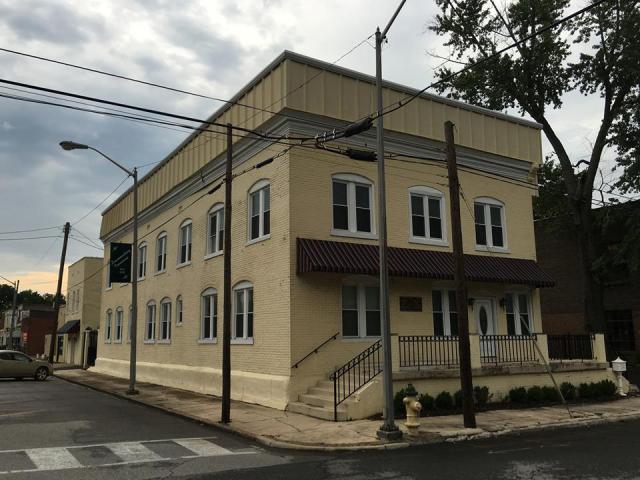
Lawrenceburg’s Oldest Buildings: The Kerr Hotel

Why did the commercial focus of Lawrenceburg suddenly shift from North Military Street to North Locust Street in the early 20th century? The history of one iconic Lawrence County building will tell us. Its story is the story of the changing role of Lawrenceburg’s downtown area, and its present state gives hope to all who long to see our main street rejuvenated.

It’s known as the old Kerr Hotel, but it might also be called the Neeley Hotel, the Lawrenceburg Hotel, the White House, the Carriage House, or the Wackerman place. We continue to call the place the Kerr Hotel today, even though it’s been years since it was a hotel, and it’s been even longer since the Kerrs owned it.

Whatever you call this historic structure, though, one fact about the property is certain: the history of this tidy, well-kept old building at the corner of Depot Street and North Military Street in Lawrenceburg will forever be linked to the railroad.

For almost a century, this lot had some of the heaviest traffic in town. When the railroad came to Lawrenceburg in 1883, the depot–where trains stopped to drop off and pick up freight and passengers–was built just north of the Square, and a new, wide street was cut from the railroad tracks to North Military Street to connect the town to the tracks. This new thoroughfare was appropriately named Depot Street.

At that time, North and South Military Streets were part of Jackson’s Military Road; a 19th-century thoroughfare connecting Nashville to New Orleans. Traffic along the route was heavy, but travel was slow, creating the need for travelers to stop frequently for the night. Fronting a major roadway at one of the busiest intersections in town, and just a block from the city’s only railroad access, the lot was a natural spot for a hotel.

Although we don’t know exactly when the first structure was built on this prime location, we know that as early as 1888, the lot contained a “two-story frame building.” And we know that a frame hotel with multiple covered porches existed in the place as early as 1896. Although no photos of that first hotel are known to exist, insurance maps from the time show us that it was shaped like an ‘H,’ with two north-south oriented rectangular wings connected by one long, central east-west corridor.

In 1896, the office of that hotel was in the front of the building, facing North Military Street. The hotel’s dining room comprised much of the back of the building, which was flanked on the outside by two cisterns. A spacious livery stable and carriage house–a structure which served as the 19th-century parking garage for the hotel’s guests–stood diagonally from the hotel on the north side of Depot Street, near the modern-day back parking lot of Coleman Memorial Methodist Church.

That frame hotel on the corner was known as the Neeley Hotel, after its owners, W.M. and S.A. Neeley. The handsome brick building that stands there today was built sometime between 1907 and 1909. According to family tradition, it was built by Joseph and Mary Mezera, who owned the lot at that time.

Perhaps it was no coincidence that the modern brick building was built around the time that Lawrenceburg got its first access to electricity. The building was wired for electricity as early as 1910, and for a time it was no doubt the most modern and luxurious hotel in town–that is, until the new 50-room Lawrenceburg Hotel was built on the Square in 1913.

Between 1909 and 1928, the property changed hands several times, and the handsome brick structure was under the management of many different local families. In 1928, the hotel was purchased by U.H. and Della Kerr of Savannah, Tennessee, who ran the hotel until 1946.

The building sheltered untold thousands of travelers and permanent residents, alike, throughout the years. It was once a prime location for formal dinners and banquets, and, according to County Historian Kathy Niedergeses, customers could pay 35 cents just to take a shower at the hotel when the it was in its prime.

Two great changes altered the course of the business in the mid-20th century. The first came in the spring of 1934, when a new route was chosen for the Jackson Highway, or what we now know as Highway 43.

This massive infrastructure project was a fascinating–and successful–endeavor to rebuild Andrew Jackson’s original Military Road as a modern, paved interstate highway between Nashville and New Orleans. There was only one problem for the people of Lawrence County: the state had decided to completely pass over the county’s historic business districts along the original Military Road in favor of a less-obstructed, more easterly course.

Despite a spirited protest by the businessmen of Lawrenceburg and Loretto to keep the highway running through the cities’ main streets–including at least one petition drive that netted over 200 signatures–the route of the massive new Jackson Highway was set for Locust Street in Lawrenceburg, and bypassed the business district of Loretto and the town of Ethridge completely. The reason? Railroad tracks.

In an effort to save money and create as unobstructed a pathway as possible for the new road, state highway officials set a course for the highway that completely avoided crossing the L&N railroad altogether.

The result was a harsh blow for downtown businesses in Lawrence County. While Military Street would continue to serve as the seat of local commerce for a few more years, that dominance rapidly and inevitably shifted to the new Jackson Highway, and the Kerr Hotel no doubt began to feel the pinch quickly after the new route opened.

The second change to visit the hotel came when the last passenger train made its final run through Lawrenceburg on December 6, 1954. Automobiles–which became more affordable and thus more prevalent at the midpoint of the 20th century–made passenger trains obsolete. Cars allowed travelers the freedom of the open road, eliminating the need for frequent stops and, consequently, shuttered many small, locally-owned hotels around America.

The Kerr Hotel was no different. It held on until the 1970s, when it permanently closed its doors as a hotel and reopened, for a time, as an antiques mall. The building continued to change hands until 1999, when it was purchased by T.J. and Sammie Hughes, who have done a great deal of improvement and restoration work on the building.

Today, the old Kerr Hotel is still in the hospitality business, although in a much different way than the structure’s builders probably would have imagined. It is the headquarters of Prime Hospitality Group, a local manufacturer of hotel furniture. The furniture built by Prime Hospitality has made its way into some of the nation’s top hotel chains, including branches of Holiday Inn, Staybridge, Hilton, Fairfield Inn, Hampton Inn, and Comfort Suites.

The rebirth of the Old Kerr Hotel into the headquarters of Prime Hospitality gives us hope that more of our beloved iconic downtown buildings might be lovingly restored and again used to help bolster the local economy.

This article is the second installment in a series about historic buildings in Lawrence County which are more than 100 years old. Please stay tuned for the next installment!

** For this article, I am especially indebted to the work of County Historian Kathy Niedergeses, whose article about the Old Kerr Hotel in the Summer 2002 issue of ‘Lawrence County Heritage’ I referenced for much of the basic information about this building’s past. Her article is available to read at both the Lawrence County Archives and the Lawrence County Public Library. **

14183814_1119733601450299_5883020091133608530_n

Posted in Uncategorized | Leave a comment

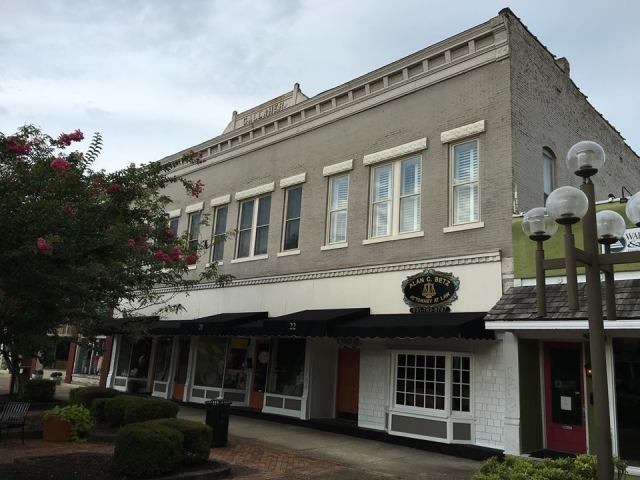
Lawrenceburg’s Oldest Buildings: The Betz-Gallaher Building

A secret society’s meeting place, a silent movie theater, a performance hall, and a pool hall all under the same roof in downtown Lawrenceburg?

That’s part of the colorful past of the Gallaher Building, on the east side of the Public Square.

Today, the Gallaher Building principally houses the law offices of White and Betz, as well as gift- and clothing-store Creative Designs Lawrenceburg. White and Betz, which has served our area for more than thirty years, is owned and operated by City Attorney and 2015 ‘Citizen of the Year’ Alan Betz.

Mr. Betz and his staff of courteous professionals offer quality legal services backed by decades of valuable experience. They have also been very kind to allow me to sell ‘Lawrence County History Trivia’ the book from their offices since its release last autumn.

The Gallaher Building occupies all of original town lot 5, which was first purchased from the city in 1832 by William H. Fields for $285.

The first Sanborn Insurance Map of Lawrenceburg, drawn in 1896, indicates that there was a frame building on the site that year, a building which contained three separate businesses: a dry goods store on the north, a gentleman’s clothing shop in the middle, and a hardware store in the southernmost partition of the building.

That frame building appears to have escaped the ravages of the Lawrenceburg Fire of 1898 (which destroyed most of the northern half of the Square), and by 1899, the gentleman’s clothing store had gone out and was replaced by a saloon. By 1905, both the dry goods store and the saloon had closed their doors. The northernmost partition was vacant that year and the center partition was a grocery and restaurant.

Sometime between 1905 and 1908, a gentleman named J. Polk Rippey is said to have operated an opera house on the property. Unfortunately for Mr. Rippey, the building burned and, according to Rippey, he “did not have a penny of insurance on it.”

The current brick Gallaher Building was built around 1910. By 1916, it was home to an eclectic variety of businesses: Tripp’s Pool Hall in the southern end, a silent movie theater known as the Jitney in the middle, and a grocery on the northern end owned by Jim Crews occupied the ground level. The second floor of the building housed the law offices of Tom Helton and W.H. “Bid” Lindsey. A large room on the second floor was also used for meetings by the local chapter of the International Order of Odd Fellows, a secretive fraternal organization that had been active in its philanthropic work in Lawrence County since before the Civil War.

The Jitney showed many classic movies of the silent era, but it also had a stage on which traveling musical acts frequently performed.

The building was named for Dr. W.M. Gallaher, a prominent local physician who owned the building in the mid-20th century and who operated the Gallaher Dry Goods Company there. Dr. Gallaher was a philanthropist and civic leader who practiced medicine in this area for 65 years and remained active in civil and religious causes until his death.

In more recent local history, the Gallaher Building–specifically the office of Mr. Betz–was featured in the author photos of ‘Teaching the Pig to Dance,’ Senator Fred Thompson’s book about growing up in Lawrenceburg.

The Gallaher Building–along with the rest of downtown Lawrenceburg’s Historic Commercial District–was listed on the National Register of Historic Places on April 14, 1992.

This segment is the first in a series which will focus on buildings in our county which are more than 100 years old. Stay tuned for the next installment.

14021443_1107081286048864_8987026052558479427_n

Posted in Uncategorized | Leave a comment

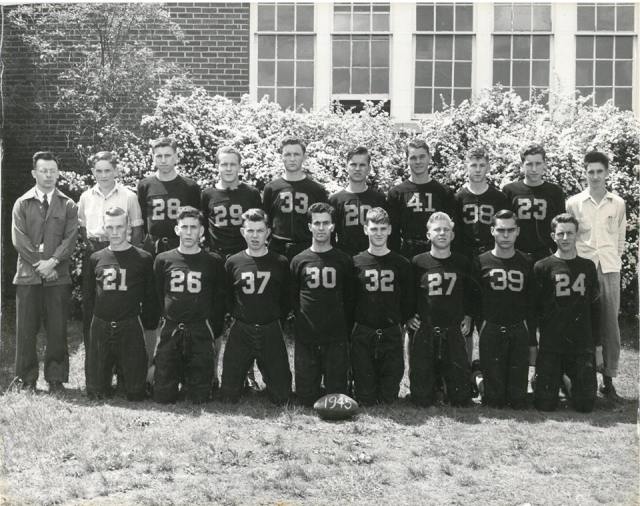
Loretto High School Football Team of 1945

Thanks to the Lawrence County Public Library for sharing this photo with us! It shows the 1945 Loretto High School football team. Do you see anyone that you recognize?

Coach John Pechonick,
Managers Billy Drew Whitfield (on left) and Jack Forsythe (on right).

#28 Roy Shannon
#29 C.H. Adams
#33 James Doyle Newman or James Allen Thornton
#20 Jody Hill
#41 Clyde Canerday
#38 Max Methvin
#23 Bill Beckman
#21 ?? Gallion
#26 Aubrey Hess
#37 Jack Phillips
#30 Bill Grisham
#32 Ray Methvin
#27 J.T. Brewer
#39 Allen Lipscomb
#24 Elmer Cooke13507132_1058161987607461_3408766869391181469_n

Posted in Uncategorized | Leave a comment