Cold Weather Blues

If the cold weather has got you down, just remember that it could be worse!

Lawrenceburg’s single-day snowfall record was set on January 1, 1964, when a new year’s blizzard dumped 16 inches of snow on the area.

On another night, in January 1893, the Lawrence ‘Democrat’ reported that the mercury in Lawrence County dipped to a bone-chilling -8 degrees!

Do you have any cold weather stories you’d like to share? Type them in the comments!

Posted in Uncategorized | Leave a comment

Bicentennial Day

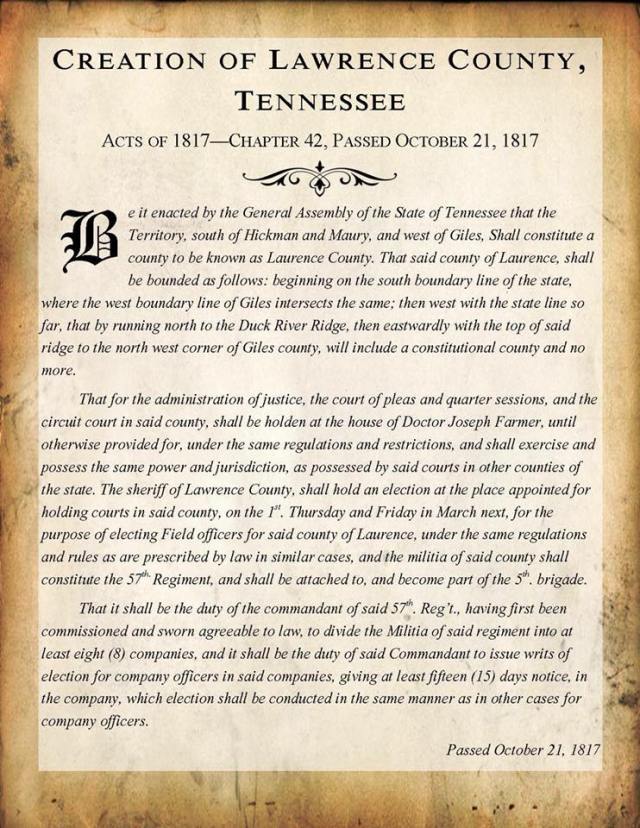
Happy 200th birthday, Lawrence County!

On this day 200 years ago, the General Assembly of Tennessee voted to create Lawrence County from lands newly acquired from the Chickasaw Indians, and from portions of surrounding counties.

A wild and rugged place, it would be almost sixty years before the County was home to more than 10,000 souls.

22688388_1524839400939715_6587887000276314393_n

Posted in Uncategorized | Leave a comment

The Statue That Almost Wasn’t

In our last post, we explored the exceptional nature of Lawrenceburg’s statue of David Crockett compared to the counties around us. Today, in order to provide some local historical context to the ongoing debate about Confederate statues, I would like to examine the story of how one of those neighboring counties spent more than thirty years working to erect a monument in memory of its Confederate veterans.

The following essay was written by Lee Allen Freeman, a loyal fan of Lawrence County History Trivia and venerated local historian of Lauderdale County, Alabama. Lee is the head of the Local History and Genealogy Department of the Florence-Lauderdale Public Library, and has spent many years studying the history of our area. I am pleased to share his essay as a guest post.

“The Monument that Almost Wasn’t: Lauderdale County’s Confederate Monument.”

By Lee Freeman

All Florentines have seen him, standing sentinel in front of the courthouse in Florence. Perhaps you’ve wondered who he is and how long he’s been standing there. Or, like me, perhaps you’ve been to the courthouse so often that you’ve simply taken his presence for granted and no longer stop to consciously think about him. I’m referring of course to the Confederate monument which stands outside our courthouse, which commemorates the men from Florence-Lauderdale who died fighting for the Confederate cause in the Civil War.

With everything going on lately I thought it might be beneficial to consider the history of our Confederate monument. Perhaps a better understanding of the history of the monument and the ladies who raised the money to build it, will be helpful. In what follows I have tried to be non-partisan, only setting forth the history of the monument. What follows should not be taken as an endorsement of either slavery or the Confederate States of America. To paraphrase a comment made several years ago by Virginia Civil War historian Dr. Ervin L. Jordan, the job of the historian is neither to praise or condemn, but to explain.

The Ladies Memorial Association, composed of “noble women, many of them with broken hearts,” who “still cherished the memory of the Southern cause as sacred, and honored those who gave their lives in defense of the principles of this beautiful Southland,” was founded, with Mrs. Fannie Louisa Pickett (1817-1907), wife of former Confederate Col. Richard Orrick Pickett (1823-1898) as president, in 1869. Mrs. Pickett served two years, until she was succeeded by Mrs. Ophelia Cutler Smith (1835-1906), wife of former Confederate Cutler Smith (1837-1905). “Before the organization of a memorial association these devoted women, under the leadership of Mrs. Cassity, cared for the graves of their heroes.” The late Dr. Larry Nelson of the University of North Alabama in his July, 1988 Alabama Review article insists that the Ladies Memorial of Association was only officially organized in 1876.

By 1876 plans were afoot by the Ladies Memorial Association for a Confederate monument “to be erected on the square just north of the Court house and barber shop.” A conscious choice was made to erect the monument in that year, which also happened to be the United States’ centennial. To that end a fundraiser was held which netted $140 ($100 of that total being donated by a Tuscumbia resident). By 1878 the Association had decided to parcel out the monument’s base in blocks to be inscribed at $5 apiece.

In 1879 Capt. James Bowser, who owned a quarry “six miles below our [Florence] landing,” was contracted to supply about 60,000 lbs of stone with which to build an impressive monument and had actually set up “a derrick which is used in moving the stones that are being polished for the Confederate monument.” By 1881 only $650 had been raised with which to build the monument (which must have been intended to be a pretty huge monument if they needed 60,000 lbs of stone) however most of these funds had “run low and the work was suspended.” At a citizens’ meeting held in April of 1881, Col. Edward A. O’Neal, future governor of Alabama (1882-1886), offered a resolution which was unanimously adopted that transferred the unfinished monument, all of its remaining funds and all related matters to local contractor, undertaker and Florence mayor Zebulon Pike “Uncle Pike” Morrison (1880-1890). Unfortunately by 1889, no substantive additions had been made by the city to the statue, which was still essentially just the base, what the Florence Gazette described on April 28, 1883 as a “granite pile.”

The Florence Gazette considered the uncompleted monument “neither pleasant to the eye nor creditable to the patriotism of our people.” The Gazette agreed that times were “very hard” and that “we are all very poor; but it is due to the memory of the gallant dead, as well as to ourselves, that some steps be taken” to complete the monument.
Six years later when still no progress had been made, the Florence Wave (forerunner of the Florence Herald) sarcastically editorialized in March of 1889 that “the base of the proposed monument to the confederate [sic] dead of Lauderdale County, standing on the Court House square is a complete monument to the supineness of our people.” [Italics in original]
Undaunted by the seeming indifference, fundraising by the Ladies Association continued and a further $1,000 was raised by 1890. By 1890 however “in the general cataclysm in business, in which nearly all our banks went to the wall,” this money was lost and the ladies had to start their fund-raising efforts all over again. (The 1890 bank failures followed Florence’s 1887-1889 intense yet brief industrial boom, which saw the population increase from 2,000 in 1887 to 6,000 people by 1889.)

By 1894 still only the pedestal or base of the statue had been finished, the monument sitting “unfinished on Court square, next to the treasurer’s office,” and by then a debate had erupted over where it should be located, at its current location on Court Square, “at the intersection of Court and Tennessee streets, in the centre [sic] of the street” or in Monumental Park, site of a Confederate fort in 1862, now the site of the Florence-Lauderdale Coliseum. Monumental Park was originally designed to be a park containing a monument or monuments to the fallen Confederate soldiers of Florence, and though the space shows up on several decades of old city maps labelled “Monumental Park” the park was apparently never actually built.

The Ladies Memorial Association stated that it favored the Court Square location for its monument and would, “by representatives, go before the city council next Monday night to ask the consent of that body to have it placed there.” However by 1897 the statue had still not been completed and the issue of its location had still not been resolved; by this time many people were again arguing that it should be placed in the City Cemetery. In April of 1899 the Florence Times sarcastically noted of the unfinished monument that “all strangers in the city . . . enquire about it,—and the necessary answer is a humiliating one to all who have any pride in the city. Cannot the Ladie’s [sic] Monument Association hurry up with their movement to finish the memorial?”

By April of 1899 a chapter of the United Daughters of the Confederacy had been founded in Florence and the daughters soon became involved with the efforts to complete the monument. Significantly, one Cincinnati businessman with a company in Florence donated a large sum of money to assist with the monument’s completion and a few Union veterans from Florence also made donations.

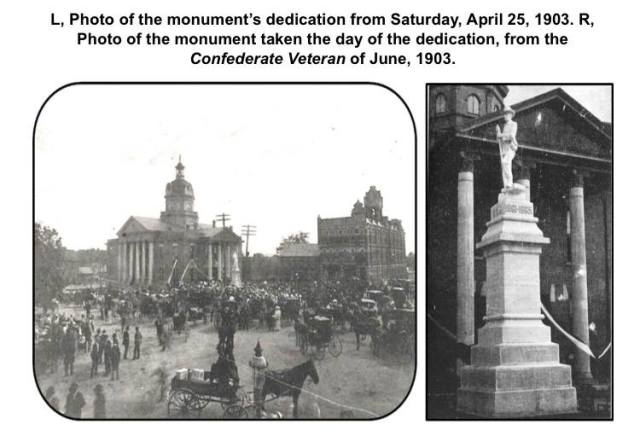
Finally, by April of 1903, after nearly 30 years, the statue had been completed, apparently without any county or city funds whatsoever. According to the Florence Times the statue stood proudly

Upon the public square about 30 feet north of the Courthouse corner. It faces east on Court street, as if a constant reminder to the travelers of that busy thoroughfare that though prosperity may lift our city into high eminence, though commercial activity may drive us with a tyrant hand and the footsteps of our historic past may be blotted out by modern development, and though the generation of witnesses to the valorous deeds of our heroes may pass away—yet the recollection of their virtues, their patriotism and their brave devotion to duty, will ever dwell in the hearts of the people.

According to information recorded by Mrs. Amelia Camper (1855-1930), wife of Florence Times founder and Confederate veteran Moncure W. Camper, herself president of the Ladies Memorial Association in 1904, the monument itself consisted of a shaft of stone nearly 16 feet tall, surmounted by the 7 feet tall figure of a Confederate soldier, a lowly private, returning from the war, who has lowered his rifle, held in his left hand, while with his right he returns his bayonet, and has thrown down his knapsack, resting one foot on it. According to Mrs. Camper’s 1904 article the statues pose was deliberately chosen to suggest the return of peace.

Beneath the private on the sides of the pedestal was an inscription, which reads: “C. S. A. 1861-1865. Deo Vindice [Latin for ‘God will prove us right.’].” Another inscription on the shaft reads: “In memory of the Confederate Dead from Lauderdale County, Florence, Alabama. Unveiled with appropriate ceremonies April 25th, 1903. . . . Glory Stands Beside Our Grief. . . The Manner of their Death was the Crowning Glory of their Lives.”

The statue was carved in Carrera, Italy (though we don’t know the name of the sculptor), and “after many delays” was finally delivered to Court Square on Wednesday, April 15 at about 9 am. The monument was officially dedicated on Saturday, April 25, 1903 Confederate Memorial Day, the day set aside to honor the Confederate dead, in an impressive ceremony at which an estimated 3,000-5,000 people were present, most likely including many local African-Americans which probably included a few local black Union and Confederate veterans. A procession traveled from the Female Synodical College (since 1913 the site of the John McKinley Federal Post Office and Courthouse), led by Maj. Alfred Moore O’Neal (1840-1909), a Confederate veteran, son of the late veteran and governor Edward Asbury O’Neal (1819-1890), and Commander of Camp Edward A. O’Neal, Sons of Confederate Veterans (SCV).

At the square “a platform had been erected for the most prominent actors in the proceedings, while seats were provided for as many of the visitors as could be accommodated.” The program began with a prayer by Confederate veteran Rev. AP Odom (1843-1916) followed by a chorus of children led by City School Superintendent HC Gilbert (1857-1944) who sang “America.” A speech was given by Massachusetts native, former Florentine and Confederate veteran Dr. HA Moody (1842-1916), a physician and professor at the State Medical College in Mobile, AL (formerly the physician at the Bailey Springs Resort). A song was then rendered by Florence’s Cornet Band. To close the ceremony Methodist minister the Rev. Mitchell Malone (1842-1927), a Confederate veteran and also county tax assessor offered a benediction. The United Daughters of the Confederacy (UDC) awarded Crosses of Honor to all the eligible Confederate veterans who were present.

In his address, Dr. Moody eulogized the “Lost Cause” of the Confederacy and praised the virtue and bravery of the men who sacrificed their lives for that “sacred” cause.

The monument itself was officially unveiled by 13 boys and girls, dressed in white with red ribbons, each a descendant of a Confederate veteran, at which time 400 school children broke out in song singing “Dixie.” The assembled veterans (about 100 were present) then let loose with the rebel yell.

After the dedication ceremony, in a touching symbolic gesture at the Florence City Cemetery during the Confederate memorial exercises, three Confederate veterans and three Union veterans shook hands over the grave of a fallen soldier (There was much pro-Union sentiment in Lauderdale during the war and between 1889 and 1905 Florence would have two different Grand Army of the Republic Posts for Union vets and these Union veterans were always invited to take part in Confederate Memorial exercises.)

When Florence’s third courthouse was built in 1965 it was built one block south of the site of the first two courthouses and the statue was moved from its original location after the third courthouse was completed.

And that’s the story of Florence’s Confederate monument, a monument which almost wasn’t.
 

21078348_1474586689298320_3568386843681881063_n

Posted in Uncategorized | Leave a comment

Lawrenceburg’s Exceptional Statue

With everything in the press about statues and monuments lately, you may have caught yourself wondering, “Why doesn’t Lawrenceburg have a statue of a Confederate soldier on the courthouse square like most of the other counties in Tennessee?”

The answer reveals something about our county’s unique history.

By some estimates, there are more than 1,500 statues in the United States which commemorate the Confederacy or the men of the Confederate armed forces. It is very common to see these marble Johnny Rebs eternally standing guard, muskets at parade rest, their stony eyes gazing southward in front of courthouses in county seats across the former Confederate States.

Most of these statues were erected during the monument-building craze which swept the nation some thirty or forty years after the Civil War, with funds largely raised by the children and grandchildren of Confederate veterans seeking to honor the service of their forebears.

Lawrence County certainly sent its share of young men to fight for Confederate independence, and many of those young men made the ultimate sacrifice in the service of the Confederacy. So why isn’t there a marble Johnny Reb on our Public Square today like there is in Florence, Pulaski, Franklin, or any number of nearby county seats?

When the monument-building craze began, it happened to coincide with another craze which swept Lawrence County in the late nineteenth century: Crockett Fever, which was no doubt fed by the arrival of what would have been the pioneer’s 100th birthday in 1886.

Lawrence County has a long history of emphasizing its ties with the king of the wild frontier. Our first countywide celebration of Crockett’s birthday happened in 1890, and it drew a crowd of about 5,000 people to Lawrenceburg, which at the time was a city of only about 600 souls.

At that time, a local group known as the David Crockett Memorial Association laid the cornerstone for a monument to Crockett in what is today the Rosemont section of Lawrenceburg. Although that part of town was largely woods and pastureland in 1890, the owners of the Lawrenceburg Land Company envisioned the neighborhood as a pleasantly grand addition to the city, with the monument to Crockett serving as the focal point of a small city park to be known as “David Crockett Park” (not to be confused with the state park of the same name, which stands on the other side of the city today).

Unfortunately for the Land Company, their plans ran aground in a stormy sea of lawsuits and the vision they had for Rosemont never materialized. We don’t know what became of that cornerstone, either, but we do know that it contained a small tin time capsule into which were placed issues of local newspapers.

The plans for that original monument to Crockett were much grander than the statue that we now have of him. It was to be “carved in Italy from pure white marble and shipped to Lawrenceburg in time to be unveiled at the Annual Celebration of Crockett’s birthday in 1891.”

Despite these high hopes, the idea of a marble statue to David Crockett in Lawrenceburg never materialized, and the idea of an annual celebration of Crockett’s birth didn’t take off until David Crockett State Park began hosting Crockett Days in the 1980s.

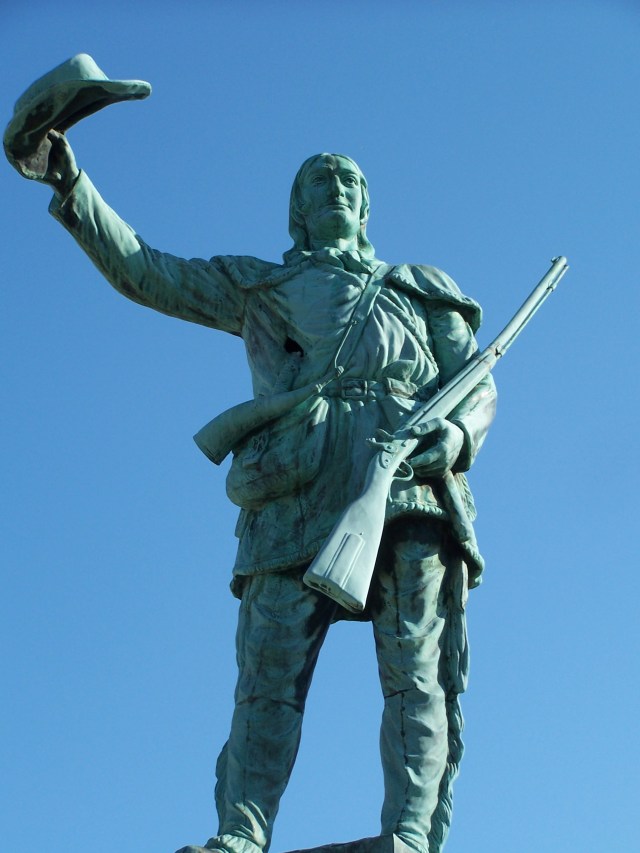
Although we don’t know why that first statue proposal fizzled, we do know that the idea of memorializing Crockett persisted. On November 7, 1921, a mass meeting was held in Lawrenceburg for the purpose of raising money for a new bronze statue of Crockett, to be placed on the southern side of the courthouse.

Work began on this project in earnest. The W.M. Dean Marble Company of Columbia created the bronze statue for the cost of about $3,000. Today, that amount would be almost $44,000.

Finally, after many years of waiting and several stops and starts, the statue of Crockett that stands on the southern end of our Public Square was unveiled with great fanfare on September 14, 1922.

So it was that, while Lawrence County was without a doubt just as proud of its Confederate veterans and their service as surrounding counties were, Lawrenceburg’s connection to David Crockett superseded its desire to raise a memorial for the Civil War. And this was despite the formation of the county’s chapter of the United Confederate Veterans in 1891, and the organization of Lawrence County’s first Sons of Confederate Veterans camp in Lawrenceburg in 1904. Such organizations usually took the lead in the construction of such monuments.

As a result of that unique connection we have to Crockett’s life and rise to prominence, Lawrence County is home to one of the oldest and only full-body statues of David Crockett in the country instead of the standard marble Confederate soldier that became so common throughout the South at that time.


Davy Crockett statue

Posted in Uncategorized | Leave a comment

Open Windows at the Courthouse

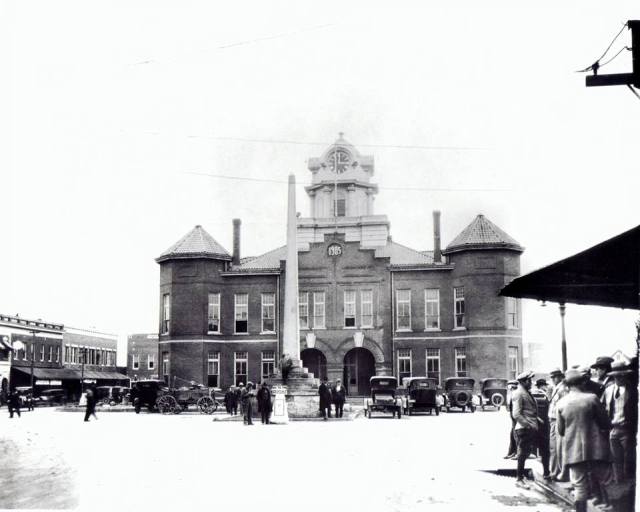
Thanks to The Lawrenceburg Community Theatre for sharing this early image of the 1905 Courthouse in Lawrenceburg. The fact that so many of the courthouse windows are open and so many folks are crammed under the shade of the nearby awning makes it seem as though it was probably almost as hot that day as it is in Lawrence County today. #LawCo200


20294108_1631608756849111_393176989067609146_n

Posted in Uncategorized | Leave a comment

Lawmen of Lawrence County: Chief Arthur M. Smallwood

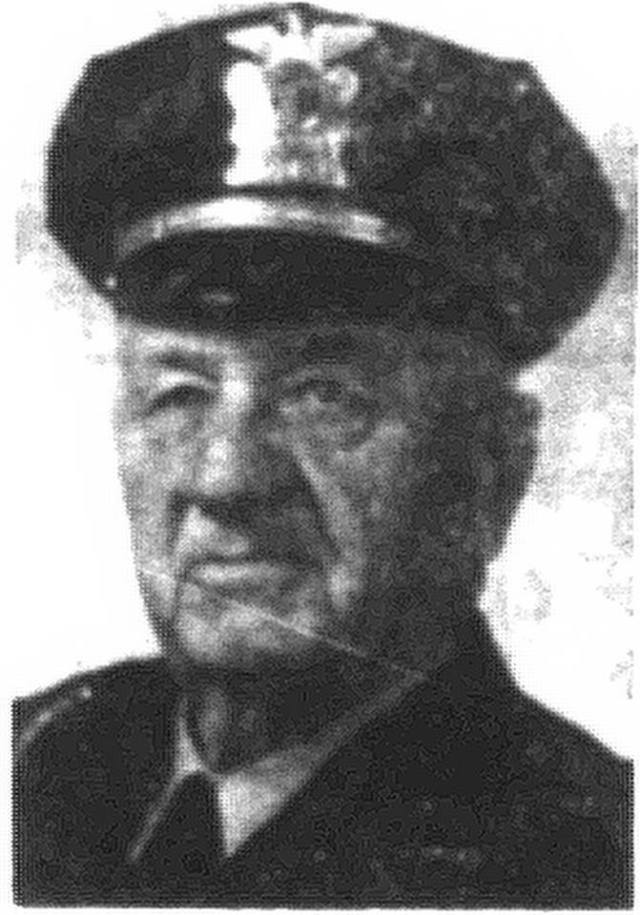
A.M. Smallwood (1888-1958) was a career law enforcement officer who, during his fifty-one-year career, served as deputy sheriff, sheriff of Lawrence County, Federal prohibition officer, and chief of police of the city of Lawrenceburg.

Perhaps no law enforcement career in Lawrence County saw more change that did that of Chief Smallwood. When he began his career in 1906 as deputy sheriff under his father, Sheriff John T. Smallwood, the Lawrence County Sheriff’s Department hired only a handful of deputies to protect and serve its population of about 17,000 souls.

At that time, most of Lawrence County still traveled by horseback, and electricity was still a thing of the future for almost all of the county’s residents. But when Chief Smallwood retired more than five decades later, not only did almost every family in the county own or have access to at least one automobile, but the county’s population had skyrocketed by 65%, and what would become one of the largest bicycle plants in the world had just been built on the northern end of Lawrenceburg.

Perhaps no change was bigger for Smallwood and lawmen of his generation than the rise and fall of Prohibition. After serving as sheriff of Lawrence County from 1914 to 1918, Smallwood joined the Alcohol Tax Division of the Internal Revenue Department, where he enforced prohibition by tracking down moonshiners, arresting them, and destroying their stills.

During his twenty-five years as a revenuer, Chief Smallwood had no shortage of adventures, many of which made the Nashville papers. During one raid in 1931, Smallwood and his agents were waiting at a still near the Rutherford County line when its owners drove up a long, narrow country lane. When the moonshiners saw that their operation had been compromised, they threw the car into reverse and sped backward down the lane, crashing into and uprooting a cedar tree. Smallwood sprinted alongside the car until it crashed, apprehending the driver and two gallons of illegal liquor from within the car.

Closer to home, on Bluewater Creek in southern Lawrence County in the summer of 1922, Smallwood participated in a raid that could have very well cost him his life. After crawling for some distance toward a still with a posse of men, Smallwood and fellow-agent A.L. Binkley jumped to their feet and shouted for the still’s operators to throw up their hands.

Seventeen-year-old Clyde Clifton struck Smallwood on the head with a shovel. Luckily, Smallwood was not seriously injured by the blow, and was able to take part in the ensuing gun battle. Clifton was not so lucky. While his brother Henry was arrested without injury, a bullet passed through Clyde’s stomach, and he later died of his wounds at the hospital in Columbia.

In August 1931, while about to conduct a raid with a posse in tow, Smallwood was flagged down by three men stranded on the roadside near Centerville. The men were struggling to repair a ruptured inner tube and needed help. They almost immediately regretted flagging down Smallwood’s car. Smallwood quickly noticed that the men had two half-gallon jugs and half a pint of liquor in the back seat of the car, and he immediately arrested them and impounded their vehicle.

Chief Smallwood was a legend in his own right, and helped to shape law and order in Lawrence County and throughout Middle Tennessee in a very formative time in our county’s history. He passed away in 1958 and is buried in Mimosa Cemetery in Lawrenceburg.

Special thanks to his descendants Buddy and Jim Looney for sharing his story with me.

19702158_1429952950428361_1912895570406534447_n

Posted in Uncategorized | 1 Comment

Lawmen of Lawrence County: Constable Dan Smith

Constable Dan Smith was a young man of 27 with a wife and three children in 1925. He had developed a reputation in the southern end of Lawrence County as a prolific finder and destroyer of moonshine stills.

The illegal whiskey business has always existed in Lawrence County, but it became a bustling trade in the years after the passage of the 18th Amendment. Prohibition created a high demand for illegal liquor.

Poor farmers with no scruples about the evils of alcohol and a desire to make a quick buck soon found that their corn crop was worth a great deal more as hooch than it was as corn, and so the county began flowing with moonshine.

One such local moonshiner was Dave Styles. A semi-literate, 51-year-old farmer with a large family and a place on Center Point Road, Styles was one of the few moonshiners in the area who hadn’t yet been visited by Constable Smith in the summer of 1925. And Styles intended to keep it that way.

“If Smith ever comes on my land,” Styles allegedly boasted to a friend, “I’m going to kill him.”

But Styles, if Federal authorities were to be believed, was not just a lone wolf moonshiner looking to make a small profit. Neighbors believed that he was the head of a local moonshine ring which included nearly half-a-dozen men clandestinely making and transporting whiskey in the community’s hills and hollows.

The situation came to a head when Styles gave a severe cursing to an associate named Hubert Brown. Brown, resenting Styles’s insults, quickly betrayed Styles to Constable Smith, telling him exactly where Styles kept his moonshine still.

The next day, Constable Smith and deputies J.E. Keeter and Dan Hardeman set out for the Styles place with axes and long-arms in tow. At about 10 a.m., while the three men were pushing their way through a dense cornfield toward the copse of woods where the still was hidden, a shot rang out, and Smith fell wounded.

Keeter and Hardeman hit the ground, the three lawmen hidden well within the dense cornstalks. With all the speed they could muster, the two deputies reached the constable, and they quickly realized there was nothing they could do. With his final breath, Smith said, “I guess Styles got me after all.” The two deputies later testified that they followed a set of wet footprints from the cornfield to Styles’ home, where they found a shotgun leaned against the wall. The gauge of Styles’s shells would prove to be the same gauge that killed Smith.

That night, the people of Center Point decided they had had enough of Styles and his friends running liquor through their community. A lynch mob of about 75 armed and angry people arrived at Styles’s house by night to mete out their own brand of harsh justice on him for the murder of Constable Smith.

The sheriff, however, was two steps ahead of the lynch mob. He had arrived at Styles’ home just an hour before and arrested Styles and his son for the murder of Constable Smith. Whether it was by coincidence or by shrewd instinct, this quick thinking no doubt saved Styles from a violent and humiliating death at the hands of his neighbors that night.

Styles remained in jail until his trial the following February. Meanwhile, Lawrence County did what it is still well-known for doing in times of crisis: it went to work to care for Constable Smith’s family, whom the ‘Lawrence News’ claimed were left with only $9 to their name.

That newspaper immediately set up a fund for the relief of Smith’s wife and children. It was later claimed by Styles’s defense attorney that, as Smith had been a member of the Ku Klux Klan, that organization also did a great deal to help the Smiths financially, including allegedly paying for his funeral and offering to pay the fees of the prosecuting attorneys.

This became an important point of contention in Styles’s trial. At the behest of the defense, for one of the first times in Tennessee history, potential jurors were vetted in part on their willingness to take an oath that they were not and never had been in the Ku Klux Klan.

Whether Smith actually was in the Klan or not cannot be said with certainty. There is no doubt that some klansmen probably contributed to his funeral expenses, as many of the leading and most wealthy citizens of the region at that time were also leading klansmen. However, the looming specter of Klan involvement made the trial that much more of a sensation in the Nashville papers.

At his first trial for the murder of Constable Smith, Styles was found guilty of second-degree murder. Some years later, the Tennessee Supreme Court threw out the verdict due to inconsistencies in evidence collection.

Styles, as much as I have been able to find, seems to have left Tennessee for South Carolina, where he died in his 90s. Constable Smith was buried at Bethel Cemetery on Revilo Road, where his grave remains unmarked to this day.

Posted in Uncategorized | Leave a comment

The Old Rebels

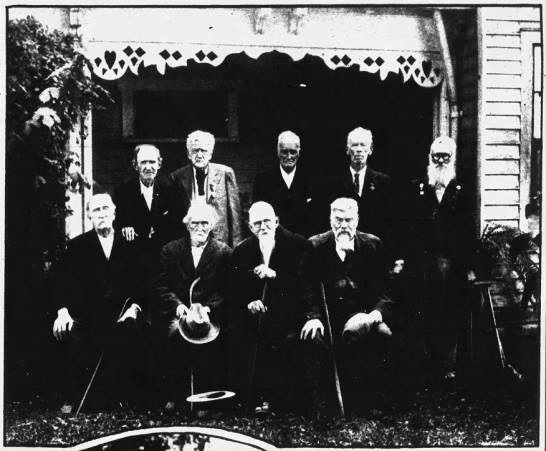
More than sixty years after the guns went silent and the flags were furled at the end of the Civil War, Lawrence County’s aging Confederate veterans continued to gather as often as they could to relive the military exploits of their youth.

This photo shows a group of unnamed Lawrence County Confederate veterans during a reunion in Lawrenceburg in 1929.

When the first Confederate veterans gatherings began in Lawrence County in the 1890s, it was not uncommon for the entire community to turn out in order to eat with and honor the old veterans, who would, in turn, usually bring some small relic of their wartime service to show off to the crowd.

As can be seen here, not many of the old Rebels were able to attend the 1929 Lawrence County reunion.

17884088_1341161732640817_4448611651434852750_n

Posted in Uncategorized | Leave a comment

The Great Ethridge Gunfight

The city of Ethridge may be a quiet place today, but more than eighty years ago this month, it saw one of the most exciting peacetime gunfights in Lawrence County’s history.

It all began with an armed robbery, in broad daylight.

On March 12, 1935, at just past 2:30 in the afternoon, two men walked into the Farmers and Merchants Bank of Ethridge, pulled the shades closed, and drew guns on the cashier. Within minutes, the criminals had absconded with over $2,000 in cash from the bank’s cash drawer.

Harold Kellogg was the only cashier at the bank that afternoon. His coworker, Cleve Massey, was nearby helping O.I. North prepare his income taxes. Mr. North was the owner of the North Funeral Home, which survives today as the Neal Funeral Home on North Military Street in Lawrenceburg.

The postmaster of Ethridge, Harry Cunningham, saw the pair enter the bank and rushed to fetch Massey at Mr. North’s home. After he raised the alarm that the bank was being robbed, Cunningham and Massey went to a nearby store and grabbed two firearms while the thieves leapt into a waiting green Chevrolet sedan, attended by two more bandits.

Cunningham, armed with a shotgun, and Massey, armed with a .32 pistol, opened fire on the getaway car as it sped eastward, toward the Jackson Highway. They were joined by Eugene Cunningham, the father of the postmaster, who opened fire on the vehicle with his own weapon. One of the men scored a hit, shattering the back glass of the car and wounding one of the robbers, who visibly slumped over. Cunningham and Massey also believed that they had punctured at least one of the vehicle’s tires. The criminals returned fire, but did not injure anyone.

Tom Fite, a postal clerk at the Ethridge post office, approached the car during the robbery to get a good look at it. The driver pulled his gun on Fite and held him hostage inside the car until the other bandits had fled the bank.

Although deputies gave chase, the robbers gave them the slip. The car was abandoned at Rattlesnake Falls and discovered the next day. As it turned out, the car had been stolen in Kentucky and was outfitted with Mississippi plates.

Unfortunately for them, the robbers did not learn their lesson at Ethridge. Two of them were captured when they tried to conduct a similar daylight robbery in Jonesboro, Arkansas. The other two were captured on the same day almost a year later, one in Reno, Nevada and one in Poplar Bluff, Missouri. The four men were all tried and sentenced to lengthy prison sentences for their role in the Ethridge bank robbery. None of the robbers, as it turned out, were locals.

Posted in Uncategorized | Leave a comment

The Tragic Death of William Rowland

Before he was executed by firing squad, one Lawrence County man took a last long drink of water–from his own grave.

William Carroll Rowland was a simple man who lived a relatively quiet life. Illiterate and poor even by the standards of a community of poor farmers, in the years before the Civil War, he lived in a ramshackle dogtrot cabin on Granddaddy Road with his wife and four children.

Rowland was no great supporter of the Confederacy. Payton Sowell, writing in the ‘Lawrence Democrat’ almost six decades after the Civil War, said that the impoverished farmer was opposed to secession, but that he feared to make his sympathies known, so he determined instead to join the Confederate army, which he did in November 1861.

After he enlisted, Rowland turned to a crowd of onlookers and said resignedly, “Take care of my family.”

Unfortunately for Rowland, enlisting in the Confederate army was the first in a series of poor choices that lead to his ultimate demise; a demise which would be sanctioned by six Confederate generals and the Confederate War Department.

At some point over the next winter–probably after the Confederate defeat at Forts Henry and Donelson–Rowland deserted his unit in the 54th Tennessee Infantry and, as the remarks on his muster role say, “joined Lincoln’s army.”

Desertion was a capital offense in both armies during the Civil War. If a soldier were caught after deserting, he could be–and often was–executed by his own men.

On the first day of the Battle of Shiloh, Rowland, who was now fully a Union soldier, was captured and taken prisoner with a group of other Union soldiers. When he was recognized, the wheels of military justice turned swiftly.

General Order Number 12 of the Confederate Army of the Mississippi was the death warrant of Carroll Rowland. He was sentenced to death at 4:00 p.m. on April 12, 1862 at Corinth, Mississippi. As can be seen here, the order was approved by Confederate generals Polk, Bragg, Hardee, Breckinridge, and Slaughter, as well as one illegible name and the Confederate War Department.

Payton Sowell recalls in his 1919 ‘Democrat’ article that Rowland’s grave was dug on the night of the 11th, and that by the next morning, it was partially full of water due to the high water table of the area.

As Rowland sat upon his coffin, awaiting his execution and no doubt thinking of the wife and large family he was leaving behind in that dogtrot cabin on Granddaddy Road, the burial detail began to scoop the water out of his grave.

It was then, as he watched the water being pulled from the fresh earth, that Rowland asked if he might have a drink from it. One of the burial detail obliged, and so it came to be that Carroll Rowland of Granddaddy Road awaited his death on that spring day in 1862 by drinking water from his own grave.

Rowland was executed by firing squad and buried that day as the Tennessee regiments watched. His wife Eliza, widowed at the age of 26, was left with four children, three of whom were 5 years old or younger.

Rowland’s old cabin is most assuredly long-gone by now. Payton Sowell estimated that it probably stood about six miles from the city limits of Lawrenceburg, and that in 1919, the wooded and rugged place had been cleared and was growing thick with cotton and corn.

17022089_1296732810417043_6980079478126199312_n

Posted in Uncategorized | Leave a comment