The Blizzard of ’93 Strikes Lawrence County

Thirty years ago today–March 12, 1993–it began to snow in Lawrence County and across most of the eastern United States. When the day ended on March 14, hurricane-force winds had dumped record amounts of snow across the country.

The Blizzard of ’93, as the storm is called, cost the United States 33 lives, more than $8.7 billion in damage, and left millions without power. Mount Le Conte, Tennessee saw a baffling 56 inches of snow.

Although the worst of the storm was south, east, and northeast of Lawrence County, the NOAA Regional Climate Center estimates that Lawrence County saw between three and six inches of snow that weekend, and some local people went without electricity for several days.

As the snow began to fall on March 12, an unusual meeting began at the Lawrence County Courthouse. About 20 Amish men showed up to share their concerns about proposed legislation with the county commission’s safety committee and Lawrence County’s state representative. The proposed bill would have required strobe lights to be placed on alhorse-drawnl vehicles in Tennessee.

The purpose of the bill was to make the buggies more visible at night to motorists, but the men who gathered at the courthouse while the snow continued to fall outside saw the proposal as a threat to their religious liberties. The Old Order Amish of Lawrence County use no gas or electric-powered vehicles and travel exclusively by horse.

As Amish Bishop Eli Stuzman told the committee that night, “We are trying to follow what our forefathers have taught us. We ain’t going to put them on our buggies. We’ll take jail before we pay any fine.” Another Amish man who was present for the meeting reiterated Stuzman’s sentiment when he said that he would “rot in jail” before he placed a strobe light on his buggy.

The committee had considered postponing its meeting due to the developing weather situation, but they had no way of quickly notifying the Amish men who had planned to attend, none of whom had access to television or radio.

In Lawrence County, the Blizzard of ’93 is sometimes confused with the Ice Storm of 1994 which occurred less than a year later. The Ice Storm of 1994 caused much more widespread damage to the local power grid.

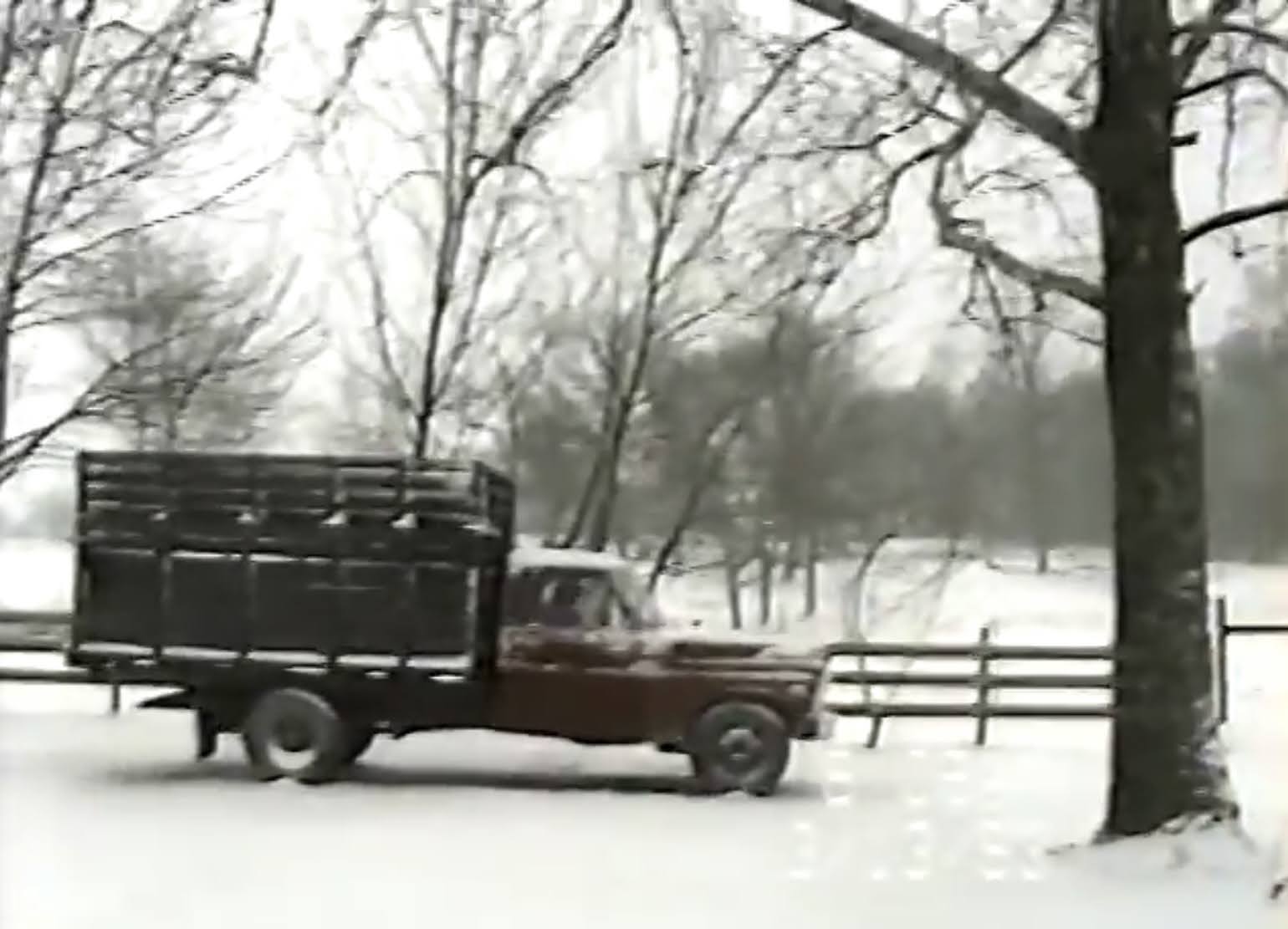
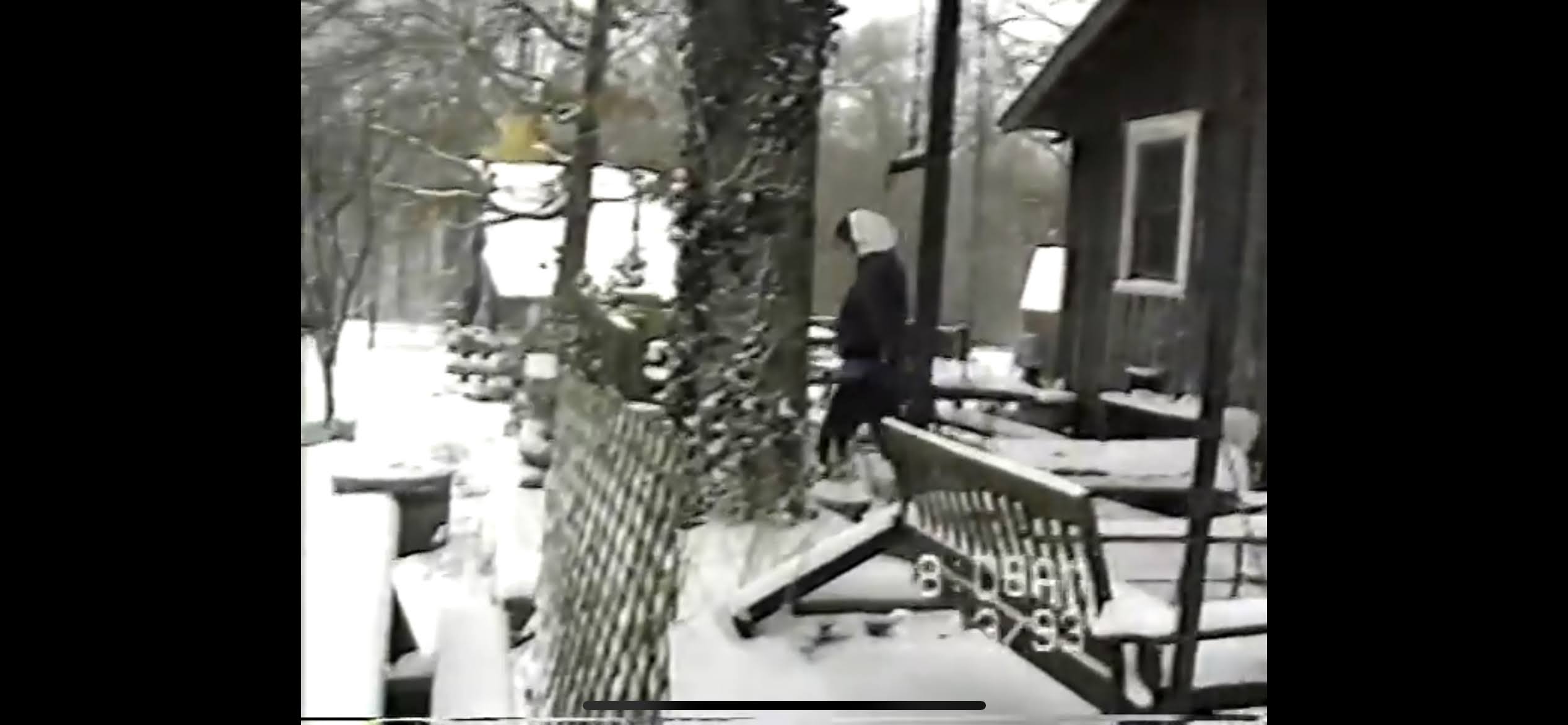
The photos attached are screenshots from home video made by Iler Mae Alley in Deerfield, western Lawrence County on March 13, 1993. The blizzard occurred on Iler Mae and husband Chester Alley’s fiftieth wedding anniversary.

Posted in Uncategorized | Leave a comment

Remembering David Crockett

William Simonton was a boy when David Crockett built his gristmill operation on Shoal Creek, at the falls which now bear his name in David Crockett State Park. In 1880, as a 74-year-old man, Simonton recounted some of his memories of Crockett to a correspondent of the Pulaski ‘Citizen.’

At the age of 13, Simonton said that he rode the six miles to Crockett’s mill on horseback, carrying a massive bag of corn. When he reached the mill, he found that it was being operated solely by Elizabeth Crockett, David’s wife.

Simonton goes on to say that Elizabeth–whom he described as a “large, pleasant-faced woman”–took the bag from his horse and ground the corn into cornmeal, herself. She then replaced the bag on his horse and “sent him homeward always with a kind word.”

It is hardly a shock to historians that Simonton found Elizabeth operating the mill alone. David was famously hard to keep at home. His hunting expeditions and political campaigning kept him away for long periods of time, leaving Elizabeth, their children, and their slaves to operate the mill and distillery operation without him.

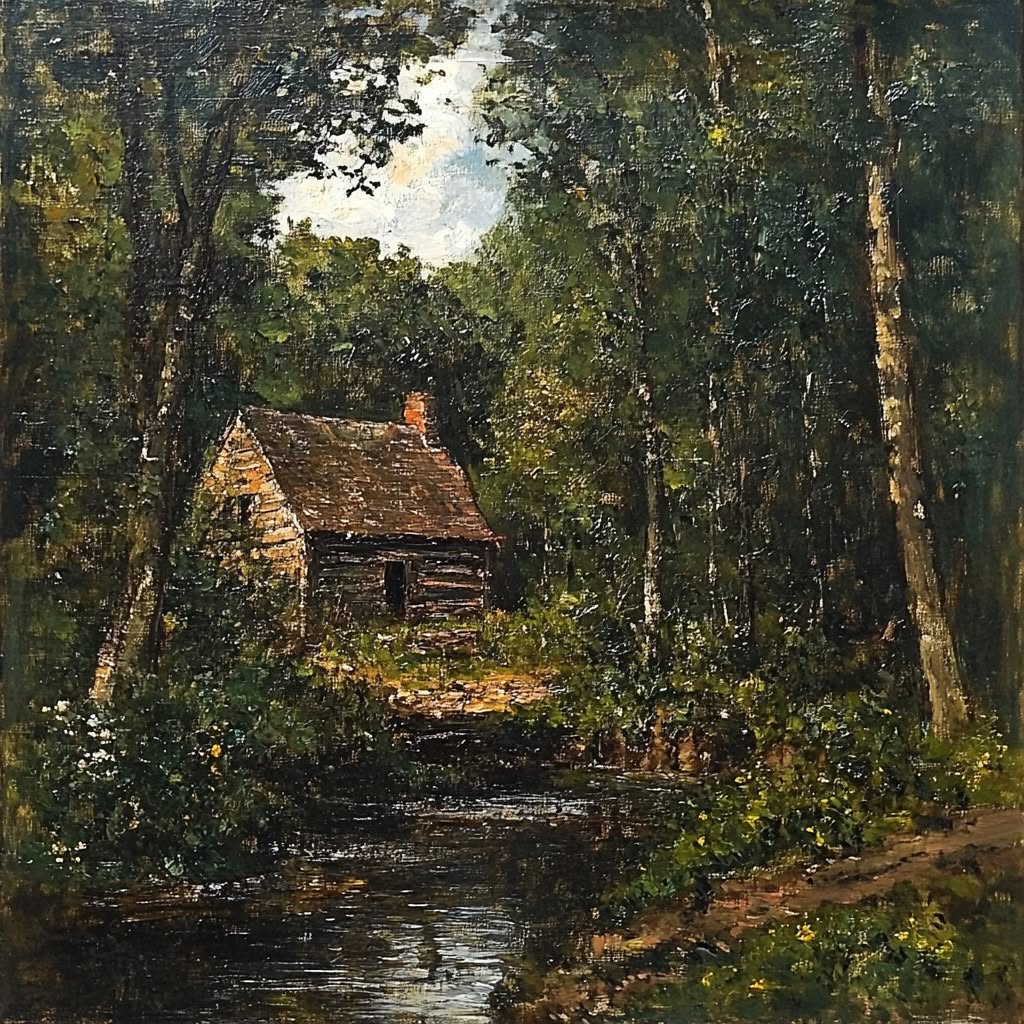
However, despite his wanderlust, Crockett was not completely negligent of his family’s needs. In 1880, a cabin that Simonton claimed Crockett had built near Shoal Creek to shelter his family was still standing as a testament to his provision for their needs–albeit it was standing several miles from where it had originally been built! The same Pualski ‘Citizen’ article tells us that, in addition to knowing Crockett and his family while they lived in Lawrence County, William Simonton had engaged in what is likely the first historic preservation effort in Lawrence County’s history in order to save the cabin for posterity.

With a sense that Crockett’s cabin was of great historic importance, Simonton had dismantled and faithfully reconstructed the Crockett cabin from its original location near Crockett Falls to a place near the Crescent Mill textile factory that Simonton owned a few miles downstream. The correspondent for the ‘Citizen’ writes that “the logs of the cabin show numerous holes for the wooden pins upon which [Crockett] hung the skins of the numerous game he killed.” The chimney, which was built of “slabs, sticks and mud” was still intact and attached to the cabin in 1880.

However, it was also noted that, despite Simonton’s valiant efforts at preservation, the cabin was “rapidly sinking down to dust” after almost 60 years of vacancy.

Posted in Uncategorized | Tagged , , , , | Leave a comment

LawCo Fact or Fiction: The President’s Revenge

Who doesn’t love a tall tale? Over the next few weeks, I will examine some Lawrence County lore. After I present the facts, I will give each legend a rating of True, Mostly True, Mixture, Mostly False or False.

Local Legend: James K. Polk’s first official action as president of the United States was to fire the postmaster of Lawrenceburg, Tennessee.

My Rating: MOSTLY TRUE

James K. Polk, the eleventh President of the United States, was no stranger to Lawrence County. Although he lived in Columbia, Polk was admitted as a practicing attorney at the Lawrence County Court of Pleas and Quarter Sessions on October 2, 1820, and over the next two decades, his vocation and his political ambitions brought him frequently to court in Lawrenceburg.

The story goes that, when Polk was elected President of the United States in 1844, one of his first official acts as president was to fire Stephanus Busby, the postmaster of Lawrenceburg, because the two were somehow political enemies, or because Busby had somehow insulted Polk at one time.

The old legend, it is said, is particularly popular among Busby’s descendants.

As it turns out, the legend is probably true.

Polk took the oath of office as president of the United States on a stormy March 4, 1845. By April 19, just a month-and-a-half after Polk’s inauguration, Roberson D. Parish had replaced Stephanus Busby as the postmaster of Lawrenceburg, a job which Busby had held since 1839.

But there’s more.

On February 18, 1844, Polk was in Lawrenceburg for court. While he was there, he wrote a letter to two political allies in Nashville, instructing them to publish some particular speeches in the Nashville ‘Union’ as soon as possible. Nothing very unusual for a politician gearing up for a presidential race.

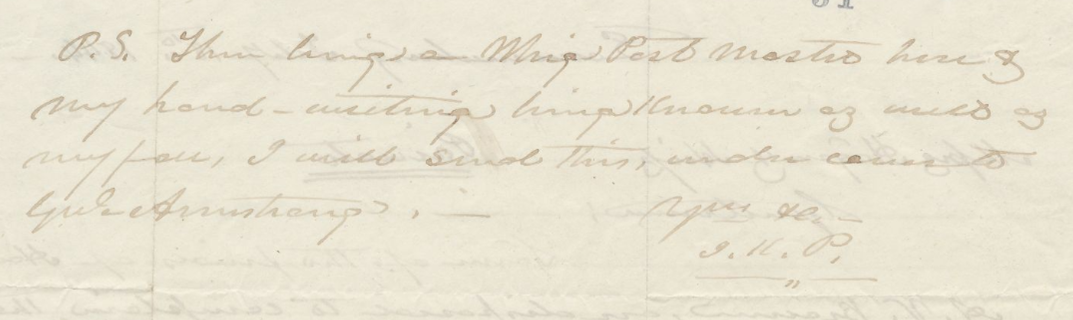
What was unusual about Polk’s letter on that day is that he added a postscript which said:

“P.S. There being a Whig Post master here & my hand-writing being known as well as my face, I will send this, under cover to Genl. Armstrong. J.K.P.”

Source: University of Tennessee Knoxville Digital Collections. 1844 Feb. 18, Lawrenceburg [Tennessee, to Mr.] Hogan [and Mr.] Heiss / James K. Polk : page 2

This small note tucked away in Polk’s personal correspondence validates the fact that Polk was certainly distrustful of Busby, whose political leanings were apparently so passionate that Polk suspected him of losing or destroying mail to hurt Polk’s chances of election.

In fact, Polk was so suspicious of Busby that he had to get someone else to address the envelope, and he had to have it sent to a proxy recipient simply to ensure its delivery.

Having to go to such extraordinary lengths to get his mail through no doubt stuck with Polk, so we should not be surprised that a new postmaster was appointed for Lawrenceburg so quickly after Polk’s inauguration.

While I can’t confirm that firing Busby was the first thing Polk did after taking office, surviving evidence suggests that that Polk disliked and distrusted Busby, and that Busby was removed from office very soon after Polk became president. Therefore, I give this local legend a rating of MOSTLY TRUE.

James K. Polk
Posted in Uncategorized | Leave a comment

Thanks, Daddy Mick

By Clint Alley

“You don’t have to sugarcoat it. My great-granddaddy was a carpetbagger.”

The voice on the other end of the phone burst into a jovial peal of laughter, easing my discomfort and making me laugh, too. I was in the middle of a big research project, and calling someone’s ancestor a carpetbagger still carried repercussions in Tennessee, even in the 21st century.

My former high school principal was a tall, distinguished, energetic man with a deep voice, snow-white hair, and a sharp eye. He was the very opposite of reticence. As our exchange over the phone that summer day reminded me, Mickey Dunn was a man who would tell the truth, warts and all. It was an honesty which added to his well-deserved reputation as a good coach and a dedicated educator.

In the summer of 2017, I was researching the history of the old Lawrenceburg City Cemetery, a lonely and solemn old burying ground tucked away on a tree-shrouded bluff in a quiet corner of our home of Lawrenceburg, Tennessee. I was planning a tour of the cemetery for that Halloween, and I wanted to locate every source that I could about the cemetery and the surrounding area.

Mickey’s family had once owned a sprawling farm across the street from the old cemetery. I had a sheaf of documents about the farm; deeds, tax cards, newspaper clippings, obituaries, census returns, old aerial photographs, and whatever else I had managed to dig up in the library’s local history room and the county Register’s office. But to get the heart and soul of the story, I knew there was only one man I could ask. And, like everyone in our community, I knew that he always answered the phone when someone needed help.

The story of how Mickey’s family came to settle on the old farm that now comprises a residential and business district on the western fringe of Lawrenceburg is a fascinating one. In the early days of Lawrenceburg’s history, a Methodist preacher named Noah Parker bought the place. He built a brick home on a knoll beside what was then the main road to Waynesboro, known locally as Waterloo Street. Rev. Parker’s home was incorporated into the Harris home in the 1990s, and is one of the only structures from that period in Lawrenceburg that survives today.

Noah’s daughter Mary Ann fell in love and married a fiery young attorney named Caleb Davis. Rev. Parker willed the half of the farm on the north side of Waterloo Street to the young couple, and they built a sprawling home on the property, just across the street from Rev. Parker’s old home. All was set for a grand happily-ever-after.

Until the Civil War began.

When Tennessee seceded from the Union, Davis made great speeches in support of secession. But when it became apparent that the war would not be over in a summer, and Federal troops first appeared on that western road beside Davis’s house in the spring of 1862, Davis experienced a sudden change of sympathies. When the Union army began administering the Oath of Allegiance to Confederate citizens, Davis later claimed that he was the first person in Lawrence County to travel to nearby Pulaski to take it.

After that, Davis threw his support entirely behind the Union cause, giving supplies to passing Union soldiers, even nursing a wounded Yankee through his final illness and burying him beside his own home (an interesting choice, given that he lived literally just yards away from the old city cemetery). Davis even spent three days hiding in nearby woods from Confederate guerillas who targeted him for execution due to his betrayal of the Cause.

So it will come as no surprise that, when a young Federal soldier came to town at war’s end in the spring of 1865 and wanted a place to stay while he established himself in business, he went to the one man in town whom he knew he could trust.

Thomas Dunn—Mickey’s aforementioned great-granddaddy—was a Kentucky-born soldier of Irish parentage. He volunteered for the Union army in 1861, and after his term of enlistment was done, he took on the role of sutler for the Union headquarters at nearby Pulaski. Thomas liked Tennessee, and he no doubt saw opportunity in the new economy that would rise from the ashes of the Confederacy.

And, despite his Yankee origins and Catholic faith, Thomas seems to have incorporated quickly into the social fabric of the community. By 1868, he was serving as a leader in a new social club alongside former Confederate officers. In a town that had been effectively abandoned during the war, in a county which would not recover its prewar population for two decades, Thomas’s sense of industry and desire to settle must have been a welcome relief to many of his former enemies.

Thomas lived for a while in an outbuilding behind the Davis home while he built a thriving and successful mercantile and timber business in Lawrenceburg. And, when Davis decided to leave Lawrenceburg for good in 1872, Thomas took the opportunity to buy his farm.

The Dunn family would own that land for generations, whittling parcels away bit-by-bit over the years through bequests and sales until finally the old farmhouse was demolished and the family cemetery exhumed and remains moved to the local Catholic cemetery in the mid-1960s.

As I pieced together this timeline, Mickey helped me fill in the gaps with recollections about family members who grew up there and personal anecdotes about the place. We called, texted, and met at the library half a dozen times that summer. He was not only willing to help me understand the history of his family farm, he was eager, often answering my questions at night.

But that was no surprise to me. That was the kind of man that Mickey Dunn was.

When my grandmother died my senior year in high school, Mr. Dunn found me in the cafeteria the next day before classes began. He extended a firm handshake to me, looked me in the eye, and said, “I’m sorry for your loss, Mr. Alley.” It was a moment of kindness that I will never forget. And that was just the tip of the iceberg of his kindness.

Mickey had a passion for helping people. He took special interest in the young people of our community who came from abusive or impoverished backgrounds, often taking them to doctor’s appointments when no one else could and showing them tough love and concern when no one else would. He believed in the power of mentorship, and changed the lives of many hard-pressed teenagers around a shared love for basketball. He also believed in the power of community, and saw the students under his care as an extended family. To Mickey, being a high school principal was not a job, it was a part of his identity.

Mickey was straightforward about his ancestor being a carpetbagger. But in recent years, a lot of southerners have come to realize that carpetbaggers, for the most part, were not bad folks. Far from the wicked and conniving hucksters of Gone With the Wind-fame, many of the people history remembers as “carpetbaggers” were humanitarians with an eye toward helping newly-freed slaves realize their potential. True, there were some opportunists in their number who sought to make a quick buck at the expense of economically-ravaged southerners, but those were probably more the exception than the rule.

Many carpetbaggers were former soldiers like Thomas, who came south with the army and liked it so much that they decided to return permanently and build a life here. Many more were teachers with a heart for the downtrodden, a mantle which Mickey Dunn would wear with pride a century-and-a-half later.

Mickey lost his battle with cancer on January 26, 2020. When he died, our community lost a mighty champion of learning, kindness, empathy, and honesty. But, as many of the speakers at his funeral attested, his legacy lives on in changed lives, in altered courses, and in restored dignity. Mickey Dunn planted seeds of kindness and love in places where few others dared go, and a mighty forest of integrity and self-worth will shade our community for generations to come as a result. He also left us a wonderful example to follow, and a crucial mission of empathy to continue.

Thanks, Mickey. For everything.

Posted in Uncategorized | Leave a comment

Answering Reader Questions: The Origins of the Middle Tennessee District Fair

The Fair was headline news in 1913.

Melba Scott recently asked:

What year or years was the county fair located in Leoma on either Fair Street or Avenue?

That’s a great question, Melba!

The Middle Tennessee District Fair is Lawrence County’s biggest annual event. And while COVID-19 may have cancelled it for 2020, the Fair has been a staple of community life in Lawrence County for more than a century.

In modern times, the fair sprawls across nearly 30 acres of modern facilities in Lawrenceburg’s Rotary Park, including a new 4,600-seat grandstand and arena, three exhibit halls, a 23,000 square-foot livestock pavilion, and a 7-acre midway with a paved sidewalk.

Normally, the last week of September sees thousands of people entering the gates of these massive fairgrounds. But the fine modern facilities enjoyed by fair-goers today are a far cry from the event’s humble origins.

Middle Tennessee District Fair advertisement in the Florence Herald, 1933.

The Beginning

Lawrence County held a small fair in 1860, near the site of the modern water filtration plant on West Gaines Street in Lawrenceburg. This event was strictly agricultural and, although turnout was good, the Civil War and Reconstruction dampened any desire to repeat it in the following years.

What we now know as the Middle Tennessee District Fair began as a county fair in 1910. And, like Melba said, it was held in Leoma, a community just a few miles south of Lawrenceburg.

Aside from the agricultural exhibits and the general atmosphere of celebration, that first fair bore little resemblance to its modern descendant.

In 1910, Leoma was a bustling community served by both a major highway and a railroad depot. And, true to the community’s rural roots, the fair began as a unique celebration of the harvest.

The first fair was a combined farmer’s fair and farmer’s institute held on October 20, 1910 in Leoma. To answer Melba’s question, it appears that the Fair was held in Leoma from 1910 to 1915.

A fair, in the original sense of the word, was a public show of agricultural products, equipment, and livestock. These shows were often accompanied by contests where the best agricultural product in each category was judged and prizes or “premiums” were awarded. This aspect of the fair survives today in the agricultural, home economics, and livestock contests held at the Middle Tennessee District Fair.

But what on earth is a ‘farmer’s institute?’

Modeled on a similar event held for teachers, a farmer’s institute was a meeting of local farmers to hear lectures from experts about certain agricultural topics. The speaker at the Leoma event in 1910 was commissioner of agriculture Col. John Thompson. And, although we don’t know what lectures were delivered at that farmer’s institute in Leoma, we do know that a similar event featuring Commissioner Thompson in Goodlettsville later that year featured lectures about the benefits of clover, the science of keeping a good orchard, and one lecture entitled simply, “Weed Seed.”

From this modest event sprang a tradition that is a major part of our local identity.

A later Lawrence County Fair on Lafayette Street in Lawrenceburg.
Image courtesy of the Lawrence County Historical Society.

After the 1910 event, the Fair added elements of entertainment and education with each successive year, making each year’s event bigger and better-attended than the one before. Those first fairs were very different from the Fair we know now.

In addition to the standard agricultural exhibits which formed the core of the event, the Leoma Fair included some exciting–and eccentric–community events. The 1911 fair saw what may be the first recorded Fair Day in the Lawrence County school calendar, when school superintendent Jesse McArtor “ordered a suspension of all public schools in the county” on October 6 to encourage attendance of the Fair’s educational exhibits. The superintendent urged every school to attend the fair in Leoma, and took the opportunity to declare it a school “rally day.”

In 1912, Fair organizers issued a unique challenge to the school system. The largest wagonload of students and teachers from a single school which passed through the gate would get free admission. Second place was awarded with half-price admission, and third place was awarded with one-third-price admission. These awards were given in the form of refunds, which would not be issued until 4:00 p.m.

In addition to the special speakers invited for the education rally, the exhibits that Mr. McArtor may have wanted the students to see probably included things like the stereopticon lecture about hookworm presented at the 1912 Leoma Fair. Or perhaps the “Library Round Table” discussion. All, of course, while being serenaded by the Leoma Cornet Band.

The Switch to Lawrenceburg

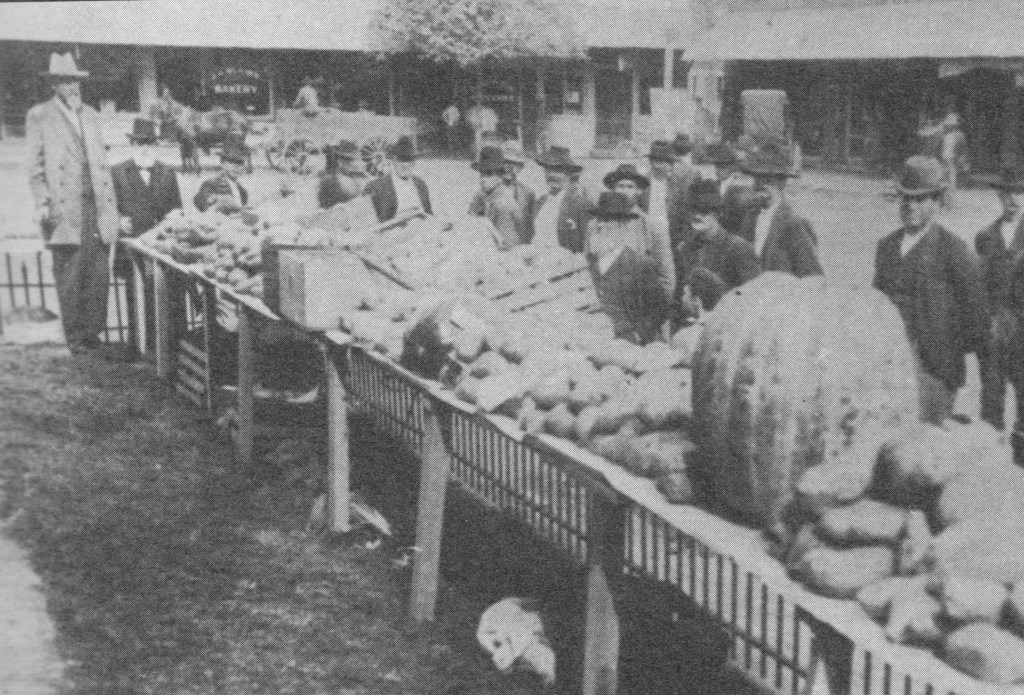
In 1914, while the Leoma Fair was drawing large crowds and hosting a variety of events, a separate, more-modest “corn and pumpkin show” consisting solely of agricultural displays had begun on the Square in Lawrenceburg. In 1916, the Fair Association decided not to hold the popular event in Leoma, and the Lawrenceburg fair took over as the county’s main event.

One of the early Fairs held on the Public Square in Lawrenceburg.
Image courtesy of the Lawrence County Historical Society.

The Fair quickly outgrew the Square in Lawrenceburg. For several years, it was held on Lafayette Avenue before the construction of Fairview Park, which is still the home of the Fair today.

In 1931, the Lawrence County Fair was officially designated the “Middle Tennessee District Fair” by an act of the Tennessee General Assembly. Also in 1931, due to cutbacks caused by the Great Depression, the Middle Tennessee District Fair was said to have been a larger event than the Tennessee State Fair in Nashville.

The City of Lawrenceburg purchased Fairview Park from the Lawrence County Fair and Park Association in 1950 for $57,000. Later that year, the Fair and Park Association dissolved and the Lawrenceburg Rotary Club adopted the Fair. Six decades later, the Rotary Club is still performing this function.

The decision to cancel the Fair this year was no doubt a difficult one. We will miss the Fair this year. But I, personally, am very grateful to the Rotary Club for taking such proactive steps to protect the health and wellbeing of our community. And while it may not feel like Fall this year without the Fair in town, the Fair is an event with a rich pedigree and a long legacy of thriving despite adversity. Here’s hoping that the Fair will return in 2021, better than ever.

Thanks for your great question, Melba! If you have a question about local history that you would like me to answer, send me a message or leave a comment at Lawrence County History Trivia!

Special thanks to Lawrence County Archivist Ashley Armstrong for her assistance in locating some of the documents needed to write this post.

Posted in Uncategorized | Leave a comment

Answering Reader Questions: Some Dam History

Spencer Hand recently asked us:

When was the dam built, when was it decommissioned, and why is it still there?

Excellent question, Spencer!

The Lawrenceburg Hydroelectric dams are located on Shoal Creek, around 1.8 miles apart. The first dam, known simply as “Lawrenceburg No. 1,” was completed in 1907, two years after the city of Lawrenceburg held a special election which approved the sale of municipal bonds to finance the project (Our Hometown, Carter and Carpenter, p. 93).

The first decade of the twentieth century saw a slough of progressive initiatives put into action by the people of Lawrence County, initiatives which improved the quality of life for every citizen and which played a key role in Lawrence County being the fastest-growing county by population in Tennessee between 1900 and 1910. In 1905, the county court ordered the construction of a beautiful and elegant new courthouse, which was wired for electricity before it was available in Lawrence County. This was followed in rapid succession by the decision to build the first hydroelectric dam (1905), the decision to build the county’s first tuition-free public high school (1908), and the construction of the first municipal water tower (1908).

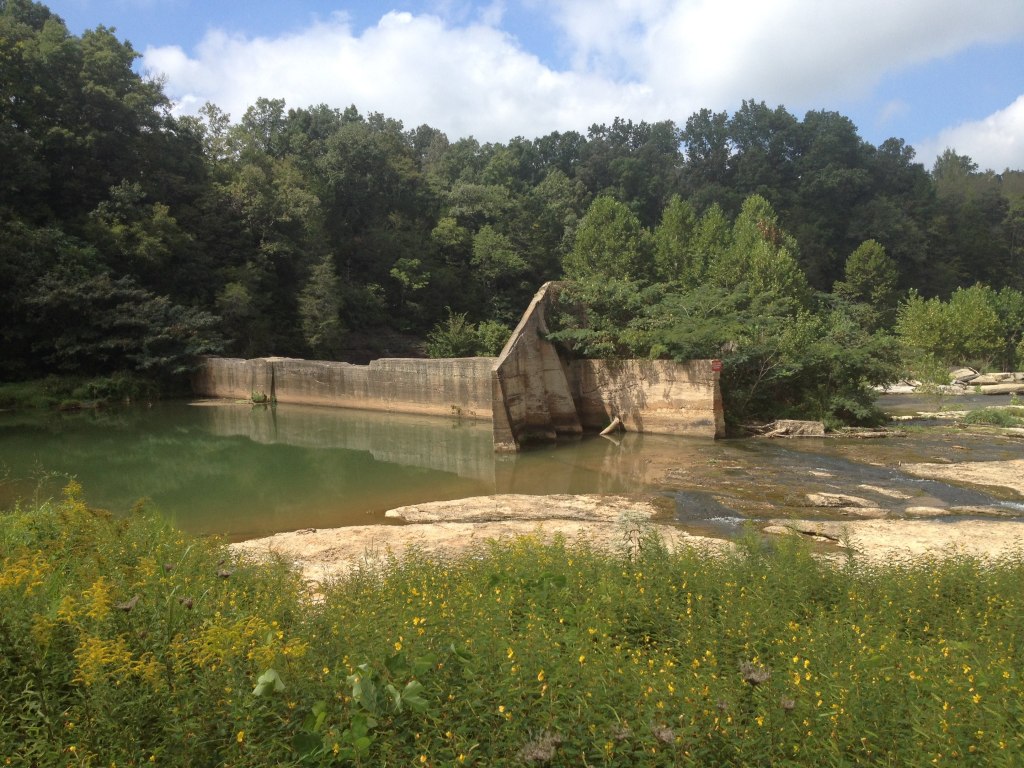
Remains of Lawrenceburg Hyrdoelectric Dam No. 1 in 2014

The first dam provided the people of Lawrenceburg with cheap electricity for several years. Local lore has it that the Garrett House on South Military Street was the first private residence in Lawrenceburg built with electrical wiring installed at the time of construction (‘About Our Cover,’ Lawrence County Heritage, Kathy Niedergeses Vol. 6, No. 4, p. 154).

By 1915, the first hydroelectric dam was unable to produce the amount of electricity to meet the demand of the rapidly-growing city of Lawrenceburg. A second plant was planned 1.8 miles downstream. This facility was completed in 1924 and is known as Lawrenceburg Dam No. 2 (National Register of Historic Places Nomination Form, Lawrenceburg Dam No. 2).

Lawrenceburg Hydroelectric Dam No. 2

In 1922, the Lawrenceburg power plant was making a profit of $15,000 per year, a local windfall which not only improved the lives of local people and drew new businesses to the area, but which also allowed the city to engage in a number of public improvement projects–paving streets, erecting electric street lights, and funding the city’s nascent fire department–without having to raise taxes. The Knoxville Sentinel reported that year that residents of Lawrenceburg were paying “only four cents a kilowatt-hour and down for their electric current,” compared to nearby Florence, Alabama, which was paying “sixteen cents and more for its current.” (‘Lawrenceburg’s Hydro-Electric Plant Supplies Street Paving, Lighting, Fire Protections Free,’ Knoxville Sentinel, Knoxville, Tenn.: 5 Nov 1922, p. 18)

The two dams provided for Lawrenceburg’s electrical needs until the creation of the Tennessee Valley Authority in 1933. According to the National Register of Historic Places Nomination form for Dam No. 1, the dams ceased operation as hydroelectric plants in 1939.

Now to address Spencer’s question as to why the dams are still there. I, personally, am certainly glad that these historic landmarks are still with us to the degree that they are, but let’s approach the question from the standpoint of local economy.

The dams represent a significant capital investment by the city of Lawrenceburg that at various times throughout the late 20th century contained the promise of making a return on that investment beyond the dividends paid to the early-20th-century inhabitants of Lawrenceburg. While Dam No. 1 and the 31 wooded acres comprising the peninsula of the horseshoe bend of Shoal Creek is still owned by the city, Dam No. 2 was sold to the Union Carbide company in 1957.

During a study conducted by TVA in 1981, it was estimated that Lawrenceburg Dam No. 1 could generate 2.2 million kilowatt hours of electricity per year if it were reactivated, an amount that fell just short of providing the 2.6 million kilowatt hours then needed by the city in 1981. At that time, TVA was considering reactivating ten small dams throughout the state of Tennessee in order to ease the burden of electricity output on larger dams (‘TVA looks to small dams for electricity,’ Johnson City Press-Chronicle, Johnson City, Tenn: 28 Aug 1981, p. 2).

Dam No. 1 and its powerhouse have been heavily damaged by flooding in the years since that 1981 TVA study. Dam No. 2, however, is still in relatively good shape.

The dams are also valuable from a cultural and historical perspective, as reflected in their inclusion on the National Register of Historic Places in 1990. They represent one of the most progressive and forward-thinking eras of our local history, and they also stand as a monument to the fact that Lawrenceburg is a place that values innovation.

Thanks to Spencer Hand for reading and asking these great questions! I will answer more reader questions in coming days!

Posted in Uncategorized | 1 Comment

“A Rumbling in the Heavens:” The Lawrenceburg UFO of 1846

Something happened in the the sky over Lawrenceburg, Tennessee on a clear afternoon in late October 1846.

Nearly 175 years later, the story still piques curiosity and demands explanation.

According to the Lawrenceburg Academist, the incident happened about midday on October 23, 1846. The noise was the first thing that people noticed.

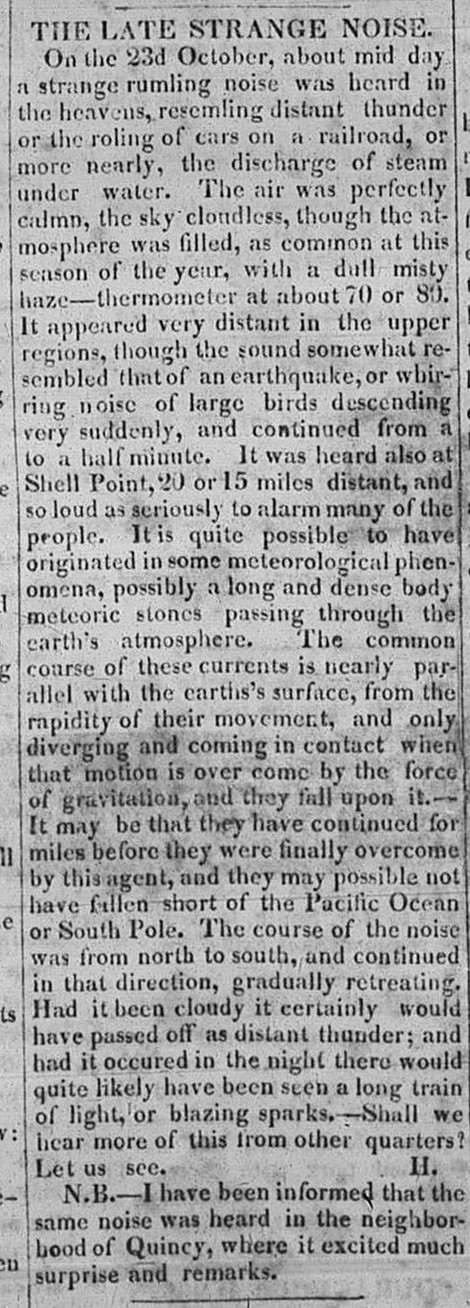
An article entitled The Late Strange Noise¹ recorded that “a strange rumling [sic] noise was heard in the heavens, resembling distant thunder or the roling [sic] of cars on a railroad, or more nearly, the discharge of steam under water.”

the late strange noise

The story from The Academist.

But the noise was none of those things. The railroad was still more than three decades in the future for Lawrenceburg in 1846. And the weather was pristine. The article went on to say that “the air was perfectly calm, the sky cloudless,” and the temperature was pleasantly somewhere in the mid-70s.

But for a full half-of-a-minute, the air was filled with a dull rumbling, traveling distinctly from north to south. The Academist goes on to say that the noise “resembled that of an earthquake, or whirring noise of large birds descending very suddenly.” And it was heard nearly 20 miles away.

More than a century later, an article about the event found in a junk store scrapbook in Loudon, Tennessee claimed that the noises were accompanied by violent explosions that shattered windows. The junk store article in question goes on to say that witnesses saw “trails of steam over the city,” and that at least two people saw “a strange slag-like material fall from the sky after the explosions.”

Lucky Selvidge, the man who found the scrapbook, wrote about the find in a 1972 article for the Democrat-Union.² His opening line tantalizingly asks “could Lawrenceburg have been visited by a spaceship from another world, more than 125 years ago?”

Selvidge speculates further that the rumbling noises and the explosions described by witnesses were suggestive of “jet aircraft engines…breaking the sound barrier.” He goes on to say that “falling slag has been reported countless times in UFO sightings.”

11390088_832770750146587_4291507493145293036_n

An early view of Lawrenceburg, probably made about three or four decades after the ‘Late Strange Noise.’

But the Academist took a more circumspect view of the incident. The “late strange noise,” it said, “is quite possible to have originated in some meteorlogical phenomena, possibly a long and dense body of meteoric stones passing through the earth’s atmosphere.”

Indeed, the Academist article seems to describe in minute detail what happens when a large meteorite strikes the earth.

An almost identical event happened four months later near Hartford, Iowa. As related in the Nashville Republican Banner³ on November 1, 1847:

On the 28th of February, 1847, at about ten minutes before three o’clock in the afternoon, the attention of the people in this region was arrested by a rumbling noise as of distant thunder; then three reports were heard one after another in quick succession, like the blasting of rocks or the firing of a heavy cannon half a mile distant. These were succeeded by several fainter reporters, like the firing of small arms in platoons…Two men were standing together where they were at work; they followed with their eye the direction of one of these sounds, and they saw about seventy rods from them the snow fly. They went to the spot. A stone had fallen upon the snow, and bounded twice…

Unbeknownst to the people of Lawrenceburg or Hartford in 1846, or apparently to Mr. Selvidge in 1972, is that, millions of miles from the earth, Biela’s Comet had broken in half in early 1846, scattering a massive debris field in its wake. The meteoric activity described in Lawrenceburg and Hartford was probably connected to this obscure astronomical event.

In 2013, a massive meteor exploded in the earth’s atmosphere over the region around the Russian city of Chelyabinsk. The explosion created a shockwave which shattered glass and damaged buildings throughout the area, injuring nearly 1,500 people. The Chelyabinsk event was recorded on cell phones and dash cams by hundreds of people.

The following link is a compilation of some of those videos. Compare the sounds made by the Chelyabinsk meteor with the reports from the Academist and the unnamed junk store scrapbook article describing the Lawrenceburg event of 1846.

Chelyabinsk Meteor Compilation

Lawrence County was very sparsely-populated at the time of the explosion, and few records of the event have survived. This kind of scarcity of source material can fuel speculation like Mr. Selvidge’s idea that the noise was evidence of alien beings visiting Lawrenceburg.

Scientific reasoning, however, leads us to the much more likely conclusion that the explosion in Lawrenceburg in late 1846 was more likely the result of a falling meteor on par with the Chelyabinsk event.

Did aliens land on the Lawrenceburg Square in 1846? No. Did a meteor fall in broad daylight somewhere south of Lawrenceburg? Probably so.

As Richard Feynman said, “Science is what we do to keep from lying to ourselves.”

But still, as Mr. Selvidge’s colorful article attests, it can be great fun to ask ‘what if?’

61-5p5GsDGL._AC_SL1024_

The truth is out there, Mulder.


¹ “The Late Strange Noise,” The Academist, 2 Dec 1846, p. 1: Lawrenceburg, Tenn.
² “Century-Old County Mystery Found in Junk Shop,” The Democrat-Union, 27 Jul 1972, p. 1: Lawrenceburg, Tenn.
³ “Fall of Meteorid Stones in Iowa,” Republican Banner, 1 Nov 1847, p. 2: Nashville, Tenn.

Posted in Uncategorized | Leave a comment

Davy is Restored

By Clint Alley

If you are out and about downtown today, you may notice that a familiar face has a brighter smile.

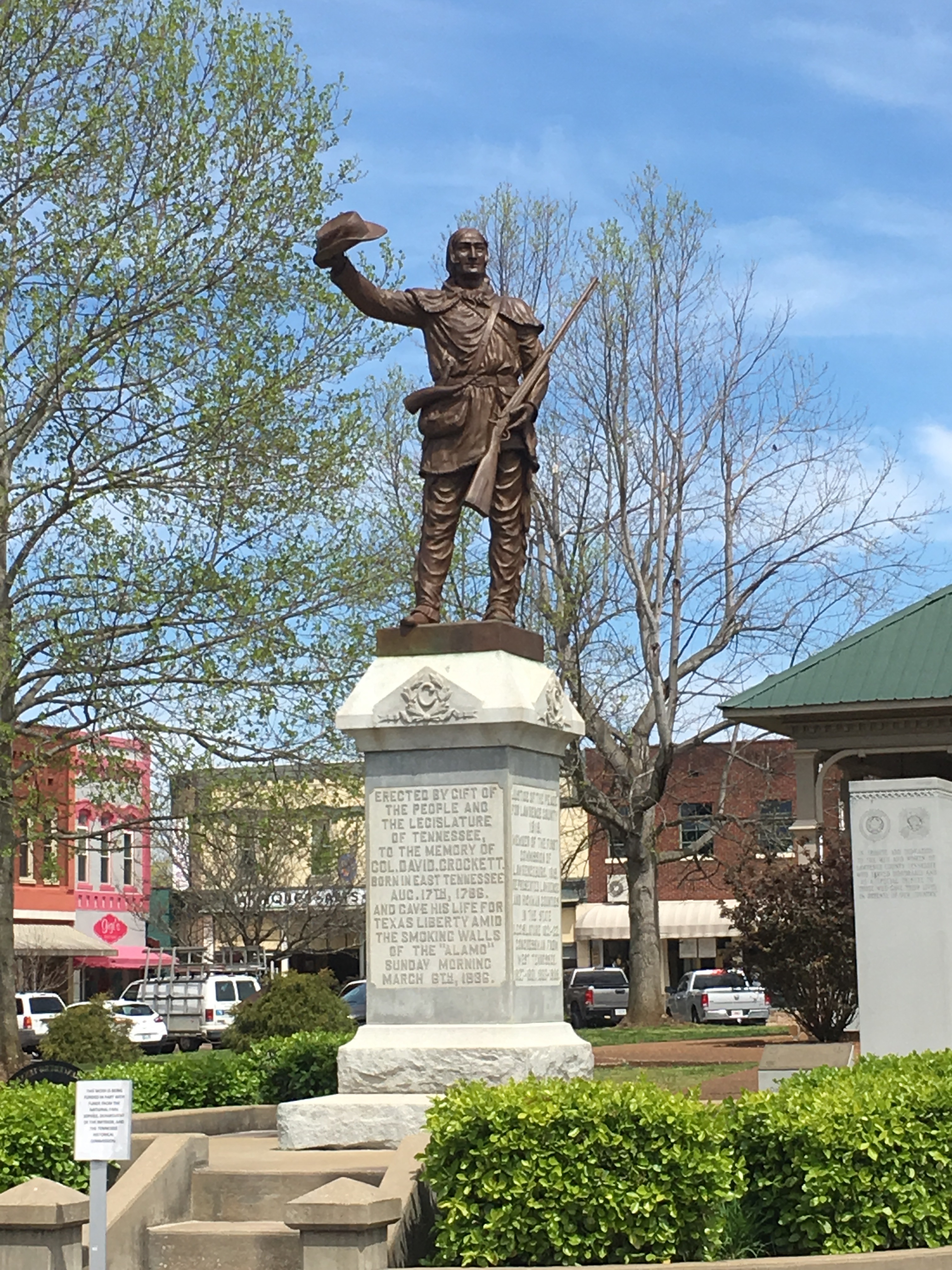
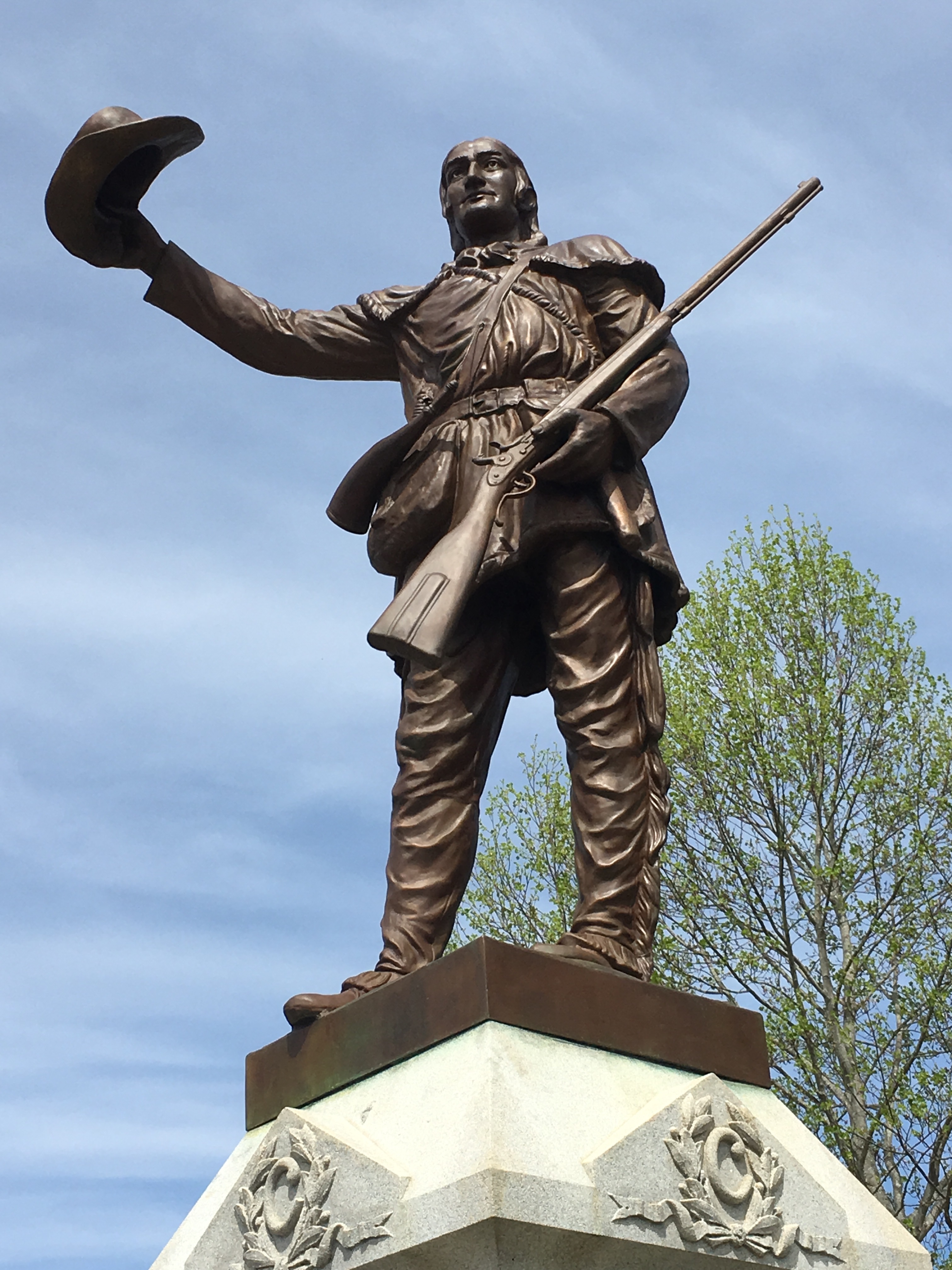
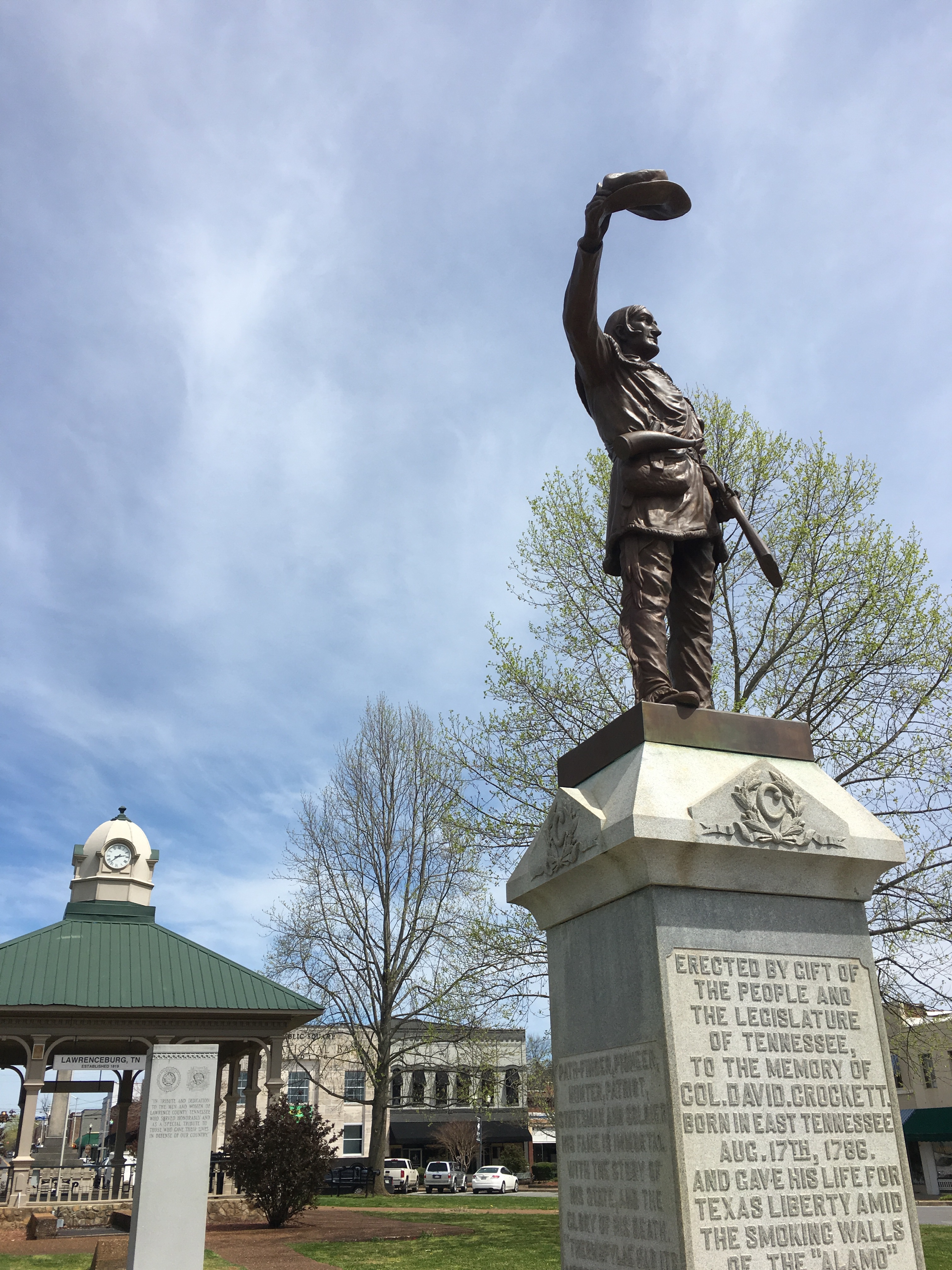
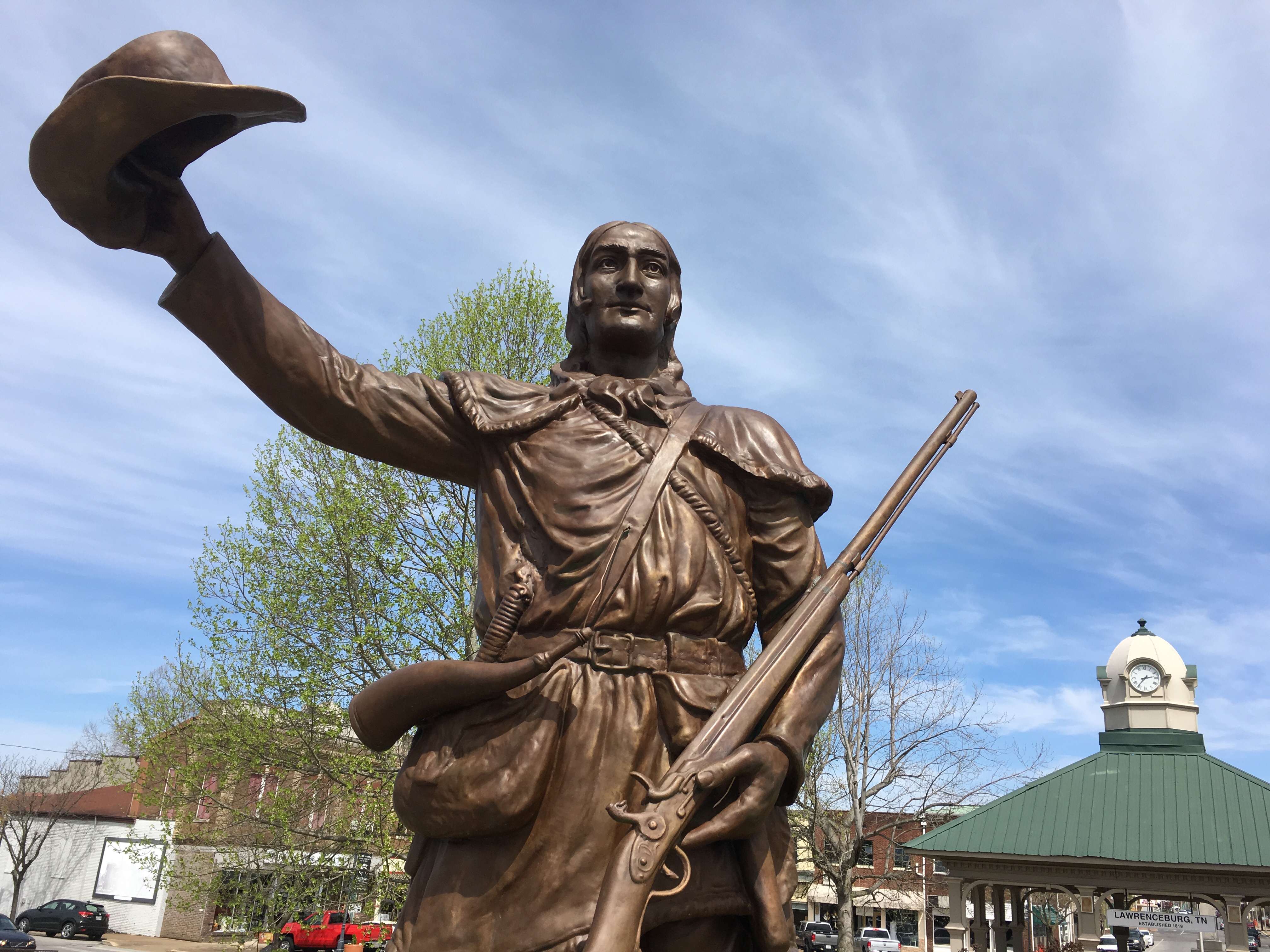
Lawrenceburg’s 97-year-old full-body statue of David Crockett on the Public Square was recently restored by the Terra Mare Conservation company, using funds from a $15,000 grant from the Tennessee Historical Commission.

David Crockett was an early settler of the area, a pioneer of local government, and a founding father of the city of Lawrenceburg. He also launched his political career during his time in Lawrence County, and by the time he moved west in 1822, he was becoming a household name statewide.

Enjoy these photos of the new and improved Colonel Crockett.

Posted in Uncategorized | 1 Comment

A New Sheriff In Town

When Sheriff-elect John Myers takes office, he will be the 56th sheriff in the 201-year history of the Lawrence County, Tennessee Sheriff’s Department, and the first Republican to hold that office in five decades.

The longest-serving sheriff in Lawrence County history, according to the best information on hand, was Sheriff William Dorning, who held the office for twelve years, between 1994 and 2006. Second-longest service belongs to Sheriff Thomas Matthews, who was sheriff of Lawrence County for ten years, between 1831 and 1841.

Incumbent Sheriff Jimmy Brown is tied for third-longest service as sheriff at eight years (2010-2018), a record that he shares with Sheriff Tom Pyrdum (1982-1990).

Posted in Uncategorized | Leave a comment

When Greg O’Rear Met Elvis

Lawrence Countian Greg O’Rear was a legendary Tennessee lawman who is remembered almost as much for his extraordinary stature as he is for his extraordinary career.

O’Rear served in the Tennessee Highway Patrol in many capacities in the mid- and late-twentieth century, culminating in his appointment as state safety commissioner.

O’Rear met many famous and infamous people through his law enforcement career, from politicians to celebrities to assassins. In this photo, O’Rear (white hat, foreground) is seen escorting Elvis Presley away from the state capital on March 8, 1961, after the king of rock ‘n roll addressed the Tennessee legislature and was made an honorary colonel in the Tennessee National Guard.

26239640_1602784249811896_6713209385775955428_n

Posted in Uncategorized | Leave a comment