Grave-robbers In Appleton?

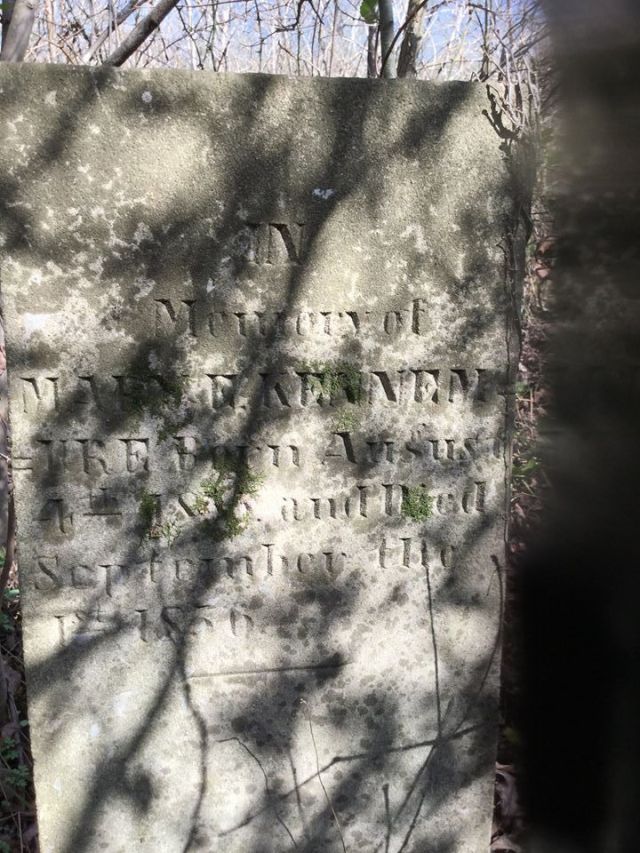
Was this grave in Appleton Cemetery disturbed by graverobbers 85 years ago?

The answer is, yes, it probably was, although to this day, no one knows why.

For at least three weeks in the autumn of 1930, the Appleton community in southeastern Lawrence County was stalked by nocturnal grave-diggers. At first, the visitors dug a single fresh grave in the community’s burial ground. However, no bones or coffin seemed to be disturbed.

A few nights later, they dug a similar grave in the same cemetery, but “deeper and wider.” Observers noted the footprints of two men and one truck leading away from the scene.

By this time, the community was abuzz with what it could all mean. Some said that there was money hidden in the cemetery. But no one expected what happened next.

On their third nocturnal visit to the graveyard, the men dug into the grave of a child, whom the ‘Tennessean’ described only as “a one-year-old…who was buried in 1856.”

Although it is possible that the grave in question could be of someone else, the burial place of Mary E. Kennemure is a likely candidate because it meets all of the criteria set out by the paper.

The graverobbers did not disturb the coffin of the child, although they did dig into the child’s grave. A local man named McGill heard his dog barking on the night it happened, but he did not go to the cemetery to investigate out of fear that he might be harmed.

It’s possible that McGill’s dog scared the would-be graverobbers off that night. Whatever the case, the suspicious activity ceased afterwards.

13307475_1044862132270780_6792703316940136476_n

Posted in Uncategorized | Leave a comment

Local Boy Killed at Pearl Harbor

Did you know that the first Tennessean to be killed in World War II was from Lawrence County?

Private Leland V. Beasley was a 1936 graduate of Loretto High School. The son of Mr. and Mrs. Cyrus Beasley, Leland joined the army air corps in the autumn of 1939 and became a mechanic in the 42nd Bombardment Squadron.

In March 1940, he was stationed at Hickam Field, Hawaii, which is the air field closest to Pearl Harbor.

Private Beasley was killed when the Japanese attacked Pearl Harbor on December 7, 1941. He was one of nine casualties from the 42nd Bombardment Squadron, and one of 2,403 American servicemen killed in that attack.

The December 12, 1941 edition of ‘The Tennessean’ declared that Beasley was the “State’s First War Casualty.”

Private Beasley’s body was initially interred at Schofield Barracks, near Pearl Harbor. But in 1947, his remains were disinterred and moved to the Nashville National Cemetery, where he is buried in plot 1, grave number 181.

13256361_1038829589540701_1385441143190892773_n

Posted in Uncategorized | Leave a comment

Happy Birthday, Big Gold Machine!

Did you know that Lawrence County High School’s award-winning Big Gold Machine marching band turns 87 this year?

The first band program at LCHS was organized in 1929 by band director Harold Kellogg. Many local businesses contributed to the creation of the program by helping to purchase instruments.

Posted in Uncategorized | Leave a comment

Deerfield Baptist Church Turns 100!

On Sunday, April 24, Deerfield Baptist Church in western Lawrence County will celebrate its 100th anniversary with a special service and a groundbreaking ceremony for its new sanctuary.

Deerfield Baptist was organized as a Missionary Baptist Church in 1916 by Rev. John Irwin, a pastor from Wayne County. During the church’s first dozen years, the congregation met in the old Deerfield schoolhouse one weekend a month.

During those once-a-month weekends, on Saturday evenings, the church would hold a business session, and on Sunday afternoons–after the Deerfield Church of Christ was finished with the schoolhouse–the Baptists would hold their services.

In those first few years, Deerfield Baptist held many brush-arbor revivals (special church services held outdoors beneath temporary shades), and the church baptized new believers in nearby creeks, a practice it continued until the late 1960s. Deerfield Baptist and nearby Greenwood Methodist also frequently held joint revival services.

The first sanctuary of Deerfield Baptist, pictured here, was built in 1928 on land donated by Deacon T.M. Dixon. From the cutting of timber for lumber to the hammering of the final nail, that first sanctuary was built completely by the members of the church. It had coal-oil lamps along the walls for light, and in the summertime, bats frequently flew through the open windows during evening services.

The church’s current brick sanctuary was finished in 1956. To help pay for the building, church members held special suppers, sold quilts for $3.00 each, and raised cotton in the church’s cotton patch.

Lawrence County History Trivia congratulates Deerfield Baptist on its first one-hundred years of ministry, and sends wishes that its second hundred years will be even more fruitful than its first.

Do you know of a local congregation or organization celebrating a milestone anniversary? Let us know, and we will be happy to share your good news with our readers.

13083337_1019210594835934_6479970854135631942_n.jpg

Posted in Uncategorized | Leave a comment

The Fearsome Rolling Pin of Sarah Dearing Kimbrough

This sweet little lady is said to have killed an enemy soldier during the Civil War. How did she do it? The answer will give you new respect for a humble kitchen utensil.

William M. Kimbrough and Sarah Dearing Kimbrough were newlyweds when the Civil War broke out. He was 27 and she was but 17, and they had married less than two months before the war began. They lived just across the county line, on the Giles County side of Weakley Creek Road.

Bill, as he was known, volunteered for service in the Confederate army in 1862, and served for two years in the 32nd Tennessee Infantry, until his capture in the summer of 1864.

One day, as the family story goes, a Union soldier forced his way into the kitchen. Thinking fast, Sarah grabbed the first thing she had available to defend herself: a rolling pin, which she then used to beat the man to death.

Whether it is true or not, this family legend underscores the great dangers faced by many women during the Civil War, especially if their husbands and sons were away serving in the military.

12670827_1008535392570121_7887700866279802268_n

Posted in Uncategorized | Leave a comment

The General Richard Allen Home of Ethridge

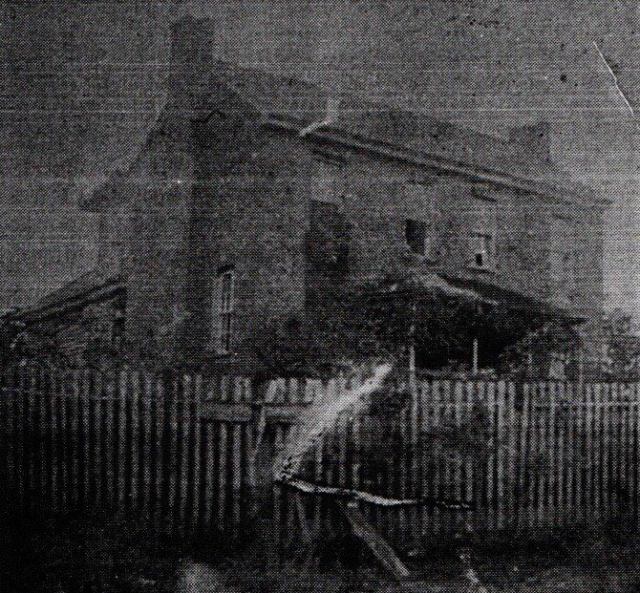
Have you ever noticed the empty lot between Rick’s of Ethridge and Ethridge Church of Christ? Did you know that one of the most well-known buildings in the county once stood on that spot?

The building in this grainy black-and-white photo stood in that now-empty lot for most of the 19th century. General Richard Allen, a veteran of the War of 1812, built a stand here along the Military Road, where weary travelers could stop and get a good meal and a place to stay the night.

Allen’s Stand was a well-known gathering point for local people, too. When Lawrence County’s first Confederate soldiers left for training in the spring of 1861, a going-away dinner was held in the field across from the Stand.

No doubt the saddest day this old house ever saw was when General Allen’s talented young son, Captain William B. Allen, was laid to rest in his early twenties in a garden on the back side of the property. William B. Allen was cut down in his prime, leading the Lawrenceburg Blues into battle at the Siege of Monterrey during the Mexican War. More than 1,000 people showed up at Allen’s Stand for his funeral.

Today, the garden-turned-cemetery is all that’s left of Allen’s Stand. The old home was demolished in the early 20th century.

12512343_1007926155964378_1395415729962357894_n

Posted in Uncategorized | 1 Comment

The Lawrenceburg Military Academy

Did you know that Lawrenceburg once had its own military academy, and that the school’s baseball team was coached by a former outfielder for the New York Yankees?

The Lawrenceburg Military Academy enjoyed a very brief existence on a sprawling campus on East Gaines Street, just across the highway from the modern location of the Lawrence County Public Library. The campus was part of the spacious old Sowell property.

The school held its open house on November 3, 1920. Subsequent newspaper articles indicate that the school had an early enrollment of at least 40 boys and young men, and their sports teams were very active in local secondary school athletics.

Students at LMA took regular secondary school courses, with an added emphasis on military drill and outdoor survival skills.

LMA’s baseball coach was Luther “Doc” Cook, who played 288 games as an outfielder for the New York Yankees between 1913 and 1916. The Military Academy squared off against local schools in athletics, including LCHS.

The school closed rather abruptly. On January 1, 1923, the academy reopened in Florence, Alabama as the Florence Military Academy, taking twenty students with it as boarders. The campus of the Lawrenceburg Military Academy was gradually developed into the modern Admiral Circle neighborhood.

Posted in Uncategorized | Leave a comment

The Old Lawrence County Public Library

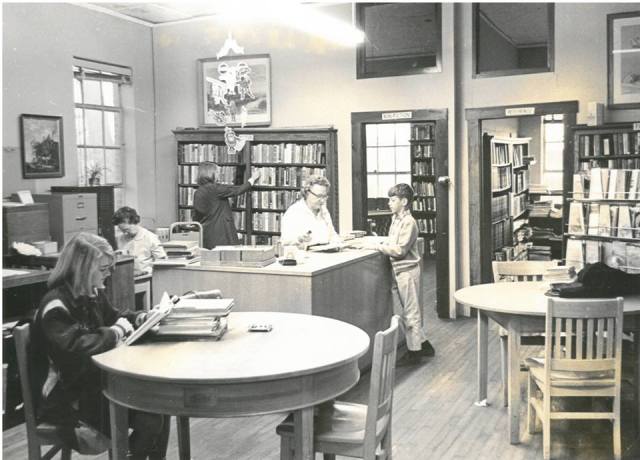
Have a look at this gem from the files of the Lawrence County Public Library! This photo is from around 1965, when the library was on the second floor of the old City Hall building.

260556_460747787452865_3740593916490942764_n

Posted in Uncategorized | Leave a comment

A Drunk History of Lawrenceburg

The city of Lawrenceburg voted for total prohibition of alcohol sales almost twenty years before the United States passed a Constitutional amendment to do the same, and the action sparked the outrage of Lawrence County’s German population.

Lawrence County has had a complicated history with the issue of alcohol sales.

For the first eighty years of the county’s history, alcohol–mostly in the form of whiskey–could be obtained easily and drank freely in our streets. County father David Crockett distilled his own brand of whiskey at Shoal Creek, and some early pastors were even said to have been sometimes paid in whiskey by their congregations. Indeed, it was not uncommon in those early days for jugs of whiskey to be used as currency in Lawrence County.

Throughout the nineteenth century, saloons, taverns, pool halls, and grocery stores in Lawrence County stocked and sold liquor with relative ease. People also gathered in grocery stores to drink at all hours of the day.

When the blacksmith Lewis Kirk shot and killed Giles County farmer Robert Westmoreland on the Square in Lawrenceburg in 1859, it was a Tuesday afternoon, but Kirk, himself, may have well been the only sober person on the Square at the time. Many of the witnesses testified that they had spent most of the afternoon drinking at the grocery stores around the Square. Many of those witnesses also recalled seeing other witnesses drunk or near-drunk, including the town’s doctor, who apparently operated on Westmoreland after spending the afternoon drinking with the other bystanders.

Public intoxication, as might be imagined, was a serious problem in those days. It was not uncommon to see men–even public officials–passed-out drunk in the streets for days at a time.

Clerk and Master W.T. Nixon recorded in his journal on at least one occasion in the 1880s that he was unable to have a deed recorded at the courthouse because the Register of Deeds was drunk in his office that day.

Most accounts of violent crime recorded in local newspaper articles and county court minutes at that time began with drunkenness and ended with tragedy.

Although an organized temperance movement existed in Lawrence County as early as the 1840s, it apparently was not enough to curb the thirst of the county’s drinkers. By the turn of the 20th century, a group of Lawrenceburg citizens had had enough.

On the week of March 20, 1901, a large crowd assembled at First Methodist Church and voiced their desire for Lawrenceburg to be reincorporated with a new charter that declared alcohol sales within the city limits to be illegal.

A week later, a majority of Lawrenceburg’s voters chose to make Lawrenceburg a “dry” city, and the city’s charter was abolished and reincorporated by the state legislature later that summer. Under the new city government, saloons were shut down and the sale of alcoholic beverages was put to an end.

But not everyone was pleased with the demise of alcohol sales in Lawrenceburg.

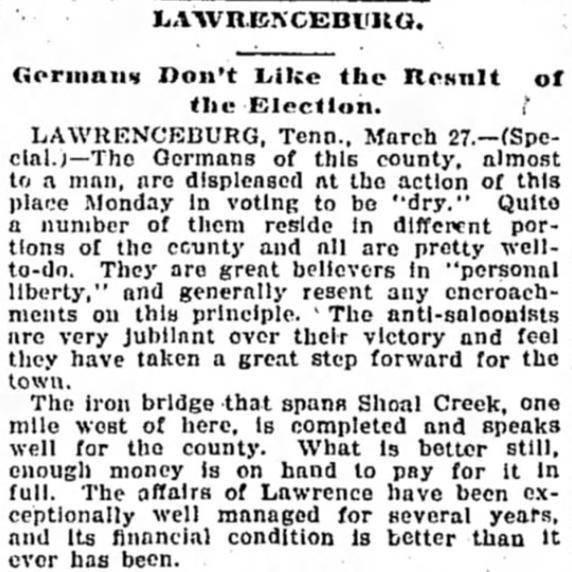
According to a brief article in The Nashville ‘Tennessean’ of March 28, the county’s many German immigrants were greatly “displeased” by the results of the referendum. The paper cites the German citizens’ love for individual liberty as the reason for their displeasure. However, it should also be noted that many of these German immigrants brought their cultural affinity for alcohol with them when they came to Lawrence County, and we have evidence that a great number of them found success making wine and brewing beer on their farms.

The prohibition of alcohol was one of the earliest progressive causes to take hold in Lawrence County and throughout the South. In most of these cases (although we can’t be sure locally, due to lack of written evidence), the most outspoken champions of prohibition were women.

12745796_973254146098246_6974563845268529749_n

Posted in Uncategorized | 1 Comment

Librarians of Yesteryear

When the Lawrence County Public Library was first established in 1941, it was situated in a room on the second floor of City Hall. The current library building was built in 1970 and expanded in the 1990s.

Do you have any memories of that first library in City Hall? Let us know in a comment!

12654626_448384758689168_1329422365173016068_n

Posted in Uncategorized | Leave a comment