Murray First Attracted By Friendliness of Lawrenceburg

Bicycle and lawnmower manufacturer Murray Ohio was the largest local employer that our area has ever known. Practically everyone in Lawrence County had a relative who worked at the plant in its local five-decade history, and the plant’s presence in Lawrenceburg undeniably shifted the fortunes of our community for the better.

But have you ever stopped to ask why Murray chose Lawrence County?

They almost didn’t.

But one thing changed their minds.

According to a 1986 ‘Times Daily’ interview with Murray executive Cromer Smotherman, Murray made the decision to relocate from Ohio in 1955 due to increasing competition from other manufacturers near their Cleveland plant.

After making the decision to relocate, Murray hired the Fantus Company of Chicago to advise them on potential places for relocation. Fantus examined several criteria, including utility costs and available manpower. Fantus chose five communities in Middle Tennessee for Murray’s consideration.

Lawrenceburg was the last community on their list, and by the time the Murray officials had seen the first four communities, most of them had decided to skip Lawrenceburg in favor of one of the other places. But the Fantus Company insisted that the Murray officials come to Lawrenceburg and meet some of the people.

And although Lawrence County was not as competitive in other areas as the other four communities, it was the people of Lawrence County who changed Murray’s mind.

Although the city officials who met the Murray men had no idea what company they represented, they went out of their way to show them hospitality, and the people of the county made them feel very welcome. Not long after, the decision was made to relocate the Murray plant to Lawrenceburg, and the rest is history.

The hospitality, friendliness, and civic-mindedness of the citizenry of Lawrence County helped bring about the largest economic boom our county has ever known, one which completely altered the course of our area’s future.

As Cromer Smotherman said, “It was the people they first met when they got to Lawrenceburg that caused the decision to be made to move here.”

On a personal note, I (Clint Alley) encourage you to do as our parents and grandparents did; take pride in your hometown, and go out of your way to brag on the good things about it. You never know who might be listening, and what good might come from telling the world that you are proud to be from Lawrence County, Tennessee.
10574384_773858586037804_789998304690551708_n

Photo Credit: Florence ‘Times Daily’
Posted in Uncategorized | Leave a comment

These Veterans of 1812 Were Still Living in Lawrence County 70 Years Later

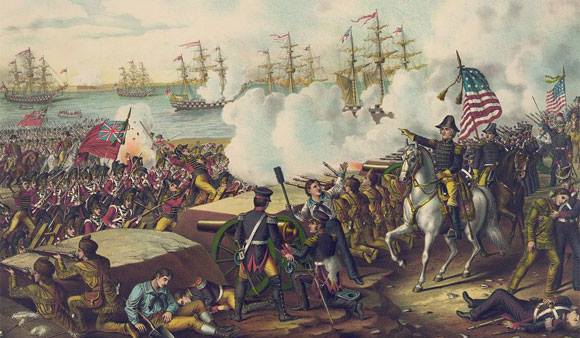
The War of 1812 is commonly referred to as our ‘Second War of Independence’ because it was the second time the United States defeated the British. And, years after the smoke finally cleared, many of its veterans called Lawrence County home.

In 1883, the Secretary of the Interior compiled a list of people who were drawing pensions from the United States government for military service. While the great majority of these pensioners were disabled Union veterans of the Civil War (Confederate pensioners were not counted, as they were ineligible for Federal pensions), some of the pensioners named on the roll were still drawing pensions for services rendered in the War of 1812 and the Mexican War, respectively.

In Lawrence County, 30 pensioners were counted in 1883. Among these, 3 men were recognized as War of 1812 veterans, and 10 women were recognized as widows of War of 1812 veterans. The rest were probably all disabled Civil War veterans of the Union army and Union widows.

The three War of 1812 veterans still living in Lawrence County in 1883 were William Pollock of Henryville, Robert B. Williams of Lawrenceburg, and David Adkinson of Wayland Springs, all of whom were born in the 1790s.

Pollock served in Colonel Robert Steele’s 4th Regiment of West Tennessee Militia, in the company commanded by Captain James Shinault. Pollock’s regiment was raised to serve in the Creek War, and spent a great deal of their service guarding wagon trains of supplies and building boats to transport supplies down the Coosa River.

Robert B. Williams served in the 1st Regiment of West Tennessee Militia, commanded by Colonel Philip Pipkin. Williams was elected as one of the sergeants of his company, and later promoted to quartermaster sergeant. The 1st Regiment, like the 4th Regiment, was raised to fight against the Red Stick Creeks in the Creek War, but, according to the Tennessee State Library and Archives, the 1st Regiment spent the duration of the conflict garrisoning 4 forts near Mobile, where they were ravaged by disease and desertion.

David Adkinson served in the 5th Regiment of East Tennessee Militia, commanded by Colonel Edwin Booth. This regiment was organized at Knoxville and ordered to the vicinity around Mobile to protect the area against any Indian or British attacks. Adkinson was mustered into service on November 13, 1814, in Rhea County, Tennessee and was discharged on May 13, 1815 at Kingston, Tennessee, completing the six-month term of enlistment that was required of most militia companies.

The names and addresses of the widows of War of 1812 veterans still living in Lawrence County in 1883 were as follows:

Martha Broadway, Fall River
Polly Pennington, Henryville
Martha Hail, Knob Creek
Sally Adkinson, Lawrenceburg
Elizabeth Counce, Lawrenceburg
Martha Blair, Lawrenceburg
Mary Oglesbay, Lawrenceburg
Elizabeth A. Gibson, Lawrenceburg
Sina Eakin, Lawrenceburg
Rebecca Newton, Pleasant Point

For their service, the veterans and widows named above received pension payments of $8.00 per month from the Federal government, which would be the equivalent of around $200 per month today.

10177497_772454252844904_7223316022962227737_n

Artist’s rendering of the Battle of New Orleans

Posted in Uncategorized | 1 Comment

The Coldest Day Lawrence County Has Ever Know

It’s been a little chilly out today, but it’s mild outside compared to what it was 49 years ago today. On January 30, 1966, Lawrence County reached its record low temperature of -14 degrees Farenheit.

Posted in Uncategorized | Leave a comment

The Bridges of Lawrence County

Lawrence County is a land of many creeks, so it should come as no surprise that the county is also home to 195 bridges.

According to the Tennessee Department of Transportation, the oldest operating bridges in Lawrence County are 2 concrete tee-beam bridges and 2 concrete culverts on Pulaski Highway, just east of Lawrenceburg, all of which were built in 1929.

The iconic old steel truss bridge which crosses Crowson Creek on the Old Waynesboro Highway, across from the entrance of David Crockett State Park in Lawrenceburg, was built in 1933.

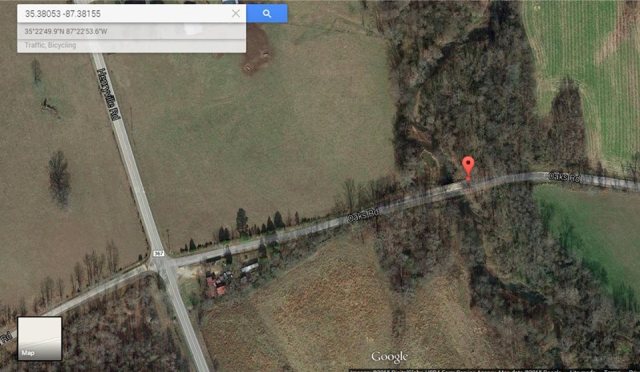
Of Lawrence County’s many bridges, only one is currently rated as structurally deficient by the State of Tennessee (as of its inspection of June 10, 2013). Bridge number 500A1150001, where Oaks Road crosses the West Fork of the Buffalo River, just southeast of Henryville, and just east of the intersection of Oaks Road and Henryville Road, was given a sufficiency rating of 45.4 by the Tennessee Department of Transportation. This bridge was built in 1984 of prestressed concrete.

The Oaks Road bridge’s location is marked by the red balloon on this map.

However, state officials assure us that a bridge’s structural deficiency rating is no cause for panic. As TDOT spokeswoman Heather Jensen told reporters from WSMV-TV, “Just because a bridge is structurally deficient doesn’t mean it’s unsafe.”

1604615_768166516607011_9099966609255199887_n

Source: Google Earth

Posted in Uncategorized | Leave a comment

The Battle of Fairside Park: An Early Reenactment in Lawrenceburg

Did you know that one of Lawrence County’s earliest recorded battle reenactments occurred in front of the old grand stand at Rotary Park, more than 85 years ago?

When we think of reenacting today, we are probably more likely to think of Civil War reenactments, where modern men dress in Civil War-era clothing, fire reproduction Civil War weaponry, and display Civil War-era military tactics.

On November 11, 1927, however, a different kind of reenactment happened in Lawrenceburg.

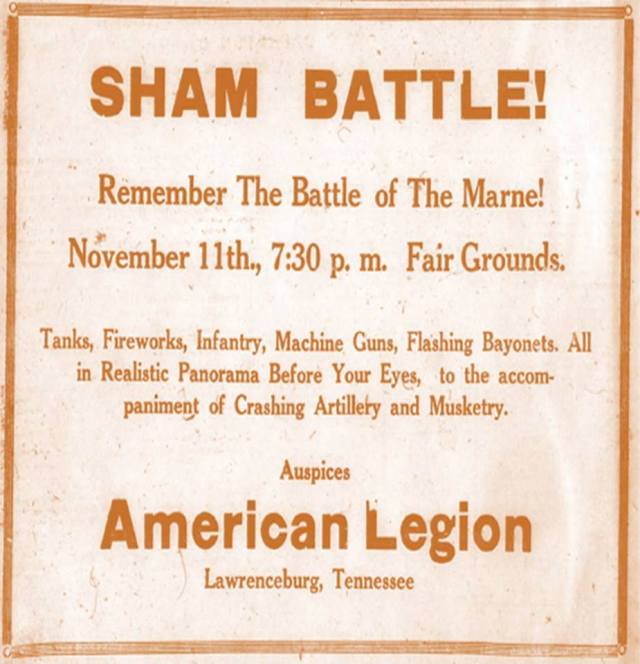
That day, as part of the Armistice Day celebrations marking the ninth anniversary of the end of World War I, the local American Legion sponsored a “sham battle,” or reenactment of the Battle of the Marne. As the event was sponsored by the American Legion, no doubt many of the participants of the reenactment were World War I veterans, themselves.

As this ad says, the reenactment included “tanks, fireworks, infantry, machine guns, flashing bayonets…to the accompaniment of crashing artillery and musketry.” The event was watched by a huge crowd that the Lawrence ‘Democrat’ said “packed and jammed the big grand stand at the fair grounds.”

10896963_764999276923735_4274843489311531362_n

Source: Lawrence ‘Democrat.’

Posted in Uncategorized | Leave a comment

How The Democrat-Union Got Its Name

Have you ever wondered why Lawrence County’s oldest newspaper is called the ‘Democrat-Union?’ And what connection does James D. Vaughan, the father of Southern Gospel music, have to the name of the paper?

The answer is that it was once two separate and distinct newspapers. In late 1925, the owner of the Lawrence ‘Democrat’ purchased the “plant and business” of the Lawrence ‘Union,’ both of which had served Lawrence County since the 1880s. The reason? James D. Vaughan, the father of Southern Gospel music, was publishing a rival newspaper at the time known as the Lawrence ‘News.’

In their farewell editorial on December 23, 1925, Charles T. Crawford and Joe Schade, the respective owners of the ‘Democrat’ and the ‘Union,’ explained that they had arranged the merger because they felt that the businesses and people of Lawrence County had been unnecessarily financially burdened by the existence of three newspapers, and that by merging the papers, they believed they could strengthen the community.

Although, according to Schade and Crawford, they both lost money in their quest to help the community. In their own words, “….the facts are that Mr. Schade sold the plant and business for less than it was worth, and Mr. Crawford bought something that he did not need, and at a price consequently that he could not well afford to pay, simply in order to lessen the burden of three papers.”

And so, eighty-nine years ago this month, on January 13, 1926, the first issue of the paper was published under its new name of ‘Democrat-Union.’ This image shows the first time the new name was used on the paper’s masthead.

8996_764049750352021_7002161220977163659_n

The first issue of the newly-named ‘Democrat-Union.’

Posted in Uncategorized | Leave a comment

You’ll Be Amazed By What They Found Hidden Upstairs In This Old Movie Theater

Have a look at what the staff of WDXE Radio found upstairs at their station!

The WDXE station is located in the old Princess Theatre building on the Lawrenceburg Public Square. The 500-seat capacity Princess Theatre was Lawrenceburg’s prime motion picture venue until the 1,200-seat Crockett Theater opened its doors on North Military Street on September 13, 1950.

This paper was probably used to identify shipments of movie reels in transit. The fragments of tape in this photo are from the Vaughan Printing Office, which stood just a few yards away from the Princess, on the site of the old Suntrust building which currently houses the James D. Vaughan Southern Gospel Museum. Vaughan operated a diversified media empire from that location, including a singing school, a printing office, one of the first radio stations in Tennessee, and one of the South’s first independent record labels.

Thanks for sharing this awesome treasure with us, WDXE!

10906046_1559306450993382_6119421855082225699_n

Photo source: WDXE Radio Facebook Page

Posted in Uncategorized | Leave a comment

When Most of Lawrence County’s Men Were in Uniform

According to an early-20th-century estimate found in the Lawrence ‘Democrat,’ around 1,600 Lawrence County men volunteered to serve in the Confederate army in “home organizations” in 1861.

In addition to the young men who marched off to war from Lawrence County to serve in the regular Confederate Army, this number probably also included older men who volunteered to serve in the militia-style home guard groups of “minutemen” which were organized in each civil district in the first months after Tennessee’s secession from the Union.

These home guard units were generally manned by men whose age or infirmity prohibited them from serving in the regular army. They were like paramilitary neighborhood watch organizations. While it is possible that they may have drilled once or twice, they probably saw very little combat, if any, and most home guard units probably dissolved after Union forces gained control of Tennessee in early 1862.

While the newspaper excerpt in question cites no source for its estimate–and it appears in an advertisement urging young men to join the Army during World War I as their fathers had joined the Confederate army in 1861–I calculated what percentage of Lawrence County’s 1860 population would have been in service to the Confederacy during that first year of war if the number was accurate.

Regardless of the type of unit volunteered for, that number indicates that at least 17% of Lawrence County’s total population and a whopping 40% of its white male population was in uniform at the outset of the Civil War. While we are not given an estimate of the ages of those volunteers, if that number is accurate, it would account for 92% of Lawrence County’s men aged 15-50.

If that same proportion of men were to volunteer for military service today, it would mean that more than 7,100 men from Lawrence County would be in uniform.

10931009_762403030516693_195508393193407939_n

Posted in Uncategorized | Leave a comment

The Missing Flag of Sacred Heart School

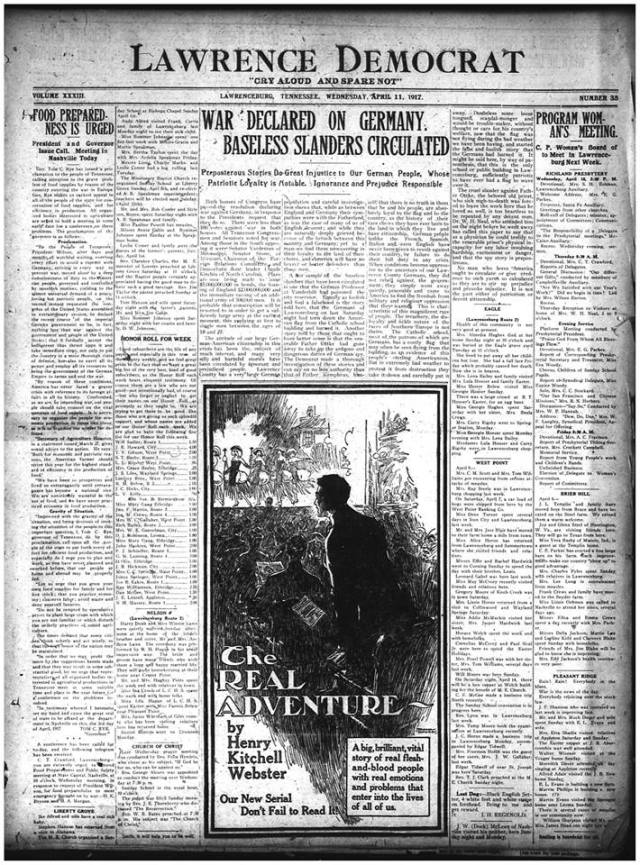
Did Lawrenceburg’s German Catholics tear down the American flag flying above Sacred Heart School in Lawrenceburg and burn it in the yard when the United States declared war on Germany in 1917?

No, they certainly did not.

But unfortunately, that did not stop that rumor–and many others just as malicious–from spreading rapidly through the county when the United States entered World War I.

At that time, Sacred Heart School of Lawrenceburg owned a very large, very beautiful, and very expensive American flag, which flew from the school. Interestingly enough, the Lawrence ‘Democrat’ reported that Sacred Heart School was the first public building in Lawrence County to ever fly the American flag–apparently even predating the court house!

To protect the flag from the elements, it was the habit of school officials to take it down during inclement weather. Such was the case on April 7, 1917. As is normal for our area in the springtime, several bands of thunderstorms had pummeled Lawrence County that day, and school officials took the flag indoors to protect it.

Unfortunately for school officials, their timing could not have been worse. The day before they removed the flag, the United States had declared war on Germany, marking our nation’s entry into World War I. Some of the town’s non-German population noticed that the flag was gone, and as Sacred Heart Church and Sacred Heart School had been founded by German immigrants, the false rumor spread that the town’s German inhabitants had torn the flag from its pole and burned it in response to the United States’s declaration of war on Germany.

In addition to the rumor regarding Sacred Heart School’s flag, it was whispered about town that Father Ottke, an elderly and kind-hearted old German priest, had left Lawrenceburg in order to be a German spy. However, in addition to being the victim of ignorance and xenophobia, Father Ottke, like the school officials, was probably also the victim of bad timing. He had left Lawrenceburg about the time that war was declared on Germany, but, as Dr. Neal told the ‘Democrat,’ Father Ottke had left town for his health, as he was far too old and feeble to be a spy for anyone.

Contrary to these idle rumors, Lawrence County’s German population remained, on the whole, extremely loyal to the United States throughout both world wars.

The Lawrence ‘Democrat’ had harsh words for those who perpetuated such rumors against the county’s German population: “No man who loves America ought to circulate or give credence to such yarns so calculated as they are to stir up prejudice and provoke injustice. It is not the part either of patriotism or decent citizenship.”

10917335_761675213922808_8884890600923985967_n

Posted in Uncategorized | Leave a comment

Baby it Was Cold Outside

This 1914 advertisement from George Brothers Dry Goods in Lawrenceburg seems especially fitting for this week! Bundle up and stay warm, Lawrence County!

10922777_760103480746648_522092108011370987_n

Posted in Uncategorized | Leave a comment