The following is a portion of an article called ‘Around the Square, 1918-1922,’ by Mrs. Docia Spann Richardson (many of you may remember our previous posts about Mrs. Richardson, as she was the second woman to vote in Lawrenceburg’s history).
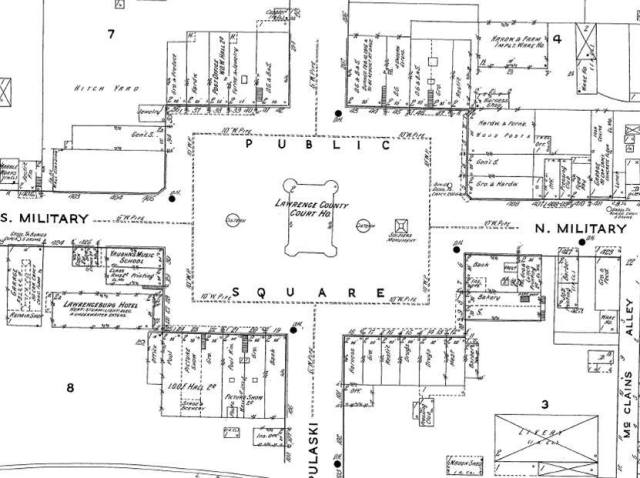
The article was published in the ‘Democrat-Union’ on May 7, 1981, and it contains Mrs. Richardson’s reminiscences of what the Lawrenceburg Public Square looked like in the year immediately following World War I. The image attached is an insurance map of the Square drawn in 1916. Many of the businesses mentioned in the article appear on the map.
“…Beginning at the corner of Pulaski Street (north side) and the Square was Bell’s Harness Shop. George Bell and son made and sold harness. North of Bell’s was a grocery store–Allgood and Anderson’s.
Next to the grocery, according to Raleigh Vernon Beckham, a Mr. Hass had a jewelry store. Adjacent to it was the Crowder-Beckham-Finley drug store, and next door the three Stockard brothers–Dr. Tom, Dr. Charles, and Parkes–operated a drug store. In the corner, R.W. Caldwell had a men’s and boys’ ready-to-wear shop called the Toggery.
A small barber shop was attached to the building just around the corner from The Toggery. It was open both to the Square and to a large hitch yard that was adjacent to this northwest corner of the Square.
In the first building directly on the Square, just around the inside corner from The Toggery, was Jim Giles’ office. He bought and sold cotton, and later he and Mrs. Giles opened a ready-to-wear and piece goods store at this location.
I cannot remember who was in business next door, but I do recall that W.S. Dustin and James T. Dunn had an office somewhere along here. They sold insurance.
(Prior to 1918, possibly around 1914, a large auditorium was located on the second floor of the building now occupied by White’s Department Store. On its stage local high school societies–the Atheneans and the Striblings–would present variety shows, such as lively debates and oratorical contests. Only young men participated in those activities; the young women presented recitations and choral numbers.)
The First National Bank was on the corner. J.H. Stribling was president and continued this post until his death in the early 1950s. James T. Dunn, James E. Spence, and Villard Richardson were some of the early cashiers.
On the second floor of this building was several offices. Among them was that of H.D. Derrick, attorney. His secretary was Miss Lurline Freemon, who was considered to be the best legal secretary around. The office of Robert B. Williams was adjacent to Derrick’s, and next to it was the office of Jerome Boynton and Warren Short, realtors.
Across North Military Street, on the corner, Tom S. Springer had a grocery store. Next to it was A.B. Sidowey’s Department Store.
Adjoinging it was M. Richardson Hardware Co. The store’s slogan was “Everything for the home and farm.” The writer of this article was assistant bookkeeper and stenographer with the firm at this time.
At about this time, probably in 1919, Kuhn’s opened its doors as Lawrenceburg’s first “5-10-25” store. To the south of Kuhn’s, Alec George had a general merchandise store.
Next to George’s was Comer’s Dry Goods, with J.F. Comer as owner and manager. Will Harvey and Elizabeth Bell North were clerks. (Later, in 1925, C.W. Moore, Sr. and sons C.W. Jr., and James Y. went into business at that location; the latter is still in business there.)
At that time Sherman Kelly had a store on the corner of the Square and Waterloo Street. He sold ready to wear and piece goods. When Kelly retired, A.B. Sidowey moved his business to this place. Two of the clerks were Mary Gaither and John Hendrix. (Later, Kuhn’s moved to this location, and for many years the Hovelmeir sisters, Kate and Annie managed the store with great dedication and efficiency.)
Dr. J.W. Danley had his offices on the second floor of this building. He was a general practitioner as well as an ophthalmologist. His wife, genial and personable “Miss Nettie,” joined him and Ed McNeal, receptionist, as assistant.
Memory fails me with respect to the building across Waterloo Street on the corner. It is likely that several businesses were in and out of that building. Next door, to the south, was McClanahan & Wall, funeral directors.
At this time, the Post Office was on the west side of the Square, next to McClanahan & Wall. Inside, the walls were plastered, painted white. Long desks, about three feet high, were placed along the walls for the convenience of patrons, and above them dates were inscribed.
Locke and Webb Hardware adjoined the Post Office, and in the corner was Dwiggins’ Grocery, owned by S.M. Dwiggins. When the owner’s health failed, Dolph Clayton bought the business and operated a flourishing grocery store until his health forced his retirement.
Another large hitch yard opened onto the Square at this point. Just around this inside corner, in a small frame building, Miss Eula McAdams had a millinery shop. Next door, Mr. and Mrs. W.R. Lewis had the Racket, selling such items as china, cut glass, crystal, silver and figurines.
At that time there were two buildings where the parks-Belk store is now located; C.W. Moore, Jr., recalls that Locke and Webb sold heavy farm equipment in the one next to the corner building, where the Stockard brothers had a drug store. Stanley Tinin, Sr., was the pharmacist.
On the second floor was, to the best of my knowledge, the first hospital in Lawrenceburg and possibly in Lawrence County. Dr. W.P. Bowen was the surgeon and Miss Bessie Keeling the nurse. When this building burned, Bowen went to another city and the drug store was moved to the east side of the Square as has been mentioned earlier.
Across South Military Street, the rudiments of vocal music was taught at Vaughan’s School of Music. A print shop published gospel song books, featuring shaped notes. Each year, a new book was published.
The east part of this building (which later became the Coffee Shop, an extension of the Lawrenceburg Hotel) served as headquarters for the Lawrence News, a weekly newspaper published by James D. Vaughan from 1919 until it was discontinued in 1938.
In 1922, Vaughan founded radio station WOAN, the first radio station in Tennessee. The broadcasting room was over the print shop.
Farther east, adjacent to the Vaughan building, was the Lawrenceburg Hotel, owned and operated by Mrs. Dora Robertson. A two-story porch ran the length of the front of the building, and hotel guests enjoyed sitting out on summer evenings, just talking and watching the comings and goings around the Square.
At that time the dining room was in the main building, back of the lobby. Waiters would bring in large trays of food in small individual bowls and platters. Mrs. Robertson served simple wholesome foods such as beans, cabbage, and potatoes, and for dessert, mostly fruit cobblers.
In the corner, Dr. Bill Gallaher had an office. Adjacent to it was Mrs. Flora Harvey’s tea room. Her hot chocolate was a special treat for us young ladies who worked in the various stores and offices around the Square.
Louis Rhulander notes that around 1922, this building housed Tripp’s Pool Room.
Next door was the Jitney, which showed silent movies, and at times presented local musicians, one of whom was Harry Gilmore. Movie stars appearing on the Jitney’s silent screen included Mary Pickford, Douglas Fairbanks, and Pearl White. Lurline Freemon comments that she and her friends never missed an installment of “the Perils of Pauline.” Other entertainment featured traveling groups such as “The Lyceum,” which presented musical programs.
A grocery store was next to the Jitney. It was owned by Jim Crews and carried what then was an up-to-date line: staples, vegetables, some fruit, but no fresh meat since that was before the time of proper refrigeration.
Upstairs, over the grocery store, were law offices. Tom Helton specialized in researching deeds, and W.H. (Bid) Lindsey was a trial lawyer.
Another poolroom was next door to the grocery, and directly north of the poolroom was a café owned by Taylor Bentley. When he left to open a general store just beyond the Shoal Creek bridge on the Waynesboro Highway, C.A. Freemon and his nephew Oscar opened a funeral parlor and furniture store there.
The Lawrence Bank and Trust Company had been on the corner of the Square and Pulaski Street since 1909, having vacated the building on the corner of the Square and south Military bought by James D. Vaughan. One of the bank officials was Hart Phillips, who built the big frame house on the northwest corner of Pulaski Street and Locust Avenue (U.S. Highway 43).
The Square of sixty years ago was the business center of the community. And although today’s square is beautiful with its corner plantings and brick walkways, the old Square had its own uniqueness and appeal.”







 Lawrence County History Trivia