Lawrence County’s Spookiest Stories: The Glowing Tombstone

Near the back of an old cemetery in the western part of Lawrence County, so the story goes, there is a tombstone that glows an eerie green. Although we don’t know exactly why, there are plenty of people who have seen it happen.

Several years ago, Nick Harris and three friends piled into a Dodge Daytona and went out to see if it was really true.

When they arrived at the cemetery in the dead of night, they saw nothing but pitch darkness–at first. It wasn’t until they turned to leave that one of them noticed a faint green light coming from the back of the cemetery.

Nick’s friend Bill Allen led the party toward the stone, which continued to glow with that otherworldly green light until they reached it. When they got to the stone, it stopped glowing.

“I’ve never been so scared in my life,” said Harris.

The Glowing Tombstone has long been an object of fascination for many Lawrence County people. What makes it glow? Why does it glow only on certain nights? Is there just one Glowing Tombstone or are there many?

What do you think?

**As a reminder to our readers during this special series of local spooky stories, we at Lawrence County History Trivia do not condone trespassing or vandalism. Vandalism of a cemetery in Tennessee is a Class E felony, and carries a maximum sentence of six years in prison and a fine of $3,000.**

Posted in Uncategorized | Leave a comment

Lawrence County’s Spookiest Stories: Mt. Zion

The place called Mt. Zion is in the remote southern part of the county, near the Alabama line, in a beautiful clearing beside Sugar Creek. At a hollow between the rugged ridges, in a peaceful place where the woods break, there sit two churches and a sprawling antebellum cemetery at a fork in the road.

The older of those two churches, Mt. Zion Methodist Church (pictured here), is listed on the National Register of Historic Places, and is believed to be the oldest Protestant church building in Lawrence County. A suspension footbridge crosses Sugar Creek nearby. Locals call this the “Swinging Bridge,” and there has been a variation of that bridge in the same place for over a century.

The cemetery probably has around 500 graves, including a rare grave-house and the final resting places of several of the area’s earliest settlers. It is likely that their slaves are probably buried in unmarked graves toward the back of the cemetery.

Mt. Zion is not far from the site of the Battle of Sugar Creek, which was the last battle of the Civil War fought in Middle Tennessee.

In the spring and summer, Mt. Zion is a lovely place that beckons Sunday afternoon picnickers, hikers, and anyone who wants to dip their toes in the cool water of Sugar Creek.

Perhaps it is because the place is so remote, or perhaps because the cemetery is so old, or perhaps because the surrounding hills make the little valley seem a little darker at night; whatever the reason, Mt. Zion is said to be one of the most haunted places in all of Lawrence County.

Those who are brave enough to go there after dark claim to have seen ghostly figures moving slowly among the gravestones of the old cemetery. Some have felt the Swinging Bridge jerk and sway violently while trying to cross at night. And many folks claim to have heard dreadful moans and screams from the surrounding woods.

One spirited group of paranormal enthusiasts also claim to have recorded what they believe to be the heated cries of a Bigfoot at the place in the spring of 2008.

Have you ever encountered anything spooky at Mt. Zion?

12191579_914250008665327_2553447780933864859_n

Posted in Uncategorized | 27 Comments

Lawrence County’s Spookiest Stories: The Whistling Patty

This week, in honor of Halloween, we will take a look at some of our county’s local ghost stories and spooky tales. Tonight’s post is about Whistling Patty.

Whistling Patty–sometimes known as Screaming Patty–is not necessarily a person. It is not necessarily an animal. No one is quite sure what the Whistling Patty is, but everyone who has seen it agrees that they do not want to see it again.

Some of our readers have told us that they have encountered Whistling Patty while in the woods late at night in the northern part of the county, specifically around Anderson Creek and Summertown. It is described as a predatory creature that makes noises similar to a baby crying or a woman screaming.

Dwayne Stewart told us in 2013 that he had encountered the Patty while coon hunting along Anderson Creek many years ago. He said you could always tell when the Patty was nearby because the dogs would come back frightened and refuse to hunt, and that many older men refused to hunt the area at all because of the Patty.

One of those older men claimed that he once watched as the Patty killed several of his dogs, and then followed him back to his truck.

Have you ever seen or heard the Whistling Patty?

Posted in Uncategorized | Leave a comment

A Courthouse Ahead of its Time

The 1905 Courthouse which once sat at the center of the Lawrenceburg Square was an imposing and beautiful building.

But did you know that it was also ahead of its time?

When the courthouse was under construction, the Lawrence ‘Democrat’ reported that it would be wired for electricity and telephones.

That doesn’t seem like a big deal to us today, but when you consider that there were no electrical or telephone lines in town in 1905, it somewhat changes our perspective.

In fact, at the time they were building the courthouse, it would be two years before electricity was even available in Lawrence County.

The generation which built the 1905 courthouse believed in laying a good foundation for the next generation, even if it meant taking risks. They knew that the key to growing their community was to do things that their children would one day thank them for doing.

That is the attitude which fueled projects like the building of a beautiful courthouse with electrical hookups, opening a tuition-free high school years before most of the rest of the state did, and damming Shoal Creek to provide the people with reasonably-priced and reliable electricity.

12108122_912266542197007_8046824413290430085_n

Posted in Uncategorized | Leave a comment

The Buried Indian Treasure of Alexander Springs

Have you ever been on a treasure hunt?

One field in northern Lawrence County was supposedly a popular destination for treasure-hunting Indians in the early 20th century.

Past Lawrence County Historical Society president Bill Alexander described Seneca Field as an “abandoned field overgrown with sage grass, plum, and cherry trees.” It was just north of Weber City, on what later generations knew as the Tom Hampton Place. But this field, so it was said, contained a secret.

As the legend goes, the field was once a campsite for a band of traveling Seneca Indians. How and why a band of Seneca Indians came to create a campsite in southern Middle Tennessee is not retained in the story. The Seneca are native to the northeast and Canada, and their presence in our county would indicate that they were, indeed, far from home.

These Indians supposedly buried a large cache of gold in this field, in hopes of coming back to the place at a later time to retrieve it.

According to the tale as recounted by Alexander, the Indians never returned for their gold, and as late as the 1920s, fresh holes could be spotted there at sunrise, made by locals searching for the treasure. Indian people also supposedly came from far away to dig in the field.

Whether there was ever gold in Seneca Field is left to speculation. But the fact is, people did once frequently dig holes in the field searching for it.

I (Clint Alley) was reminded of this story while perusing some articles written by my great-uncle Bill Alexander this afternoon. But I first heard the legend from my grandfather Mack Kerr when I was a boy. My grandfather grew up in the vicinity, and he had heard the old story when he was a child. His mother (Bill Alexander’s sister, Florence Alexander Kerr) told him that she remembered seeing the fresh holes which periodically dotted the field in the early 20th century.

A similar buried treasure destination was Ivy Bluff, which was “on the north bank of Buffalo Creek, a few hundred yards below the crossing of Highway 43.” Although not as popular a location for excavation as Seneca Field, strangers also frequently dug holes near Ivy Bluff, searching for long-lost gold.

Posted in Uncategorized | Leave a comment

The Hunter and the Witch

As schoolchildren, many of us learned the tale of the Bell Witch of Adams, Tennessee. It is a timeless piece of state folklore. But did you know that Lawrence County is said to have had its own local witch in the county’s early days?

According to a 1915 Lawrence ‘Democrat’ article, “it was believed that there were witches in the community” when Lawrence County was first being settled in the late 1810s and 1820s. And one hunter believed that he may have killed one.

This hunter related to his friends and neighbors that each time he went hunting, he saw the same large deer, and this deer would leisurely come within a few paces of him. Several times, the hunter fired on the deer at point-blank range, but the deer was never injured, and it only scampered away.

The hunter determined that the deer was not a real deer, but a phantom deer or the spirit of a witch in the form of a deer. To test his theory, he molded a silver bullet and went hunting again.

In the field, the large deer approached him, and the hunter took aim and fired the silver bullet. Only this time, the deer was clearly injured, and limped away into the woods.

The hunter never saw the deer again, but not long after, an old woman of the community fell seriously ill. This woman “had been suspected of witchery” by her neighbors. The nature of the old woman’s illness is said to have been a secret among her neighbors, but soon word spread throughout the county that she had been seriously wounded by a silver bullet.

Lawrence County abounds with tall tales, legends, and ghost stories, and we will be sharing more with you occasionally throughout the month of October.

Posted in Uncategorized | Leave a comment

Going Old School…VERY Old School

The Lawrence County Schools System does its best to ensure that all of the public schools under its jurisdiction have up-to-date textbooks for our county’s students.

But did you know that more than a dozen private schools in Lawrence County are still using a textbook that was first copyrighted in 1879–completely by choice?

The Amish of Lawrence County do not send their children to public schools. The issue of private education and compulsory attendance in schools is what drove many Old Order Amish settlers from other states to Lawrence County.

Unlike some other states, Tennessee allows Amish communities to set up their own parochial schools. These Amish schools begin for children who are seven years old and never go past the 8th grade; the Amish believe that any education past the 8th grade is superfluous to the agricultural lifestyle they lead.

One of the textbooks used by the Amish schools is McGuffy’s Fourth Eclectic Reader, which was a staple in American elementary schools from the late 19th century through the early 20th century, but which was long ago replaced in public schools by more modern readers and textbooks.

McGuffy’s Reader contains brief excerpts of many poems and short stories chosen for younger children to practice reading. Each selection typically teaches a moral or ethical lesson.

Amish education focuses heavily on the basics of reading, writing, and arithmetic. Amish children do not study history or science, and although they speak a dialect known as Pennyslvania Dutch at home, they are exposed to the English language at an early age in order to communicate with their non-Amish neighbors and for business purposes.

The school in this photograph is the Amish school on South Brace Road in Ethridge.

To see the McGuffy’s Fourth Eclectic Reader, follow this Google Books link:

https://tinyurl.com/y3afv9fu

12140565_908119112611750_289791632978637421_n

Posted in Uncategorized | Leave a comment

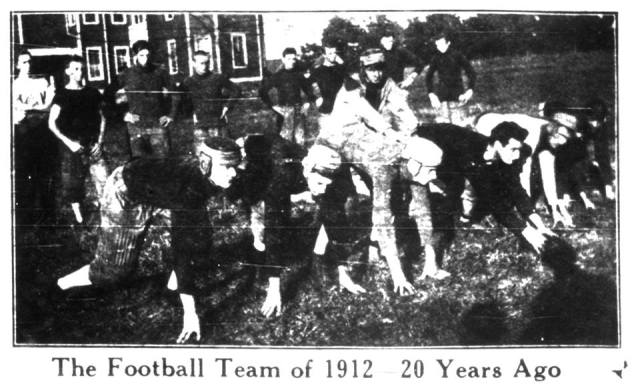
The LCHS Football Team of 1912

Friends, I apologize for my long period of silence. I have been busy finishing the long-delayed and hopefully-anticipated book version of ‘Lawrence County History Trivia.’

But I am pleased to announce that, after a few final edits, I will be sending the final draft to the publisher this week! I will announce online when and where it is available for purchase.

In the meantime, since we are well into football season, please enjoy this photo from the 1912 season of one of Lawrence County High School’s earliest football teams.

LCHS’s first football team was formed in the summer of 1910, and the game was played continuously at LCHS for the next 12 years. At that time, football was controversial and extremely dangerous. The Lawrence ‘Democrat’ in 1912 published a quotation which said that football was “rougher than prize-fighting.”

Players were protected by flimsy pads and helmets in those days, and the rules of the game forbade substitutions, forcing injured players to continue playing. Among the host of dangerous maneuvers which were legal in those days was ‘spearing,’ the act of stopping an opposing player by ‘spearing’ him headfirst.

The LCHS football program was discontinued for a decade following a 1922 matchup with Centerville in which the opposing quarterback suffered a broken neck and died. It was reestablished in 1932, and has continued uninterrupted for 83 years.

12107013_904999476257047_8534101292231730632_n

Posted in Uncategorized | Leave a comment

Tied to the Whipping Post

In Lawrence County’s early days, people convicted of petty theft were sometimes whipped in public as punishment.

Crime and punishment were quite different in those days. Some of the most common offenses in Lawrence County’s first years were gambling and debt. In the August 1819 session of the circuit court, four men were fined $5.00 each after being caught gambling.

Similar rulings occurred that year against men found guilty of not paying their debts.

Patrick Gillespie was found guilty of petit larceny on October 6, 1825. As punishment, he received “twenty-five lashes on his bare back.”

When T.J. Lindsey was found guilty that same year of marrying a second time in Illinois while his first wife was still alive in Tennessee, his wife Nancy was granted a divorce from him.

In 1833, John Brandon became the first Lawrence Countian to be sentenced to the state penitentiary for horse-theft. For that crime, Brandon received a sentence of three years in the new state prison in Nashville.

In 1835, thirteen men were found guilty of gambling, and each was ordered to pay the $5.00 fine for that offense. (Five dollars in 1835 would be about $113 today, after adjustment for inflation).

T.J. Deavenport was found guilty of betting on elections in 1839, and ordered to pay a fine of $5.00, although, unfortunately, the court record does not tell us if Deavenport’s money was riding on the Whig candidate or the Democratic candidate that year.

Posted in Uncategorized | Leave a comment

The Eyeless Fish of Depot Street

Are there eyeless fish swimming deep beneath Depot Street in Lawrenceburg?

There certainly were in 1891.

That October, future mayor of Lawrenceburg J.W. Garrett dug a well on some property he owned on Depot Street. At that time, there was not much north of Depot Street but rolling fields.

The Lawrence ‘Democrat’ explained that, after much hard digging, Garrett struck “a cave through which runs a large stream of water.” This subterranean river quickly filled the bottom of Garrett’s well, and despite the fact that a steam pump labored over the site for eleven hours, “the pool at the bottom of the well was not lowered a fraction,” and everyone was relieved to find that plentiful water could be had at the north end of town.

Garrett’s well, however, contained something besides water.

Not long after striking water, Garrett began to catch eyeless fish in the well, which is a good indicator that he had, indeed, struck a cave. The ‘Democrat’ put it this way:

“Jim Garrett will take pleasure in describing the blind fish taken out of his well at the depot, or he will show you the fish if he has any of them on hand. Being eyeless, they are readily caught with the hand.”

Most such blind fish are found in caves, like the Spring Cavefish, which was first discovered in a well like Garrett’s in Lebanon, Tennessee.

As we have mentioned before, there exist many old legends of a giant cave beneath downtown Lawrenceburg. As late as the 1960s, some old men claimed that they had gone into the cave as boys in the late 1800s from its entrance southeast of the Cumberland Presbyterian Church, and many such “old-timers” believed that the cave stretched from there all the way to Mile Crossing, where North Military Street crosses the railroad tracks.

Posted in Uncategorized | Leave a comment