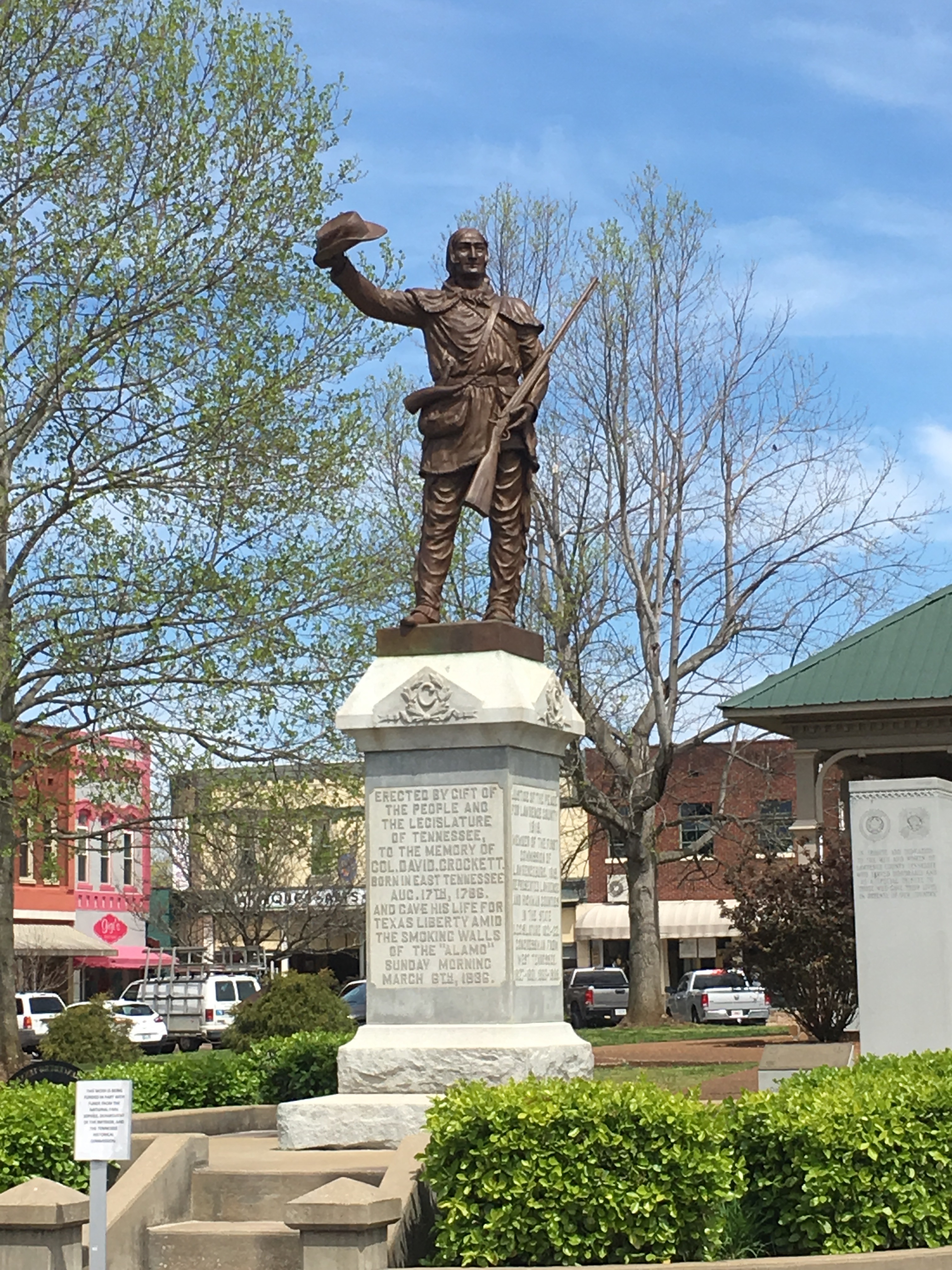
In our last post, we explored the exceptional nature of Lawrenceburg’s statue of David Crockett compared to the counties around us. Today, in order to provide some local historical context to the ongoing debate about Confederate statues, I would like to examine the story of how one of those neighboring counties spent more than thirty years working to erect a monument in memory of its Confederate veterans.
The following essay was written by Lee Allen Freeman, a loyal fan of Lawrence County History Trivia and venerated local historian of Lauderdale County, Alabama. Lee is the head of the Local History and Genealogy Department of the Florence-Lauderdale Public Library, and has spent many years studying the history of our area. I am pleased to share his essay as a guest post.
“The Monument that Almost Wasn’t: Lauderdale County’s Confederate Monument.”
By Lee Freeman
All Florentines have seen him, standing sentinel in front of the courthouse in Florence. Perhaps you’ve wondered who he is and how long he’s been standing there. Or, like me, perhaps you’ve been to the courthouse so often that you’ve simply taken his presence for granted and no longer stop to consciously think about him. I’m referring of course to the Confederate monument which stands outside our courthouse, which commemorates the men from Florence-Lauderdale who died fighting for the Confederate cause in the Civil War.
With everything going on lately I thought it might be beneficial to consider the history of our Confederate monument. Perhaps a better understanding of the history of the monument and the ladies who raised the money to build it, will be helpful. In what follows I have tried to be non-partisan, only setting forth the history of the monument. What follows should not be taken as an endorsement of either slavery or the Confederate States of America. To paraphrase a comment made several years ago by Virginia Civil War historian Dr. Ervin L. Jordan, the job of the historian is neither to praise or condemn, but to explain.
The Ladies Memorial Association, composed of “noble women, many of them with broken hearts,” who “still cherished the memory of the Southern cause as sacred, and honored those who gave their lives in defense of the principles of this beautiful Southland,” was founded, with Mrs. Fannie Louisa Pickett (1817-1907), wife of former Confederate Col. Richard Orrick Pickett (1823-1898) as president, in 1869. Mrs. Pickett served two years, until she was succeeded by Mrs. Ophelia Cutler Smith (1835-1906), wife of former Confederate Cutler Smith (1837-1905). “Before the organization of a memorial association these devoted women, under the leadership of Mrs. Cassity, cared for the graves of their heroes.” The late Dr. Larry Nelson of the University of North Alabama in his July, 1988 Alabama Review article insists that the Ladies Memorial of Association was only officially organized in 1876.
By 1876 plans were afoot by the Ladies Memorial Association for a Confederate monument “to be erected on the square just north of the Court house and barber shop.” A conscious choice was made to erect the monument in that year, which also happened to be the United States’ centennial. To that end a fundraiser was held which netted $140 ($100 of that total being donated by a Tuscumbia resident). By 1878 the Association had decided to parcel out the monument’s base in blocks to be inscribed at $5 apiece.
In 1879 Capt. James Bowser, who owned a quarry “six miles below our [Florence] landing,” was contracted to supply about 60,000 lbs of stone with which to build an impressive monument and had actually set up “a derrick which is used in moving the stones that are being polished for the Confederate monument.” By 1881 only $650 had been raised with which to build the monument (which must have been intended to be a pretty huge monument if they needed 60,000 lbs of stone) however most of these funds had “run low and the work was suspended.” At a citizens’ meeting held in April of 1881, Col. Edward A. O’Neal, future governor of Alabama (1882-1886), offered a resolution which was unanimously adopted that transferred the unfinished monument, all of its remaining funds and all related matters to local contractor, undertaker and Florence mayor Zebulon Pike “Uncle Pike” Morrison (1880-1890). Unfortunately by 1889, no substantive additions had been made by the city to the statue, which was still essentially just the base, what the Florence Gazette described on April 28, 1883 as a “granite pile.”
The Florence Gazette considered the uncompleted monument “neither pleasant to the eye nor creditable to the patriotism of our people.” The Gazette agreed that times were “very hard” and that “we are all very poor; but it is due to the memory of the gallant dead, as well as to ourselves, that some steps be taken” to complete the monument.
Six years later when still no progress had been made, the Florence Wave (forerunner of the Florence Herald) sarcastically editorialized in March of 1889 that “the base of the proposed monument to the confederate [sic] dead of Lauderdale County, standing on the Court House square is a complete monument to the supineness of our people.” [Italics in original]
Undaunted by the seeming indifference, fundraising by the Ladies Association continued and a further $1,000 was raised by 1890. By 1890 however “in the general cataclysm in business, in which nearly all our banks went to the wall,” this money was lost and the ladies had to start their fund-raising efforts all over again. (The 1890 bank failures followed Florence’s 1887-1889 intense yet brief industrial boom, which saw the population increase from 2,000 in 1887 to 6,000 people by 1889.)
By 1894 still only the pedestal or base of the statue had been finished, the monument sitting “unfinished on Court square, next to the treasurer’s office,” and by then a debate had erupted over where it should be located, at its current location on Court Square, “at the intersection of Court and Tennessee streets, in the centre [sic] of the street” or in Monumental Park, site of a Confederate fort in 1862, now the site of the Florence-Lauderdale Coliseum. Monumental Park was originally designed to be a park containing a monument or monuments to the fallen Confederate soldiers of Florence, and though the space shows up on several decades of old city maps labelled “Monumental Park” the park was apparently never actually built.
The Ladies Memorial Association stated that it favored the Court Square location for its monument and would, “by representatives, go before the city council next Monday night to ask the consent of that body to have it placed there.” However by 1897 the statue had still not been completed and the issue of its location had still not been resolved; by this time many people were again arguing that it should be placed in the City Cemetery. In April of 1899 the Florence Times sarcastically noted of the unfinished monument that “all strangers in the city . . . enquire about it,—and the necessary answer is a humiliating one to all who have any pride in the city. Cannot the Ladie’s [sic] Monument Association hurry up with their movement to finish the memorial?”
By April of 1899 a chapter of the United Daughters of the Confederacy had been founded in Florence and the daughters soon became involved with the efforts to complete the monument. Significantly, one Cincinnati businessman with a company in Florence donated a large sum of money to assist with the monument’s completion and a few Union veterans from Florence also made donations.
Finally, by April of 1903, after nearly 30 years, the statue had been completed, apparently without any county or city funds whatsoever. According to the Florence Times the statue stood proudly
Upon the public square about 30 feet north of the Courthouse corner. It faces east on Court street, as if a constant reminder to the travelers of that busy thoroughfare that though prosperity may lift our city into high eminence, though commercial activity may drive us with a tyrant hand and the footsteps of our historic past may be blotted out by modern development, and though the generation of witnesses to the valorous deeds of our heroes may pass away—yet the recollection of their virtues, their patriotism and their brave devotion to duty, will ever dwell in the hearts of the people.
According to information recorded by Mrs. Amelia Camper (1855-1930), wife of Florence Times founder and Confederate veteran Moncure W. Camper, herself president of the Ladies Memorial Association in 1904, the monument itself consisted of a shaft of stone nearly 16 feet tall, surmounted by the 7 feet tall figure of a Confederate soldier, a lowly private, returning from the war, who has lowered his rifle, held in his left hand, while with his right he returns his bayonet, and has thrown down his knapsack, resting one foot on it. According to Mrs. Camper’s 1904 article the statues pose was deliberately chosen to suggest the return of peace.
Beneath the private on the sides of the pedestal was an inscription, which reads: “C. S. A. 1861-1865. Deo Vindice [Latin for ‘God will prove us right.’].” Another inscription on the shaft reads: “In memory of the Confederate Dead from Lauderdale County, Florence, Alabama. Unveiled with appropriate ceremonies April 25th, 1903. . . . Glory Stands Beside Our Grief. . . The Manner of their Death was the Crowning Glory of their Lives.”
The statue was carved in Carrera, Italy (though we don’t know the name of the sculptor), and “after many delays” was finally delivered to Court Square on Wednesday, April 15 at about 9 am. The monument was officially dedicated on Saturday, April 25, 1903 Confederate Memorial Day, the day set aside to honor the Confederate dead, in an impressive ceremony at which an estimated 3,000-5,000 people were present, most likely including many local African-Americans which probably included a few local black Union and Confederate veterans. A procession traveled from the Female Synodical College (since 1913 the site of the John McKinley Federal Post Office and Courthouse), led by Maj. Alfred Moore O’Neal (1840-1909), a Confederate veteran, son of the late veteran and governor Edward Asbury O’Neal (1819-1890), and Commander of Camp Edward A. O’Neal, Sons of Confederate Veterans (SCV).
At the square “a platform had been erected for the most prominent actors in the proceedings, while seats were provided for as many of the visitors as could be accommodated.” The program began with a prayer by Confederate veteran Rev. AP Odom (1843-1916) followed by a chorus of children led by City School Superintendent HC Gilbert (1857-1944) who sang “America.” A speech was given by Massachusetts native, former Florentine and Confederate veteran Dr. HA Moody (1842-1916), a physician and professor at the State Medical College in Mobile, AL (formerly the physician at the Bailey Springs Resort). A song was then rendered by Florence’s Cornet Band. To close the ceremony Methodist minister the Rev. Mitchell Malone (1842-1927), a Confederate veteran and also county tax assessor offered a benediction. The United Daughters of the Confederacy (UDC) awarded Crosses of Honor to all the eligible Confederate veterans who were present.
In his address, Dr. Moody eulogized the “Lost Cause” of the Confederacy and praised the virtue and bravery of the men who sacrificed their lives for that “sacred” cause.
The monument itself was officially unveiled by 13 boys and girls, dressed in white with red ribbons, each a descendant of a Confederate veteran, at which time 400 school children broke out in song singing “Dixie.” The assembled veterans (about 100 were present) then let loose with the rebel yell.
After the dedication ceremony, in a touching symbolic gesture at the Florence City Cemetery during the Confederate memorial exercises, three Confederate veterans and three Union veterans shook hands over the grave of a fallen soldier (There was much pro-Union sentiment in Lauderdale during the war and between 1889 and 1905 Florence would have two different Grand Army of the Republic Posts for Union vets and these Union veterans were always invited to take part in Confederate Memorial exercises.)
When Florence’s third courthouse was built in 1965 it was built one block south of the site of the first two courthouses and the statue was moved from its original location after the third courthouse was completed.
And that’s the story of Florence’s Confederate monument, a monument which almost wasn’t.








 Lawrence County History Trivia