Marcella Falls: A Brief History

An ancient Native American rendezvous spot, a beautiful waterfall, and a thriving village now vanished?

Marcella Falls is a picturesque community about 13 miles northeast of Lawrenceburg, near the Giles County line. Factory Creek drops about 20 feet from a bluff at the confluence of three hills, forming a beautiful waterfall in the woods on private property.

In 1957, ‘The Annals of the Lawrence County Historical Society’ recorded a local story that Native Americans once held council meetings beneath “one of the huge oak trees still standing near one of the large springs” at Marcella Falls, and that they made pottery from the clay in a nearby field.

The place got its name from a teacher. According to an article written by Mary Ann Truitt Clayton, Marcella Paine was the educated daughter of a Maury County attorney who came to the mineral springs near the falls in an attempt to recover her poor health in the 1850s. While there, she worked as the tutor and governess of the children of A.O. Williams.

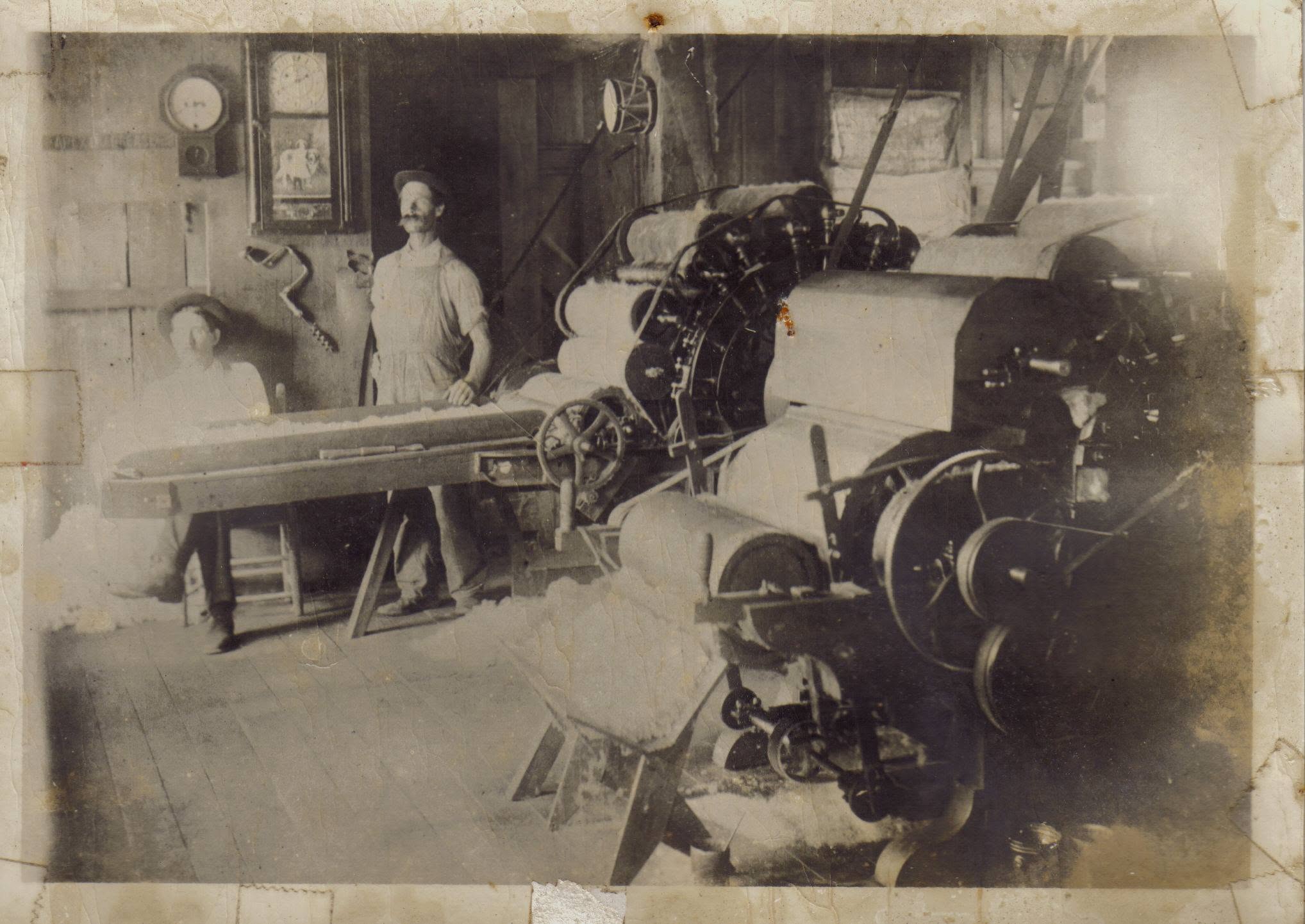
Williams saw the industrial potential of the falls when he came to Lawrence County in 1852. He and his brother harnessed the power of the falling water to operate a woolen mill, a tan yard, saw mills, and a gristmill at the falls in their prime.

The textile operation produced finished products that were shipped by wagon to Nashville and on to points far and wide. The mill also continued operation during the Civil War. According to his Southern Claims Commission application, Williams was an “uncompromising Union man” who had to smuggle his goods through the Federal lines to Columbia in order to avoid capture by Confederate soldiers.

After the war, the village around Marcella Falls continued to grow. By the time the railroad came to Lawrence County in the 1880s, Marcella Falls had a post office, churches, and a variety of small businesses clustered near the falls. However, the railroad eventually shuttered the little village by shifting commerce toward Ethridge. The post office closed in the 1890s, and by the 1920s almost all of the old businesses had dried up.

In 1925, E. Dan Smith attempted to convert the Falls into a private resort for friends and family, complete with a swimming pool and picnic area. However, Smith soon tired of nonrelatives coming to use the resort area and sold the land. The A.O. Williams cabin was renovated and preserved by Coach Ralph and Ethel Young Benson, and survives today near the Falls.

Photo: Old Jail Museum
Posted in Uncategorized | Tagged , | Leave a comment

The Pioneers of Pleasant Garden

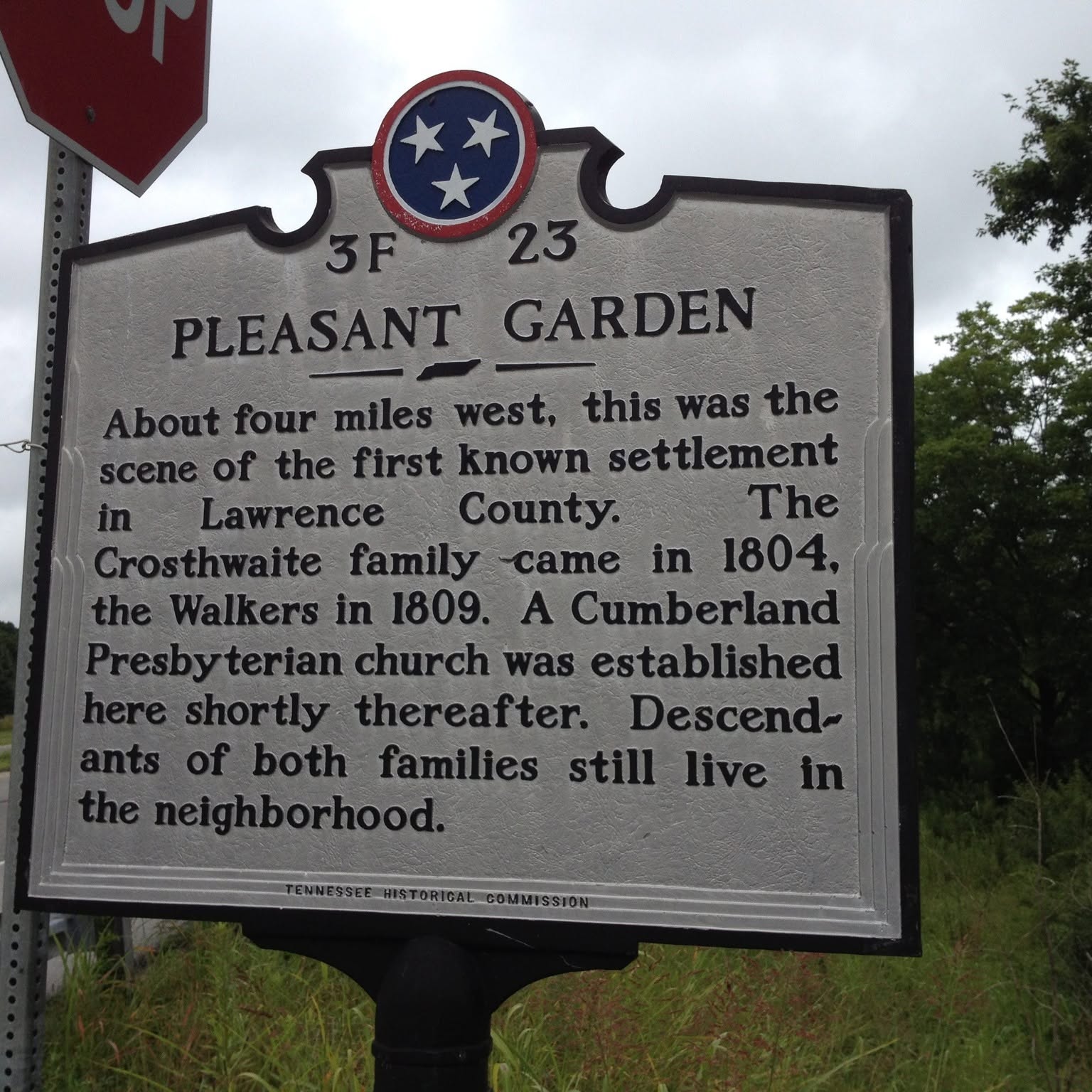
Today you may travel to the vicinity of Pleasant Garden to play a round of golf at Dixie Oaks Golf Club. But did you know that Pleasant Garden is probably also the site of one of the oldest settlements in Lawrence County?

According to an article in the ‘Annals of the Lawrence County Historical Society,’ the Crosthwaite and Walker families were some of the first white settlers in the land that would become Lawrence County. A tradition exists within the Crosthwaite family that their first forbears settled on Buffalo River in 1804, when this area was still the territory of the Chickasaw tribe of Native Americans. The Walkers, it is said, followed soon after in 1809.

What we know for sure is that Lawrence County’s earliest settlers were drawn to creeks and rivers like the land at Pleasant Garden. In addition to the plentiful drinking water provided by streams like the Buffalo River, the fertile bottom land surrounding the banks was rich in nutrients important for growing corn, cotton, and tobacco. Fast-moving water provided the necessary force to power gristmills and powder mills. Streams and rivers also provided abundant fish and attracted game which the first settlers relied on for meat.

Pleasant Garden, with its abundant timber, rolling hills, and well-watered valleys was no doubt a very pleasant place, indeed, for those first settlers, as it had been for millennia to the native peoples whom the settlers displaced. The Buffalo River was similarly enticing to the Penningtons and other families who settled near the modern location of Henryville–a few miles to the west–a decade later.

Pleasant Garden Cumberland Presbyterian Church, which sat just about 300 feet from the Buffalo River, was probably organized around 1815, and the Pleasant Garden Cemetery is believed to be one of the oldest cemeteries in Lawrence County that is still in continuous use.

County Historian Kathy Niedergeses wrote in ‘The Heritage of Lawrence County’ that the cemetery was probably established around 1819, and the remains of several enslaved people are believed to be buried in unmarked graves in the eastern section of the cemetery.

Posted in Uncategorized | Tagged , , | Leave a comment

The Lost Stand of Alexander Springs

A roadside inn, buried Indian gold, and a connection to Hellen Keller? Welcome to Alexander Springs!

On Highway 43, between Ethridge and Summertown, an old road winds through the hills and crosses the beginning of what becomes the Buffalo River. The road–Alexander Springs Road–roughly follows a path that has been traveled for more than two centuries, and it is the heart of a community that began many years before the first Alexander came to the area.

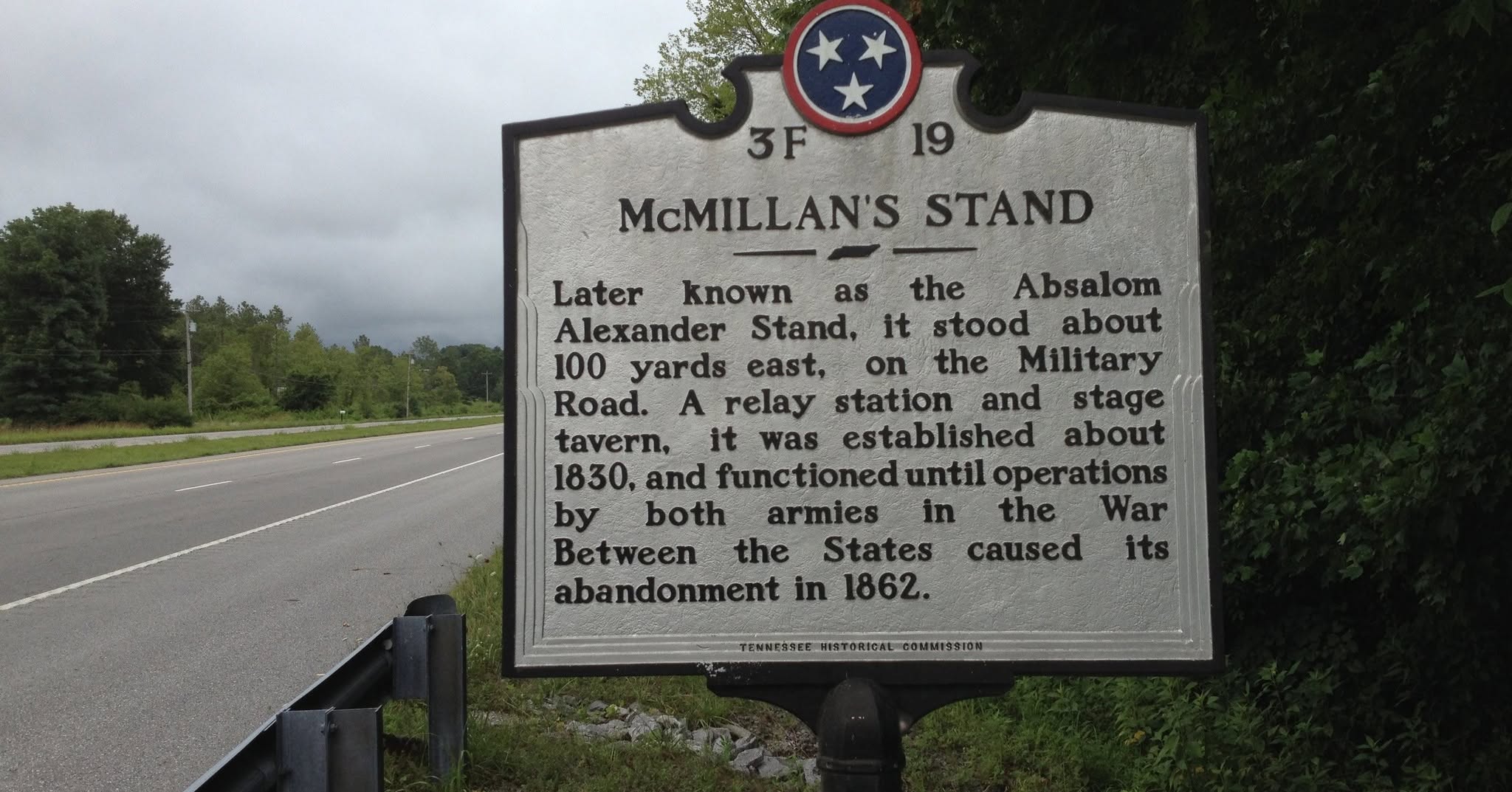
What we now call Highway 43 is the descendant of the Military Road, which was the main route from Nashville to New Orleans for many years. It was so-named because it was built by Army engineers from 1816-1820. Alexander Springs Road is part of the original route of that road.

At the place where the road met the Buffalo River, James McMillan operated a stand by at least 1835 and probably much earlier than that. A stand was a roadside inn where travelers could obtain room and board for themselves and their horses. In 1853, McMillan sold the stand and 550 acres to Absalom Alexander, who operated it with his wife Ellen Fields Alexander and their children.

According to family lore (Absalom and Ellen were my ancestors), a regular lodger at the Alexander Stand was Mary Keller of Tuscumbia, Alabama. You may not have heard of Mary, but you probably know about her granddaughter, Helen. As the story goes, Ellen became such close friends with Mary that she named one of her children in Mary’s honor. We can’t be sure if the story is true, but we do know that Ellen named her newborn son Mack Keller Alexander in 1855.

The stand and stable were dismantled during the Civil War to prevent soldiers from using the buildings. But the size of Absalom’s estate and the presence of so many excellent springs in the area leant the Alexander name to the area, and it has been Alexander Springs ever since.

A persistent legend about the community is that a group of Indians long ago buried gold on Ivy Bluff, near the old Stand. A group of Indians came to the area in 1939 claiming to have a map showing the location of the gold. Fresh holes dotted the bluff the next morning, and new holes were discovered in the area for many years.

Posted in Uncategorized | Leave a comment

The Execution of Andrew Blakemore

A daring raid, a final expression of true love, and an execution by firing squad?

It all happened in Lawrenceburg, 141 years ago today.

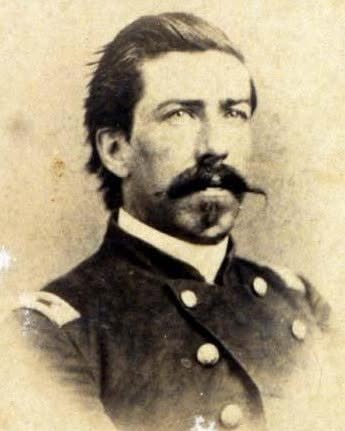
A Scottish immigrant and adopted northerner, Colonel George Spalding (pictured here) was certainly not a native of Lawrence County. As provost marshal of Union-occupied Nashville, Spalding is perhaps best remembered as the man who tried to fight the scourge of venereal disease plaguing occupying Union forces in Nashville by organizing one of the first systems of licensed prostitution in the United States. But Spalding stepped into local history on July 22, 1864, when he ordered the execution of a purported Confederate guerilla in Lawrenceburg.

Spalding and men from his Union 12th Tennessee Cavalry were on a five-day scouting mission from Pulaski to Florence when the incident occurred. In his official report, Spalding said, “I…sent parties to Waynesborough, Henrysville, [sic] and up Buffalo Creek and Shoal Creek. One of the parties were fired upon by a party of guerrillas. My men attacked them, killing one. The others made their escape in the woods. One guerrilla that was captured and brought to camp I had shot in Lawrenceburg, and made the citizens bury the body.”

That “guerrilla” was Andrew Blakemore, a 28-year-old husband and father who had completed his time in the Confederate army and come home. According to Bobby Alford’s ‘History of Lawrence County,’ the last letter that Blakemore wrote to his wife while being detained by Spalding’s men said, “I am accused of bushwhacking–God knows I am innocent of the charge, or of any other such acts.”

After his execution, Blakemore’s body was buried in Neal Cemetery on West Point Road. His epitaph reads, “Earth has no sorrow that Heaven cannot heal.” His wife Bathia, who never remarried, died in 1901.

The execution of Andrew Blakemore, although conducted by military officials and not by civil authorities, remains–as far as I can find–the only recorded public execution in Lawrence County history.

Posted in Uncategorized | Tagged , , , , | Leave a comment

When a Founding Klansman Killed a Former Confederate Spy in the Street in Lawrenceburg

A former Confederate spy killed in the street…with a shovel…by a founding member of the Ku Klux Klan? It happened in Lawrenceburg on this day in 1876.

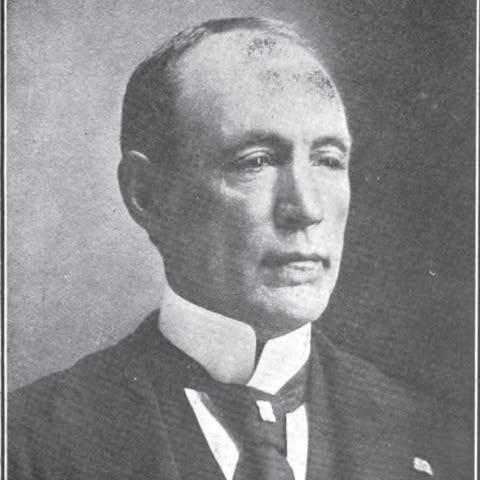
The Pulaski ‘Citizen’ tells us that on July 11, 1876, W.B. Chaffin was “drinking and creating a great disturbance” in Lawrenceburg. A constable attempted to arrest Chaffin, but was unable to complete the job alone, so Sheriff James K. Garner set out to bring Chaffin to justice. To aid in the task, Sheriff Garner summoned Circuit Court Clerk John B. Kennedy, pictured here.

Chaffin was the clerk and master of the chancery court during the Civil War. Despite taking the oath of allegiance to the Federal government and outwardly professing to be a Union man, Chaffin often harbored Confederate guerrillas in his home, and appeared around town to be quite familiar with their activities. During the Civil War, local Unionists suspected that he was a Confederate spy.

Kennedy was a native of Giles County, a veteran of the Confederate Army, and was one of the six original members of the Ku Klux Klan, which was founded in Pulaski in 1865. Some years after the war, he moved to Lawrenceburg, married the only daughter of Dr. Ephraim McClain, and settled in the house known as Monument Hill, just south of the Public Square.

When Garner and Kennedy approached Chaffin to take him to jail that day in 1876, Chaffin saw them coming, and drew his pistol on the sheriff. Acting fast, Kennedy took up a nearby spade and struck Chaffin in the head twice, the first blow with the flat side of the spade, and the second blow with the sharp edge.

The second blow fractured Chaffin’s skull. The paper tells us that Dr. Grant was summoned to the scene, but there was little he could do. Chaffin clung to life, and appeared to make a slow recovery until suffering a relapse of continual convulsions on November 30 of that year. He died on December 22.

The paper reports that Kennedy was to be tried for the action on July 19. Although it doesn’t give us the verdict, whatever punishment he faced must not have been too harsh; Kennedy is listed as among those who attended a reunion of the Third Tennessee Infantry in Lynnville the following October.

Posted in Uncategorized | Leave a comment

The Intruders on Shoal Creek

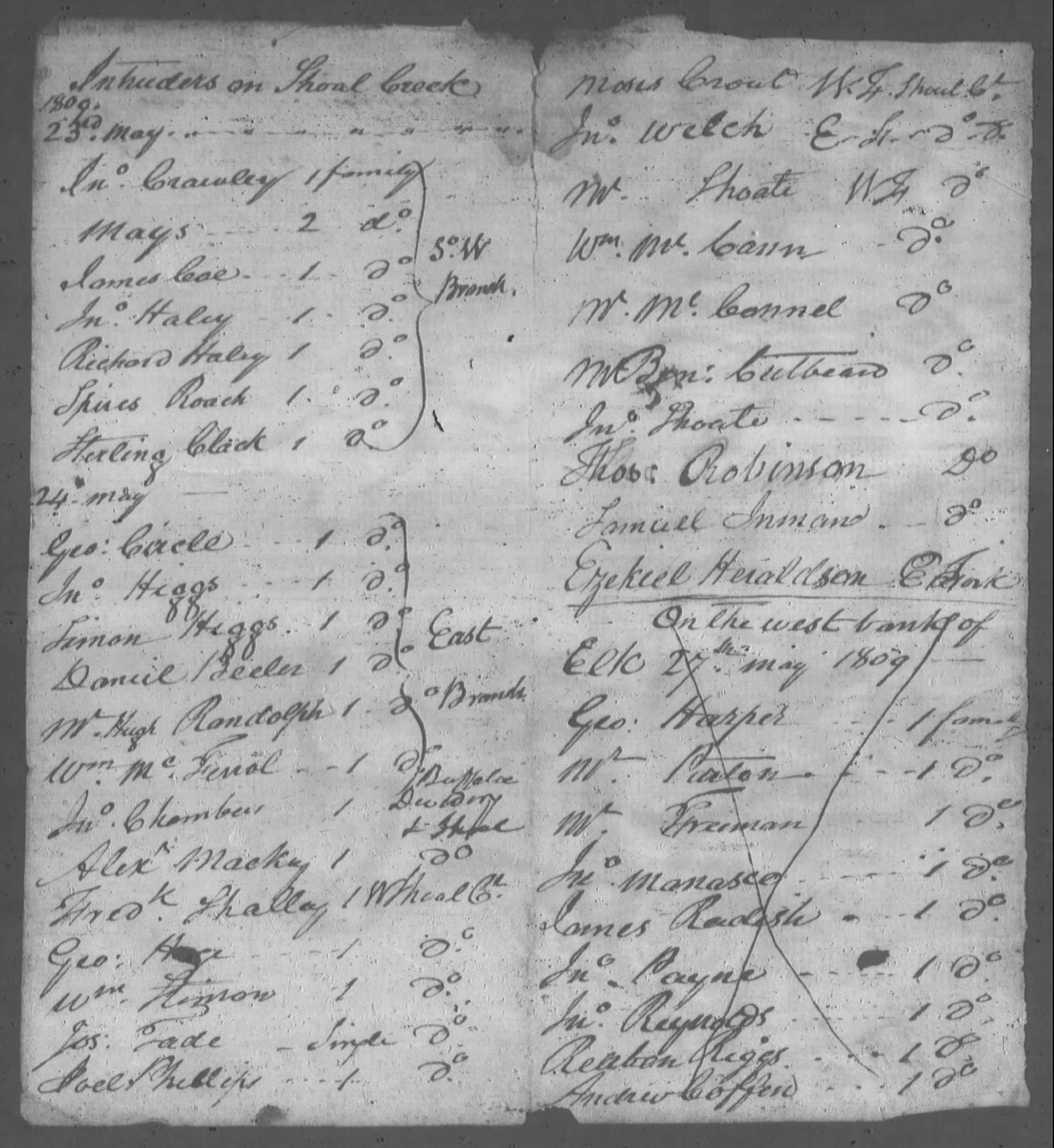
Do you recognize any names on this list of “intruders?”

Before the Chickasaw Nation ceded the land that would become Lawrence County to the United States government in 1816, the area was infested with squatters; whites who had moved to the area and built homes, farms, and businesses on the land without the tribe’s permission.

This list of ‘Intruders on Shoal Creek’ from May 23-24, 1809, contains a list of 31 families who were squatting on the land near Shoal Creek while it was still under native control.

Included in the list is Daniel Beeler, a man who would later become a prominent citizen in Lawrence County, and for whom the Beeler Fork of Shoal Creek is named.

Many of these families were forced to leave their illegally-claimed land by United States soldiers, but the tide of migration into Indian country became so impossible to control that, by 1816, the Chickasaw decided that it was best to cut their losses and take the meager sum offered for the land by the U.S. government.

Posted in Uncategorized | Leave a comment

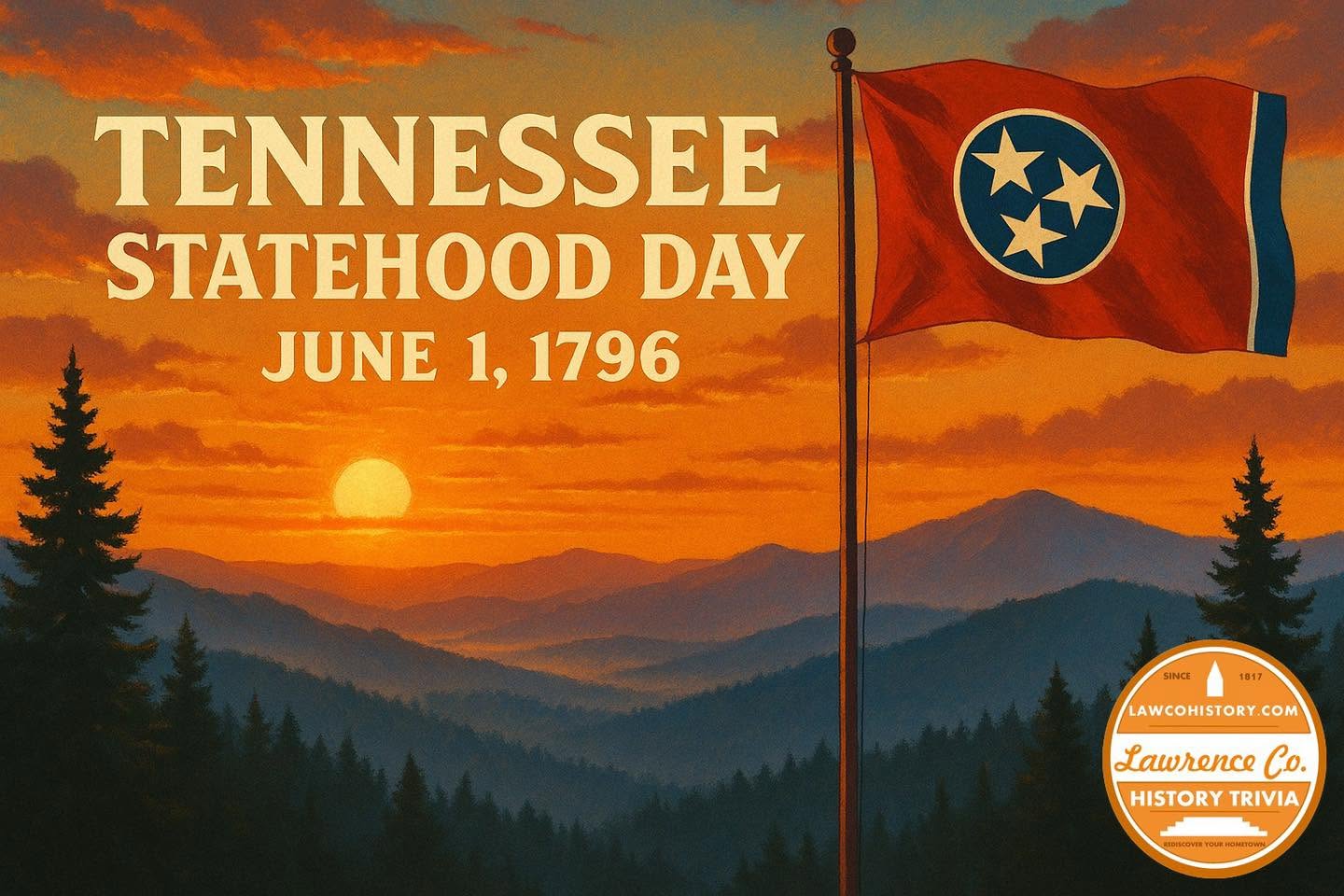
Happy Birthday, Tennessee!

Happy birthday, Tennessee!

Tennessee was first admitted to the Union on June 1, 1796 and had been a state for 21 years when Lawrence County was founded on October 21, 1817.

Tennessee’s road to statehood was long and arduous. In 1784, settlers in several western counties of North Carolina (an area that encompasses twelve modern counties in East Tennessee) formed an unauthorized state government which they called Franklin, wrote a constitution, elected a governor, and proceeded to exist in a state of political limbo for the next four years.

Neither the hapless Confederation Congress nor the State of North Carolina recognized the existence of Franklin, and after years of in-fighting and quarreling, Franklin dissolved and rejoined North Carolina in 1789. A year later, the Federal government organized the territory claimed by North Carolina west of the mountains into the Southwest Territory.

A 1795 census of the Southwest Territory showed it exceeded the population requirement for statehood. In a referendum that followed the census, voters in the territory approved the motion for statehood by a margin of 6,504 to 2,562.

After the referendum, Territorial Governor William Blount called for a constitutional convention in Knoxville to draft a state constitution. The 1796 Constitution allowed all free males who owned property the right to vote, regardless of race. This was a very progressive stance for the time. According to the historian J.G.M. Ramsey, Thomas Jefferson is said to have remarked that Tennessee’s 1796 Constitution was the “least imperfect and most republican of the state constitutions.”

The name “Tennessee” comes from the Cherokee word “Tanasi.” Although the exact meaning of the word is unclear, Tanasi was an important 18th-century Cherokee village in modern Monroe County. The village’s status as a trading center resulted in Europeans naming the river after the village. Thus, the name ‘Tanasi’ became the Tennessee River, and subsequently the State of Tennessee.

Tennessee was admitted as the sixteenth state of the Union on June 1, 1796, by a bill signed into law by President George Washington.

Posted in Uncategorized | Tagged , , | Leave a comment

Honoring The Dead: The Origins of Decoration Day

Have you ever been to Decoration Day?

The holiday has a long history in Lawrence County. Newspaper records indicate that it may have first been formally observed here in 1871 (although probably earlier) as a day set aside to decorate the graves of military casualties–specifically, casualties of the Civil War.

The immense human cost of the Civil War gave rise to the holiday. Because so many had died during the war, there was a common desire nationwide to honor that sacrifice by caring for and decorating their graves with flowers at a specified time each spring.

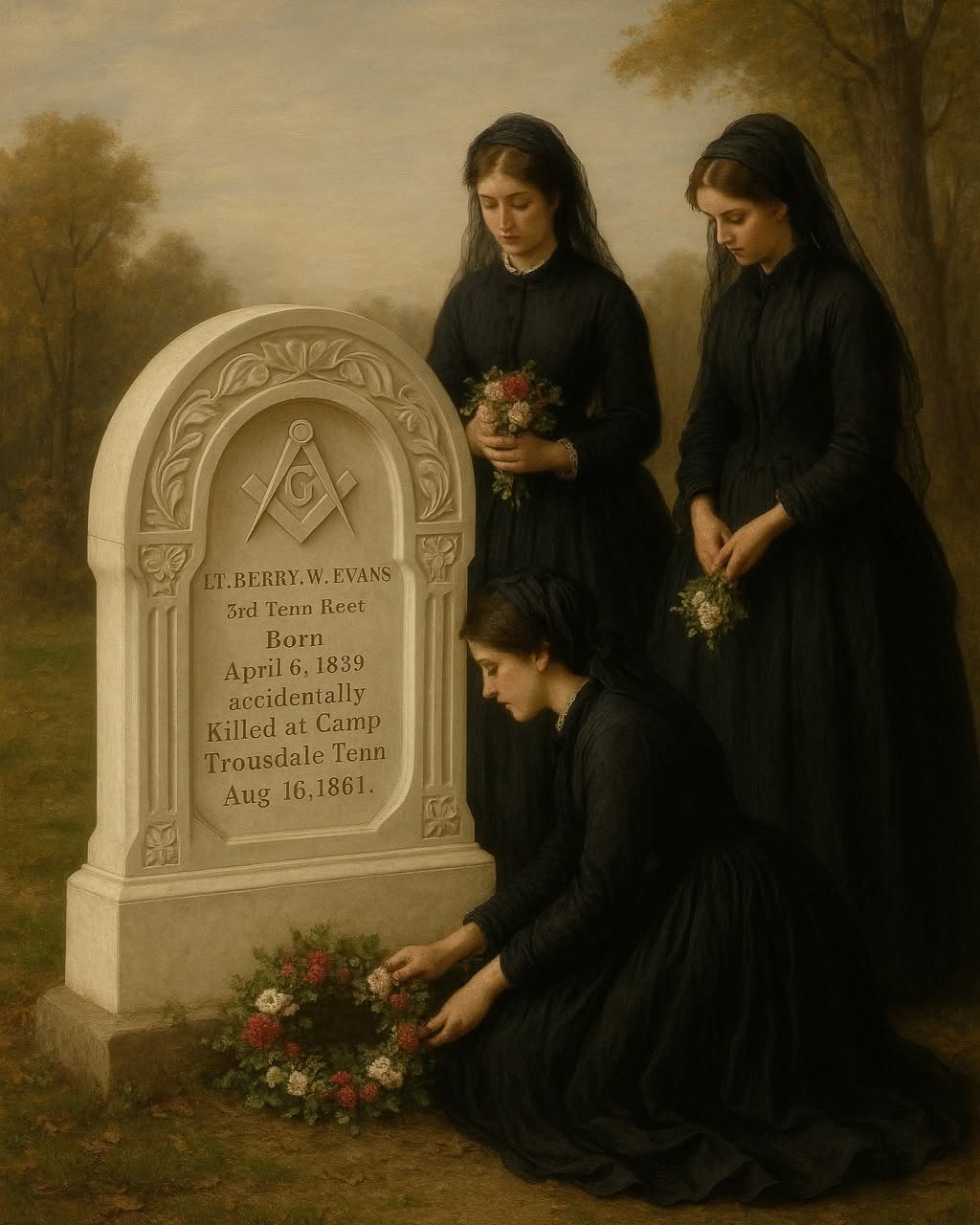
During those first Decoration Days after the Civil War, Lawrence Countians would have lain flowers on the tombs of men like Lieutenant Berry Evans, who is buried in the Old City Cemetery on Waterloo Street in Lawrenceburg. Evans, who was an officer in the Confederate unit known locally as the ‘Lawrenceburg Invincibles,’ was one of Lawrence County’s first Civil War fatalities. As his tombstone records, the popular young lieutenant was killed in training at Camp Trousdale in the summer of 1861 when a weapon accidentally discharged.

In those early days, Decoration Day was always celebrated on May 30. And, as time passed, the scope of the holiday broadened to include the decoration of the graves of men who had died in military service after the Civil War. In fact, a 1906 issue of the Lawrence ‘Democrat’ records that “no memorial day…has ever come around…when a better state of feeling has existed between the North and the South, and between the men who fought in the war, than now.”

The holiday became more commonly known as Memorial Day after World War II. In 1968, Congress set the date of the holiday to the last Monday in May. However, many local churches still observe Decoration Day sometime in the month of May as a time to remove old flowers and add new ones to the graves of loved ones in adjoining cemeteries.

Posted in Uncategorized | Tagged , , , , | Leave a comment

The Lost Reef

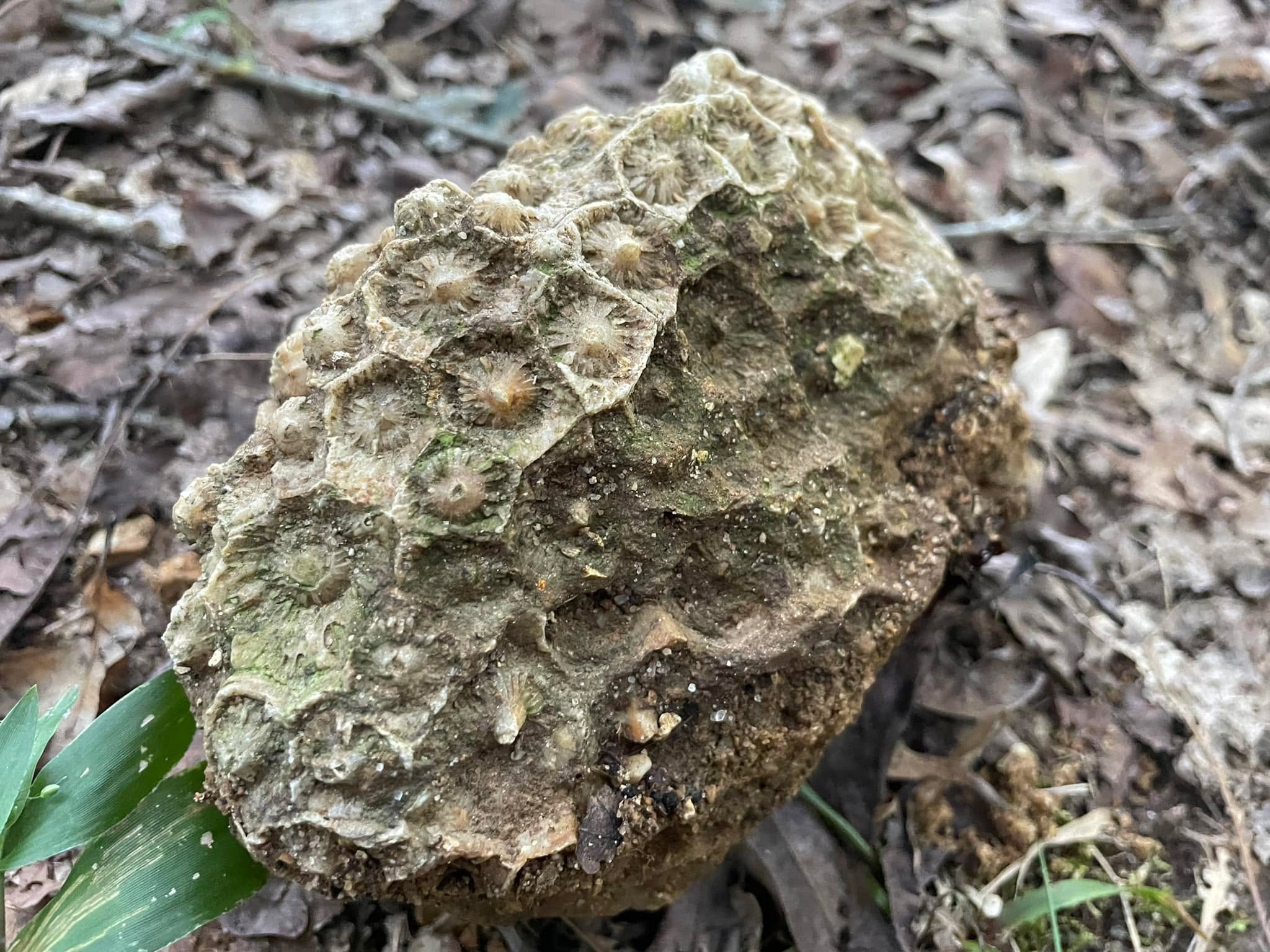
Have you ever found a cool fossil in Lawrence County?

I found this Acrocyathus fossil in western Lawrence County. The place where I found it was once covered by an immense colony of rugose coral. It thrived beneath the waters of a shallow sea.

We know this because the petrified ghosts of that reef litter the fields and woods today in thousands of honeycombed Acrocyathus fragments. They are exposed by the winter frosts and washed up by the summer rain.

When the sea dried up and the coral died, the reef was covered by mud and sediments. As the mud dried and the sediments hardened, the coral inside decayed and the cavities left behind slowly filled with minerals which, over time, formed fossils like this one.

According to the University of Kentucky Geological Survey, these fossils are approximately 330 million years old and are typically found in the geologic formation known as St. Louis Limestone. For more information about Acrocyathus, follow this link: https://tinyurl.com/ydwd7t6h

Leave photos of your favorite local fossil finds in the comments!

Posted in Uncategorized | Leave a comment

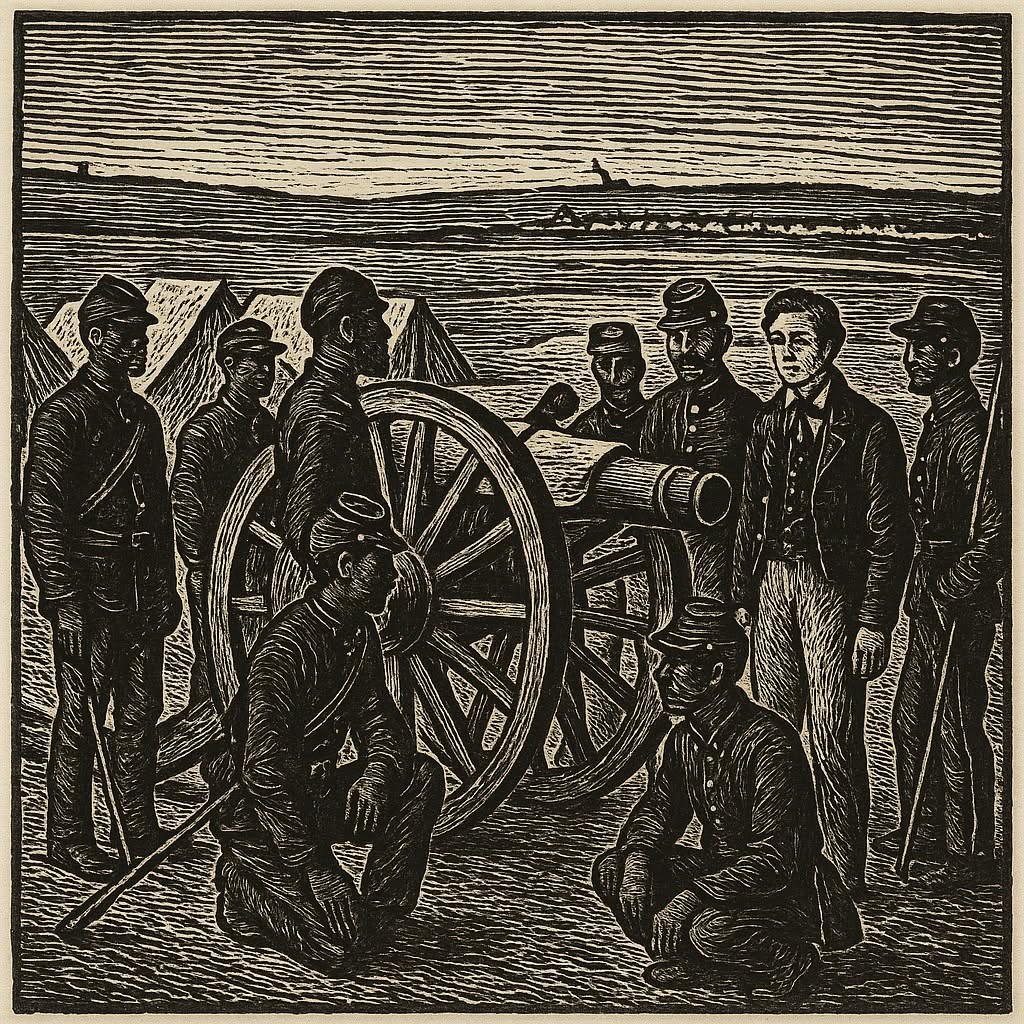
The Military Career of Corporal Silas Smith, USCT

On this day in 1865, one Lawrence County man was promoted to corporal in his artillery unit. Little did he know that he would make the ultimate sacrifice for his country in less than a year’s time.

Born free prior to the Civil War, Silas Smith was one of about a dozen “free people of color” living in Lawrence County in 1860. We don’t know the particulars of his case, but we do know that the 1860 census identifies him as being of mixed racial origins; one of the most likely scenarios is that he was probably the son of a free white mother and an enslaved African-American father.

In that 1860 census, Silas is listed as a 14-year-old free person of color living in the home of wealthy Lawrenceburg attorney and planter Lee M. Bentley.

Little is known of the circumstances surrounding Silas’s life, or why he was living in the household of a wealthy white family (the Bentley’s entire estate in 1860 would be worth over $1.5 million in today’s money).

We do know that Lee M. Bentley represented our county in the General Assembly of the state and that, according to an article of the Lawrenceburg newspaper ‘The Southern Flag,’ he also made a run for the Confederate Congress in 1861, just one year before his untimely death.

Regardless of Smith’s prewar position in the Bentley household, we know that he joined Battery A of the 2nd Light Artillery of the United States Colored Troops on April 10, 1864. The USCT was the segregated branch of the Union army created after the Emancipation Proclamation so that African-Americans could serve in the armed forces of the Union cause.

Despite Confederate threats to treat them as slaves in revolt if captured, more than 180,000 African-Americans joined the USCT, including ten Lawrence County men, four of whom would pay the ultimate price while serving their country.

Smith served with distinction through the remaining year of the Civil War, being promoted to corporal on May 1, 1865. After the war ended, Smith remained in the army in order to finish his three-year term of enlistment.

Unfortunately, he was admitted to an army hospital in Nashville on Christmas Day, 1865 with smallpox, and died on January 4, 1866.

Posted in Uncategorized | Tagged , , , , | Leave a comment