
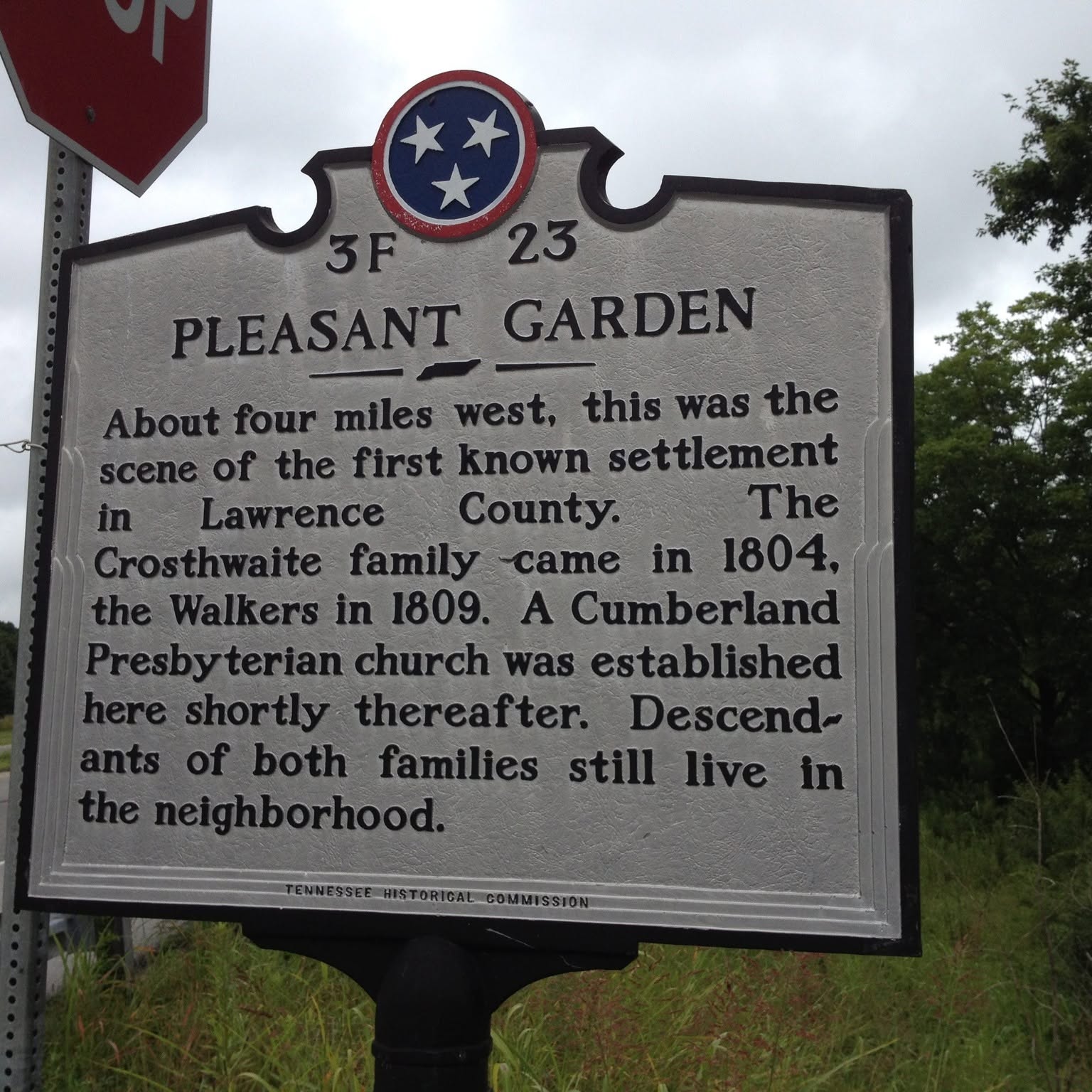
Today you may travel to the vicinity of Pleasant Garden to play a round of golf at Dixie Oaks Golf Club. But did you know that Pleasant Garden is probably also the site of one of the oldest settlements in Lawrence County?
According to an article in the ‘Annals of the Lawrence County Historical Society,’ the Crosthwaite and Walker families were some of the first white settlers in the land that would become Lawrence County. A tradition exists within the Crosthwaite family that their first forbears settled on Buffalo River in 1804, when this area was still the territory of the Chickasaw tribe of Native Americans. The Walkers, it is said, followed soon after in 1809.
What we know for sure is that Lawrence County’s earliest settlers were drawn to creeks and rivers like the land at Pleasant Garden. In addition to the plentiful drinking water provided by streams like the Buffalo River, the fertile bottom land surrounding the banks was rich in nutrients important for growing corn, cotton, and tobacco. Fast-moving water provided the necessary force to power gristmills and powder mills. Streams and rivers also provided abundant fish and attracted game which the first settlers relied on for meat.
Pleasant Garden, with its abundant timber, rolling hills, and well-watered valleys was no doubt a very pleasant place, indeed, for those first settlers, as it had been for millennia to the native peoples whom the settlers displaced. The Buffalo River was similarly enticing to the Penningtons and other families who settled near the modern location of Henryville–a few miles to the west–a decade later.
Pleasant Garden Cumberland Presbyterian Church, which sat just about 300 feet from the Buffalo River, was probably organized around 1815, and the Pleasant Garden Cemetery is believed to be one of the oldest cemeteries in Lawrence County that is still in continuous use.
County Historian Kathy Niedergeses wrote in ‘The Heritage of Lawrence County’ that the cemetery was probably established around 1819, and the remains of several enslaved people are believed to be buried in unmarked graves in the eastern section of the cemetery.


Pingback: Bringing Local History to the Classroom | Lawrence County History Trivia