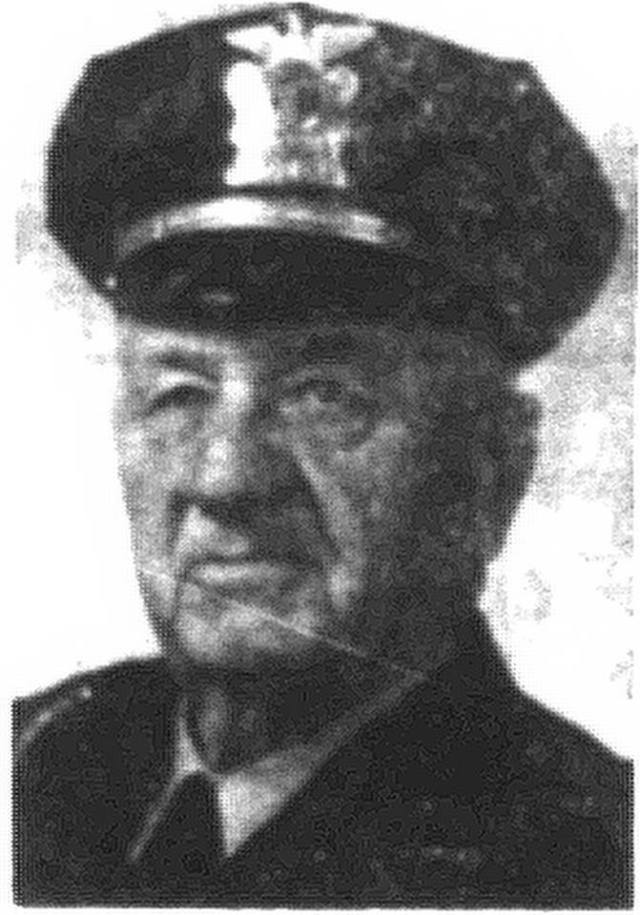
Lawmen of Lawrence County: Chief Arthur M. Smallwood

A.M. Smallwood (1888-1958) was a career law enforcement officer who, during his fifty-one-year career, served as deputy sheriff, sheriff of Lawrence County, Federal prohibition officer, and chief of police of the city of Lawrenceburg.

Perhaps no law enforcement career in Lawrence County saw more change that did that of Chief Smallwood. When he began his career in 1906 as deputy sheriff under his father, Sheriff John T. Smallwood, the Lawrence County Sheriff’s Department hired only a handful of deputies to protect and serve its population of about 17,000 souls.

At that time, most of Lawrence County still traveled by horseback, and electricity was still a thing of the future for almost all of the county’s residents. But when Chief Smallwood retired more than five decades later, not only did almost every family in the county own or have access to at least one automobile, but the county’s population had skyrocketed by 65%, and what would become one of the largest bicycle plants in the world had just been built on the northern end of Lawrenceburg.

Perhaps no change was bigger for Smallwood and lawmen of his generation than the rise and fall of Prohibition. After serving as sheriff of Lawrence County from 1914 to 1918, Smallwood joined the Alcohol Tax Division of the Internal Revenue Department, where he enforced prohibition by tracking down moonshiners, arresting them, and destroying their stills.

During his twenty-five years as a revenuer, Chief Smallwood had no shortage of adventures, many of which made the Nashville papers. During one raid in 1931, Smallwood and his agents were waiting at a still near the Rutherford County line when its owners drove up a long, narrow country lane. When the moonshiners saw that their operation had been compromised, they threw the car into reverse and sped backward down the lane, crashing into and uprooting a cedar tree. Smallwood sprinted alongside the car until it crashed, apprehending the driver and two gallons of illegal liquor from within the car.

Closer to home, on Bluewater Creek in southern Lawrence County in the summer of 1922, Smallwood participated in a raid that could have very well cost him his life. After crawling for some distance toward a still with a posse of men, Smallwood and fellow-agent A.L. Binkley jumped to their feet and shouted for the still’s operators to throw up their hands.

Seventeen-year-old Clyde Clifton struck Smallwood on the head with a shovel. Luckily, Smallwood was not seriously injured by the blow, and was able to take part in the ensuing gun battle. Clifton was not so lucky. While his brother Henry was arrested without injury, a bullet passed through Clyde’s stomach, and he later died of his wounds at the hospital in Columbia.

In August 1931, while about to conduct a raid with a posse in tow, Smallwood was flagged down by three men stranded on the roadside near Centerville. The men were struggling to repair a ruptured inner tube and needed help. They almost immediately regretted flagging down Smallwood’s car. Smallwood quickly noticed that the men had two half-gallon jugs and half a pint of liquor in the back seat of the car, and he immediately arrested them and impounded their vehicle.

Chief Smallwood was a legend in his own right, and helped to shape law and order in Lawrence County and throughout Middle Tennessee in a very formative time in our county’s history. He passed away in 1958 and is buried in Mimosa Cemetery in Lawrenceburg.

Special thanks to his descendants Buddy and Jim Looney for sharing his story with me.
19702158_1429952950428361_1912895570406534447_n

Posted in Uncategorized | 1 Comment

Lawmen of Lawrence County: Constable Dan Smith

Constable Dan Smith was a young man of 27 with a wife and three children in 1925. He had developed a reputation in the southern end of Lawrence County as a prolific finder and destroyer of moonshine stills.

The illegal whiskey business has always existed in Lawrence County, but it became a bustling trade in the years after the passage of the 18th Amendment. Prohibition created a high demand for illegal liquor.

Poor farmers with no scruples about the evils of alcohol and a desire to make a quick buck soon found that their corn crop was worth a great deal more as hooch than it was as corn, and so the county began flowing with moonshine.

One such local moonshiner was Dave Styles. A semi-literate, 51-year-old farmer with a large family and a place on Center Point Road, Styles was one of the few moonshiners in the area who hadn’t yet been visited by Constable Smith in the summer of 1925. And Styles intended to keep it that way.

“If Smith ever comes on my land,” Styles allegedly boasted to a friend, “I’m going to kill him.”

But Styles, if Federal authorities were to be believed, was not just a lone wolf moonshiner looking to make a small profit. Neighbors believed that he was the head of a local moonshine ring which included nearly half-a-dozen men clandestinely making and transporting whiskey in the community’s hills and hollows.

The situation came to a head when Styles gave a severe cursing to an associate named Hubert Brown. Brown, resenting Styles’s insults, quickly betrayed Styles to Constable Smith, telling him exactly where Styles kept his moonshine still.

The next day, Constable Smith and deputies J.E. Keeter and Dan Hardeman set out for the Styles place with axes and long-arms in tow. At about 10 a.m., while the three men were pushing their way through a dense cornfield toward the copse of woods where the still was hidden, a shot rang out, and Smith fell wounded.

Keeter and Hardeman hit the ground, the three lawmen hidden well within the dense cornstalks. With all the speed they could muster, the two deputies reached the constable, and they quickly realized there was nothing they could do. With his final breath, Smith said, “I guess Styles got me after all.” The two deputies later testified that they followed a set of wet footprints from the cornfield to Styles’ home, where they found a shotgun leaned against the wall. The gauge of Styles’s shells would prove to be the same gauge that killed Smith.

That night, the people of Center Point decided they had had enough of Styles and his friends running liquor through their community. A lynch mob of about 75 armed and angry people arrived at Styles’s house by night to mete out their own brand of harsh justice on him for the murder of Constable Smith.

The sheriff, however, was two steps ahead of the lynch mob. He had arrived at Styles’ home just an hour before and arrested Styles and his son for the murder of Constable Smith. Whether it was by coincidence or by shrewd instinct, this quick thinking no doubt saved Styles from a violent and humiliating death at the hands of his neighbors that night.

Styles remained in jail until his trial the following February. Meanwhile, Lawrence County did what it is still well-known for doing in times of crisis: it went to work to care for Constable Smith’s family, whom the ‘Lawrence News’ claimed were left with only $9 to their name.

That newspaper immediately set up a fund for the relief of Smith’s wife and children. It was later claimed by Styles’s defense attorney that, as Smith had been a member of the Ku Klux Klan, that organization also did a great deal to help the Smiths financially, including allegedly paying for his funeral and offering to pay the fees of the prosecuting attorneys.

This became an important point of contention in Styles’s trial. At the behest of the defense, for one of the first times in Tennessee history, potential jurors were vetted in part on their willingness to take an oath that they were not and never had been in the Ku Klux Klan.

Whether Smith actually was in the Klan or not cannot be said with certainty. There is no doubt that some klansmen probably contributed to his funeral expenses, as many of the leading and most wealthy citizens of the region at that time were also leading klansmen. However, the looming specter of Klan involvement made the trial that much more of a sensation in the Nashville papers.

At his first trial for the murder of Constable Smith, Styles was found guilty of second-degree murder. Some years later, the Tennessee Supreme Court threw out the verdict due to inconsistencies in evidence collection.

Styles, as much as I have been able to find, seems to have left Tennessee for South Carolina, where he died in his 90s. Constable Smith was buried at Bethel Cemetery on Revilo Road, where his grave remains unmarked to this day.

Posted in Uncategorized | Leave a comment

The Old Rebels

More than sixty years after the guns went silent and the flags were furled at the end of the Civil War, Lawrence County’s aging Confederate veterans continued to gather as often as they could to relive the military exploits of their youth.

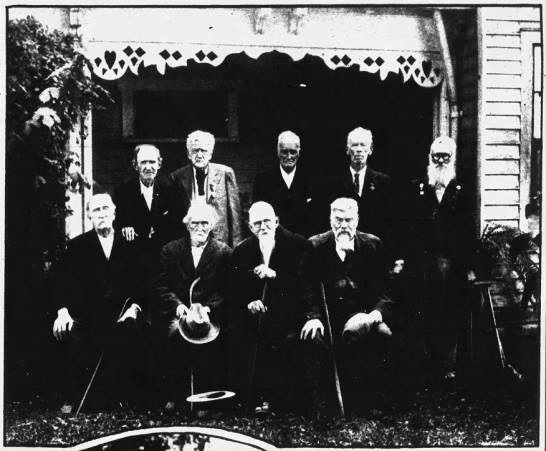
This photo shows a group of unnamed Lawrence County Confederate veterans during a reunion in Lawrenceburg in 1929.

When the first Confederate veterans gatherings began in Lawrence County in the 1890s, it was not uncommon for the entire community to turn out in order to eat with and honor the old veterans, who would, in turn, usually bring some small relic of their wartime service to show off to the crowd.

As can be seen here, not many of the old Rebels were able to attend the 1929 Lawrence County reunion.

17884088_1341161732640817_4448611651434852750_n

Posted in Uncategorized | Leave a comment

The Great Ethridge Gunfight

The city of Ethridge may be a quiet place today, but more than eighty years ago this month, it saw one of the most exciting peacetime gunfights in Lawrence County’s history.

It all began with an armed robbery, in broad daylight.

On March 12, 1935, at just past 2:30 in the afternoon, two men walked into the Farmers and Merchants Bank of Ethridge, pulled the shades closed, and drew guns on the cashier. Within minutes, the criminals had absconded with over $2,000 in cash from the bank’s cash drawer.

Harold Kellogg was the only cashier at the bank that afternoon. His coworker, Cleve Massey, was nearby helping O.I. North prepare his income taxes. Mr. North was the owner of the North Funeral Home, which survives today as the Neal Funeral Home on North Military Street in Lawrenceburg.

The postmaster of Ethridge, Harry Cunningham, saw the pair enter the bank and rushed to fetch Massey at Mr. North’s home. After he raised the alarm that the bank was being robbed, Cunningham and Massey went to a nearby store and grabbed two firearms while the thieves leapt into a waiting green Chevrolet sedan, attended by two more bandits.

Cunningham, armed with a shotgun, and Massey, armed with a .32 pistol, opened fire on the getaway car as it sped eastward, toward the Jackson Highway. They were joined by Eugene Cunningham, the father of the postmaster, who opened fire on the vehicle with his own weapon. One of the men scored a hit, shattering the back glass of the car and wounding one of the robbers, who visibly slumped over. Cunningham and Massey also believed that they had punctured at least one of the vehicle’s tires. The criminals returned fire, but did not injure anyone.

Tom Fite, a postal clerk at the Ethridge post office, approached the car during the robbery to get a good look at it. The driver pulled his gun on Fite and held him hostage inside the car until the other bandits had fled the bank.

Although deputies gave chase, the robbers gave them the slip. The car was abandoned at Rattlesnake Falls and discovered the next day. As it turned out, the car had been stolen in Kentucky and was outfitted with Mississippi plates.

Unfortunately for them, the robbers did not learn their lesson at Ethridge. Two of them were captured when they tried to conduct a similar daylight robbery in Jonesboro, Arkansas. The other two were captured on the same day almost a year later, one in Reno, Nevada and one in Poplar Bluff, Missouri. The four men were all tried and sentenced to lengthy prison sentences for their role in the Ethridge bank robbery. None of the robbers, as it turned out, were locals.

Posted in Uncategorized | Leave a comment

The Tragic Death of William Rowland

Before he was executed by firing squad, one Lawrence County man took a last long drink of water–from his own grave.

William Carroll Rowland was a simple man who lived a relatively quiet life. Illiterate and poor even by the standards of a community of poor farmers, in the years before the Civil War, he lived in a ramshackle dogtrot cabin on Granddaddy Road with his wife and four children.

Rowland was no great supporter of the Confederacy. Payton Sowell, writing in the ‘Lawrence Democrat’ almost six decades after the Civil War, said that the impoverished farmer was opposed to secession, but that he feared to make his sympathies known, so he determined instead to join the Confederate army, which he did in November 1861.

After he enlisted, Rowland turned to a crowd of onlookers and said resignedly, “Take care of my family.”

Unfortunately for Rowland, enlisting in the Confederate army was the first in a series of poor choices that lead to his ultimate demise; a demise which would be sanctioned by six Confederate generals and the Confederate War Department.

At some point over the next winter–probably after the Confederate defeat at Forts Henry and Donelson–Rowland deserted his unit in the 54th Tennessee Infantry and, as the remarks on his muster role say, “joined Lincoln’s army.”

Desertion was a capital offense in both armies during the Civil War. If a soldier were caught after deserting, he could be–and often was–executed by his own men.

On the first day of the Battle of Shiloh, Rowland, who was now fully a Union soldier, was captured and taken prisoner with a group of other Union soldiers. When he was recognized, the wheels of military justice turned swiftly.

General Order Number 12 of the Confederate Army of the Mississippi was the death warrant of Carroll Rowland. He was sentenced to death at 4:00 p.m. on April 12, 1862 at Corinth, Mississippi. As can be seen here, the order was approved by Confederate generals Polk, Bragg, Hardee, Breckinridge, and Slaughter, as well as one illegible name and the Confederate War Department.

Payton Sowell recalls in his 1919 ‘Democrat’ article that Rowland’s grave was dug on the night of the 11th, and that by the next morning, it was partially full of water due to the high water table of the area.

As Rowland sat upon his coffin, awaiting his execution and no doubt thinking of the wife and large family he was leaving behind in that dogtrot cabin on Granddaddy Road, the burial detail began to scoop the water out of his grave.

It was then, as he watched the water being pulled from the fresh earth, that Rowland asked if he might have a drink from it. One of the burial detail obliged, and so it came to be that Carroll Rowland of Granddaddy Road awaited his death on that spring day in 1862 by drinking water from his own grave.

Rowland was executed by firing squad and buried that day as the Tennessee regiments watched. His wife Eliza, widowed at the age of 26, was left with four children, three of whom were 5 years old or younger.

Rowland’s old cabin is most assuredly long-gone by now. Payton Sowell estimated that it probably stood about six miles from the city limits of Lawrenceburg, and that in 1919, the wooded and rugged place had been cleared and was growing thick with cotton and corn.

17022089_1296732810417043_6980079478126199312_n

Posted in Uncategorized | Leave a comment

School’s Out For…Epidemic?

Cancelling classes due to widespread illness is nothing new to Lawrence County.

In fact, almost a century ago, the county government ordered a lot more than the schools to close their doors in order to help combat a deadly epidemic.

In the fall of 1918, the Spanish Influenza epidemic claimed the lives of untold hundreds–possibly thousands–of Lawrence County residents. The disease is believed to have killed 3 to 5% of the world’s population (an estimated 50 to 100 million people), making it one of the worst pandemics in human history.

We will probably never know exactly how many people succumbed to the Spanish flu in Lawrence County, but we do know that entire families were stricken with it, and some lost as many as four or five loved ones within a month. It was serious enough that the county decided to impose harsh restrictions on public gatherings in an attempt to curb the disease’s spread.

On October 7, 1918, the Lawrence County Board of Health voted unanimously to adopt the following resolution:

“It is…ordered that all public schools and all private schools in the County of Lawrence be at once closed; that all public soda fountains and public drinking places be closed; that all picture shows, theatricals, and places of public amusement be closed; and that all public meetings and gatherings of the people in the County, be and the same are hereby forbidden…A strict compliance with this order must be observed, and any violation hereof will be punished as provided by law.”

This sweeping order was originally planned to be in place for just two weeks, but because the epidemic continued to rage throughout the county, the order was not officially rescinded until more than a month later, on November 11, 1918.

Included in this order, though not explicitly mentioned, were local churches, most of whom seemed to have complied with the order by cancelling their regular worship services.

Although the initial plan was to simply dock the pay of the teachers for time missed due to the Spanish flu closures, the state eventually did reimburse Lawrence County’s teachers for that month of work missed.

Posted in Uncategorized | Leave a comment

The Judgment at Gipson’s Spring

Less than a day after a local woman called down fire from God upon him, a cold-blooded bandit king took his last drink from a clear spring in Lawrence County, leaving his name behind as his only memorial.

In southwestern Lawrence County, near the old health resort community of Wayland Springs, and not far from the Wayne County line, a little tributary bursts from the earth and flows through the woods in relative tranquility. This little branch is known as Gipson’s Spring, and despite its calm demeanor, it has a tumultuous and violent history.

In the latter months of 1864, the Civil War was still in full swing in Middle Tennessee. Confederate soldiers poured through Lawrence County in those months on their way to General John B. Hood’s ill-fated gamble to liberate the city of Nashville, and the people who lived in this area continued to fend for themselves in the vacuum of law and order created by the constant movement of the two warring armies.

Lawrence and Wayne Counties were a haven for bushwhackers during the Civil War. A bushwhacker, unlike a regular soldier, had questionable allegiances and fought in unconventional ways. By war’s end, most of the gangs of bushwhackers roaming through western Lawrence County had given up all pretense of fighting for a cause and openly made war on the inhabitants, stealing and killing at their pleasure and for their own benefit.

One such gang was lead by a cruel and heartless man named Frans Gipson, who had the misfortune to meet with an old Christian soldier and accomplished prayer warrior named Judith Pettus in the last days of 1864.

That day, Gipson’s gang raided Mrs. Pettus’s home near West Point. No doubt terrified as these strange men looted her home, Judith’s three-year-old granddaughter Alice Pettus began to cry. Gipson, enraged at little Alice’s wailing, told her that if she didn’t hush, he would sling her head against the wall and bash her brains out.

Judith was incensed at such talk. She looked Gipson in the eye, no doubt moving protectively between him and Alice, and said threateningly, “I can’t reward you for speaking to a little child like that, but there is a Higher Power who can.”

We don’t know what Gipson said to that. But we do know that, according to local lore as preserved by Imogene Hagan, the next day, Gipson and his men stopped at the spring that today bears his name.

As Gipson lay at the spring to take a drink, he was killed by one of his own men. Although the reason for Gipson’s murder has been lost to us, the place where he died is named for him to this day.

And we can only speculate as to whether or not he remembered Judith Pettus’s prophetic threat to him as he breathed his last in that tranquil little spring.

Posted in Uncategorized | Leave a comment

A Family Feud

The quarrel between George Anthony and his brother-in-law Charles Nunnelly finally boiled out of control on a cool winter’s afternoon in the outskirts of Lawrenceburg.

It began some years before over a disputed tract of land, and, for reasons that have been lost to us, on that afternoon in 1905, the two men decided to go outside the city limits of Lawrenceburg and settle the argument once and for all.

Anthony was married to Nunnelly’s sister, and in 1900, they lived on a farm on the western edge of town among the city’s sparse Norweigan population.

As tempers began to flare between the brothers-in-law that afternoon, they decided to settle the matter like men. According to the subsequent article describing the event in the Nashville ‘Tennessean,’ “they accordingly chose referees, surrendered their knives, pulled off their coats and went away from town and fought for ten minutes.”

Both men knew that it was illegal to fight in town, so they carefully chose a spot that they thought was outside the jurisdiction of the law.

By the end of the fist-fight, the brothers-in-law were bruised and bloody, but Nunnelly was pinned quickly, and so he cried out first and lost the contest.

However, the two had made one serious miscalculation. They weren’t actually outside of the city limits of Lawrenceburg. After the fight was over, they were greeted by the city marshal, who arrested and fined them both for their crime.

The men did not hold grudges, it seems. The Tennessean reports that “each seemed perfectly satisfied with the settlement.”

About a year later, Anthony’s family sold almost everything they had and moved to Texas, and then eventually to Oklahoma, where Anthony and his wife are buried.

Posted in Uncategorized | Leave a comment

Jeff Davis is Coming For Your Guns?

Has the government ever conducted a mass-confiscation of guns in Tennessee?

You might be surprised to learn that the answer is yes. But what might surprise you even more is that the government responsible for this mass-confiscation was not the United States government at all.

As it turns out, President Jeff Davis, in a manner of speaking, was the one “coming after their guns” in Tennessee at the beginning of the Civil War.

During the American Civil War, most of southern Wayne County and parts of southwestern Lawrence County formed a hive of Unionist sympathy. Indeed, Wayne County harbored so many pro-Union men that a majority of the voters there voted to remain in the Union when Tennessee seceded in the spring of 1861, and hundreds of Wayne County men joined the Union army when the war began.

Why such an enclave of southern-born Union sympathizers existed in that area at that time is not an easy question to answer. It stems from a complex web of reasons including terrain, wealth, proximity to the Tennessee River, family allegiances, and even religious affiliation.

In the fall of 1861, the Tennessee General Assembly passed legislation entitled “An Act to Establish an Ordnance Bureau and For Other Purposes,” Section 18 of which required all citizens of the state to surrender their firearms to the captain of the local militia company for use of the Confederate war effort. An independent board of three local men was set up to determine the value of each firearm, and each gun owner was then supposed to be given a receipt for that value and paid by the state. If anyone were caught with a firearm that had not been turned over for confiscation, they could be fined between $25 and $50.

Confederate authorities began this confiscation process soon after the bill was passed. Thomas J. Cypert, a prolific Wayne County Unionist and later a celebrated Civil War hero, wrote of this confiscation in his book “Tried Men and True, or Union Life in Dixie.”

According to Cypert, “In my own county, we [the Unionists] at first determined to resist [the confiscation of arms], but our old men advised us against resistance, saying that such a course would bring immediate destruction on ourselves, our families, and the country. The result was that very soon the Confederates had possession of all the arms in our county of any value, and had them locked up in a room at Waynesboro, the county seat of Wayne.”

The confiscation of their arms seemed to particularly infuriate local Unionists, and it can be argued that such drastic measures by the state government helped to turn a great many moderate Unionists into Union soldiers, as it did Cypert.

Posted in Uncategorized | Leave a comment

The Northeast Corner of the Square

This photograph of Lawrenceburg from 1920 shows the north end of the Public Square, focusing on the old First National Bank building and the Gibbs-Belew building.

Notice the large number of frame residential buildings in the background. Until the mid-20th century, most of Lawrenceburg’s homes and businesses were concentrated within just a few miles of the Square.

Do you see anything in this photo that interests you?

15420938_1220494074707584_7838322662647321127_n

Posted in Uncategorized | 1 Comment