Why did the commercial focus of Lawrenceburg suddenly shift from North Military Street to North Locust Street in the early 20th century? The history of one iconic Lawrence County building will tell us. Its story is the story of the changing role of Lawrenceburg’s downtown area, and its present state gives hope to all who long to see our main street rejuvenated.
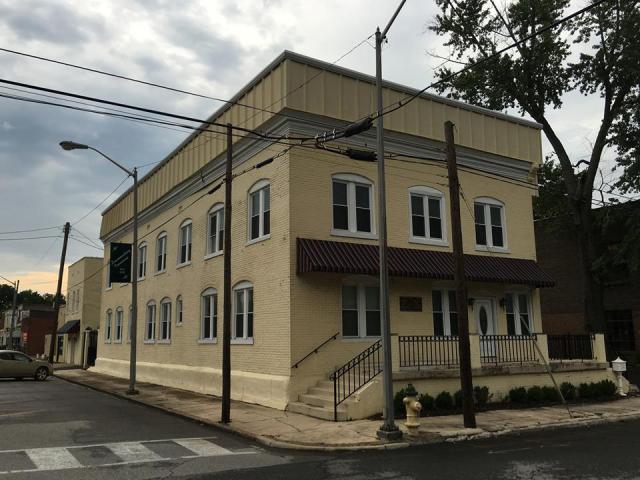
It’s known as the old Kerr Hotel, but it might also be called the Neeley Hotel, the Lawrenceburg Hotel, the White House, the Carriage House, or the Wackerman place. We continue to call the place the Kerr Hotel today, even though it’s been years since it was a hotel, and it’s been even longer since the Kerrs owned it.
Whatever you call this historic structure, though, one fact about the property is certain: the history of this tidy, well-kept old building at the corner of Depot Street and North Military Street in Lawrenceburg will forever be linked to the railroad.
For almost a century, this lot had some of the heaviest traffic in town. When the railroad came to Lawrenceburg in 1883, the depot–where trains stopped to drop off and pick up freight and passengers–was built just north of the Square, and a new, wide street was cut from the railroad tracks to North Military Street to connect the town to the tracks. This new thoroughfare was appropriately named Depot Street.
At that time, North and South Military Streets were part of Jackson’s Military Road; a 19th-century thoroughfare connecting Nashville to New Orleans. Traffic along the route was heavy, but travel was slow, creating the need for travelers to stop frequently for the night. Fronting a major roadway at one of the busiest intersections in town, and just a block from the city’s only railroad access, the lot was a natural spot for a hotel.
Although we don’t know exactly when the first structure was built on this prime location, we know that as early as 1888, the lot contained a “two-story frame building.” And we know that a frame hotel with multiple covered porches existed in the place as early as 1896. Although no photos of that first hotel are known to exist, insurance maps from the time show us that it was shaped like an ‘H,’ with two north-south oriented rectangular wings connected by one long, central east-west corridor.
In 1896, the office of that hotel was in the front of the building, facing North Military Street. The hotel’s dining room comprised much of the back of the building, which was flanked on the outside by two cisterns. A spacious livery stable and carriage house–a structure which served as the 19th-century parking garage for the hotel’s guests–stood diagonally from the hotel on the north side of Depot Street, near the modern-day back parking lot of Coleman Memorial Methodist Church.
That frame hotel on the corner was known as the Neeley Hotel, after its owners, W.M. and S.A. Neeley. The handsome brick building that stands there today was built sometime between 1907 and 1909. According to family tradition, it was built by Joseph and Mary Mezera, who owned the lot at that time.
Perhaps it was no coincidence that the modern brick building was built around the time that Lawrenceburg got its first access to electricity. The building was wired for electricity as early as 1910, and for a time it was no doubt the most modern and luxurious hotel in town–that is, until the new 50-room Lawrenceburg Hotel was built on the Square in 1913.
Between 1909 and 1928, the property changed hands several times, and the handsome brick structure was under the management of many different local families. In 1928, the hotel was purchased by U.H. and Della Kerr of Savannah, Tennessee, who ran the hotel until 1946.
The building sheltered untold thousands of travelers and permanent residents, alike, throughout the years. It was once a prime location for formal dinners and banquets, and, according to County Historian Kathy Niedergeses, customers could pay 35 cents just to take a shower at the hotel when the it was in its prime.
Two great changes altered the course of the business in the mid-20th century. The first came in the spring of 1934, when a new route was chosen for the Jackson Highway, or what we now know as Highway 43.
This massive infrastructure project was a fascinating–and successful–endeavor to rebuild Andrew Jackson’s original Military Road as a modern, paved interstate highway between Nashville and New Orleans. There was only one problem for the people of Lawrence County: the state had decided to completely pass over the county’s historic business districts along the original Military Road in favor of a less-obstructed, more easterly course.
Despite a spirited protest by the businessmen of Lawrenceburg and Loretto to keep the highway running through the cities’ main streets–including at least one petition drive that netted over 200 signatures–the route of the massive new Jackson Highway was set for Locust Street in Lawrenceburg, and bypassed the business district of Loretto and the town of Ethridge completely. The reason? Railroad tracks.
In an effort to save money and create as unobstructed a pathway as possible for the new road, state highway officials set a course for the highway that completely avoided crossing the L&N railroad altogether.
The result was a harsh blow for downtown businesses in Lawrence County. While Military Street would continue to serve as the seat of local commerce for a few more years, that dominance rapidly and inevitably shifted to the new Jackson Highway, and the Kerr Hotel no doubt began to feel the pinch quickly after the new route opened.
The second change to visit the hotel came when the last passenger train made its final run through Lawrenceburg on December 6, 1954. Automobiles–which became more affordable and thus more prevalent at the midpoint of the 20th century–made passenger trains obsolete. Cars allowed travelers the freedom of the open road, eliminating the need for frequent stops and, consequently, shuttered many small, locally-owned hotels around America.
The Kerr Hotel was no different. It held on until the 1970s, when it permanently closed its doors as a hotel and reopened, for a time, as an antiques mall. The building continued to change hands until 1999, when it was purchased by T.J. and Sammie Hughes, who have done a great deal of improvement and restoration work on the building.
Today, the old Kerr Hotel is still in the hospitality business, although in a much different way than the structure’s builders probably would have imagined. It is the headquarters of Prime Hospitality Group, a local manufacturer of hotel furniture. The furniture built by Prime Hospitality has made its way into some of the nation’s top hotel chains, including branches of Holiday Inn, Staybridge, Hilton, Fairfield Inn, Hampton Inn, and Comfort Suites.
The rebirth of the Old Kerr Hotel into the headquarters of Prime Hospitality gives us hope that more of our beloved iconic downtown buildings might be lovingly restored and again used to help bolster the local economy.
This article is the second installment in a series about historic buildings in Lawrence County which are more than 100 years old. Please stay tuned for the next installment!
** For this article, I am especially indebted to the work of County Historian Kathy Niedergeses, whose article about the Old Kerr Hotel in the Summer 2002 issue of ‘Lawrence County Heritage’ I referenced for much of the basic information about this building’s past. Her article is available to read at both the Lawrence County Archives and the Lawrence County Public Library. **



 Lawrence County History Trivia