The Daring Escape of John Bell Hollis

John Bell Hollis was just 19 years old, and it looked like he would never see 20.

The young Lawrence Countian was scheduled to be shot the next day just outside of Lawrenceburg–until quick thinking and whiskey intervened.

Hollis, despite being a native southerner, enlisted in the Union army during the Civil War. He served in Company B of the Second Tennessee Mounted Infantry from 1863 until the autumn of 1864.

According to the Annals of the Lawrence County Historical Society, an article written in the ‘Democrat-Union’ by Captain N. Brown Simms in the 1930s recalled that Hollis and a covert team of saboteurs “led a raid on the jail in Lawrenceburg to free Union prisoners” during the Civil War. It was a mission which must have been assigned him shortly after he enlisted in October 1863, as the Lawrence County Jail was burned by a different contingent of Union soldiers in November 1863.

Hollis’s raid, as the story goes, was a failure. He and his men were all captured and sentenced to death the following day. Their last night on earth was to be spent under careful Confederate guard in the vicinity of Pine Bluff in western Lawrenceburg.
That night, however, Hollis had a plan.

He convinced his guards that they deserved a drink.

And another. And then another. And then another.

Until finally, in the dead of the night, the Confederate guards tasked with guarding Hollis and his men were completely drunk. As the guards lay passed out, Hollis and his men melted into the woods near Pine Bluff and made it back to their regiment.

Although Hollis was from Lawrence County, the Second Tennessee Mounted Infantry was comprised largely of men from Wayne County, which was a hotbed of Union sympathy during the Civil War. Hollis served a year’s enlistment and went on to live a long life among his rebel neighbors.

Hollis’s status as a Union veteran apparently did little to hurt his reputation. When he died in 1917, at the age of 73, his obituary in the Lawrence ‘Democrat’ said, “As a gentleman, citizen and farmer he stood among the very best in the county. He was wise in council, calm in judgment, and faithful to the discharge of all duties.”
Posted in Uncategorized | Tagged , , , | Leave a comment

The Trail of Tears in Lawrence County

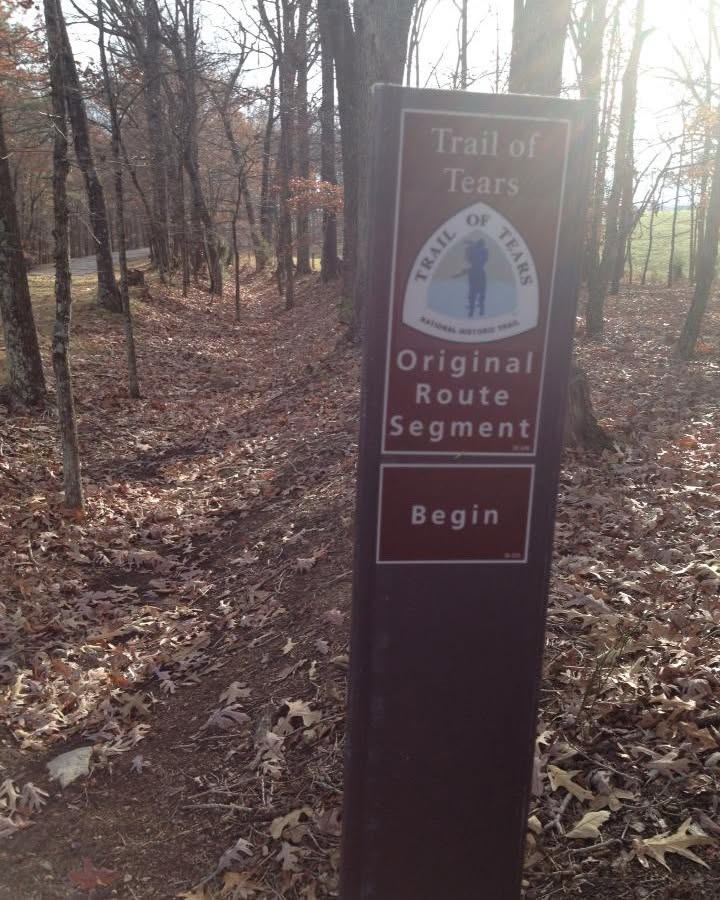
If you’ve spent much time in David Crockett State Park, you may have noticed this depression running alongside the road to the park restaurant. But what you may not know is that this depression is a remaining portion of a road used during the Trail of Tears, which passed through Lawrence County on this day in 1838.

The depression in the ground here is the original Waynesboro Turnpike, which was the predecessor of today’s Waynesboro Highway. This road was created more than 200 years ago, and it was worn down by many thousands of travelers in wagons, on horseback, and on foot.

On November 5, 1838, this section of road was traveled by Cherokee leader John Bell and a party of almost 700 Cherokee Indians during their forced relocation to Indian Territory as part of the Trail of Tears. Accompanied by a military escort commanded by Lieutenant Edward Deas, the party passed through the Square in downtown Lawrenceburg and forded Shoal Creek at Hope Springs.

According to “A Study of the Routes Used During the Cherokee Removal of 1838,” by Benjamin C. Nance, “Bell’s party consisted of about 650-700 Cherokees who supported the removal treaty and were therefore opposed to John Ross.” Bell’s party “took a more direct route than did the Ross allied parties, possibly to avoid conflict with those groups, since there was great friction between the two factions.”

The Bell Party departed East Tennessee on October 11, 1838. The route they followed is roughly adjacent to modern Highway 64. We know generally where they were and when thanks in large part to the vouchers used by Lieutenant Deas to pay for supplies and medicine along the way.

Although we aren’t sure how many people lived in Lawrenceburg in 1838, it is possible that the large, slow-moving group of Native Americans dwarfed the 1838 population of Lawrenceburg as it made its way west around the Square. No doubt it was a sight that few would forget.

Nance’s work highlighting which roads were used by the Bell Party in Lawrence County says the following:

“The route followed Choate Creek Road along Choate Creek into Lawrence County. The old road is now broken up into remnants, parts of which include Bonee Road, Norton Road, and Gimlet Road. Gimlet Road then joins Highway 64 entering Lawrenceburg…The route again diverged from Highway 64 in Lawrenceburg, following the road through the square then crossing Shoal Creek. From here the old route does not appear to deviate from the current course of Highway 64 into Wayne County.”

According to Tennessee House Joint Resolution 980, signed by Governor Haslam in 2016, the stretch of the original Trail of Tears in Lawrence County is “the longest segment of the Trail of Tears on public property.”

Posted in Uncategorized | Leave a comment

David Crockett’s Debt

Can you imagine asking your congressman to collect on a personal debt that another congressman owed you? Would you trust him to?

David Crockett was perpetually strapped for cash. Even when he lived in Lawrence County–which was, relatively speaking, one of the most prosperous periods of his life–Crockett still borrowed heavily to build his milling operation on Shoal Creek, and had to ask at least one land speculator for an extension on his payment for some land he had purchased in Lawrence County.

All of Crockett’s financial troubles multiplied when his mill was washed away by a flood of Shoal Creek in September 1821. He scrambled to liquidate his assets, was sued by several of his creditors, and moved to West Tennessee for a fresh start after selling all of his land to satisfy his creditors.

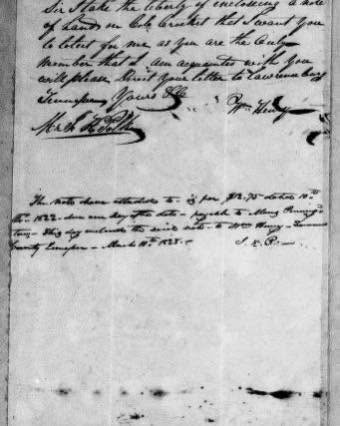
But before he left for good, Crockett borrowed money yet again. On October 10, 1822, Crockett borrowed $12.75 from Moses Pennington. The note was due the next day, but apparently Crockett never showed up to settle with Pennington.

Sometime in the next five years, Pennington must have sold or traded the note to its next recorded holder, William Henry. In 1828, William Henry sent a letter to future President of the United States James K. Polk, asking him to collect from Crockett. At that time, Polk and Crockett were both representing Tennessee in the House of Representatives in Washington.

The letter, with original spelling preserved, reads as follows:

‘Lawrenceburg Tennessee Feby 20th 1828

Sir

I take the liberty of encloseing a note of hand on Colo Crocket that I want you to colect for me as you are the Only member that I am acquainted with. You will please Direct your letter to Lawrenceburg Tennessee.

Wm. Henry’

Apparently, although Lawrenceburg was not in his Congressional District, Polk made Crockett pay up. A notation written by Polk on the letter says that he “enclosed the said note to Wm. Henry” on March 10, 1828.

By the way, how much would $12.75 be worth in 1822? According to the Westegg inflation calculator, it would be the same as borrowing around $300 today. 

Posted in Uncategorized | Leave a comment

The Alabama Migration to Lawrence County

Did you know that, for the early part of the 20th century, our county became home to a massive influx of people from North Alabama? This period of our history is known as the “Alabama Migration,” and it played a key role in shaping the unique cultural heritage of our area.

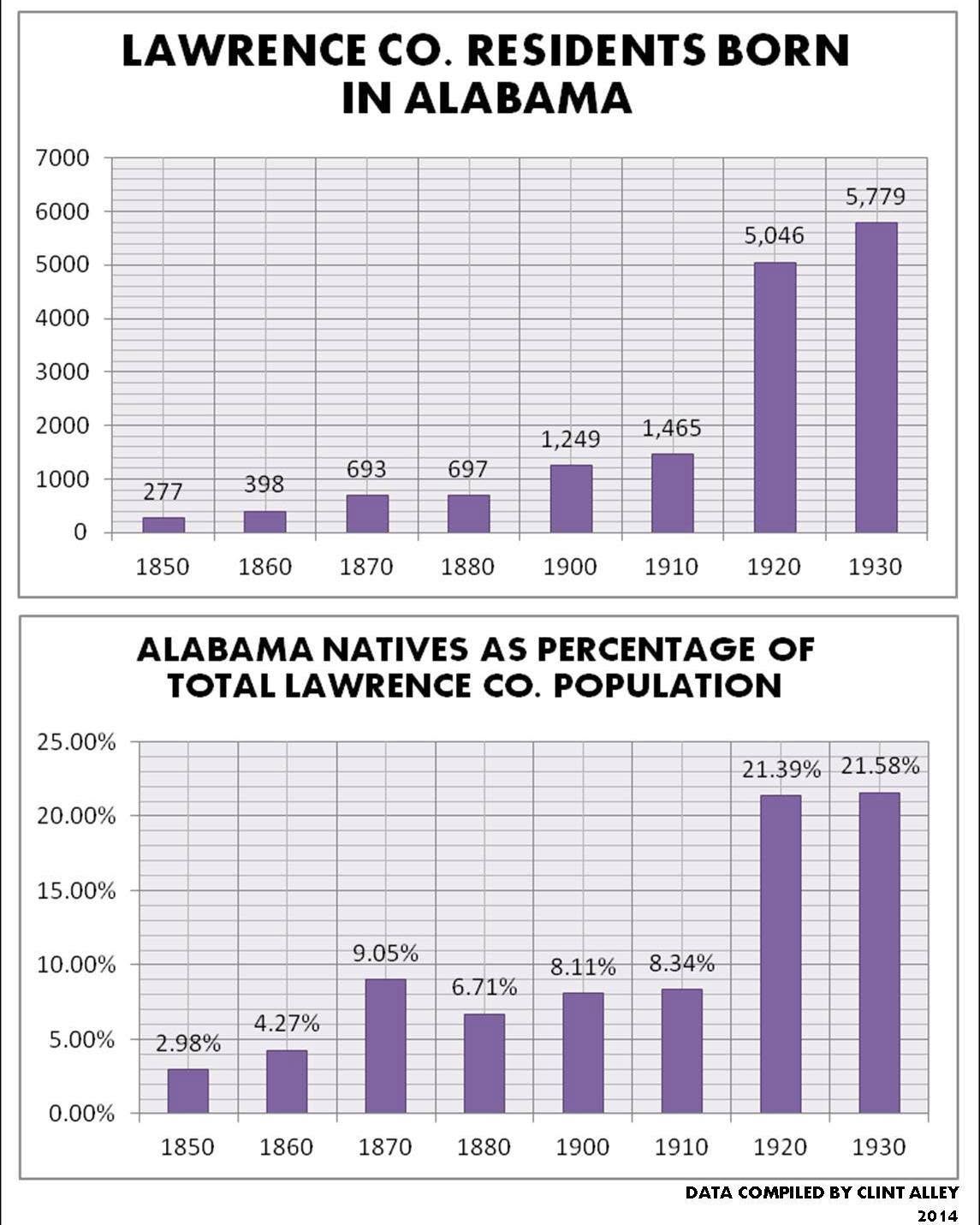
The migrants were mostly from the Alabama counties lying immediately south of the Tennessee River–Franklin, Lawrence, Cullman, Winston, and Morgan. The migration began in earnest around 1909 and continued into the 1930s, as the accompanying graphs demonstrate. By 1930, almost a quarter of all Lawrence Countians identified themselves as having been born in Alabama.

They came for a variety of reasons. At first, some came to reap the benefits of Tennessee’s lax open range laws, which allowed farmers to own large numbers of livestock without having to own a great deal of land. Others came seeking cheaper, more fertile land and new opportunity in Lawrence County’s sparsely-settled southern region.

Southern Lawrence County was the last region to be heavily logged for its rich virgin timber. The great forests that had covered almost all of the county since its founding in 1817 were not heavily logged in southeastern Lawrence until the early twentieth century.

Many of the early settlers from Alabama recalled the hundreds of saw logs they laid low as they cleared their newly-purchased land. Hugh Methvin (1893-1983) moved to Lawrence County from Cullman County, Alabama as a ten-year-old boy. Years later, Mr. Methvin wrote to the ‘Democrat-Union’ that “practically all the land along the Rabbit Trail was in woods in 1913, when we moved here…we cleared the land and built a house on it…the logs we piled and burned would bring a high price today.”

These newcomers established many new communities as they settled in southeastern Lawrence County. The land that would become Bonnertown was purchased by Alan Bonner in 1909, who moved here from Winston County, Alabama, and soon encouraged his friends and relatives to follow him. Local historian Bobby Alford says that, together with two other men, Bonner purchased over 1,600 acres of land in southeastern Lawrence County that year, and paid only $2.50 per acre for it.

The Alabamians who settled in Lawrence County brought their culture and traditions with them, and they planted the cash crop that they new best: cotton. Although cotton had been grown in Lawrence County since it was first settled, it came into its own when the Alabama Migration began. As more Alabamians flowed across the state line between 1910 and 1930, cotton production in Lawrence County flourished. Between 1900 and 1910 alone, Lawrence County’s cotton output soared by almost 300%.

The Alabama Migration had a profound effect on Lawrence County, not just in terms of population, agricultural output, or areas of settlement, but also in its cultural impact. The influx of Alabamians was so high that most of Lawrence County today can undoubtedly claim some blood connection with the Yellowhammer State.

Do you have any relatives who came here from Alabama in the early 20th century?

Posted in Uncategorized | Tagged , , | Leave a comment

The Dedication of Lawrenceburg’s David Crockett Statue

He’s stood guard over the Public Square in Lawrenceburg for 102 years today. But did you know it took thirty years for Lawrenceburg’s statue of David Crockett to become reality?

Lawrence County has a long history of emphasizing its ties with the king of the wild frontier. Our first countywide celebration of Crockett’s birthday happened in 1890, and it drew a crowd of about 5,000 people to Lawrenceburg, which at the time was a city of only about 600 souls.

At that time, a local group known as the David Crockett Memorial Association laid the cornerstone for a monument to Crockett in what is today the Rosemont section of Lawrenceburg. Although that part of town was largely woods and pastureland in 1890, the owners of the Lawrenceburg Land Company envisioned the neighborhood as a pleasantly grand addition to the city, with the monument to Crockett serving as the focal point of a small city park to be known as “David Crockett Park” (not to be confused with the state park of the same name, which stands on the other side of the city today).

Unfortunately for the Land Company, their plans ran aground in a stormy sea of lawsuits and the vision they had for Rosemont never materialized. We don’t know what became of that cornerstone, either, but we do know that it contained a small tin time capsule into which were placed issues of local newspapers.

The plans for that original monument to Crockett were much grander than the statue that we now have of him. It was to be “carved in Italy from pure white marble and shipped to Lawrenceburg in time to be unveiled at the Annual Celebration of Crockett’s birthday in 1891.”

Despite these high hopes, the idea of a marble statue to David Crockett in Lawrenceburg never materialized.

Although we don’t know why that first statue proposal fizzled, we do know that the idea of memorializing Crockett persisted. On November 7, 1921, a mass meeting was held in Lawrenceburg for the purpose of raising money for a new bronze statue of Crockett, to be placed on the southern side of the courthouse.

Work began on this project in earnest. The W.M. Dean Marble Company of Columbia created the bronze statue for the cost of about $3,000.

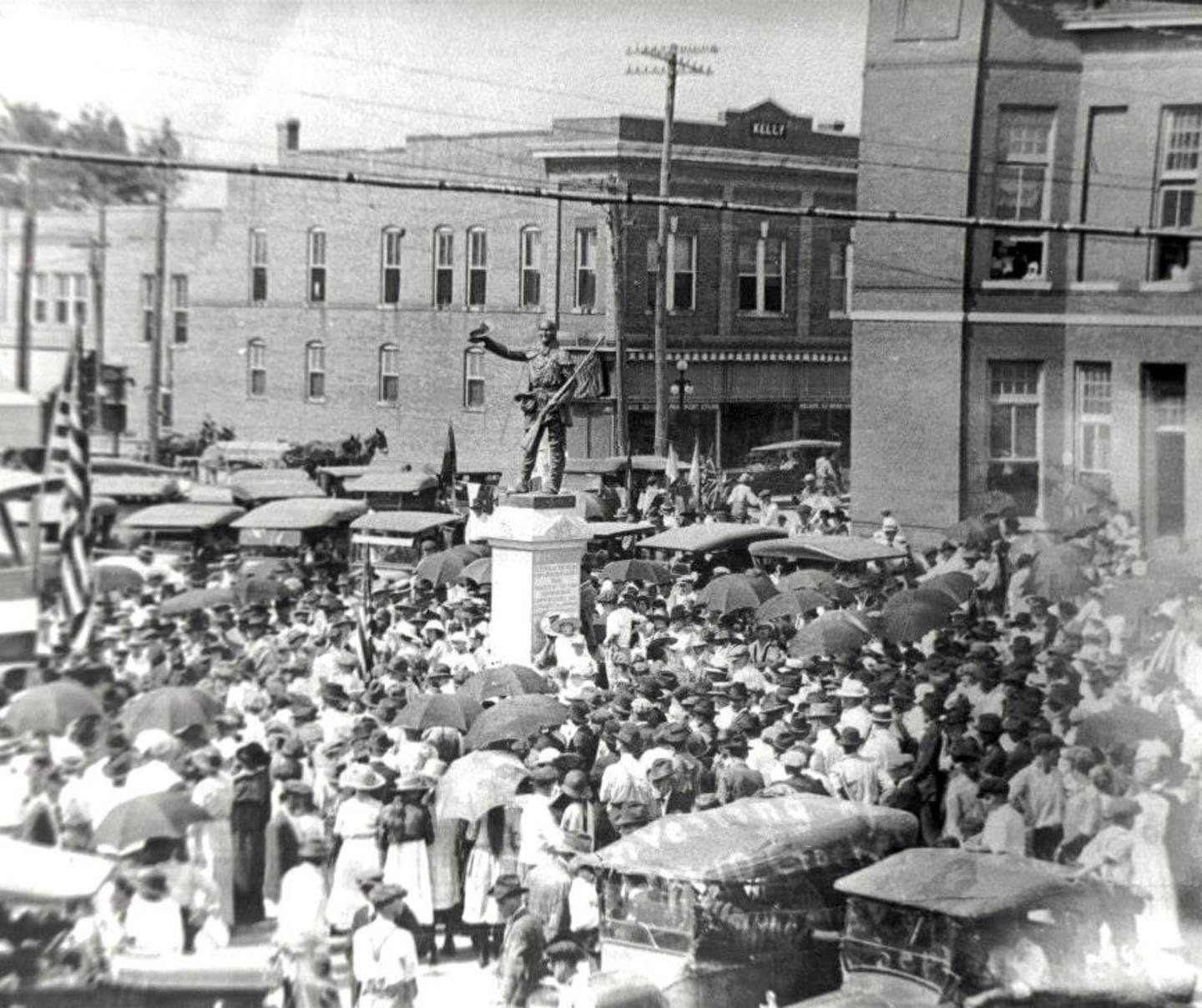
Finally, after many years of waiting and several stops and starts, the statue of Crockett that stands on the southern end of our Public Square was unveiled with great fanfare on September 14, 1922.

As a result of that unique connection we have to Crockett’s life and rise to prominence, Lawrence County is home to one of the oldest and only full-body statues of David Crockett in the country.

The Crockett statue was cleaned and restored by the Terra Mare Conservation company in 2019, using funds from a $15,000 grant from the Tennessee Historical Commission.

Below is a photo of the dedication of the Crockett Statue in 1922.

Posted in Uncategorized | Leave a comment

The Destruction of Crockett’s Mill

Thanks to Hurricane Francine, the weather forecast calls for lots of heavy rain over the next two days, increasing our chances of localized flooding. A little over two-hundred years ago, another September flood in Lawrence County helped change American history.

Frontiersman David Crockett settled in Lawrence County shortly after the Chickasaw Cession treaty was signed. As he said in his autobiography, “I went on to a place called Shoal Creek…I became so well-pleased with the country about there, that I resolved to settle in it.”

Crockett developed a reputation among his neighbors for fairness and justice. He was elected first as a magistrate, then as the colonel of the county’s militia. He served as one of the first commissioners of Lawrenceburg, and was elected to the state legislature. As he put it, it was in Lawrence County that he “began to take a rise.”

In the meantime, Crockett had borrowed $3,000 from friends and neighbors. With this money, he built a diversified industry at Crockett Falls on Shoal Creek. His businesses included an undershot gristmill, a gunpowder mill, and a whiskey distillery.

These businesses tapped into three vital needs on the frontier at that time. Settlers brought their bread-corn to Crockett’s mill to be ground into cornmeal. His powder mill produced the gunpowder needed by early settlers to hunt and to protect their homes. And the distillery transformed corn to whiskey, substantially increasing its value.

Crockett was a man on the make, and it is interesting to speculate how his life might have been different if his businesses had been allowed to grow and flourish on Shoal Creek. But, that was not in the cards.

As Crockett put it, “…I met with a very severe misfortune, which I may be pardoned for naming, as it made a great change in my circumstances, and kept me back very much in the world. I had built an extensive grist mill, and powder mill, all connected together, and also a large distillery. They had cost me upwards of three thousand dollars, more than I was worth in the world. The first news that I heard after I got to the Legislature, was, that my mills were–not blown up sky high, as you would guess, by my powder establishment,–but swept away all to smash by a large fresh [flood], that came soon after I left home. I had, of course, to stop my distillery, as my grinding was broken up; and, indeed, I may say, that the misfortune just made a complete mash of me.”

But when, exactly, was this flood? We know that Crockett was present in Murfreesboro at his first session of the legislature on September 17, 1821. By September 29, Crockett was granted a leave of absence to return home after hearing about the flood. Crockett was all but ruined by the flood. His creditors sued, and to satisfy them, he sold his land in Lawrence County and moved to West Tennessee.

He returned to Lawrence County a few times, but the last mention of him in the county’s court records was on April 5, 1822, when he granted power of attorney to Mansil Crisp to settle his remaining debts.

In West Tennessee, Crockett was elected to Congress. His run-ins with President Andrew Jackson while serving in Congress led to his eventual defeat for re-election and a final move to Texas, and to his destiny at the Alamo.

Posted in Uncategorized | Tagged , , , , | Leave a comment

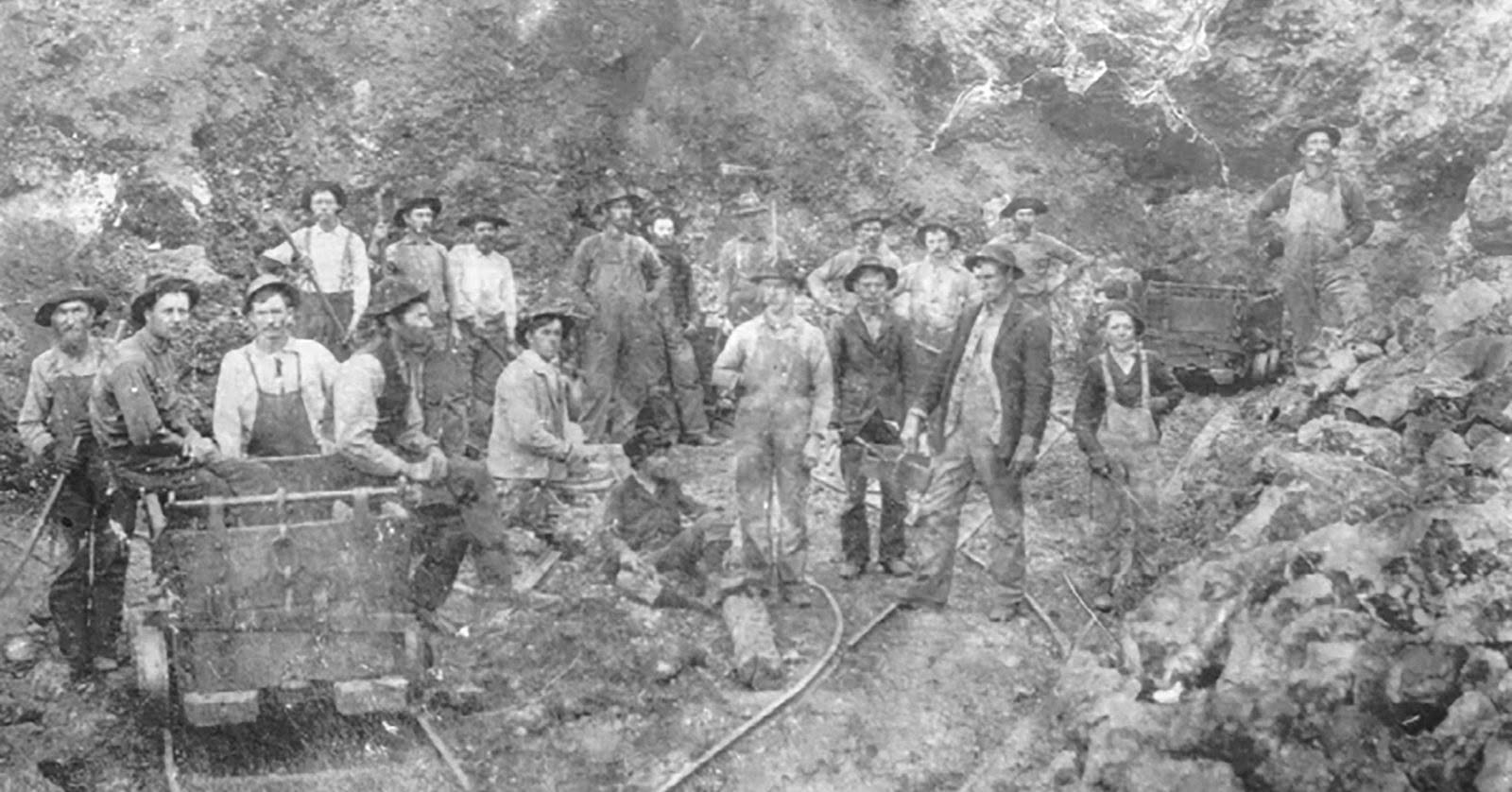
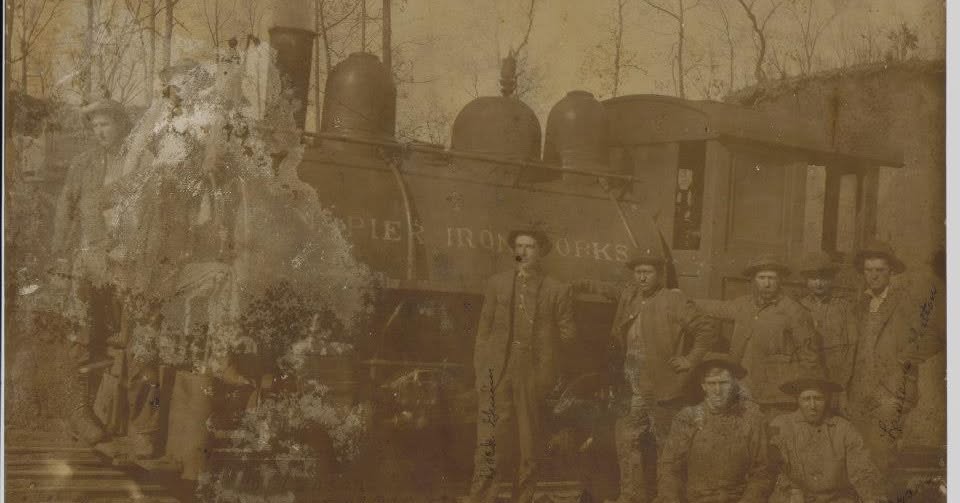
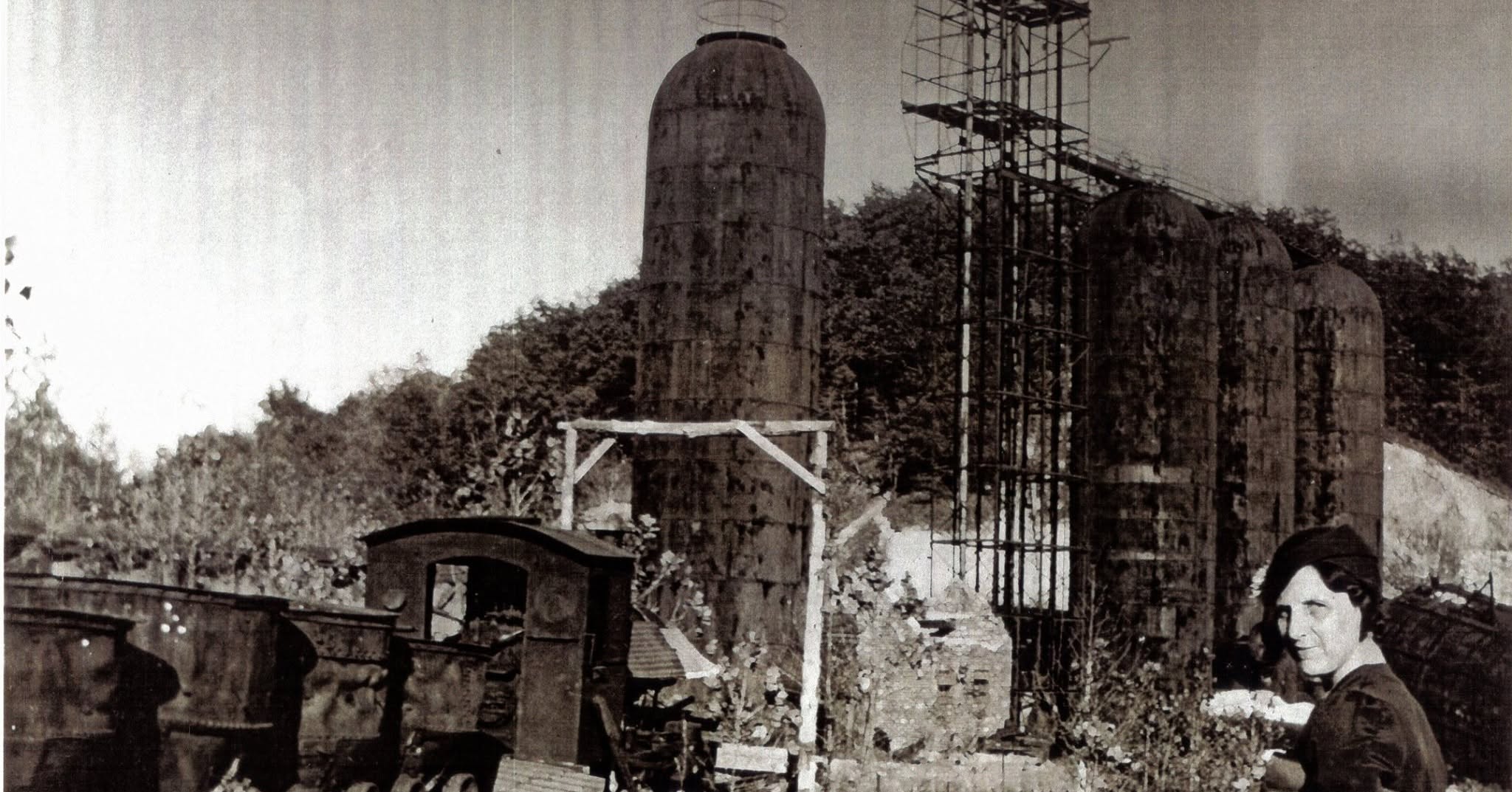
The Napier Iron Works

Before it was Napier, it was…the McLeish Reservation?

When the Chickasaw nation ceded their lands north of the Tennessee River to the United States in September 1816, there were a few exceptions. One of those exceptions was a square mile of land to include the “settlement and improvements” owned by John McLeish “on the north side of Buffalo creek.”

The McLeish Reservation was made for good reason. John McLeish, an influential member of the Chickasaw tribe, operated a valuable iron forge on the banks of Big Buffalo River in what would become northern Lawrence County and southern Lewis County. McLeish was on the front lines, so to speak, of white encroachment into the territory. An 1813 letter to Chickasaw Agent James Robertson names several of the whites McLeish knew to be living illegally on his land on the Big Buffalo River. Follow this link to read this letter in its entirety: https://tinyurl.com/3czp892w

McLeish eventually sold his square mile, including the forge, and, after brief ownership by some influential people, both land and forge were eventually owned by the Napier family.

The Napiers initially owned around 6,000 acres in the area. They continued the iron mining and smelting operations on the Big Buffalo, and the operation was expanded to include an iron furnace for smelting the brown iron ore extracted from the area’s mines.

William C. Napier owned 62 slaves in 1860, making him one of the largest slaveowners in Lawrence County. His real estate was valued at $12,000 in the 1860 census, and his personal estate is listed as being worth $65,000.

A branch railroad was built from Summertown to Napier in the 1890s. When this railroad was abandoned in the 1930s, it was purchased by the county and became Railroad Bed Pike. The Napier Iron Works land grew to more than 12,000 acres at its pinnacle. Napier once had a post office, commissary, and a segregated school. The company surrendered its charter in 1936, and the furnace was dismantled and the property sold.

Today, the legacy of the Napier Iron Works lives on in the name of the community of Napier, which straddles the line between Lawrence and Lewis Counties.

Photos: Old Jail Museum

Posted in Uncategorized | Tagged , , , , | Leave a comment

Fields of Faith at Mt. Ararat

At about 945 feet above sea level, Mt. Ararat Cemetery on Mt. Ararat Road north of Lawrenceburg is not so much on a mountain as it is on a low hill. But voices raised in sacred song once rang out across this place, and the area has a heritage of faith as towering as its biblical namesake.

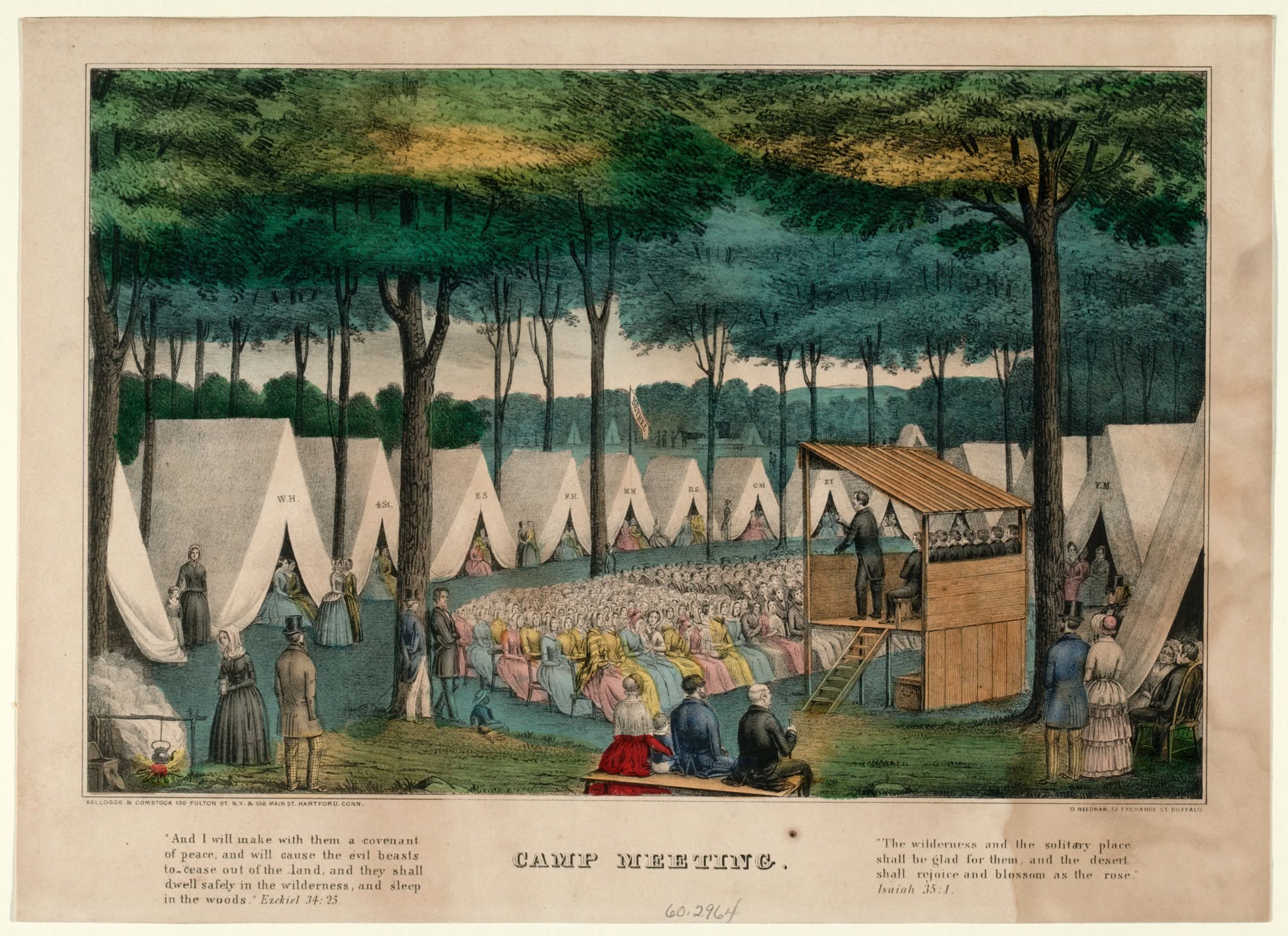
In 1839, a group of Cumberland Presbyterians established a campground across the road from the current site of the Mt. Ararat Cemetery, about three miles north of Lawrenceburg on the waters of Little Shoal Creek, for the purpose of holding old-fashioned tent revival services known as camp meetings. They named the campground Mt. Ararat, after the mountain where Noah’s Ark came to rest after the Flood in Genesis.

In an era when church buildings were still sparse, camp meetings gave hundreds or sometimes thousands of people the opportunity to hear extended sermons outdoors from itinerant preachers. Often occurring in the late summer, large brush arbors were erected to shade the congregants, and families would camp overnight in tents. These meetings usually lasted a period of three or four days.

Camp meetings were social events as well as times of religious rededication. Many people developed strong attachments to the camp grounds and the memories they made there.

On August 8, 1841, a primitive church building was raised at the Mt. Ararat campground. One of the largest gatherings recorded there was the 1847 funeral of Captain William B. Allen, who died in the Mexican War and to whose memory the Mexican War monument in Lawrenceburg is dedicated. More than 1,000 people attended his funeral.

The church grew to around 100 members until 1861, when the Civil War scattered its membership. By 1875, there were fewer than 15 members left and the original building “rotted and fell to the ground.” Despite the construction of a second church at the site in 1891, no building exists there today.

Across Mt. Ararat Road from the site of the church, however, the place’s sacred nature endures in a quiet burial ground where many of the campground’s original campers are forever laid to rest. The first burial there was in 1840, and today there are more than 370 marked burials in the place.

Lithograph, “Camp Meeting”. DL*60.2964. Peters Prints Collection.
Posted in Uncategorized | Tagged | Leave a comment

The Pension of James S. Finley

How many people do you think you could get to verify that you are a good person?

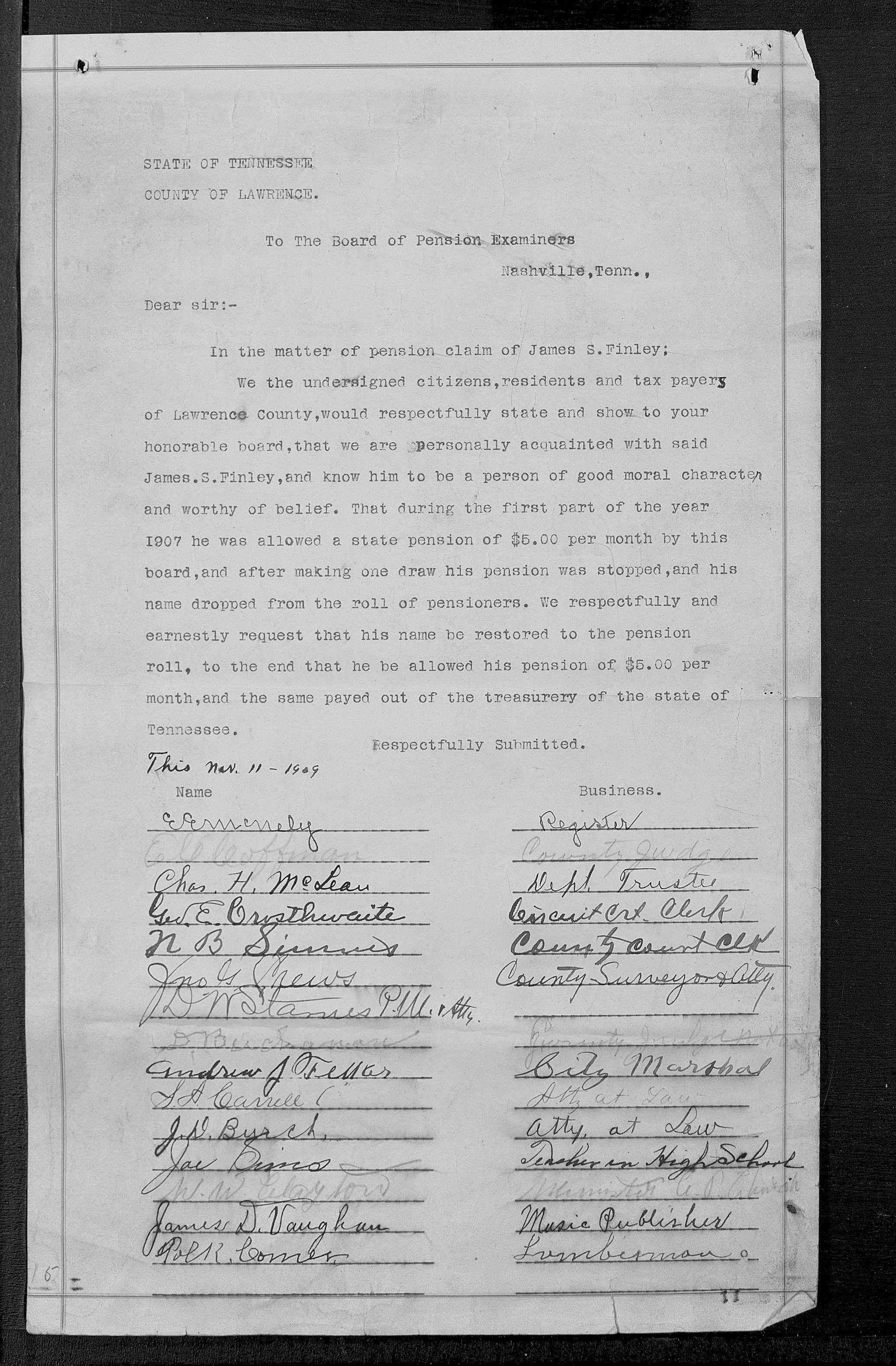
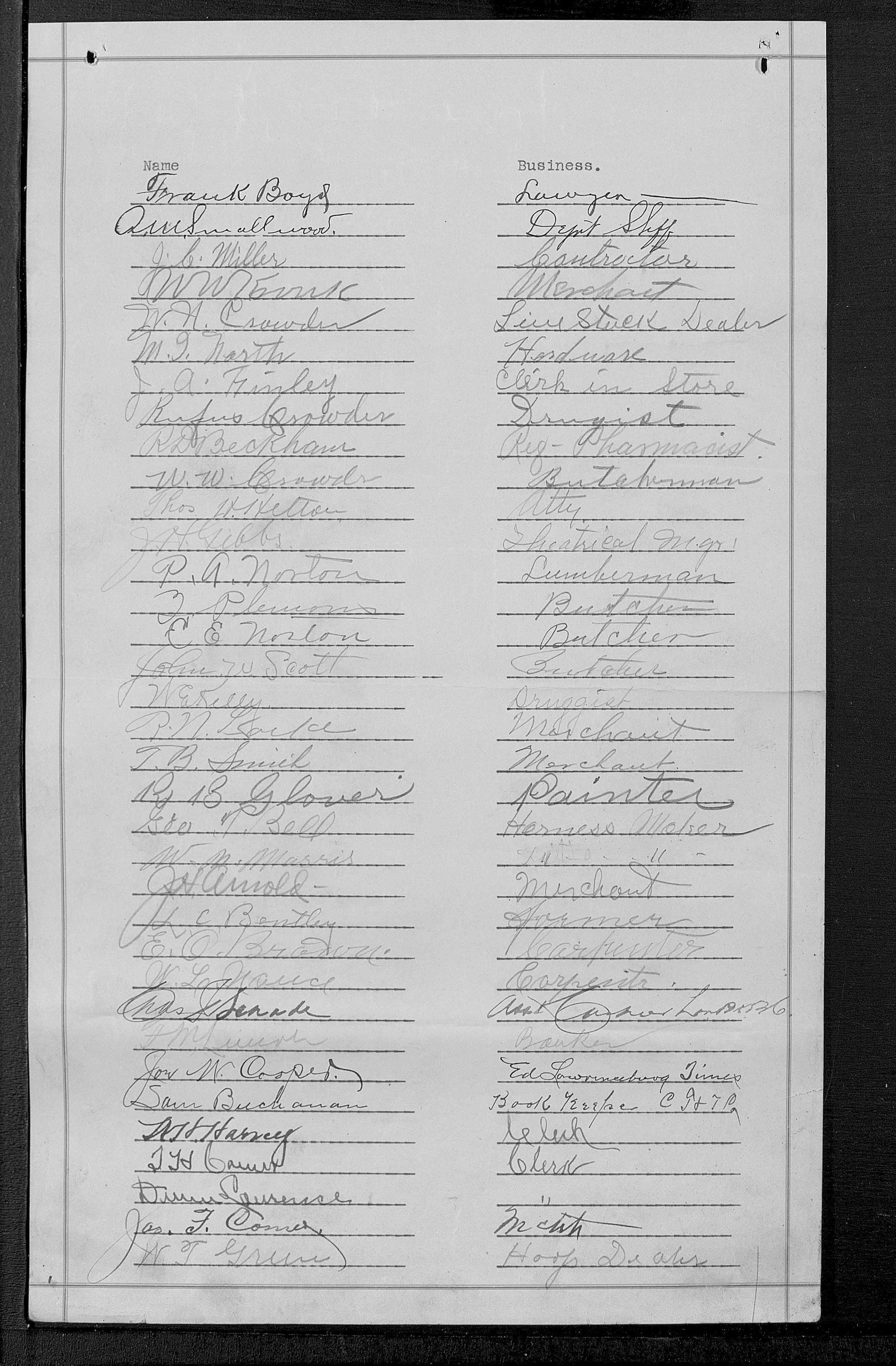
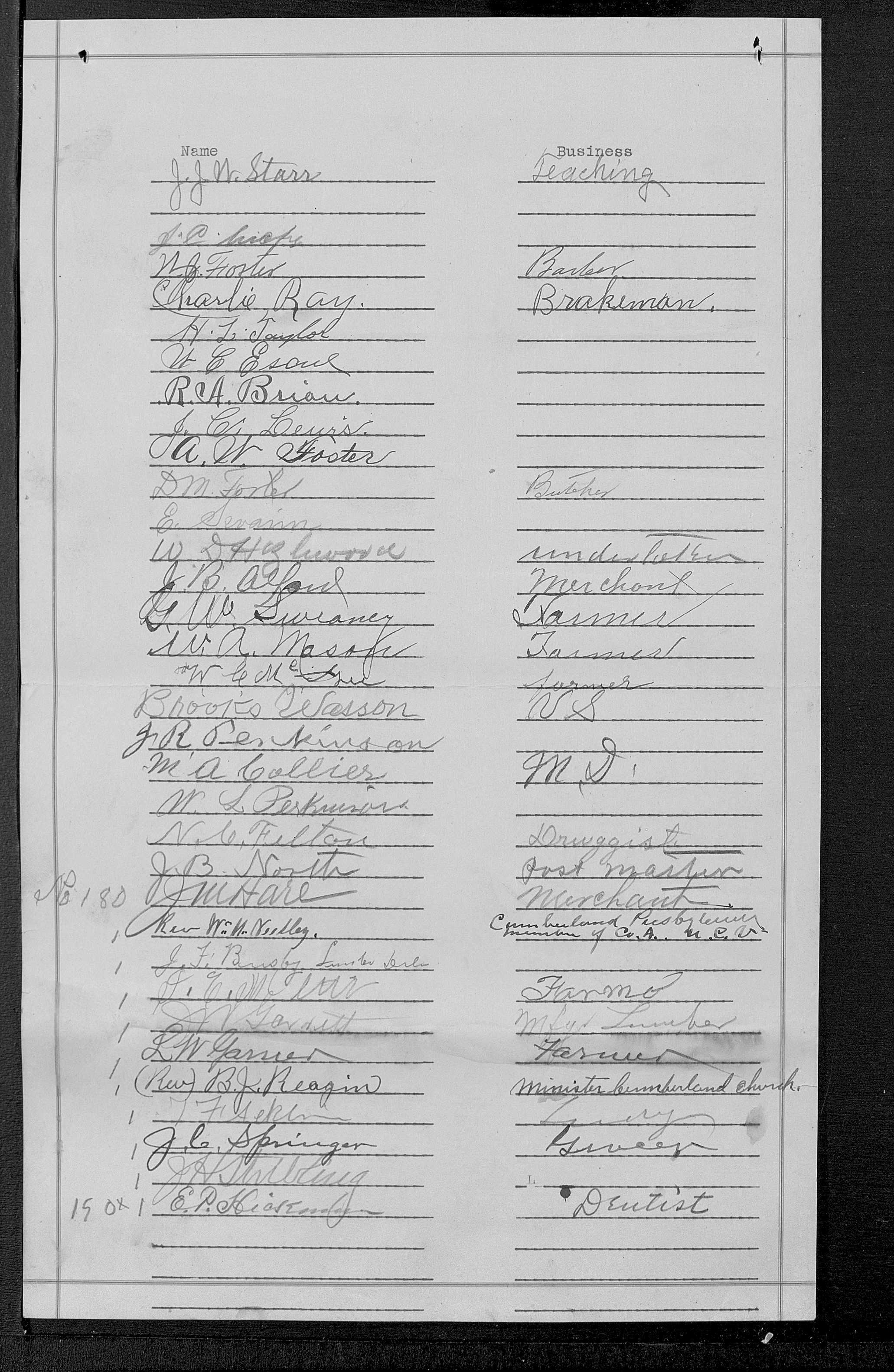
One Lawrence County man got the signatures of 190 people!

The reason? Civil War veteran drama.

In the spring of 1906, 78-year-old James S. Finley of Lawrenceburg applied for a pension from the State of Tennessee for his service in the Confederate army. In 1861, Finley enlisted in Company A of the 32nd Tennessee Infantry. He was a Methodist pastor in civilian life, and on October 28, 1861, he was elected chaplain of his regiment.

After the fall of Fort Donelson and the capture of a large portion of the Army of Tennessee in February 1862, Finley claims that he was ordered to return home until further notice. He says that when the men of his regiment were exchanged in October 1862, he reported to the conscription officer, who promptly issued him a discharge due to his status as a minister. He says that for the duration of the war, he “lived a quiet and peaceable life,” minding his own business at his home in Marshall County.

Finley’s account and his extant service record satisfied the Tennessee Board of Pension Examiners, and he was allowed to draw his $5 per month–once. After one check, Finley’s pension stopped and he was given no reason why.

As it turned out, some local Confederate veterans were outraged that Finley’s name was added to the pension roll, and they wasted no time letting the state know. Finley found out about this when the Pension Board mistakenly sent him a letter that was probably intended for the governor. It said:

“As soon as his name appeared in the published list of new pensioners, we received protests from some of the leading citizens of Lawrence County…and from Marshall County where he lived during the war. It was charged that he saw little or no service in the army, that he left the army in 1862, and that thereafter he affiliated with the other side, acting as pilot and informer for the Federal troops in this section of the state.”

Finley’s neighbor, the schoolteacher and Union veteran J.J.W. Starr, wrote a flurry of letters to the governor and the Pension Board denying the charges and insisting that Finley be allowed a fair and impartial hearing regarding the case.

T.H. Meredith, a local Confederate veteran and court official, did not mince words in his angry letters to the Pension Board. He claimed that Finley helped the Union army during the war, that he began the first Northern Methodist church ever seen in the area, that he consistently voted the Republican ticket, and that he was “a low-down cuss, and he deserves a kick from all honest men.” Meredith had some harsh words for J.J.W. Starr, too, calling him “the most contemptible Yankee that ever struck our county,” and that he “meddles in a great many things that do not concern him.”

John B. Kennedy, another local Confederate veteran and court official, took aim at Finley’s personal life, claiming that Finley had been married three times; the first wife “he treated so shamefully and so brutally…that she finally went insane and died,” the second he divorced, and the third he ordered from a “matrimonial service.” Kennedy went on to say that Finley “is the worst old Philistine who has so far escaped the jawbone.”

In the autumn of 1909, a petition circulated requesting Finley’s reinstatement on the roll, stating that he was “a person of good moral character and worthy of belief.”

The petition, seen here, is impressive. It contains 190 names of men from a variety of walks of life. James D. Vaughan, the father of Southern Gospel music, signed it, as did the mayor, a doctor, a dentist, multiple pastors, several Civil War veterans of both sides, as well as butchers, merchants, painters, carpenters, harness makers, brakemen, newspaper editors, bakers, and the city marshal.

Finley died in 1911, but was never reinstated to the pension roll. He is buried in Mimosa Cemetery in Lawrenceburg, surrounded by both his detractors and most of the 190 men who signed their names to vouch for his character.

Posted in Uncategorized | Leave a comment

St. Mary’s Cemetery: A National Register Property

While all of Lawrence County’s cemeteries are historic to some degree, only one cemetery in Lawrence County is listed on the National Register of Historic Places.

St. Mary’s Cemetery, five miles east of St. Joseph, on Gieske Road is the only remnant of the abandoned German Catholic settlement of St. Mary’s. Established in 1872, the community of St. Mary’s had a log Catholic church and was home to a handful of German immigrants who came to Lawrence County as part of the German Catholic Migration of the 1870s.

The parish was eventually absorbed by St. Joseph and the log church is long gone, but the little cemetery at St. Mary’s remains, and it is still an active burial site. Buried there are members of the Gieske, Kerstiens, Henkel, Regensberg, and Bergob families, among others.

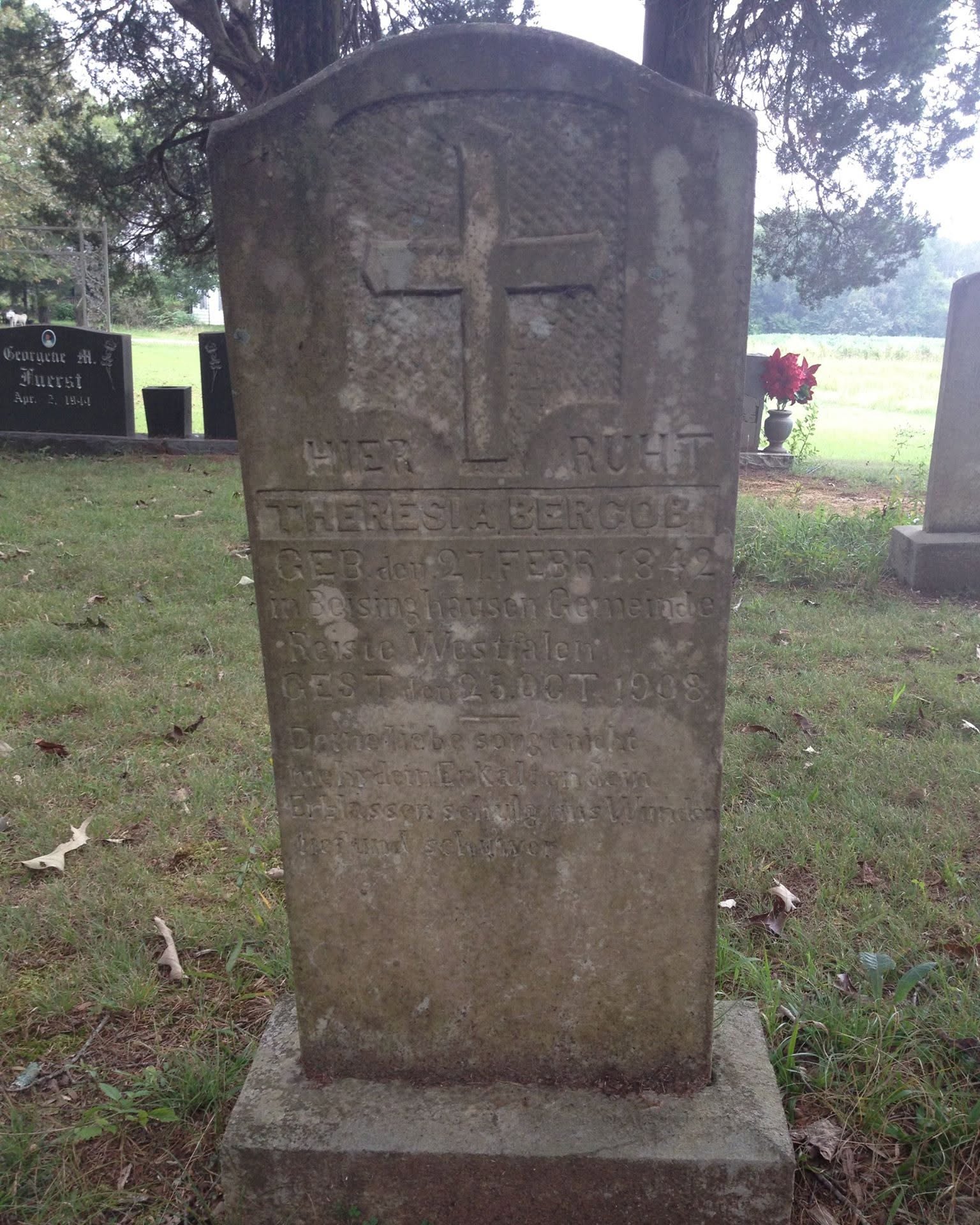
Some of the earliest stones, like this one marking the grave of Theresia Bergob, have German epitaphs. Although some parts of the stone have been worn almost illegible by more than a century of the elements, Theresia Bergob’s stone (as far as I can read it) says the following:

HIER RUHT
THERESIA BERGOB
GEB den 27 FEBR 1842
in Beisinghausen Gemeinde
Reiste Westfalen
GEST den 25 OCT 1908
Deuneliebe songinicht
mehrdein Erkaliendein
Erblassen schulg uns Wunder
lief und schuwer

The German epitaphs, combined with the cemetery’s association with the German Catholic migration, make the cedar-ringed burial ground unique enough to meet the rigorous criteria for inclusion on the National Register of Historic Places.

St. Mary’s Cemetery was listed on the National Register on October 10, 1984.

Posted in Uncategorized | Leave a comment