
Did you know that, for the early part of the 20th century, our county became home to a massive influx of people from North Alabama? This period of our history is known as the “Alabama Migration,” and it played a key role in shaping the unique cultural heritage of our area.
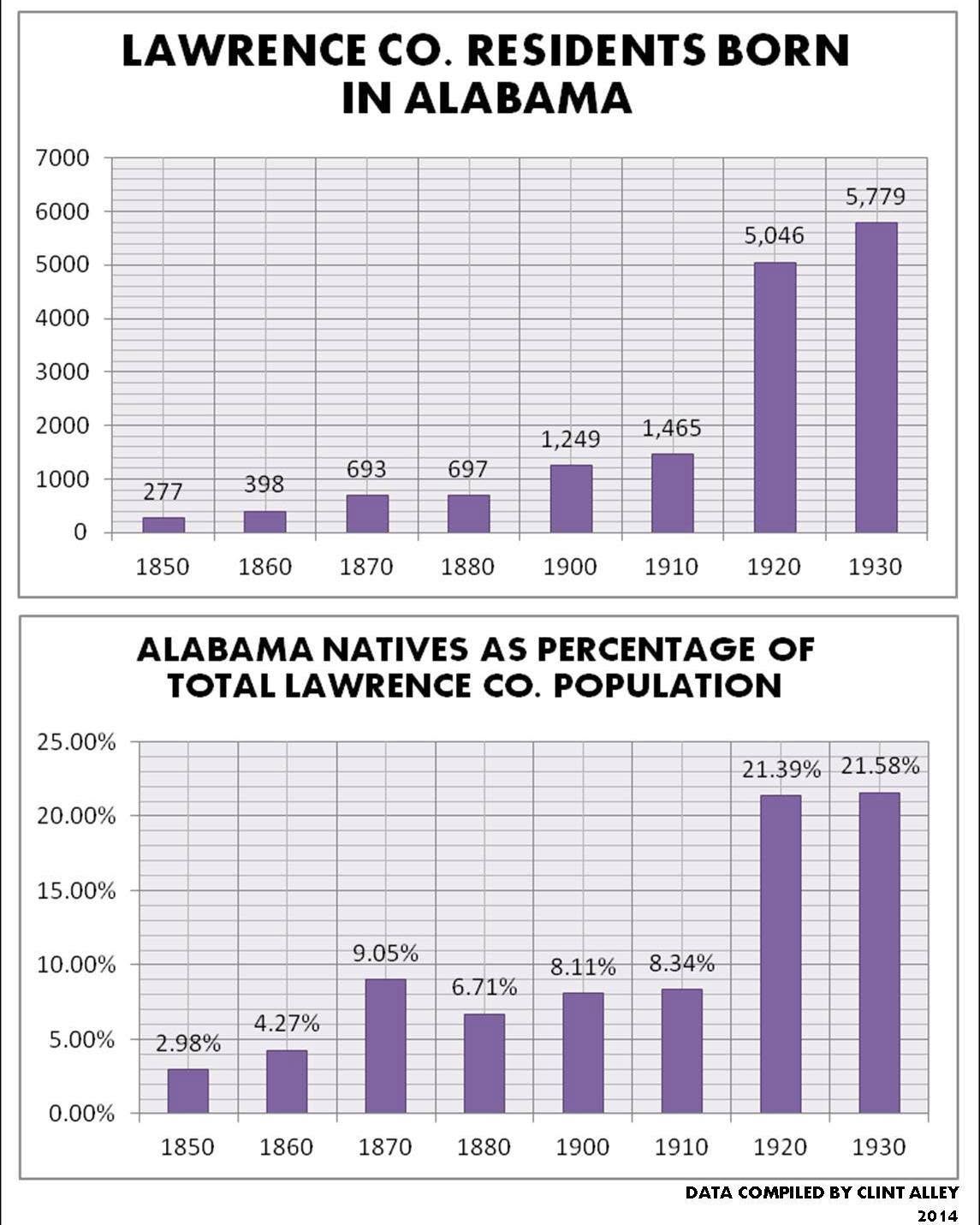
The migrants were mostly from the Alabama counties lying immediately south of the Tennessee River–Franklin, Lawrence, Cullman, Winston, and Morgan. The migration began in earnest around 1909 and continued into the 1930s, as the accompanying graphs demonstrate. By 1930, almost a quarter of all Lawrence Countians identified themselves as having been born in Alabama.
They came for a variety of reasons. At first, some came to reap the benefits of Tennessee’s lax open range laws, which allowed farmers to own large numbers of livestock without having to own a great deal of land. Others came seeking cheaper, more fertile land and new opportunity in Lawrence County’s sparsely-settled southern region.
Southern Lawrence County was the last region to be heavily logged for its rich virgin timber. The great forests that had covered almost all of the county since its founding in 1817 were not heavily logged in southeastern Lawrence until the early twentieth century.
Many of the early settlers from Alabama recalled the hundreds of saw logs they laid low as they cleared their newly-purchased land. Hugh Methvin (1893-1983) moved to Lawrence County from Cullman County, Alabama as a ten-year-old boy. Years later, Mr. Methvin wrote to the ‘Democrat-Union’ that “practically all the land along the Rabbit Trail was in woods in 1913, when we moved here…we cleared the land and built a house on it…the logs we piled and burned would bring a high price today.”
These newcomers established many new communities as they settled in southeastern Lawrence County. The land that would become Bonnertown was purchased by Alan Bonner in 1909, who moved here from Winston County, Alabama, and soon encouraged his friends and relatives to follow him. Local historian Bobby Alford says that, together with two other men, Bonner purchased over 1,600 acres of land in southeastern Lawrence County that year, and paid only $2.50 per acre for it.
The Alabamians who settled in Lawrence County brought their culture and traditions with them, and they planted the cash crop that they new best: cotton. Although cotton had been grown in Lawrence County since it was first settled, it came into its own when the Alabama Migration began. As more Alabamians flowed across the state line between 1910 and 1930, cotton production in Lawrence County flourished. Between 1900 and 1910 alone, Lawrence County’s cotton output soared by almost 300%.
The Alabama Migration had a profound effect on Lawrence County, not just in terms of population, agricultural output, or areas of settlement, but also in its cultural impact. The influx of Alabamians was so high that most of Lawrence County today can undoubtedly claim some blood connection with the Yellowhammer State.
Do you have any relatives who came here from Alabama in the early 20th century?


 Lawrence County History Trivia
Pingback: Bringing Local History to the Classroom | Lawrence County History Trivia