
Can you imagine asking your congressman to collect on a personal debt that another congressman owed you? Would you trust him to?
David Crockett was perpetually strapped for cash. Even when he lived in Lawrence County–which was, relatively speaking, one of the most prosperous periods of his life–Crockett still borrowed heavily to build his milling operation on Shoal Creek, and had to ask at least one land speculator for an extension on his payment for some land he had purchased in Lawrence County.
All of Crockett’s financial troubles multiplied when his mill was washed away by a flood of Shoal Creek in September 1821. He scrambled to liquidate his assets, was sued by several of his creditors, and moved to West Tennessee for a fresh start after selling all of his land to satisfy his creditors.
But before he left for good, Crockett borrowed money yet again. On October 10, 1822, Crockett borrowed $12.75 from Moses Pennington. The note was due the next day, but apparently Crockett never showed up to settle with Pennington.
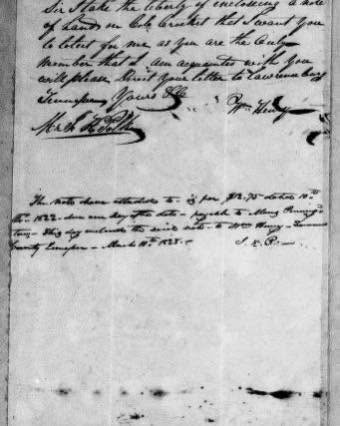
Sometime in the next five years, Pennington must have sold or traded the note to its next recorded holder, William Henry. In 1828, William Henry sent a letter to future President of the United States James K. Polk, asking him to collect from Crockett. At that time, Polk and Crockett were both representing Tennessee in the House of Representatives in Washington.
The letter, with original spelling preserved, reads as follows:
‘Lawrenceburg Tennessee Feby 20th 1828
Sir
I take the liberty of encloseing a note of hand on Colo Crocket that I want you to colect for me as you are the Only member that I am acquainted with. You will please Direct your letter to Lawrenceburg Tennessee.
Wm. Henry’
Apparently, although Lawrenceburg was not in his Congressional District, Polk made Crockett pay up. A notation written by Polk on the letter says that he “enclosed the said note to Wm. Henry” on March 10, 1828.
By the way, how much would $12.75 be worth in 1822? According to the Westegg inflation calculator, it would be the same as borrowing around $300 today.


Pingback: Bringing Local History to the Classroom | Lawrence County History Trivia