Venison, Anyone?

Happy Opening Day to all of you deer hunters out there!

Hunting has always been a popular pastime in Lawrence County. During the Civil War, the city of Lawrenceburg was abandoned to such an extent that wild animals flourished in the town’s streets and buildings.

In the spring of 1865, when the war was over and people began to return to Lawrenceburg, a local man is said to have shot and killed a fine buck right on the Public Square.

But perhaps no Lawrence County hunter has a greater reputation than Colonel David Crockett. In the late 1810s or early 1820s, when Crockett was living in Lawrence County, a Giles County minister was preaching a sermon here one Sabbath.

His sermon made reference to Nimrod, whom the Book of Genesis called “a mighty hunter before the Lord.” But at the climactic moment, the preacher forgot Nimrod’s name. When he called out to his congregation, “Tell me friends, what is the name of that mighty hunter before the Lord?” an old man in the back shouted, “David Crockett!” which caused the congregation to erupt in laughter.

Do you have any hunting tales that you would like to share? Post them in a comment!

Posted in Uncategorized | Leave a comment

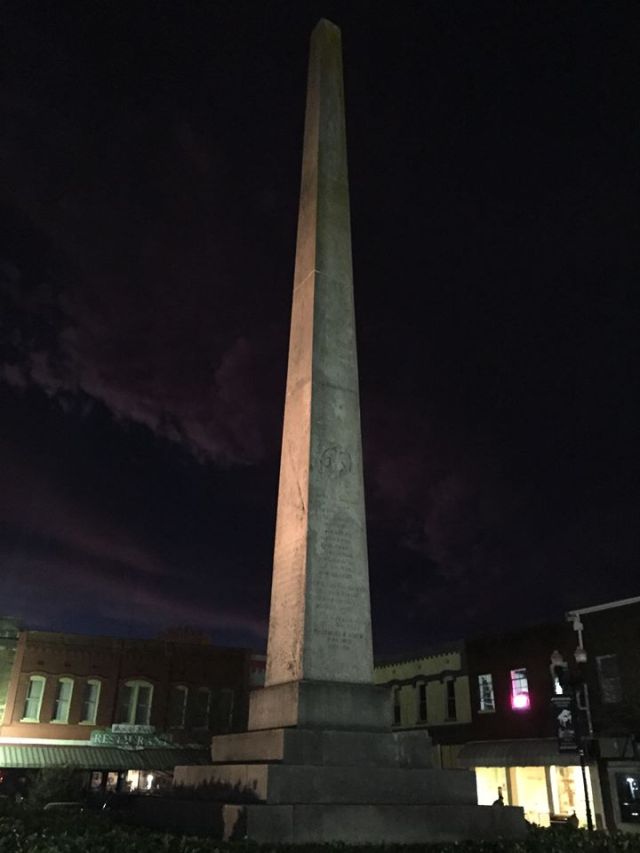
The Mexican War Monument At Dusk

The Mexican War Monument in historic downtown Lawrenceburg was brilliantly illuminated by a beautiful sunset tonight. The monument, one of only a dozen or so in the nation, is also one of the oldest at 166 years old this year. It saved the Lawrence County courthouse and, consequently, all of Lawence County’s historic public records from the torch of Union soldiers in November 1863.

12246595_923193107771017_2357531035919883652_n

Posted in Uncategorized | Leave a comment

Lawrence County’s Spookiest Stories: The Dream of the Spotted Bird

Happy Halloween!

Did a local Civil War soldier foresee his own death in a dream?

One of Lawrence County’s most dangerous men was a blacksmith named Lewis Kirk. As a young man, Kirk volunteered to fight in the Mexican War with a local company of men known as the Lawrenceburg Blues.

In 1858, Kirk shot and killed a farmer from Giles County on the Public Square in front of more than 40 witnesses. The farmer had been slandering Kirk’s name around town all afternoon. For this crime, Kirk was sentenced to serve time in the state penitentiary.

However, to Kirk’s good fortune, while he was appealing his case, the Civil War began, and he received a pardon from the governor for agreeing to serve in the Confederate army.

Kirk quickly rose to the rank of captain in the Confederate army, and he commanded a company of the 9th Tennessee Cavalry, a regiment which included many local men.

Kirk’s wartime record (comprised of reports written almost exclusively by his Unionist enemies in contemporary newspapers) is full of tales of him murdering escaped slaves, forcing old men into the Confederate army, executing a Union general while he lay wounded and dying in an ambulance, and he even supposedly once shot a man for refusing to cheer for Confederate president Jefferson Davis.

Needless to say, Kirk was widely reviled by his adversaries. So when he survived the Civil War and was allowed to come home as though nothing had ever happened, it no doubt got under the skin of some Union officers.

Not long after returning home in 1865, Kirk and a party of men which included his friend John Hildreth went hunting south of Lawrenceburg. Kirk was distracted that day, and didn’t seem to be much interested in the hunt. Shortly after it began, he left his deer stand and went to Hildreth’s.

Hildreth told Kirk that he should go back to his stand, lest the deer slip past him.

Kirk shook his head and said, “John, last night I dreamed that a beautiful spotted bird came to me. The bird whispered something I dare not tell you, but I can’t stay off to myself.”

After the hunt, the men returned to Lawrenceburg, and gathered around the Square to talk. A squadron of Federal cavalry rode through town, spoke to the men, and then rode on. When they reached the intersection of Pulaski Street and Locust Avenue, the Federals turned around, went back to the crowd of men, and told Kirk to come with them to Pulaski.

No one ever saw Kirk again.

The Federal soldiers, who later claimed that they had only apprehended Kirk to use as a guide, gunned Kirk down on the Columbia Pike near Lynville and buried him in a shallow grave right beside the road, where he lay until he was re-interred in the Lynnville Cemetery at the turn of the 20th century.

They told their superiors that he tried to escape, which is the version of events that the northern press chose to believe. The story of Kirk’s execution was reported as far away as the New York Times.

What did the spotted bird in Kirk’s dream say to him that would make him not want to be alone on the day he was killed? We will never know. But whatever it was, Kirk seemed to know that his time was short that day in the woods.

Posted in Uncategorized | Leave a comment

Lawrence County’s Spookiest Stories: The Photo of Captain Gilbreth

We need not speculate about the faith of Captain W.J. Gilbreth–or lack thereof. He made sure that generations yet unborn would know that he was an avowed atheist by having a special plate inscribed and placed on his tombstone in Lawrenceburg’s Mimosa Cemetery.

Concerning his view of religion, the plate says that Gilbreth “made his life the best he could. No fear of gods, no love of Jesus, no thought of future punishment or reward controlled his acts. His mind was free from religious or other superstition. His sense of right and justice was the law he obeyed.”

As it was told to me long ago, the story of how Captain Gilbreth came to lose his religion in Lawrenceburg, Tennessee–where a church stands on every corner–is a tragic tale of personal loss.

Captain Gilbreth was one of the many Lawrence County men who rushed to the colors when the Spanish-American War broke out in 1898. He was deployed to the Philippines with his regiment, leaving behind two young children and a pregnant wife. As the story goes, Gilbreth prayed incessantly for his wife and unborn child while he was at war. Tragically, however, his wife lost the child, and when he found out about it, Gilbreth lost his faith.

He survived the war, came home, and although he and his wife went on to have one more child, Gilbreth permanently turned his back on God and all forms of religious belief.

As an open and avowed atheist, Gilbreth certainly must have stuck out in a small town like Lawrenceburg in those day. Regardless, he filled his life with civic activity and community-mindedness. Local newspapers from the turn of the 20th century show that he attended and helped organize almost every important community function, was an active proponent of the creation and advancement of Lawrence County High School, and served in several community leadership positions.

When he died in 1934, a large stone was placed at his grave, with that bold pronouncement of his disdain for religion at the center, and two black-and-white photos on each side–one of him, and one of his wife, who would outlive him by more than twenty years.

But it’s what supposedly happened to that stone that most people remember about Gilbreth.

As legend has it, not long after Gilbreth was buried, the skies turned dark and thunder began rumbling ferociously. But the storm that day supposedly produced only one bolt of lightning, which is said to have struck Gilbreth’s tombstone with a mighty fury, forever scarring and marring his photograph.

Whether the story of the lightning bolt striking the tombstone is true or whether the damage to Gilbreth’s photo is the result of vandalism, generations of the faithful have pointed to the legend as evidence that Gilbreth had angered God for openly flaunting Him.

Whether or not the legend is true, Gilbreth’s tombstone is certainly an anomaly in Lawrenceburg, Tennessee. In a sea of stones which commemorate the faithfulness of the deceased, Gilbreth’s stone stands out for its open dismissal of faith and religious belief.

Regardless of whether you agree with his conclusions or not, no one can deny that Gilbreth’s stone–and the legend that accompanies it–is certainly unique.

19923_915391645217830_129753582645107095_n

Posted in Uncategorized | Leave a comment

Lawrence County’s Spookiest Stories: Digging Up Bones

Have you ever found anything surprising–or shocking–while digging in Lawrence County soil?

Throughout our county’s history, people have accidentally disinterred or discovered human remains in surprising places. Here are three tales of local folks who, without meaning to, disturbed the final resting place of the deceased.

According to a very old oral tradition, the community of Henryville is said to have been built on the site of an ancient Indian village. Although this story has never been proven, local people have, indeed, found thousands of Indian relics concentrated in the vicinity throughout the years.

One old-timer recorded another dim memory in the Annals of the Lawrence County Historical Society in the early 1950s. According to a story told at one of the society’s first meetings, a grisly discovery was once made on a hill north of town, at the site of the old stand (a sort of antebellum inn where travelers could rest) which stood just outside of Henryville.

We don’t know how or when, but, as the story goes, someone once accidentally discovered a mass grave of several human skeletons buried in the yard of that stand. Due to the scant details recorded in the Annals, we can only speculate as to who these people were and why they were buried in the yard of the old stand.

If the discovery was made after the Civil War, then it seems that the most obvious answer is that these bodies belonged to men killed in the skirmish fought by Forrest’s cavalry along the Central Turnpike in November 1864.

But it could also be possible that those skeletons could have belonged to Indians who died many generations before whites settled the area, or that the bones disturbed were those of some of the area’s earliest settlers. Perhaps it was the result of some forgotten pestilence? Or perhaps it was foul play? All we can do is speculate.

There is no speculation, however, as to what a local man found near Ethridge one autumn day almost a century ago.

On November 16, 1916, a young man was looking over some land he had recently purchased about two miles east of Ethridge, “116 steps south of the Ethridge and Weakley Creek mail road,” when he came upon the scattered and bleached bones and tattered clothing of a recently-murdered man.

The coroner determined that the bones–which had been gnawed upon and scattered by hogs and dogs and other such scavengers–belonged to a white male, about 35 years of age who had been dead for about three or four months. His hat, which lay nearby, was full of thin slits, which corresponded to marks on the skull, leading authorities to the conclusion that he had probably been stabbed to death.

The clothing was identified as that of a young man named Marion Clifton, who had left Giles County about four months before bound for Texas, but whose family had not heard from him since. It is an eerie thought, indeed, that for months, these bones lay just feet away from people passing by on the busy road nearby.

Our final tale tonight comes again from the vicinity of Mt. Zion and Appleton, from the battlefield of Sugar Creek. On the day after Christmas, 1864, when a thick fog shrouded the valley, General Nathan Bedford Forrest dealt a stinging blow to pursuing Federal forces there. The Battle of Sugar Creek left more than 150 men and horses dead on the field, in the woods, and no doubt in the creek, itself.

Locals still discover bullets, buttons, buckles and other Civil War paraphernalia from the area. But perhaps the most gruesome discovery happened completely by accident, some eight decades after the smoke had cleared.

While plowing corn in one of his fields near Sugar Creek in the 1940s, local farmer Steve Ball–who, in a twist of fate, was the grandson of a Union cavalryman who had fought at Sugar Creek–accidentally dug up the remains of one of the soldiers who fell at the battle. There was nothing present with the remains to indicate to Mr. Ball if the skeleton was Union or Confederate. The body was later given a proper burial at the nearby Puncheon cemetery.

Have you ever dug up anything strange in Lawrence County?

Posted in Uncategorized | Leave a comment

Lawrence County’s Spookiest Stories: The Glowing Tombstone

Near the back of an old cemetery in the western part of Lawrence County, so the story goes, there is a tombstone that glows an eerie green. Although we don’t know exactly why, there are plenty of people who have seen it happen.

Several years ago, Nick Harris and three friends piled into a Dodge Daytona and went out to see if it was really true.

When they arrived at the cemetery in the dead of night, they saw nothing but pitch darkness–at first. It wasn’t until they turned to leave that one of them noticed a faint green light coming from the back of the cemetery.

Nick’s friend Bill Allen led the party toward the stone, which continued to glow with that otherworldly green light until they reached it. When they got to the stone, it stopped glowing.

“I’ve never been so scared in my life,” said Harris.

The Glowing Tombstone has long been an object of fascination for many Lawrence County people. What makes it glow? Why does it glow only on certain nights? Is there just one Glowing Tombstone or are there many?

What do you think?

**As a reminder to our readers during this special series of local spooky stories, we at Lawrence County History Trivia do not condone trespassing or vandalism. Vandalism of a cemetery in Tennessee is a Class E felony, and carries a maximum sentence of six years in prison and a fine of $3,000.**

Posted in Uncategorized | Leave a comment

Lawrence County’s Spookiest Stories: Mt. Zion

The place called Mt. Zion is in the remote southern part of the county, near the Alabama line, in a beautiful clearing beside Sugar Creek. At a hollow between the rugged ridges, in a peaceful place where the woods break, there sit two churches and a sprawling antebellum cemetery at a fork in the road.

The older of those two churches, Mt. Zion Methodist Church (pictured here), is listed on the National Register of Historic Places, and is believed to be the oldest Protestant church building in Lawrence County. A suspension footbridge crosses Sugar Creek nearby. Locals call this the “Swinging Bridge,” and there has been a variation of that bridge in the same place for over a century.

The cemetery probably has around 500 graves, including a rare grave-house and the final resting places of several of the area’s earliest settlers. It is likely that their slaves are probably buried in unmarked graves toward the back of the cemetery.

Mt. Zion is not far from the site of the Battle of Sugar Creek, which was the last battle of the Civil War fought in Middle Tennessee.

In the spring and summer, Mt. Zion is a lovely place that beckons Sunday afternoon picnickers, hikers, and anyone who wants to dip their toes in the cool water of Sugar Creek.

Perhaps it is because the place is so remote, or perhaps because the cemetery is so old, or perhaps because the surrounding hills make the little valley seem a little darker at night; whatever the reason, Mt. Zion is said to be one of the most haunted places in all of Lawrence County.

Those who are brave enough to go there after dark claim to have seen ghostly figures moving slowly among the gravestones of the old cemetery. Some have felt the Swinging Bridge jerk and sway violently while trying to cross at night. And many folks claim to have heard dreadful moans and screams from the surrounding woods.

One spirited group of paranormal enthusiasts also claim to have recorded what they believe to be the heated cries of a Bigfoot at the place in the spring of 2008.

Have you ever encountered anything spooky at Mt. Zion?

12191579_914250008665327_2553447780933864859_n

Posted in Uncategorized | 26 Comments

Lawrence County’s Spookiest Stories: The Whistling Patty

This week, in honor of Halloween, we will take a look at some of our county’s local ghost stories and spooky tales. Tonight’s post is about Whistling Patty.

Whistling Patty–sometimes known as Screaming Patty–is not necessarily a person. It is not necessarily an animal. No one is quite sure what the Whistling Patty is, but everyone who has seen it agrees that they do not want to see it again.

Some of our readers have told us that they have encountered Whistling Patty while in the woods late at night in the northern part of the county, specifically around Anderson Creek and Summertown. It is described as a predatory creature that makes noises similar to a baby crying or a woman screaming.

Dwayne Stewart told us in 2013 that he had encountered the Patty while coon hunting along Anderson Creek many years ago. He said you could always tell when the Patty was nearby because the dogs would come back frightened and refuse to hunt, and that many older men refused to hunt the area at all because of the Patty.

One of those older men claimed that he once watched as the Patty killed several of his dogs, and then followed him back to his truck.

Have you ever seen or heard the Whistling Patty?

Posted in Uncategorized | Leave a comment

A Courthouse Ahead of its Time

The 1905 Courthouse which once sat at the center of the Lawrenceburg Square was an imposing and beautiful building.

But did you know that it was also ahead of its time?

When the courthouse was under construction, the Lawrence ‘Democrat’ reported that it would be wired for electricity and telephones.

That doesn’t seem like a big deal to us today, but when you consider that there were no electrical or telephone lines in town in 1905, it somewhat changes our perspective.

In fact, at the time they were building the courthouse, it would be two years before electricity was even available in Lawrence County.

The generation which built the 1905 courthouse believed in laying a good foundation for the next generation, even if it meant taking risks. They knew that the key to growing their community was to do things that their children would one day thank them for doing.

That is the attitude which fueled projects like the building of a beautiful courthouse with electrical hookups, opening a tuition-free high school years before most of the rest of the state did, and damming Shoal Creek to provide the people with reasonably-priced and reliable electricity.

12108122_912266542197007_8046824413290430085_n

Posted in Uncategorized | Leave a comment

The Buried Indian Treasure of Alexander Springs

Have you ever been on a treasure hunt?

One field in northern Lawrence County was supposedly a popular destination for treasure-hunting Indians in the early 20th century.

Past Lawrence County Historical Society president Bill Alexander described Seneca Field as an “abandoned field overgrown with sage grass, plum, and cherry trees.” It was just north of Weber City, on what later generations knew as the Tom Hampton Place. But this field, so it was said, contained a secret.

As the legend goes, the field was once a campsite for a band of traveling Seneca Indians. How and why a band of Seneca Indians came to create a campsite in southern Middle Tennessee is not retained in the story. The Seneca are native to the northeast and Canada, and their presence in our county would indicate that they were, indeed, far from home.

These Indians supposedly buried a large cache of gold in this field, in hopes of coming back to the place at a later time to retrieve it.

According to the tale as recounted by Alexander, the Indians never returned for their gold, and as late as the 1920s, fresh holes could be spotted there at sunrise, made by locals searching for the treasure. Indian people also supposedly came from far away to dig in the field.

Whether there was ever gold in Seneca Field is left to speculation. But the fact is, people did once frequently dig holes in the field searching for it.

I (Clint Alley) was reminded of this story while perusing some articles written by my great-uncle Bill Alexander this afternoon. But I first heard the legend from my grandfather Mack Kerr when I was a boy. My grandfather grew up in the vicinity, and he had heard the old story when he was a child. His mother (Bill Alexander’s sister, Florence Alexander Kerr) told him that she remembered seeing the fresh holes which periodically dotted the field in the early 20th century.

A similar buried treasure destination was Ivy Bluff, which was “on the north bank of Buffalo Creek, a few hundred yards below the crossing of Highway 43.” Although not as popular a location for excavation as Seneca Field, strangers also frequently dug holes near Ivy Bluff, searching for long-lost gold.

Posted in Uncategorized | Leave a comment