Do the Amish Pay Road Taxes?

Readers, if you will allow me to share some current local history with you tonight, I made this graphic to help clear up some confusion about the Amish and their role in maintaining our county roads.

As you see, because the funds for road repair come from the general fund, the Amish do, in fact, pay the same amount of taxes toward local road maintenance as everyone else who owns property.

11831814_865285413561787_349194294646129470_n

Posted in Uncategorized | Leave a comment

Billy Pierce: Lawrence County’s Little Giant

One Lawrence County war hero started his military career by throwing an embarrassing public tantrum. But when the smoke finally cleared at war’s end, he had proved himself to be one of the bravest men in the county.

On July 9, 1861, at the beginning of the Civil War, a group of young men assembled on the Public Square in Lawrenceburg to volunteer for service in the Confederate army. The first group of volunteers from Lawrence County had left for training in May, but many young men were still eagerly flocking to the colors of the fledgling Confederacy.

Among the men who showed up to volunteer on that hot July day was William A. Pierce. Like the others, the 18-year-old Pierce was eager to serve. But at 5’1″ tall, he immediately stood out from the other young men. Payton Sowell, who reminisced about the incident in the Lawrence ‘Democrat’ many years later, recalled that Pierce’s head scarcely reached the shoulders of the other men who volunteered that day.

When George H. Nixon, the officer in charge, called Pierce’s name on the roll, he took note of his small stature and said, “Billy Pierce, you are too small. You cannot go.”

After this harsh denial, Pierce walked to the sidewalk in front of what is today Bills Bluegrass (Weather’s Brothers Music) and cried like a baby as the shocked townspeople watched. Between sobs, Pierce begged the officers to allow him to go. Apparently it was a scene as extraordinary as it was embarrassing, because several of those present remembered it well into their twilight years.

When it became clear that Pierce would not stop crying until he was allowed to enlist, Captain W.B.J. Moore approached him and said that he would allow him to go with them to camp. When they arrived at Camp Trousdale for training, Pierce answered the roll as though nothing had happened, and no one raised any objections to his presence.

Over the course of the Civil War, Pierce more than proved his worth as a soldier. Because Moore had personally ensured his place in the army, a friendship developed between the two. At the Battle of Shiloh, Pierce’s arm was shattered in combat. As Pierce lay on the battlefield, seriously wounded, Captain Moore was cut down by enemy fire, and he fell to the ground across Pierce’s legs, where he died.

Pierce survived the battle, and was taken to Louisiana by Captain Moore’s brother to recover from his wounds. When he had recovered, he reenlisted in the Confederate army, this time in Nixon’s Cavalry.

Like Moore, Nixon grew to greatly respect Pierce, and he often entrusted him with very important and dangerous missions; he once ordered Pierce to spy out the location of a group of Federal soldiers. In obedience to the order, Pierce crawled on his hands and knees through half a mile of tall weeds to discover the enemy’s position. When he found them, he opened fire on them before retreating back to Nixon’s headquarters to report on their activities.

Pierce was captured near Florence, Alabama in the summer of 1864, and spent most of the rest of the war in Rock Island Prison in Illinois. No doubt when he returned, the townspeople had great respect for the blood he had shed for his country, but few of them would ever forget the many tears he had first shed in order to serve.

Posted in Uncategorized | Leave a comment

Murray Ohio and Lawrenceburg: The Power of Community Spirit

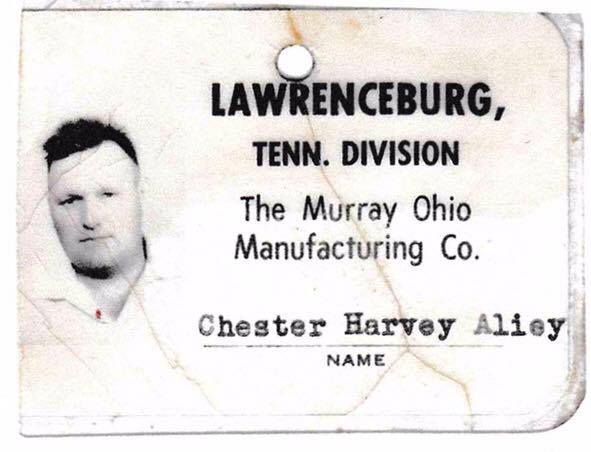
How many of you can remember wearing name badges that look like this?

This badge belonged to Chester Alley, who began work at Murray Ohio in 1956, when the Lawrenceburg plant was first built.

The story of Murray Ohio coming to Lawrenceburg is the story of a community working together for the greater good. According to Cromer Smotherman, Lawrenceburg was the last site that the company was planning to visit on their tour of Tennessee, and most of the executives had already decided to build the new plant in another city in Tennessee.

At the behest of their guide, however, the Murray executives visited Lawrenceburg, and they were impressed not only by the progressive attitude of the elected officials, but by the positive attitudes and friendly dispositions of the people of Lawrence County. The warm welcome they received in Lawrenceburg made them change their minds about building in another city, and so they decided to bring Murray to Lawrenceburg, and changed the history of our area forever.

Making the decision to build the new plant was not as easy as it might seem. The city of Lawrenceburg agreed to pay for the building of the plant, but it did not have the resources on hand to foot the $2 million bill for the massive construction project.

On October 14, 1955, the people of Lawrenceburg went to the polls to vote on whether or not to approve of the issue of $2 million worth of industrial bonds by the city of Lawrenceburg. The measure needed 75% of the vote in order to go into effect.

Needless to say, it was a leap of faith on the part of the citizens of Lawrenceburg. But after a brief and frenzied voter-education campaign on the part of the Chamber of Commerce and local elected officials, the people of the city voted 2,346 to 5 to approve these bonds–although ground had been broken on the site more than a month before, and the people did not yet even know the name of the company!

In addition to building the plant, the city had to deal with the issue of housing the 52 families which had to move to Lawrenceburg from Cleveland to work as supervisors at the new factory. At that time, the city of Lawrenceburg did not have enough rental houses to accommodate those 52 families until they could build or buy homes of their own.

In response to this problem, several local people pitched in and built 25 new brick houses to help house the families from Cleveland.

As a result of these different segments of our community working together, building each other up, and relying on each other’s support, Lawrence County experienced its greatest economic expansion to date. The money brought in by Murray helped to fund a swath of municipal improvement projects, which in turn helped to attract more industry and improve the quality of life for local people like Chester, who–along with his wife Iler Mae–eventually retired from Murray.

If I (Clint Alley) may take a moment to make an editorial comment, I believe that one of the greatest lessons we can learn from the arrival of Murray in Lawrenceburg is that bringing jobs and attracting industry to our area is not just the job of our local elected officials. Improving our community is everyone’s shared responsibility.

You may not be a member of the county commission or the chamber of commerce, but you never know who might be listening when you criticize or belittle Lawrence County, just as you never know who might be listening when you take time to brag on the positives of our community.

Look out for your neighbor. Volunteer your time to help keep our community clean and our children in school and out of trouble. Buy local. Encourage out-of-town friends to visit David Crockett Park or Laurel Hill Lake. Work with local government instead of pulling against it. We all want to live in a place where our children can find work and make a good living. We all want a better community.So let’s start building that community today, one positive action at a time.

10984600_860361790720816_8474976365485145656_n

Posted in Uncategorized | Leave a comment

Name That Historic Lawrence County Floor!

Can anyone name this historic Lawrence County building just from its floor pattern?

11695801_857498337673828_6374825396551407852_n

Photo credit: Clint Alley

Posted in Uncategorized | Leave a comment

A Traffic Jam in Downtown Lawrenceburg

How is traffic this afternoon?

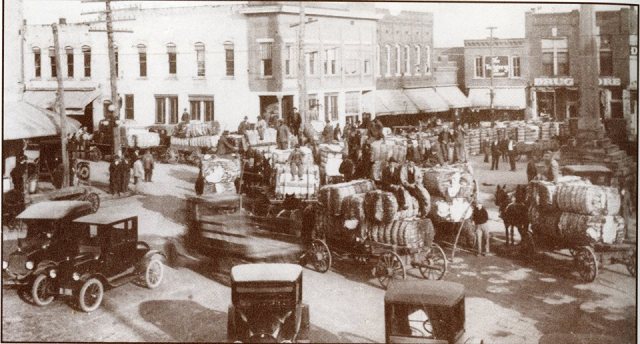
As you can see in this image from the 1920s, traffic could get a little hectic in downtown Lawrenceburg in the days when cotton was king, especially not long after harvest, when cotton markets were sometimes held on the Square.

This image shows the north side of the Square, with the Mexican War Monument at right and the Toggery in the northeast corner. The word ‘toggery’ is a quaint old term for a shop that sells clothing.

11760076_857606760996319_2701418308688194906_n

Photo credit: Lawrence County Historical Society

Posted in Uncategorized | Leave a comment

The Lawrence County Public Library: Check it Out!

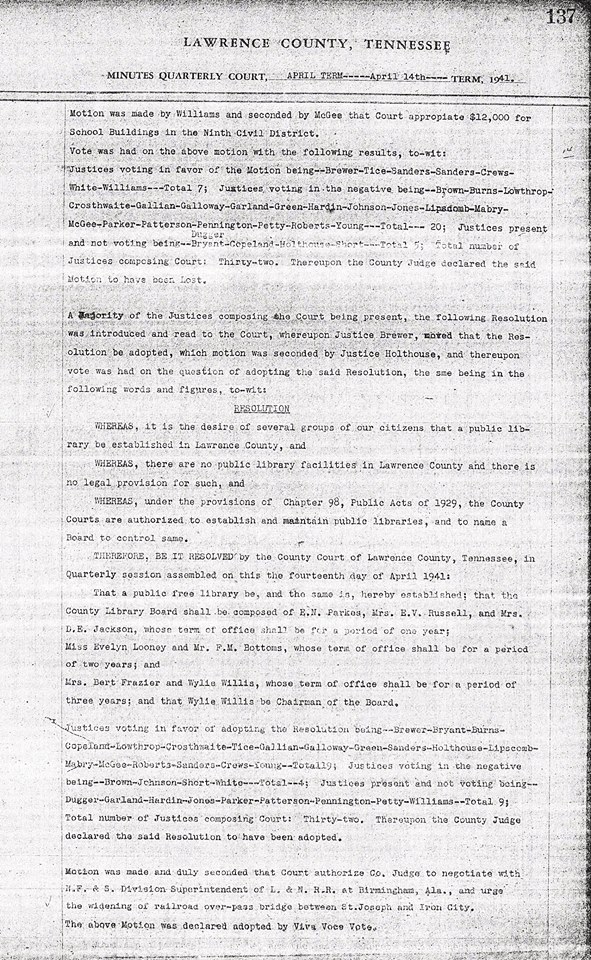
Lawrence County has had a first-rate public library for 74 years. The attached image of the county court minutes from the day the library was created is the library’s “birth certificate.”

On April 14, 1941, the Lawrence County Quarterly Court voted to create the Lawrence County Public Library, but it wasn’t just that decision which created the library; it was the work of our entire community.

Prior to the county’s creation of the library, a group of concerned citizens spearheaded a drive to fund the project and to create its stock of books. This effort had been supported by many folks in Lawrence County in one way or another for almost half a century.

Hundreds of local people, civic organizations, and community clubs donated money and books to help launch the library in the months leading up to the official creation of the department.

Like most great community efforts, the idea for our public library grew from the ground up, and it continues to grow today. As the way we access information has changed, the library has adapted to better-serve its patrons. Today, you can still check out books and write reports at the library, but you can also download free e-books, learn how to write a resume, book a place for your club meeting, create an e-mail account, get free Internet access, learn your family’s role in our nation’s history, and get your children excited about learning.

The library has programs for all age groups and it is open to people from every socioeconomic background. The way we access information may change, but the Lawrence County Public Library will always find new ways to help our community learn and grow.

11700935_855741527849509_32236216516499298_n

Posted in Uncategorized | Leave a comment

A Presidential Barbecue: Lawrenceburg’s Celebration of James K. Polk

Who doesn’t love a good, old-fashioned barbecue?

In Lawrence County’s earliest years, public barbecues were held to celebrate important days. There was a public barbecue to celebrate the railroad coming to Lawrenceburg in 1883, to celebrate the city’s first observance of David Crockett’s birthday in 1890, and to commemorate the first reunion of Confederate veterans in Lawrence County in 1891.

But, much earlier than that–particularly in Lawrence County’s antebellum years–public barbecues were held to celebrate a certain politician or to allow civic leaders the opportunity to give speeches or have debates near elections. One such massive rally and barbecue was held at Lawrenceburg in honor of presidential candidate James K. Polk on October 25, 1844, just a few days before that year’s presidential election.

Local man John McMasters was thirteen years old when he attended the barbecue, and he reminisced about the event to the ‘Lawrence News’ at the age of 91. Mr. McMasters’s account of the event is told here in his own words:

“The crowd gathered on the square and the first thing they did they rolled out a barrel of whisky, set it up and knocked the head out and drove nails all around and hung cups on them and told everybody to help themselves.

“The barbecue was south [of the Square], near the old college and when we started to dinner there were twenty-six young women riding gray horses and bell to all their girths. They rode two by two, and a man in front of them. When they got there a Miss Tarkinton made a public speech.

“We had plenty of bread and meat and I don’t think I saw but one man drunk, that is down drunk.”

Posted in Uncategorized | Leave a comment

Paid in Full: Lawrenceburg Innkeeper Shows Respect to Revolutionary Veteran

Take a break from the controversy and anger that has saturated the national news in the past week and enjoy one of my favorite lighthearted stories from Lawrence County’s early days.

Here’s a feel-good story about how one Lawrence County man showed his respect for a veteran with an act of kindness.

According to one of Lawrence County’s earliest newspapers, in the spring of 1846, an old man came to Lawrenceburg to apply for a pension.

The old man stayed the night at the inn (probably the Farmer’s Inn, which stood near the Square in Lawrenceburg). The innkeeper noticed that the old man was so feeble that he could barely feed himself, so he stepped in and helped the old man eat.

While he ate, the old man told the innkeeper that he was a veteran of the Revolutionary War, and that he had fought at the Siege of Savannah, Georgia, where he had served alongside the famous patriot soldier William Jasper. Although relatively unknown to Americans today, Jasper was a Revolutionary superstar in antebellum America. He had helped to turn the tide of the Battle of Sullivan’s Island by rallying the men around a torn and tattered South Carolina flag. Jasper died at the Siege of Savannah, his regiment’s flag still in his hands.

The old man told many tales of his service to the innkeeper during his stay at the inn. When it came time for the old man to settle his bill with the innkeeper, he produced his “scanty means” to pay, but the innkeeper refused the old man’s money, saying to him, “Sir, your bill was paid the day you fought by the side of the brave Jasper at Savannah.”

Posted in Uncategorized | Leave a comment

A Bandit Buried in the Road in Leoma

Did you know that a bandit lies buried under the Old Military Road in Leoma? And that he was killed by the brother of General Nathan Bedford Forrest?

Unlike Florence’s tale of outlaw Tom Clark being buried under Tennessee Street, Leoma’s own outlaw under the street is verified by an eyewitness account. The story begins with the Civil War.

W.P. Oliver, who wrote for the Lawrence ‘Union’ under the pen-name of ‘Fleetwood,’ was a boy of 16 when he witnessed the outlaw buried beneath the street.

As he recalled, it was about the year 1863 when Captain William Forrest, the brother of General Nathan Bedford Forrest, was “riding six miles south of Lawrenceburg on the Old Military Road” with a squadron of cavalry. Right where the city of Leoma currently stands, Forrest encountered a rogue named Davis in a Confederate uniform attempting to waylay a wagon driven by a young man named Bud Thomason, who was bound for the Clay factory with a load of thread.

When Captain Forrest arrived, he saw that the highwayman was attempting to cut the harness from one of Bud’s horses. Forrest ordered Davis to leave the horse alone. Instead of obeying the captain’s order, Davis pulled his gun and fired at him. Forrest narrowly dodged the first bullet, jumped from his horse, and took up a defensive position behind a clay embankment.

Davis fired a second time, and the ball struck the captain’s horse, piercing the beast behind its shoulders. Forrest then took aim with his own weapon and shot Davis squarely through the heart. Davis fell to the road, dead.

Forrest and his squadron continued on their way, as did the wagon driven by Thomason. Unfortunately, Forrest’s horse made it only as far as the nearby Hall’s Stand, home of Jake Springer, where the animal succumbed to its wounds and fell dead in the yard.

After the incident, the few citizens who lived nearby quickly buried Davis’s body in a shallow grave, without a coffin, about two feet in the ground. They built a rough fence of dead limbs around the grave to keep livestock from disinterring the body.

This fence stood around the grave for many years, until Oliver says that a forest fire burned it up. The same fire that burned the fence also felled a nearby tree, which fell lengthwise across the grave, covering it completely and serving as a grave marker to those who remembered what had happened at the place.

Oliver goes on to say that the log was still covering the grave when they began building the town of Leoma, but was moved some years afterward by someone who did not know that a man was buried beneath it, and Oliver wrote that “there is nothing there now to indicate the spot.”

While Oliver did not witness the killing of the outlaw Davis, he could clearly remember seeing Captain Forrest’s horse lying dead in Jake Springer’s yard, and he remembered the fence of dead limbs and the burned-out log on the grave. On a more grisly note, Oliver said that he also once saw a road crew accidentally exhume some of the bandit’s bones in the course of their work.

bill forrest zoom

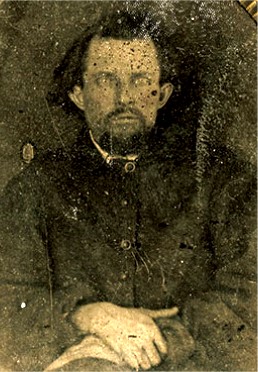
Captain William “Bill” Forrest From the Matt Hagans Collection Source: Forrest Family Faces

Posted in Uncategorized | Leave a comment

The Literary Societies: When LCHS Went Greek

Did you know that LCHS once had fraternal organizations similar to college fraternities and sororities?

Harkening back to a time when high schools had more in common with colleges, the clubs were known as ‘literary societies,’ and they existed for several years after the school’s founding. The literary societies were extremely active in community life; they played intramural sports against each other at school field days, and they often organized student debates, plays, and concerts for public enjoyment, with proceeds benefitting the school.

The literary societies fostered a sense of healthy competition for LCHS students, and gave some organization and order to school extracurricular activities, but over time they were replaced by the school clubs that we know today.

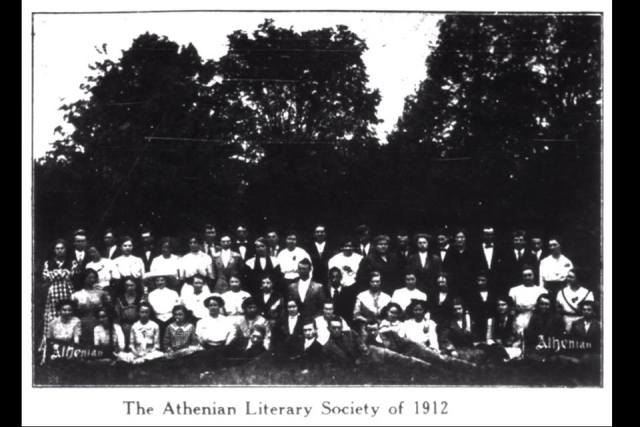
This image from an issue of the Lawrence ‘Union’ is over a century old, and it shows one of the earliest literary societies at LCHS, the Athenian.

11024693_847295835360745_6316915804307921334_n

Photo credit: The Lawrence ‘Democrat.’

Posted in Uncategorized | Leave a comment