
A few veterans’ accounts of the Battle of Sugar Creek in southeastern Lawrence County survive. At least two are found in the book ‘The Military Annals of Tennessee.’
In the mid-1880s, a Nashville educator and civic leader named J. Berrien Lindsley began to collect stories from Tennessee’s Confederate veterans about their respective units’ experiences during the Civil War. He sold the multivolume work by subscription and relied on survivors of the war to submit their units’ histories for publication.
The result was a series of books called ‘The Military Annals of Tennessee.’ Written twenty years after the Civil War, the unit histories are prone to overemphasize the heroism and sacrifice of Confederate soldiers, and the accounts sometimes suffer from hazy memory. That being said, the books offer some details about the war that aren’t found anywhere else.
C.W. Heiskell of the 19th Tennessee Infantry recalled this about Sugar Creek:
“On this retreat [from Nashville] the Nineteenth was in two engagements–one near Pulaski, where Forrest captured two cannon with horses and caissons and brought them off; and the other engagement after crossing Sugar Creek. There it lost one man killed. The fight near Pulaski occurred on Christmas-day, 1864. The regiment was barefooted and ragged, and that day had marched twenty-four miles. As it neared camp, about eleven o’clock at night, marching in the darkness and drizzling rain and sleet, Col. Heiskell, whom some of his men had often asked to have the regiment mounted, said to them, “Well, boys, how do you like the cavalry?” One said, “O this is not regular cavalry.” Another replied, “I think it has been pretty regular of the last forty-eight hours.
“The Federal cavalry gave us no more trouble after Sugar Creek.”
Polk G. Johnson of the 49th Tennessee Infantry wrote:
“[The 49th Tenn. Infantry] moved with Hood to Nashville, and took part in the engagement there, Dec. 16, 1864, and retreated with his army after its defeat, in Walthall’s division. On the 20th of Dec., 1864, it came under the orders of Gen. Forrest, commanding the rear-guard, and was engaged on the 24th in the battle south of Lynnville, and the engagements at Anthony’s Hill and Sugar Creek. Another has said: ‘Each Confederate officer and soldier appeared to act and fight as if the fate of the army depended on his individual conduct. And never were there manifested higher soldierly virtues than by Forrest’s heroic band–including the infantry…The men marched barefooted in many cases, often waist-deep in ice-cold water, while sleet beat upon their heads and shoulders.’ The same writer says of Sugar Creek: ‘The creek was about saddle-skirt deep, and through it the Federal cavalry dashed rearward without regard to any ford, and after them followed Walthall’s dauntless men, charging waist-deep through the icy water.'”
John Johnston, a Confederate cavalryman from West Tennessee wrote a memoir of his wartime experiences in the 1890s, recalled this about the fight at Sugar Creek:
“That night Gen. Forrest and our main body marched on until after midnight and went into camp at Sugar Creek, fourteen miles from where they had the fight at Anthony’s Hill–as the place was called. Here our men were put in position, which was fortified by piles of rails and logs and such material as they could pile up, and laid in wait for the enemy.
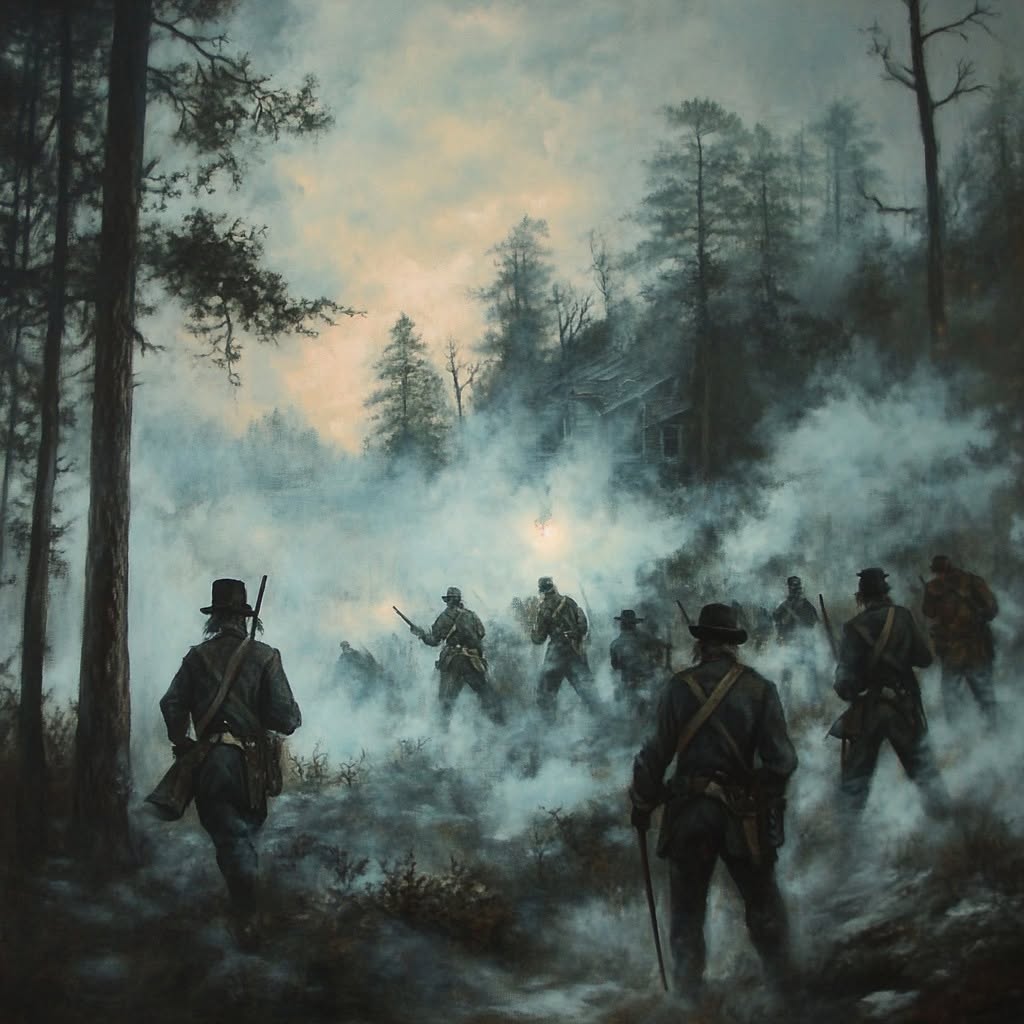
It was said that the morning was very foggy, and our men at their breastworks were concealed from the enemy. As they came on early that morning, our small cavalry force retired before them, and they were drawn very close to our line before they knew of the presence of our men. Here again they were met with a terrific volley from our men, which threw them into disorder, whereupon our infantry left their breastworks and charged them and put them to rout.
This was the last fighting that was done on this famous and remarkable retreat, and it was here that poor Johnson Penn was killed.
Our army marched on undisturbed from that point to the Tennessee River, with the exception perhaps of a few skirmishes between their advance guard and our extreme rear. I believe that our part of the command was thrown to the rear at one time to keep back their advance, but it amounted to nothing.
My memory is dim as to our further marching, except that I remember that we, with Col. Kelly and perhaps a hundred men, continued on the 25th and 26th to follow a parallel route down the winding valleys on the right of the main road; that one night we went into camp at a house at the foot of a steep hill; that the ground was covered with snow; and that Monroe Taylor and I bivouacked together on the side of the hill, being the only two privates left in our regiment.”


 Lawrence County History Trivia
Pingback: Bringing Local History to the Classroom | Lawrence County History Trivia