
A Confederate spy, a black market for clandestine cotton, and a town just as defiant in the middle of the Civil War as it was at the beginning? According to one eyewitness on this day 162 years ago, that was Lawrenceburg in 1863.
In the fall of 1863, a northerner named John C. Smith traveled through Lawrence County in the midst of the Civil War. The letter he wrote to a Union general about his journey revealed that our county was not only still defiantly pro-Confederate at that stage of the war, but that it was also home to a Confederate spy and several factory owners who had duped the Union out of thousands of dollars worth of cotton.
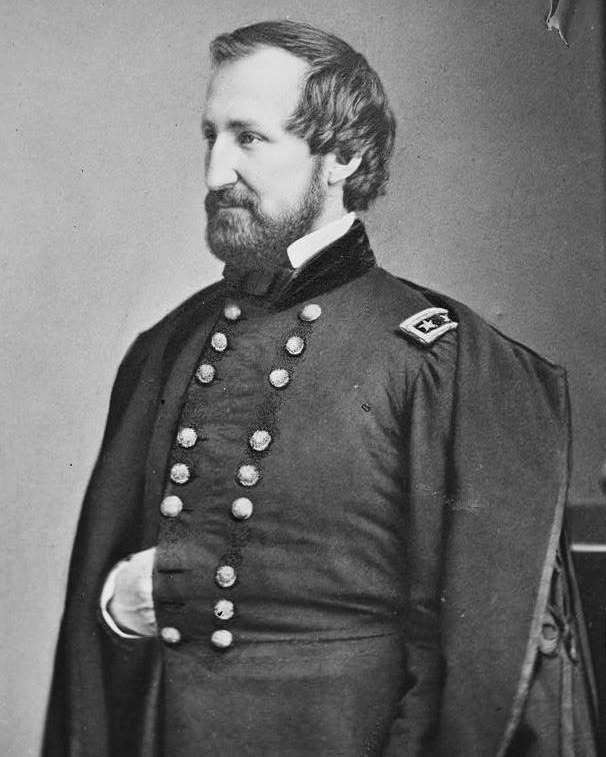
Writing to Union General W.S. Rosecrans (pictured here) on October 14, 1863, Smith reported that, from Clifton to eastern Wayne County, “I found two-thirds of the people for the Union and no mistake and willing to take up arms for the old flag, and many of them have already done so.”
But Smith found a different political landscape entirely when he approached Lawrenceburg. He said, “When I got within 8 miles of Lawrenceburg, and all the way and in the place, I found all rebels.” This loyalty to the Confederate cause is especially remarkable at this stage of the war, given the major Confederate defeats that summer at Gettysburg and Vicksburg.
During his journey, Smith found one of the few openly Unionist men in Lawrenceburg and stayed the night at his house. Although he doesn’t tell us the name of his host, he does divulge the things he learned about Lawrenceburg’s clandestine Confederate black market while staying there.
According to Smith’s host, some of the owners of the cotton factories surrounding Lawrenceburg had taken the oath of loyalty to the Union the previous year, but had continued to secretly furnish the Confederate quartermaster at Huntsville with “thousand upon thousands of yards of cloth and hanks of thread to sew with.”
These factory owners received as payment from the Confederate army “captured cotton from the U.S. Government,” which they secretly picked up “at the tunnel between Pulaski and Huntsville on the railroad.” Much of the cotton, according to Smith, was branded as belonging to the Confederate government. He urged Rosecrans to confiscate these factories for the Union, as he reckoned that the contents thereof “would be enough to pay 50,000 soldiers for six months’ service.”
Smith goes on to say that the town of Lawrenceburg was generally “nearly deserted, and in a dilapidated condition.” Among the other peculiar personalities Smith was informed of by his host was Birney Chaffin, who was no doubt the court clerk W.B. Chaffin. According to Smith’s mysterious host, Chaffin “pretended to be a Union man and has taken the oath…but [he] is undoubtedly a southern spy.”
The evidence against him? Smith’s host said that Chaffin “has always a number of [pro-Confederate] bushwhackers with him in his house.” Smith went on to say that Chaffin “is the worst man and most dangerous spy the rebels have there.”


Pingback: Bringing Local History to the Classroom | Lawrence County History Trivia