
On this day 162 years ago, Federal soldiers surrounded the courthouse in Lawrenceburg with torches at the ready after a brief fight in the streets. But quick thinking on the part of a local citizen saved our courthouse and our county’s early history.
On November 3, 1863, Union and Confederate soldiers squared off in a brief skirmish near downtown Lawrenceburg that has come to be known locally as “The Battle of Lawrenceburg.”
It began when Confederate forces under Colonel Albert G. Cooper recaptured Lawrenceburg from a small occupying force of Federal soldiers.
The Confederates, numbering about 500, used the Lawrence County jail to house, according to the Union officer in charge of the action, “…many Union citizens who refused to join the rebel army, as also some Federal soldiers…” When word reached Major Thomas Fitzgibbon of the 14th Michigan Mounted Infantry, stationed in Columbia, he set out with a force of 128 men to free the captive Unionists.
After a botched attempt at surprise, Fitzgibbon’s force reached Lawrenceburg at daybreak on November 3. When he came within a mile of Lawrenceburg, Fitzgibbon was informed by local slaves that the Confederates were waiting for them. According to Fitzgibbon, the slaves “volunteered their fears of my destruction, as Cooper had ‘over 500 men’ ready to receive me…[the Confederate commander] was told (they said) of my coming, and ‘got ready to lick me.'” Fitzgibbon’s men engaged Confederates fortified behind cotton bales along what Fitzgibbon called the “Mt. Pleasant Road.” After a fierce fight, the Confederates were driven from town, having released the prisoners roughly an hour before Fitzgibbon’s arrival.
Fitzgibbon’s men burned the jail, and ordered loose cotton strewn inside the courthouse to prepare it for firing, as well. But some citizens of Lawrenceburg pointed out that burning the courthouse might destroy the nearby Mexican War monument. Fitzgibbon had no desire to harm the monument, as he was a veteran of the Mexican War, himself. This, coupled with Fitzgibbon’s desire to quickly remove his outnumbered force from Lawrenceburg, convinced him not to burn the courthouse, saving the building and all of its local records from destruction.
As Fitzgibbon wrote, “the citizens begged that I would spare the court-house, as its destruction would disfigure and perhaps mutilate and destroy a monument close by, erected in memory of those of its former residents who died on the plains of Mexico defending the Republic.”
As Fitzgibbon left town, the Confederates reformed and attacked again with about 150 men. At this point, Fitzgibbon’s horse was shot out from under him, as were the mounts of many of his officers. During this counter attack, Fitzgibbon’s men probably encountered the famous Rebel Yell. As he put it, “the fierce yells of my assailants gave warning of their near approach.” The Confederate troopers attempted a final charge, which was shattered by a surprise attack from Fitzgibbon’s men in nearby woods, who had been ordered to “take no more prisoners.”
At 6:00 p.m., his command returned to Columbia, having accomplished their mission. Fitzgibbon attributed his success against such an overwhelming force that day to the bravery of his men, the disorganization of his enemy, and his men’s use of “breech-loading rifles and revolvers.” Fitzgibbon’s men captured 26 Rebel prisoners. By his estimate, the 14th Michigan sustained three wounded men and seven killed horses, which he says they “soon replaced from the stables of adjacent farm houses.”
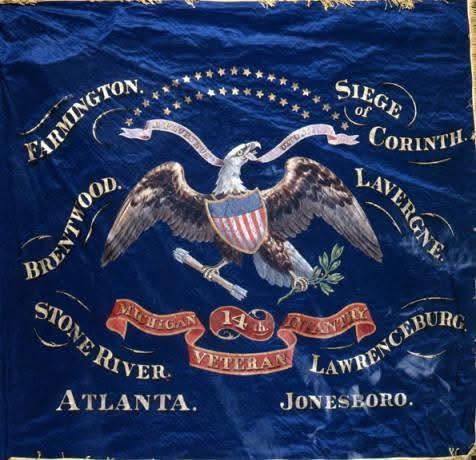
The 14th Michigan Infantry memorialized the fight at Lawrenceburg as a battle honor on their regimental flag, which can be seen in this image.


Pingback: Bringing Local History to the Classroom | Lawrence County History Trivia