
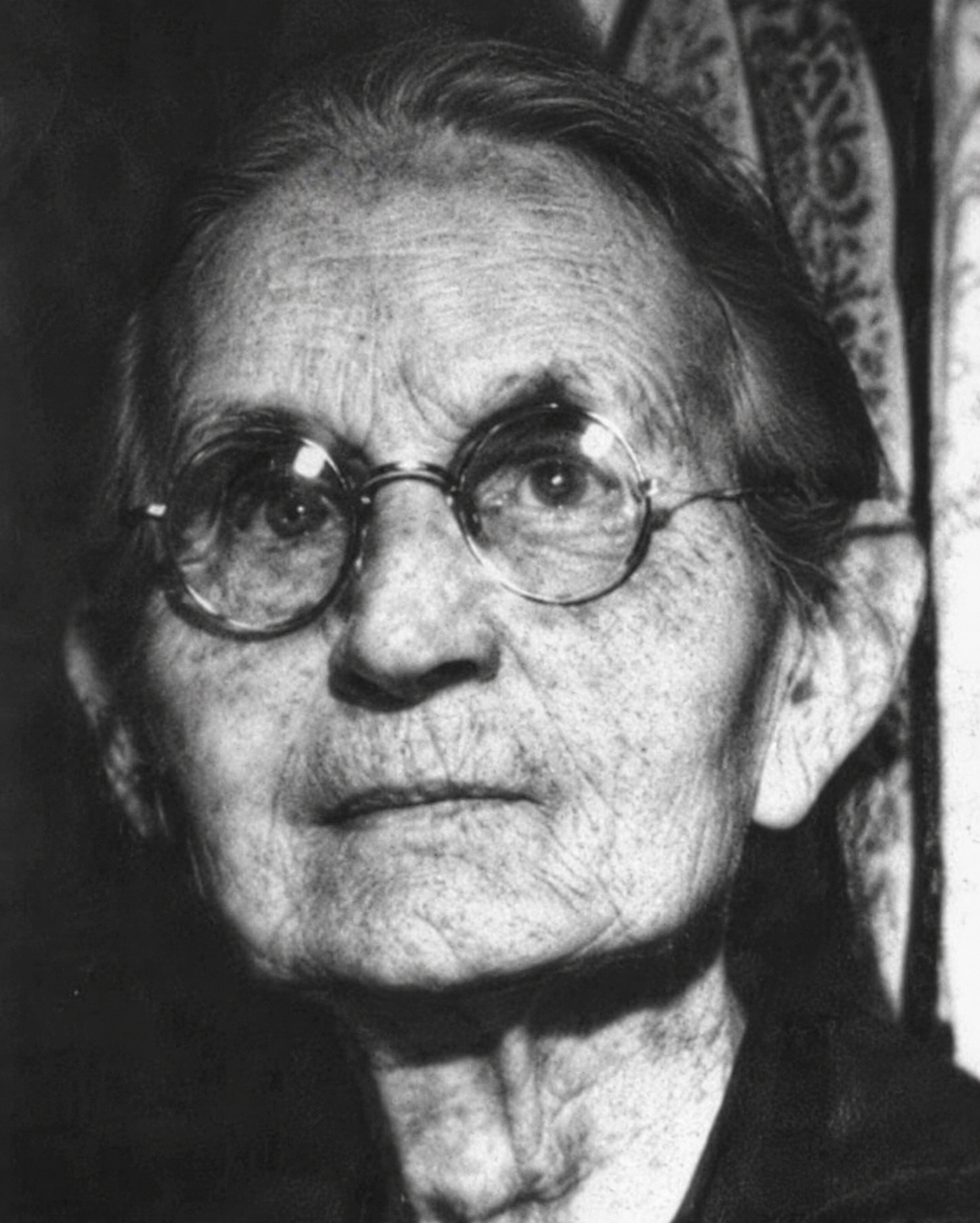
Louise Schnettgocke cried as she boarded the ship for America. Although excited by the opportunity that awaited her, the 25-year-old felt a profound sense of “utter loneliness” as she stood on the dock in Bremen, Germany the spring of her twenty-fifth year.
Born in 1856 in the village of Recke, Germany, Louise went to work at fourteen as a housekeeper and cook for a butcher, a job for which she was paid “one pair of wooden shoes, two dresses, and the German equivalent of one dollar in cash” in her first year.
She understood loss and hard work at an early age.
Her twin brother convinced her to come to America. She spent almost every penny she had to book passage, and met him in Baltimore after a seventeen-day sea voyage that she made by herself. When she landed, she couldn’t speak a word of English. Soon she moved to Indiana, where she got a job at a shoe factory. Children sometimes ran behind her, calling her “Green Dutch” because she spoke no English, an insult that caused her much pain.
Louise learned English by speaking with her coworkers at the shoe factory. She recalled, “When someone taught me an English word I say to them that I pay them a penny to teach me more.” Louise learned English at a penny a word.
Her life changed forever when she met Joseph Hovelmeier in Indiana. Hovelmeier, himself a German immigrant, had purchased a lot in the German Catholic Homestead Association’s German Addition to the city of Lawrenceburg in 1877. In 1882, Louise joined him in Lawrenceburg, where he was working as a blacksmith. The pair were married on September 19, 1882.
In 1871, during the Franco-Prussion War, Louise had been part of a group of girls who were “required to knit and spin for the soldiers” twice a week. Her adopted nation fought two world wars against her native country during her lifetime. But when Percy Priest interviewed her for the ‘Tennessean’ in 1940, shortly after Adolf Hitler invaded Poland, she did not mince words on her opinion of the dictator. “Hitler, I do not like him,” she told Priest “with some vehemence.”
In Lawrenceburg, like many other settlers with the German Catholic Homestead Association, the Hovelmeiers carved out their own version of the American dream, and their descendants are still among us in Lawrence County, today. Married until his death in 1907, the pair had many children, and Louise lived to the age of 91.


 Lawrence County History Trivia
Pingback: Bringing Local History to the Classroom | Lawrence County History Trivia
My name is Edward Kasper, the great grandson of Louise (Schnettgoecke) Hovelmeier’s twin brother, August Frank Schnettgoecke Sr. That makes Mrs. Hovelmeier, my great grand aunt. I am presently living in Marthasville, MIssouri. My grandparents were August Frank Schnettgoecke Jr. and Mathilda “Hilda” (Marquart) Schnettgoecke. My mother was Rita Rose (Schnettgoecke) Kasper. I have only heard stories of Mrs. Hovelmeier and her family. My mom has met her and her four daughters when they came to St. Louis to visit her twin brother’s family. I enjoyed my genealogy and have traced all eight of my great grandparents back to their native home in different areas of Germany. Thanks for the history lesson. I have read part of this story in a Tennessee newspaper written in 1940, when a reporter interviewed my great grand aunt.