
For the first century of Lawrenceburg’s existence, the local postmaster was usually the owner of a general store or mercantile where people could come to get their mail when they were in town. Postmasters were prominent and important individuals who were instrumental not only in collecting and distributing the mail, but in vouching for the character of people in the community.
By the early twentieth century, as methods of travel and roads improved, post offices began rural free delivery, where letter carriers collected mail in wagons at the post office and carried it to people who lived in the country. As the way people got their mail changed, the role of postmaster and post office changed, as well.
The current Lawrenceburg Post Office is the result of Franklin D. Roosevelt’s New Deal. In the summer of 1934, as part of the Federal government’s efforts to jump-start the American economy out of the Great Depression, the Postmaster General of the United States announced that money had been allocated for the construction and improvement of post offices around the nation. Of the $65 million in allocated funds, $1,155,000 went to Tennessee, and of those funds, $80,000 was earmarked for the construction of a new and permanent post office in Lawrenceburg. An additional $185,000 in Federal funds was also allocated for the construction of a sewer system for Lawrenceburg.
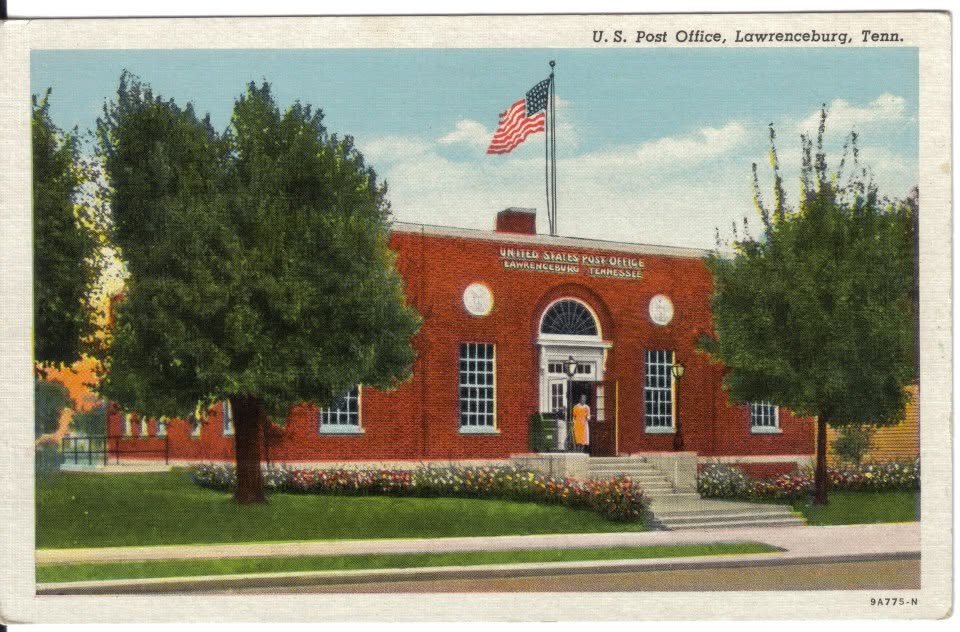
In March 1935, the construction firm of Forcrum and James of Dyersburg was awarded the $65,000 contract to build a new post office in Lawrenceburg. The building’s location was selected with a purpose; at that time, North Military Street was the city’s main commercial artery.
According to the site ‘Living New Deal,’ the Lawrenceburg Post Office “was completed in 1935 with Louis A. Simon as supervising architect and John W. Wolcott Jr. as architect. The original building is a ‘symmetrical five-by brick building’ and has been extended with an addition that is in sympathetic design. Concrete American eagle medallions are inset above the windows on either side of the fanlight above the entrance doors. Replicas of the eagle medallions are also above 2 of the windows on the extension.”
The post office was dedicated in the autumn of 1935 in a ceremony attended by Congressman Clarence W. Turner.

 Lawrence County History Trivia