Could You Pass This Eighth Grade History Test from 1935?

Could you have passed an 8th grade history class in 1935?

The following questions were taken directly from the first two sections of the history portion of an 8th grade final exam given in Lawrenceburg in 1935. The history portion had five sections overall, but to conserve space, I have reprinted only the first two sections. The test was published in its entirety in a January 1935 edition of the ‘Democrat-Union.’

HISTORY

A. Write the word True or False at the end of each of the following statements.

1. John Sevier was called the father of Middle Tennessee.

2. Tennessee was the first state to leave the union, and the first to return to it.

3. Indians would burn the homes of the settlers, but would not kill the women and children.

4. The settlers always dealt fairly with the Indians.

5. Tennessee was organized as a territory of the U.S. before it became a state.

6. The early schools were in session on Saturday and Sunday.

7. Andrew Jackson was at one time Governor of Tennessee.

8. People of Tennessee had nothing to do with bringing on the Civil War, for they owned no slaves.

9. Governor Horton emphasized the building of highways and bridges.

10. Abraham Lincoln was a Tennessean.

11. Spemeer spent his first winter in Middle Tennessee in a log cabin.

12. At one time there was only one county in Tennessee.

13. Nancy Ward was a friendly Indian woman who told the white people that the Indians were going to attack the settlements.

14. Most of the clothing worn by early Tennesseans was bought in North Carolina.

15. The American Colonies had won their independence before Tennessee became a state.

16. The United States does not collect a tariff on any imported article.

17. Early settlers of Tennessee were illiterate backwoodsmen.

18. Houston, a Tennessean, led the Texans to independence from Mexico.

B. Fill the blanks in the following with the proper word or words.

1. Bonnie Kate was the wife of _______.

2. The reorganization bill which gives our State Government its present form was passed during _______ administration.

3. Most of the Governors of Tennessee have been members of the _______ party.

4. The hero of the World War was _______.

5. The Tennessee Century Exposition was held during the administration of _______.

6. the first public school system in Tennessee was adopted during John C. Brown’s administration in the year.

7. the Ku Klux Klan was first organized at _______.

8. What Governor of Tennessee secured a hospital for the insane? _______

9. What Governor of Tennessee resigned and became leader of the Texans in their fight for independence?

10. The two governors of Tennessee who have held office for twelve years are _______ and _______.

11. The first institution of learning in the Mississippi Valley was opened in what is now Tennessee by _______.

12. Tennessee had trouble with the Spaniards over the use of the _______.

13. The Tennessean who is said to have “slept with one eye open” was _______.

14. The first actual settler of Middle Tennessee was _______.

15. The Indians’ greatest mistake was _______.

16. Our present Direct Representative in the State Legislature is _______.

17. The present Governor of Tennessee is _______.

18. James K. Polk’s ancestral home is _______.

19. The Hermitage near Nashville was _______.

20. What widely known person recently ate breakfast at the Hermitage? _______

21. Tennessee has had _______ Constitutions?

22. The last Constitution was adopted in the year _______.

23. The following Tennesseans became President of the U.S. _______

24. An army of Tennesseans defeated a British army at _______ during the Revolutionary War.

25. The two brothers who opposed each other for governor of Tennessee were _______ and _______.

26. the first regularly elected governor of Tennessee was _______.

27. Tennessee became a State in the year _______.

28. Tennessee was at one time a part of what State? _______

29. The first settlement in Tennessee was made in the year _______.

30. The American colonies gained their Independence from _______ as a result of the _______.

31. England gained a free hand in America by defeating _______.

32. New York was first called _______.

33. Five countries that made settlements in the new world are _______.

34. The length of the governor’s term is _______ years.

35. Members of the Legislature serve _______ years.

36. In Tennessee the _______ has the power to pardon criminals.

37. The State Legislature meets in regular session once every _______ years.

38. State of Franklin was named in honor of _______.

39. American General at Battle of New Orleans was _______.

40. The Vice President of the United States is _______.

Posted in Uncategorized | Tagged , , , , , | Leave a comment

When Lawrenceburg Voted at Bayonet-Point

On this day 146 years ago, according to the Pulaski ‘Citizen,’ a company of Union soldiers under the command of General Don Carlos Buell arrived in Lawrenceburg.

Although the article doesn’t specify why the company was dispatched to Lawrenceburg, it is possible that they were sent in preparation for the presidential election in November. Buell was in command of the Federal troops stationed in Maury and surrounding counties during Reconstruction. The already-tense election season (which would determine if Andrew Johnson or Union General Ulysses S. Grant would become president) was made more volatile by the activities of vigilante groups like the Ku Klux Klan. One of the Klan’s favorite means of suppressing the rights of former slaves was intimidating them away from the polls during elections.

The deployment of Federal troops to Lawrenceburg may have been a means to ensure that vigilantes didn’t attempt to bully freed blacks away from the polls. However, as many contemporaries argued, a company of Federal soldiers guarding the polls also served as a means of intimidating former Confederate voters from voting against Grant.

An article from a Clarksville paper said that a company of Buell’s Federal soldiers “was stationed in about 40 feet from the polls with fixed bayonets” during the presidential election in Columbia. It also noted that, while Grant and other Republicans won large majorities in Columbia, there were also “42 more votes polled than were registered” in Columbia.

Posted in Uncategorized | Tagged , , , , , , | Leave a comment

The Tornadic Election of 1913

Not long ago, we mentioned that the mayor of Lawrenceburg won re-election in 1913 by only 4 votes. It was the closest election in the city’s history. But we didn’t mention that that election continued as scheduled despite the touchdown of what was then described as “the most severe [tornado] ever experienced” in Lawrence County up to that time.

On March 13, 1913, as the polls remained open in Lawrenceburg, a damaging tornado cut a swath from one end of Lawrence County to the other between 4:00 and 5:00 p.m. The Lawrence ‘Democrat’ describes its path as entering the county west of Iron City, then passing east of Loretto, striking Springer Station, and doing “a great deal of damage” around Leoma, before moving to within a mile and a half east of Lawrenceburg. I have traced the estimated path of the storm on this 1913 map of Lawrence County.

Miraculously, no one was injured or killed in the storm, although several people experienced close calls when the storm came roaring through. Mike Niedergeses got caught on the road when the storm occurred. His buggy was overturned and he was “blown into the woods where he held to a bush while trees fell all around him.”

East of Lawrenceburg, the home and barn of Eugene Deladtz were completely destroyed, as was a saw mill belonging to Rippy Chambers and a barn belonging to A. Zozle. M.J. Sims lost around $200 worth of timber when the twister roared through his woods. John Barline and a man listed only as ‘Niedergeses’ lost barns to the storm, and the home of J.W. Napier was torn completely from its foundation before catching fire.

Immediately following the tornado, the county experienced one of the “heaviest rains that ever fell in this county,” during which lightning struck the home of Rev. Elliot, and knocked a hole in his roof.

Undaunted, the people of Lawrenceburg continued to vote that day, handing the incumbent mayor, J.W. Garrett, a razor-thin victory over his opponent. Garrett was the owner and builder of the Garrett House, which still stands south of the Public Square.

Posted in Uncategorized | 1 Comment

When the President Came to Lawrenceburg

In 1836, the President of the United States stopped in Lawrenceburg. And what he said here incited the wrath of his political enemies.

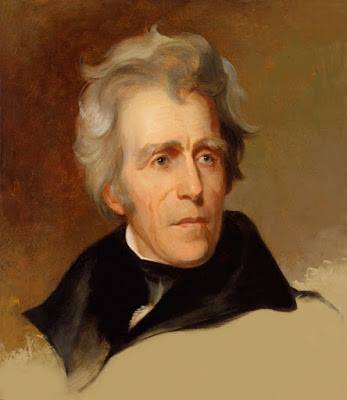
Andrew Jackson was no stranger to Lawrence County. Indeed, local tradition has it that he was a regular at the horse races in Glenrock (modern Loretto). In 1836, he was nearing the end of his final term as President of the United States. That fall, he stopped in Lawrenceburg on his way to Florence.

When he stopped here, it was the season of one of the harshest presidential campaigns that the nation had ever seen. His hand-picked successor and vice president, Martin Van Buren was running against William Henry Harrison of Ohio and Senator Hugh White of Tennessee. Both Harrison and White ran as members of the Whig party. Among other things, the Whig party’s main platform was to malign Andrew Jackson and destroy all things Jacksonian.

According to an article from the Nashville Whig newspaper the ‘National Banner and Nashville Whig,’ Old Hickory was greeted warmly when he arrived in Lawrenceburg. A number of the citizens of Lawrence County supported him politically, and several had served under him in the Creek War and the War of 1812.

One local veteran in particular approached Jackson in the street that day. Although we don’t know his identity, he introduced himself to the President as a veteran of Jackson’s New Orleans campaign. According to the ‘Banner,’ the veteran told Jackson that he was unsure of any of the candidates in that year’s presidential race, and asked Jackson for whom he should vote in the upcoming election.

To the great astonishment and wrath of his Whig enemies, Jackson told the man plainly, “Sir, if you wish the measures of my administration carried out, you ought to support Mr. Van Buren–Judge White is a Federalist.”

The Whigs of the ‘Banner’ and the Pulaski ‘Trumpet of Liberty,’ from whom they gleaned the story, bashed the President for expressing his opinion on who should be his successor. According to them, expressing such an opinion was “undignified and derogatory to his elevated station” as a sitting President of the United States.

However, despite his enemies’ objections, Jackson continued to support Van Buren, who won the election that fall with 170 electoral votes and almost 51% of the popular vote.

Posted in Uncategorized | Tagged , , , , , | Leave a comment

Did an Indonesian Volcano Jump-Start David Crockett’s Political Career?

Did an Indonesian volcano help to launch David Crockett’s political career in Lawrence County? You’ll be surprised that the answer is probably ‘yes.’

The year 1816–the year that Lawrence County was first opened to legal white settlement–was one of the coldest years in recent history. In fact, it was known colloquially at the time as “The Year Without a Summer,” “Poverty Year,” “The Summer That Never Was,” and “Eighteen-Hundred-and-Froze-to-Death.”

According to Allen R. Coggins’s book ‘Tennessee Tragedies,’ the high temperature for the 4th of July that year in Savannah, Georgia, was only 46 degrees. Birds in New England froze to death in their nests in summertime, and severe frosts occurred at least once EVERY month that year in that region. Around the world, temperatures plummeted, precipitation skyrocketed, and famine ravaged entire pockets of the globe as crops failed.

But why?

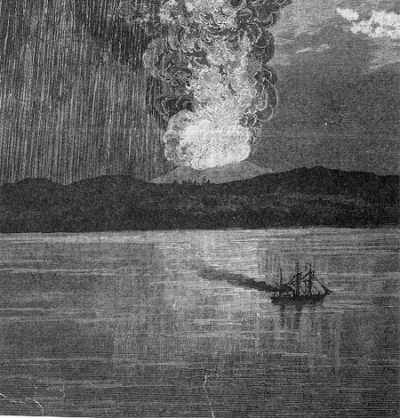
We know now that the cause of the ‘Year Without a Summer’ was three separate volcanic eruptions from different parts of the earth. The final and most cataclysmic of these was the eruption of Mt. Tambora in Indonesia, which, in April 1815, experienced the largest volcanic eruption that the earth had seen in 1,300 years. The explosion ejected tons of ash into the upper atmosphere of the earth. Ice core samples have revealed that enough of this ash entered the atmosphere that, over the course of several months, the entire earth was cloaked in it.

In New England, this ash was recorded as a ‘dry fog,’ which couldn’t be dissipated by anything, even heavy rains. The ash cloud, combined with a rare low level of solar activity, disrupted global weather patterns, causing intense floods, lost harvests, and an increase in epidemic disease.

Also in the Fall of 1816, after the land that would become Lawrence County was ceded to the United States by the Chickasaw, David Crockett left home and began to seek out new land; a journey which would lead him to Shoal Creek in Lawrence County.

Before he settled in Lawrence County, Crockett and his family had lived on Beans Creek in Franklin County, Tennessee for several years. In his autobiography, Crockett described his reason for leaving Beans Creek thusly: “The place on which I lived was sickly, and I was determined to leave it.”

But, perplexingly, as Crockett biographer Bob Thompson found out when he visited Crockett’s Franklin County homestead site in 2010, the land on which Crockett had lived on Beans Creek is even today fertile and well-watered, a veritable farmer’s paradise.

Thompson came to the conclusion after visiting Crockett’s so-called ‘sickly’ land that Crockett simply was not a very good farmer.

However, Crockett’s last harvests at Beans Creek would have occurred in the autumns of 1816 and 1817, in the peak of ‘The Year Without a Summer.’ With heavy rainfall, persistent cold, and little sunlight, Crockett’s land on Beans Creek no doubt would have seemed extremely ‘sickly.’

When Crockett left his ‘sickly’ land and came to Lawrence County in the fall of 1817, it was a lawless and unorganized territory. He developed a reputation among his neighbors as a fair and just man, and was instrumental in establishing law and order, and served as a leader in the new county’s government. His presence in this specific place, at that specific time, launched his political career.

Had his land in Beans Creek not been ‘sickly,’ in 1816 and 1817, it’s possible that he would have stayed on for several more years, missing his window of opportunity to ‘take a rise’ in Lawrence County, as he put it in his autobiography. His election as magistrate lead to his election as colonel of the militia, which lead to his appointment as commissioner of Lawrenceburg, which lead to his election as state representative, which eventually lead him to Congress, a dramatic political falling-out with Andrew Jackson, and a journey to Texas to start again; a journey which met a hero’s end at the Alamo.

So, did the Mt. Tambora eruption launch Crockett’s political career? Not directly. But it may well have ensured that he was in the right place, at the right time.

Posted in Uncategorized | Tagged , , , , , | Leave a comment

When Lawrence County Voted to Leave the United States

By Clint Alley

Second Time’s a Charm?

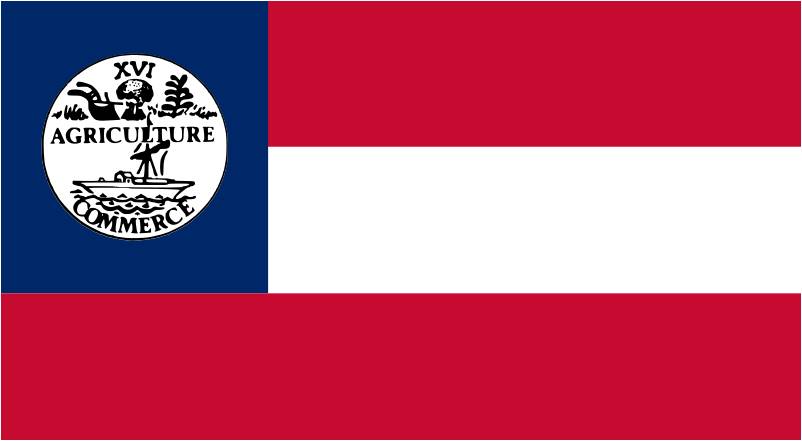
This flag was proposed to the Tennessee Legislature by State Senate Speaker Tazewell B. Newman on 25 Apr 1861. Because the state had not yet seceded from the Union, it was voted down. Information source: 'Flags of Tennessee' by Devereaux D. Cannon, Jr. Image Source: Wikimedia Commons.

This flag was proposed as the new state flag to the Tennessee Legislature by State Senate Speaker Tazewell B. Newman on 25 Apr 1861. Because the state had not yet seceded from the Union, it was voted down. Information source: ‘Flags of Tennessee’ by Devereaux D. Cannon, Jr. Image Source: Wikimedia Commons.

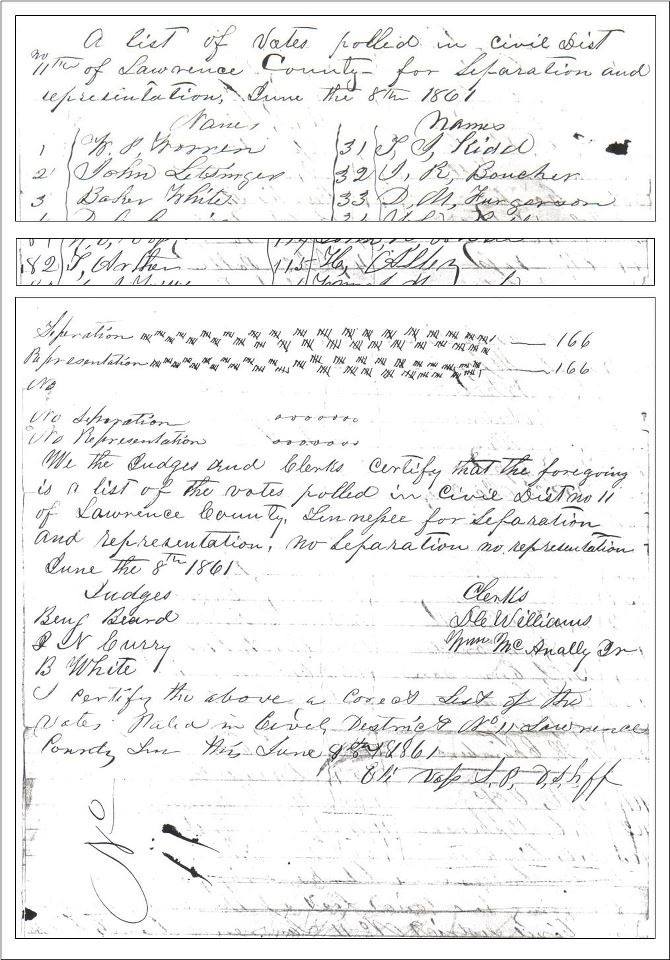
On June 8, 1861, almost 1,200 Lawrence County men–as well as thousands of others across the state–went to the polls to decide if the state of Tennessee would remain in the Union or join the Confederacy.

The state had held a secession referendum for the first time on February 9, 1861, and the issue had been soundly rejected by a whopping 80% of the state’s voters. However, after the Confederacy bombarded Fort Sumter and Lincoln issued a call for volunteers to suppress the rebellion in the South on April 15, the issue gained new traction and Tennessee’s legislature voted to secede from the Union on May 6. However, to give this decision the appearance of the blessing of the people, the legislature of Tennessee ordered a second referendum on June 8, which, in most of Middle and West Tennessee, affirmed the decision to leave the Union and join the nascent Confederacy. Tennessee was the last state to secede. [1]

That is why, when Lawrence County went to the polls to decide the issue, it had already sent a full company of men off to war on the side of the Confederacy almost a month before. The Lawrenceburg Invincibles marched off to join the Confederate army on May 16, 1861.[2]

The Returns

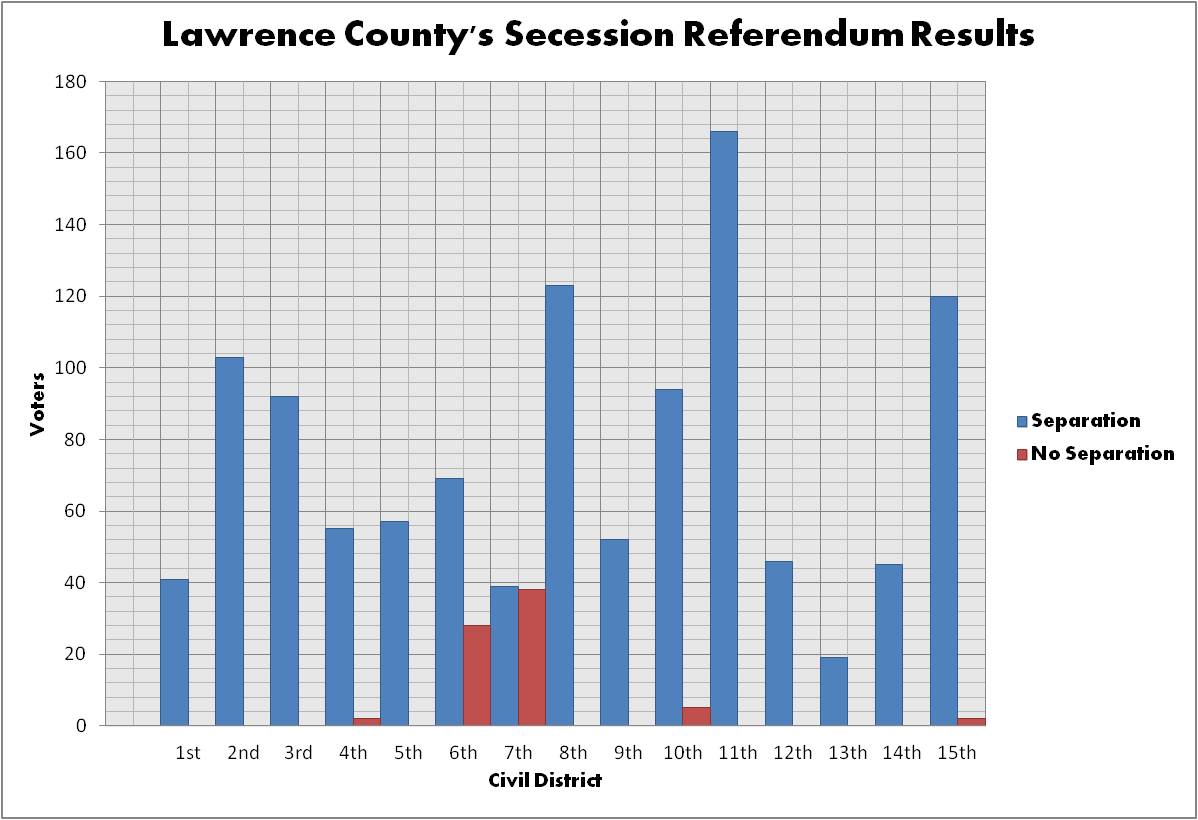
Lawrence County's secession referendum results from 8 Jun 1861. Source: Lawrence County (TN) Archives.

Lawrence County’s secession referendum results from 8 Jun 1861. Data source: Lawrence County (TN) Archives.

The results of the election are preserved at the Lawrence County Archives. Each return is broken down by district. The question on the ballot gave voters four questions to consider. Should the state:

1. Separate from the Union

2. Not separate from the Union, and

3. Be represented in the Confederacy, or

4. Not be represented in the Confederacy.

Of the votes cast, 1,121 voted to secede from the Union, and 1,119 voted to be represented in the Confederacy. Only 75 voted to remain in the Union, and 64 voted not to be represented in the Confederacy.[3]

But why four options instead of two?

A Varied Political Spectrum

Secession Referendum Return From Lawrence County's 11th District. Source: Lawrence County, TN Archives.

Secession Referendum Return From Lawrence County’s 11th District. Source: Lawrence County (TN) Archives.

While most secessionists favored the two-step process of leaving the Union and joining the Confederacy, the issue was not quite as clear-cut as that. Other secessionists favored Tennessee’s leaving the Union, but remaining an independent republic instead of joining the Confederacy. Still others hoped to stay in the Union, but remain officially neutral in the conflict, much like Kentucky and Missouri.

As the results show, however, the most popular course of action in Lawrence County in 1861 was leaving the Union and joining the Confederacy, which is what Tennessee did. A whopping 94% of the county favored secession, while only 6% wanted to stay in the Union. Ten of Lawrence County’s fifteen civil districts voted unanimously for secession. The most opposition for the secession movement came from Lawrence County’s 6th and 7th districts, which voted 29% and 49%, respectively to stay in the Union.[4]

Alfred O. Williams from Marcella Falls, one of the county’s Unionists, later said that excitement was so high in favor of secession that summer that no man dared speak openly about his loyalties to the Union. One man near in Williams’s district who did so was threatened so much for speaking out against secession that he finally left the county and joined the Federal Army.[5]

[1] Dwight Pitchcaithley. “When Tennessee Turned South.” New York Times. http://opinionator.blogs.nytimes.com/2011/06/01/when-tennessee-turned-south/?_php=true&_type=blogs&_r=0 [accessed 8 Jun 2014].

[2] Viola Carpenter, and Mary M. Carter, Our Hometown: Lawrenceburg, Tennessee, The Crossroads of Dixie, (Lawrenceburg, TN: Bobby Alford, 1986), 27.

[3] Election Returns, 8 Jun 1861. “Separation and Representation.” Lawrence County Archives, Leoma Tenn.

[4] Ibid.

[5] Alfred O. Williams (Lawrence Co., Tennessee) claim, office no. 1431, case no. 13983, Barred and Disallowed Case Files, Southern Claims Commission, 1871-1880; digital images, “Southern Claims – Barred and Disallowed,” Fold3.com [accessed 8 Jun 2014].

Posted in Uncategorized | Leave a comment

The Ramah Tornado of 1932

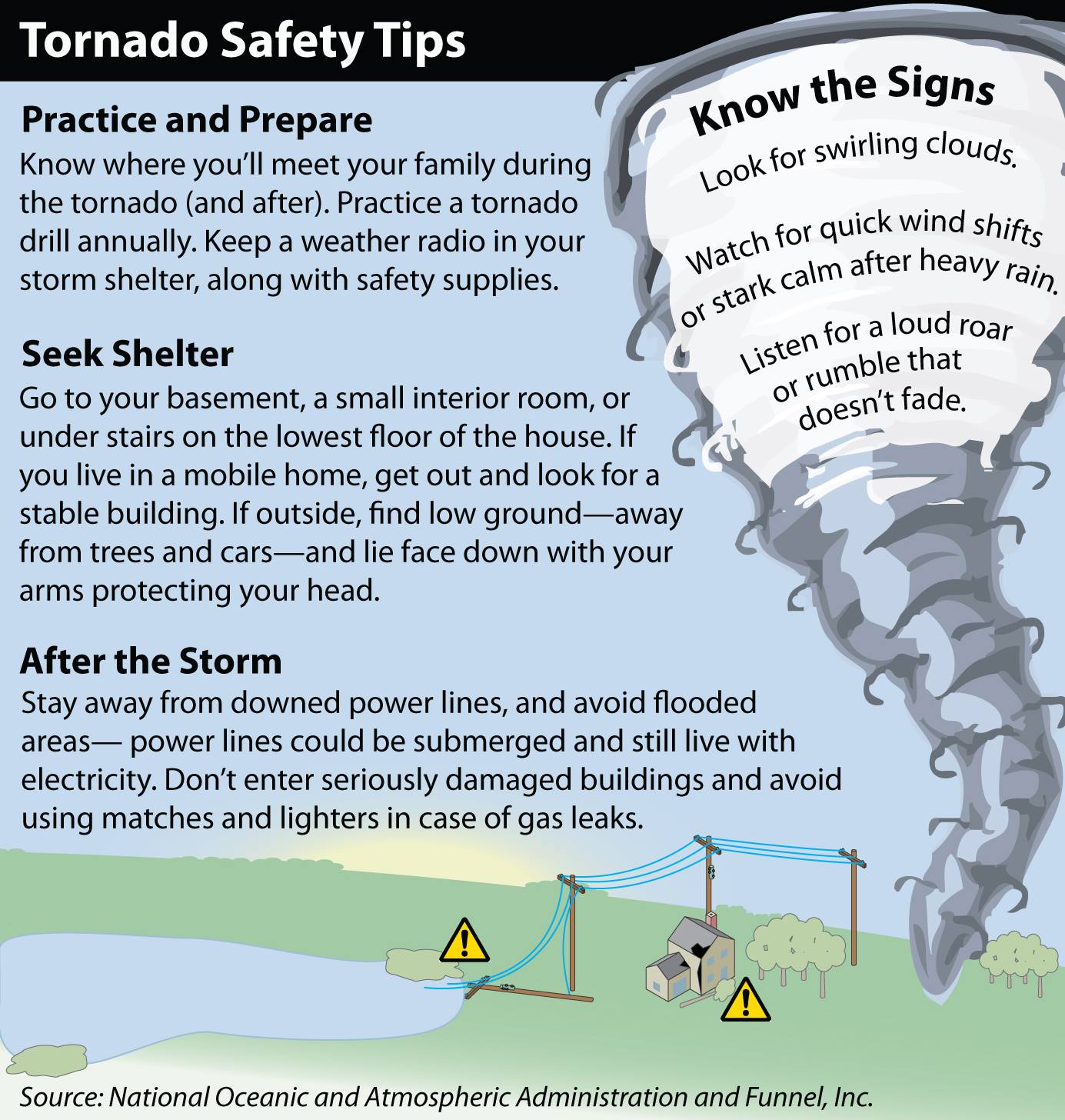
Did you know that a Ramah man was injured in 1932 when a tornado tossed a mule against him? But first, a word about severe weather preparedness.

As our area braces for potentially inclement weather, we would like to encourage you to please ensure that you and your family are prepared to take cover in a secure, interior space in the event of a tornado or violent storm. If you live in a trailer or mobile home, be sure to evacuate to a more-secure location well before the storms hit (such as a neighbor’s or relative’s home).

Our area has an unfortunately long history with dangerous thunderstorms. One hair-raising episode of Lawrence County’s severe weather history occurred in Ramah, near Five Points.

On March 21, 1932, in part of a deadly outbreak of storms that killed over 400 people throughout five Southern states, a tornado described in a contemporary newspaper account as being “over 50 feet wide” touched down in “a valley near Ramah.” The tornado struck the home of Bud and Troy Lussman.

Bud Lussman was in the barn when the storm struck. A mule was blown against him, breaking his arm in two places. His wife and four children were in the house. When the storm struck the house, Mrs. Lussman was thrown into the fireplace, and their children were scattered over the field, some landing 150 yards from the house. Miraculously, although the parents were both injured, no one was killed at the Lussman house.

The tornado then destroyed the nearby home of Mr. and Mrs. Robert Welch. The couple and their son, Jack, were all injured by the storm, but everyone in the household survived. Jack was blown 50 feet by the storm as he attempted to enter the cellar.

In 1932, the people of Ramah had practically no warning when the tornado approached their community. Today, thanks to dedicated meteorologists and modern technology, we have more warning that violent storms are approaching. Please remain weather alert! Tune in to local radio and television stations to keep abreast of developing severe weather stories this week.

Posted in Uncategorized | Tagged , , , , | Leave a comment

The Blacksmith and the Farmer: A Tale of Slander, Bacon, and Murder in Lawrenceburg, Tennessee

By Clint Alley

A Sordid Tale

One of the most infamous murders in Lawrence County’s history was committed in broad daylight, in front of more than forty witnesses. Friends of the killer said that it was a matter of honor, while friends of the slain insisted that it had nothing to do with honor and everything to do with bacon.

While not the household name that he once was, the killer in this case is well-known among local historians in Middle Tennessee. Lewis Kirk, the Confederate cavalryman, is the stuff of legend. In fact, his exploits are so astonishing, it is hard to distinguish which parts of his life are fact and which are fiction.

The Man

Kirk’s enemies accused him of a laundry list of atrocities both during life and after his death, including—but not limited to—the assassination of an injured Union general as he lay in an ambulance, the murder of countless contraband slaves, and the shooting death of a civilian who refused to cheer for Confederate president Jefferson Davis.[1] The stories told about him by his supporters are equally as raucous. According to local lore, Kirk—a captain in the 9th Tennessee Cavalry—taught his men to fight with reins in their mouths, pistol in one hand, and throwing-axe in the other.[2]
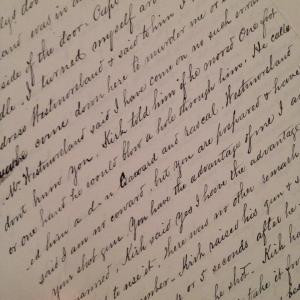
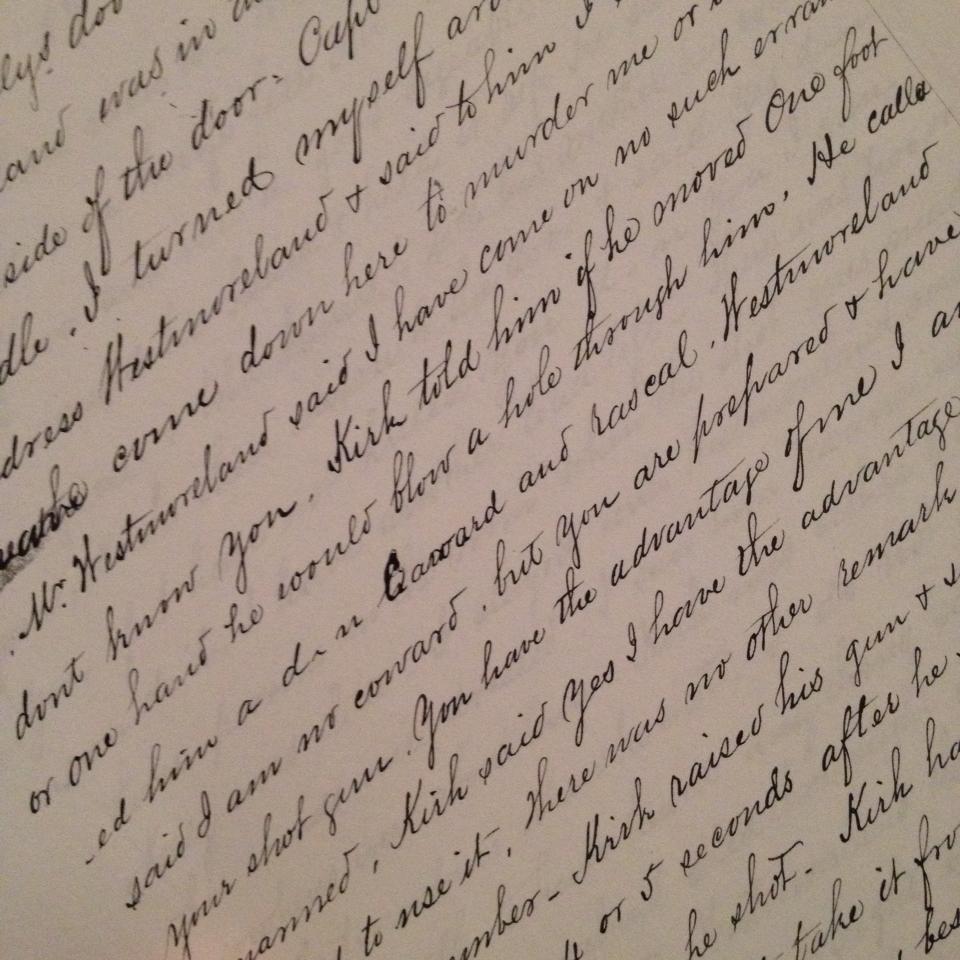
The case file for Kirk's murder trial is available at the Tennessee State Library and Archives. Photo by Clint Alley

The case file for Kirk’s murder trial is available at the Tennessee State Library and Archives. Photo by Clint Alley

While it is tempting to dive into the particulars of his military career, that will have to wait for another day. This article will focus on a prewar episode of Kirk’s life that is equally as dramatic. But first, some background information about the man, himself. Before he was a Confederate officer, Kirk was a blacksmith, operating a modest shop next to his home just west of the Public Square in Lawrenceburg.[3]

Kirk was a veteran of the Mexican War, having joined the ‘Lawrenceburg Blues,’ in 1846. The Blues were the local infantry company raised as part of Tennessee’s overwhelming response to the president’s call for volunteers for the Mexican War.[4] Kirk was one of the few men in the company who did not fall ill or die in combat at the Battle of Monterrey.

After his company mustered out of service at New Orleans on May 23, 1847, Kirk returned to Lawrenceburg, and married first to Martha Glover on December 28, 1847,[5] and second to Ann Green on October 17, 1852.[6]

The Murder

Although the witness accounts of the slaying differ somewhat on the facts of the case, the events as reconstructed here represent a consensus of what most witnesses agreed was the truth. The recollections of the witnesses were clouded by alcohol, as most of those present at the time of the killing confess to having had “a drink or two” at the Drug Store (as state witness Willis James said, “The liquor was pretty good.”)[7] Curiously, none of the men remember themselves as being drunk that day, but many of them recollect the others as having been drunk.

On the afternoon of November 9, 1858, at around 3 p.m., Kirk entered the Public Square in Lawrenceburg on foot, carrying a double-barreled shotgun on his shoulder. It was a Tuesday afternoon, and the Square was crowded with people going about their day-to-day business. Kirk went first to Chaffin’s Grocery, which stood at the west side of the Square. He next went to Kelly’s Grocery, which was about 50 yards north of Chaffin’s, in the northwestern corner of the Square. At Kelly’s Grocery, Kirk began arguing loudly with Thomas J. Westmoreland.[8]

Westmoreland was a farmer from Giles County, and was in Lawrenceburg—so the prosecution asserted—to see if he could find a man named P.M. Wright, who had bought $4.25 worth of bacon from him before. It was Westmoreland’s aim that day—as his friends would later say in court—to either collect on the note, or to sell more bacon to Wright. But in addition to the note for Wright’s bacon, Westmoreland also had a hunting knife with a four-inch blade in his pocket, which he had borrowed from his friend Willis James, with whom he had stayed the night before at his James’s farm seven miles outside of Lawrenceburg.[9]

When James and Westmoreland arrived in Lawrenceburg, it was about noon, and they decided to stop at Richardson’s Tavern for dinner. Also in the tavern that day was John Morrison, a blacksmith. According to Morrison, Westmoreland asked if he was Kirk, and when he told him that he was not, Westmoreland replied, “It makes no difference. Damn Kirk and all his friends! If he darkens the door, he will darken a damned dark hole!” According to Morrison, Westmoreland’s tirade against Kirk went on, saying that he would like to meet ‘Cotton Bale’s’ brother. ‘Cotton Bale’ Kirk was an alias given to Lewis Kirk’s brother Frank, who was known throughout the countryside as a cotton thief.[10] Morrison goes on to say that Westmoreland had had some difficulty with Frank, which he mentioned at the tavern but upon which he did not elaborate.

After Westmoreland left the tavern, Morrison said that he saw him walk to Kirk’s house and shop, looking for him. When he saw no one there, he came back to the Square and went about his business in town.

When Kirk learned that there was a man looking for him about town and using his name in a most unsavory manner, he loaded his double-barreled shotgun and went to the Square to find him. He found Westmoreland at Kelly’s Grocery. As Kirk approached, Westmoreland stepped halfway outside the door, with one half of his body concealed behind the door frame.

Kirk asked if he was the man who had been using his name around town. Westmoreland, clearly addled, denied it. Kirk pressed his case, calling him a “damned liar, a scoundrel, and a coward.” Westmoreland shouted back, “You have your shotgun; you have the advantage of me!” To which Kirk angrily replied, “I do have the advantage of you, and I intend to use it, if necessary!” Kirk then added, “If you’ll lay down your weapons, I’ll whip you with the weapons God gave me!”

Westmoreland made a sudden move toward Kirk, and Kirk fired one barrel of his shotgun into the right side of Westmoreland’s abdomen. Westmoreland fell in the doorway. Ephraim Crabtree testified that he saw a ‘large knife’ opened in Westmoreland’s hand when he fell, and that Westmoreland closed it and put it in his pocket in the chaos that ensued.

While he was being restrained by the men standing nearby, Kirk coolly said that he had a barrel left for Westmoreland’s “damned friend,” that Westmoreland should suffer for what he had done, and that he was going to “cut the damned rascal’s throat.”

As there was no jail in Lawrence County at that time, the sheriff placed Kirk under armed guard in a nearby hotel for the night. Westmoreland struggled for his life for a few hours, but eventually succumbed to his wounds. The testimony of Willis James—who had served in Mexico with Kirk for a short time—indicated that he judged Dr. Wann, the attending physician, to be “about half-drunk after the shooting.”[11]

Westmoreland was buried in Pisgah Cemtery in Giles County. His headstone bears the inscription “Assassinated in Lawrenceburg, Tennessee.”[12] In a twist of fate, Kirk’s brother Frank was, himself, murdered in Pulaski on December 18, 1858.[13]

The Trial

Kirk was initially to be tried for first-degree murder in the Lawrence County courthouse. However, when word got out that the sheriff was attempting to find jurors to try Kirk’s case, the men of Lawrence County suddenly became very hard to find. The sheriff testified that he rode across three districts, and could not find a single man at home when he went to round up a jury.[14] As a result, the trial’s venue was changed to Columbia.

Because eyewitness accounts disagreed about whether the knife was in Westmoreland’s pocket or in his hand during the shooting, Kirk’s lawyers seem to have hinged the bulk of their case on the fact that Westmoreland had come to town with the intention of starting trouble. This is a safe assumption because Kirk’s lawyers objected at every mention of Westmoreland’s bacon note. Indeed, the bacon note made Westmoreland seem more like a victim of circumstance than an aggressor, and it can be said with a reasonable degree of certainty that the bacon note almost sent Kirk to prison.

The Pardon

Kirk was found guilty of second-degree murder and sentenced to fifteen years in the state penitentiary. By the time the verdict came, Tennessee was on the cusp of revolution. It was to Kirk’s great luck that, while he sought a new trial, the secession crisis of 1861 had reached a fever pitch in Tennessee. Although the documentation of his pardon request has been lost to time, it is known from contemporary newspaper accounts that Kirk pledged to join the Confederate army if the governor would grant him a pardon.

Governor Isham G. Harris was an unrepentant Confederate sympathizer, and no doubt Kirk’s veteran status played handily into his pardon request. Kirk was pardoned, and joined the Confederate Army. Oral tradition states that he first joined the ‘Lawrenceburg Invincibles.’

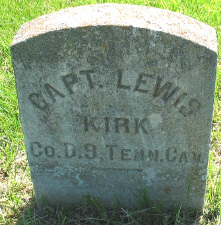
Lewis Kirk's headstone in Lynnwood Cemetery. Source: Findagrave Memorial # 39538535.

Lewis Kirk’s headstone in Lynnwood Cemetery. Source: Findagrave Memorial # 39538535.

In 1862, he returned to Lawrence County to raise a Confederate cavalry company, of which he served as captain for the duration of the war. At a later date, I hope to elaborate on Kirk’s military career.

Kirk’s Descendants

Kirk’s descendants live on among us today as members of not only the Kirk family, but also in the blood of some of the Williams, Crook, Massey, Abernathy, Moore, Gibbons, and Talley families of Lawrence and surrounding counties in Tennessee.[15]


Sources

Alford, Bobby. History of Lawrence County: Book Two. Lawrenceburg, TN: Bobby Alford.

Ancestry.com. Tennessee State Marriages, 1780-2002 [database on-line]. Provo, UT, USA: Ancestry.com.

Brewer, A L. “The Era of Rebel Atrocity.” The New York Times, August 20, 1865. Accessed February 6, 2014. http://www.nytimes.com/1865/08/20/news/the-era-of-rebel-atrocity.html.

Compiled Service Records of Volunteer Soldiers Who Served During the Mexican War in Organizations from the State of Tennessee. Micropublication M638, RG 94. Washington: National Archives. Digital image, Fold3.com (http://www.fold3.com/image/245/272385639/ : accessed 11 Feb 2014).

Find A Grave, “Memorial page for Thomas J. Westmoreland (4 Dec 1830-9 Nov 1858).” Last modified 30 March 2008. Accessed 15 April 2014. Findagrave Memorial #25633971.

McDonald, William L. Civil War Tales of the Tennessee Valley. Florence, AL: Heart of Dixie Publishing, 2003.

“Murder.” Nashville Union and American, , sec. page 3, column 1, December 28, 1858. http://chroniclingamerica.loc.gov/lccn/sn85038518/1858-12-28/ed-1/seq-3/

Tennessee. Tennessee State Library and Archives. Nashville. State Supreme Court Records, 1860.


[1] A.L. Brewer, “The Era of Rebel Atrocity.” The New York Times, 20 Aug 1865, online.

[2] William L. McDonald, Civil War Tales of the Tennessee Valley (Florence, AL: Heart of Dixie Publishing), 59.

[3] 1850 Industry Schedule, Lawrence Co., Tenn., Schedule 5, p. 174.

[4] Lewis M. Kirk, compiled military record (private, Company M, 1st Tennessee Infantry Regiment), Compiled Service Records of Volunteer Soldiers Who Served During the Mexican War in Organizations from Tennessee, M638 (Washington: National Archives), RG 94. Digital image, Fold3.com (http://www.fold3.com/image/245/272385639/ : accessed 11 Feb 2014).

[5] Marriage record of Lewis M. Kirk to Martha Glover, Ancestry.com. Tennessee State Marriages, 1780-2002 [database on-line]. Provo, UT, USA: Ancestry.com.

[6] Marriage record of Lewis M. Kirk to Ann Green, Ancestry.com. Tennessee State Marriages, 1780-2002 [database on-line]. Provo, UT, USA: Ancestry.com.

[7] Lewis Kirk v. State of Tennessee, State Supreme Court Records, 1860, Box 311: Range 32, Section E, Shelf 2, Tennessee State Library and Archives, Nashville. Deposition of Willis James, pg. 63.

[8] Lewis Kirk v. State of Tennessee, State Supreme Court Records, 1860, Box 311: Range 32, Section E, Shelf 2, Tennessee State Library and Archives. Deposition of Joseph E. Bailey, pg. 47.

[9] Lewis Kirk v. State of Tennessee, State Supreme Court Records, 1860, Box 311: Range 32, Section E, Shelf 2, Tennessee State Library and Archives. Deposition of Willis James, pg. 63.

[10] Bobby Alford, History of Lawrence County: Book Two. Lawrenceburg, TN: Bobby Alford, 53.

[11] Lewis Kirk v. State of Tennessee, State Supreme Court Records, 1860, Box 311: Range 32, Section E, Shelf 2, Tennessee State Library and Archives. Deposition of Willis James, pg. 63.

[12] Find A Grave, “Memorial page for Thomas J. Westmoreland (4 Dec 1830-9 Nov 1858).” Last modified 30 March 2008. Accessed 15 April 2014. Findagrave Memorial #25633971.

[13] Nashville Union and American, 28 Dec 1858.

[14] Lewis Kirk v. State of Tennessee, State Supreme Court Records, 1860, Box 311: Range 32, Section E, Shelf 2, Tennessee State Library and Archives.

[15] I have done a great deal of research attempting to locate Kirk’s descendants. For more information about the families of his children, please leave your name and e-mail address with the Lawrence County Archives and I will contact you.

Posted in Uncategorized | 1 Comment

The Life of Captain T.D. Deavenport

Captain Thomas D. Deavenport of Lawrence County had an illustrious career of public service that unfortunately contributed to a tragic path of self-destruction.

Deavenport was born on September 18, 1837. He began life working on his father’s Lawrence County farm. He attended Jackson College in Columbia, completing all but his final session there due to his father’s death in 1844.

Thomas went to Kansas after his father’s death. While in Kansas, he later said that he witnessed that state’s violent struggle with the doctrine popular sovereignty, a doctrine which stated that the state’s position on slavery should be decided by direct election of the people.

He returned to Tennessee in 1857, and began reading law in Florence, Alabama the same year. In 1858, he taught school in Lawrenceburg until he was admitted to the bar and began practicing law.

When the Civil War began in 1861, Deavenport helped to raise a company of men from Lawrenceburg to serve in the Confederate army. When the company was mustered into the 32nd Tennessee Infantry, Deavenport was commissioned as a lieutenant, and was promoted to captain on November 4, 1861.

Deavenport was taken prisoner at the fall of Fort Donelson in 1862, and exchanged several months later. Although he fought bravely with his company throughout the war, his military career was effectively ended in late August 1864, when he was shot through the lungs with a Minié ball at the Battle of Jonesborough, Georgia.

He survived his wounds and continued practicing law in Lawrenceburg after the Civil War. He was elected to serve as Lawrence County’s delegate to the State Constitutional Convention of 1869, and then to the State Senate in 1877.

Unfortunately, despite his stellar record of public service, Deavenport was also a heavy drinker. He was frequently publicly intoxicated, and had at least one public confrontation with his second wife while drunk (his wife, interestingly enough, was the daughter of a Union veteran). His law partner, W.T. Nixon, recorded Deavenport’s frequent drunkenness in his journal, which is available for viewing at http://archive.flpl.org/cdm/ref/collection/journals/id/578 .

Nixon mentions Deavenport 104 times throughout the journals, and many of those references mention Deavenport’s struggle with alcoholism, a struggle which no doubt began when he was shot through the lungs at the Battle of Jonesborough.

On January 25, 1880, Nixon wrote:

“Capt Deavenport is still
drinking and they say he was drunk on the square again
today. This is shameful and I regret it so much for there
is no finer man when sober.”

On August 23, 1880, Nixon wrote:

“Had a trial of trying to reconcile Capt & Mrs D.
Capt drunk again – bad drunk. “

On March 17, 1881, Nixon wrote:

“I am out done with Deavenport & Love
who have now been drunk for nearly three
weeks. I do not see how they stand it.”

On March 9, 1884, Nixon wrote:

“Capt Deavenport and Bill Love [the Register of Deeds] are down
town drunk as fools. Tried to make some
arrangement to get Capt’n a place to
sleep but failed only for Pete Smith who
says he will not let him lie out.
If anybody thinks whiskey will not
utterly ruin a man, body and soul, let
him look at Captn D.”

However unfortunate his last years were, it must be taken into account that Deavenport’s war wounds no doubt made it extremely painful for him to breathe, and, in a time before modern medicine, this pain no doubt played a major role in his alcoholism. Despite his troubled personal life, it cannot be denied that Deavenport was a patriot and a public servant.

Captain Deavenport passed away on February 11, 1889, leaving a wife and five children. He is buried in the Old City Cemetery on Waterloo Street

Posted in Uncategorized | Tagged , , , | 1 Comment

How The County Got Its Shape

By Clint Alley

Lawrence County’s Changing Borders

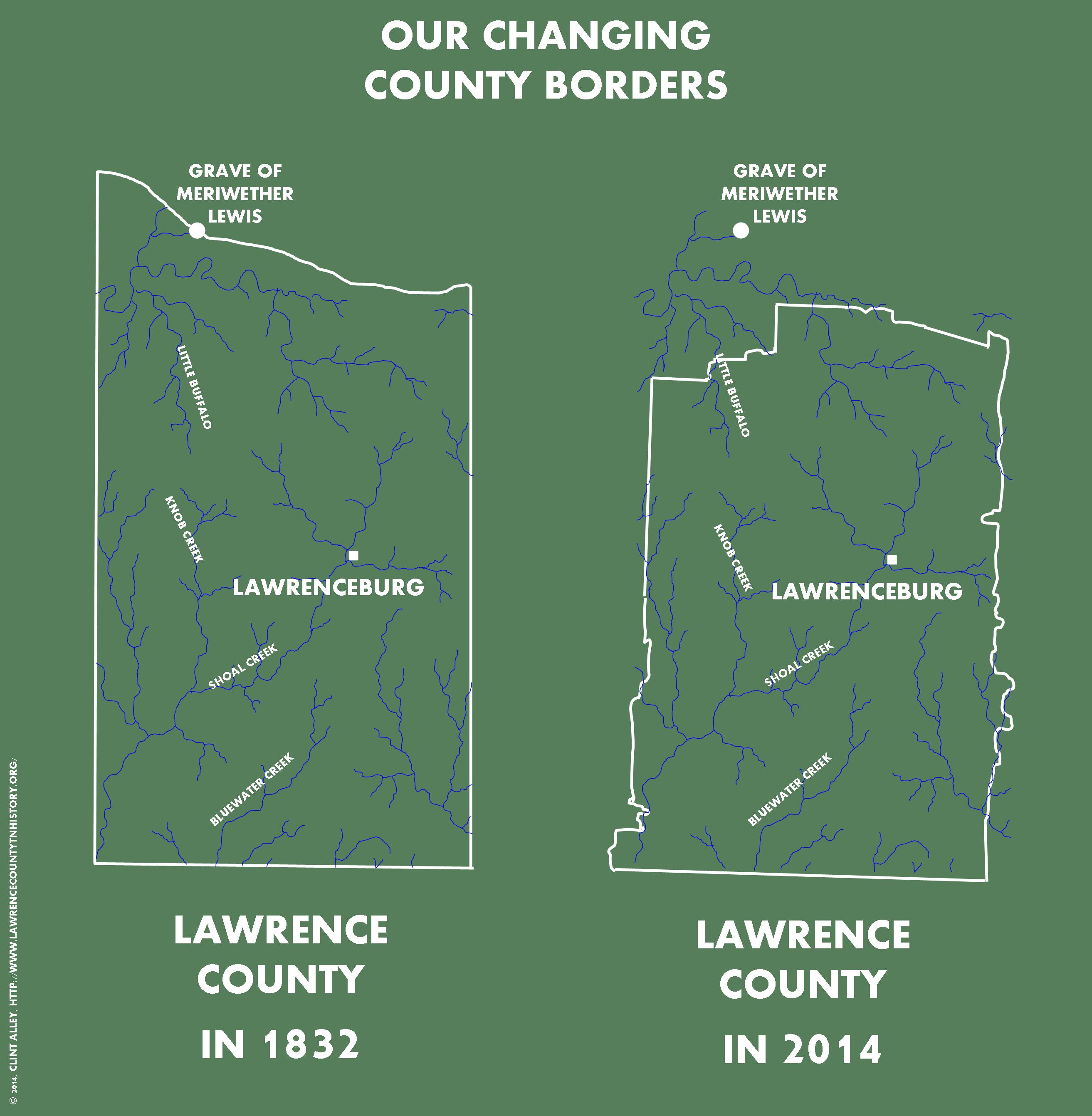
At left is a reproduction of Lawrence County's boundaries as found in Matthew Rhea's 1832 map of Tennessee. At right is modern Lawrence County, with the Rhea waterways overlaid for comparison. Infographic created by Clint Alley.

At left is a reproduction of Lawrence County’s boundaries as found in Matthew Rhea’s 1832 map of Tennessee. At right is modern Lawrence County, with the Rhea waterways overlaid for comparison. Infographic created by Clint Alley.

You may have seen ‘How the States Got Their Shapes,’ but have you ever thought about how our county got its unique shape? And did you know that Lawrence used to share a border with Hickman County?

At the left is a reproduction of the map made of Lawrence County by Matthew Rhea in 1832, notable for its attention to detail in the county’s waterways. At the right are the modern borders of Lawrence County. For comparison, I have overlaid the waterways from Rhea’s 1832 map on the modern county borders, despite the fact that several of the streams may have since changed or slightly deviated their courses. But the city of Lawrenceburg and the grave of Meriwether Lewis have not moved in the 182 years since Rhea’s map was drawn.

Lewis County

The most dramatic alteration in the county’s original boundaries was the creation of Lewis County in 1843. It was formed from parts of Perry, Hickman, Lawrence, Maury and Wayne counties.[1] The grave of famed explorer Meriwether Lewis (of ‘Lewis and Clark Expedition’ fame) was located at one time on Lawrence County’s northern border. Today it is several miles inside Lewis County. The explorer met his end at nearby Grinder’s Stand on October 11, 1809 of suspected suicide–although the debate about his cause of death rages on among historians to this day.[2]

Private Acts

Changes in the original ramrod-straight east and west borders of Lawrence County are attributed, in part, to dozens of private acts of the Tennessee Legislature over the almost two centuries of Lawrence County’s existence. To avoid paying property taxes in two different counties, landowners who lived on the county line often petitioned the state government to include their lands wholly in one county or another. On the rare occasions that these requests were granted, it changed the boundaries of the entire county, giving us the crooks and crannies that we see on the modern map.[3]

Caution to Genealogists

Shifting boundaries are especially important for genealogists to remember. If you find an ancestor who seems to have jumped the county line, remember that the county line may well have jumped them, instead.

Sources

FamilySearch, “Lewis County, Tennessee.” Last modified Feb 13, 2014. Accessed March 26, 2014. https://familysearch.org/learn/wiki/en/Lewis_County,_Tennessee.

Lawrence County, Tennessee Census Records: 1820, 1830 & 1840 and Miscellaneous Early County Records. Edited by Shirley Hollis Rice.

National Park Service, “Natchez Trace: Meriwether Lewis.” Accessed March 26, 2014. http://www.nps.gov/natr/historyculture/meriwether-lewis.htm.

[1] FamilySearch, “Lewis County, Tennessee.” Last modified Feb 13, 2014. Accessed March 26, 2014. https://familysearch.org/learn/wiki/en/Lewis_County,_Tennessee.

[2] National Park Service, “Natchez Trace: Meriwether Lewis.” Accessed March 26, 2014. http://www.nps.gov/natr/historyculture/meriwether-lewis.htm.

[3] Lawrence County, Tennessee Census Records: 1820, 1830 & 1840 and Miscellaneous Early County Records, ed. Shirley Hollis Rice , 89-105.

Posted in Uncategorized | Leave a comment