The Lawrence County Public Library: Check it Out!

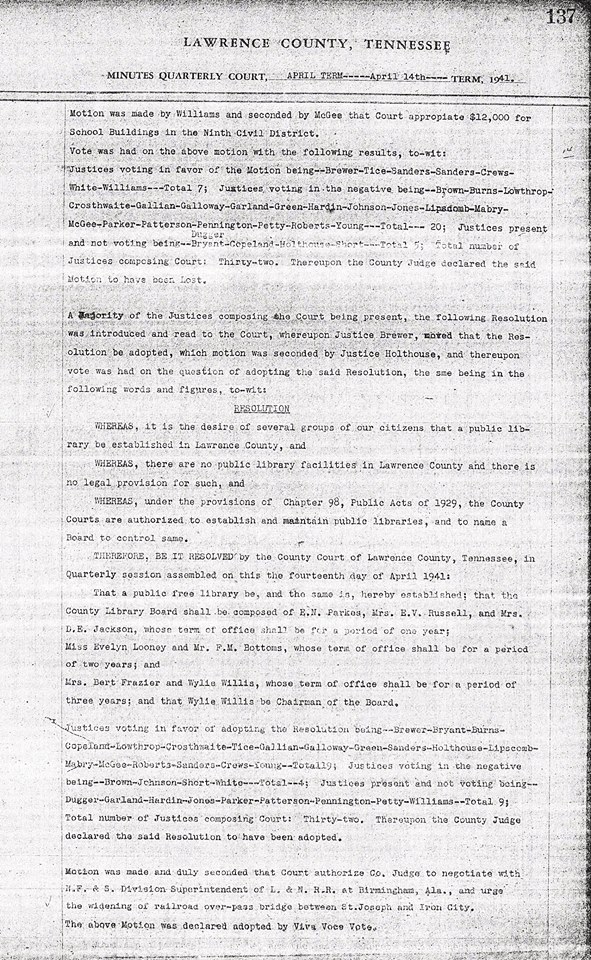
Lawrence County has had a first-rate public library for 74 years. The attached image of the county court minutes from the day the library was created is the library’s “birth certificate.”

On April 14, 1941, the Lawrence County Quarterly Court voted to create the Lawrence County Public Library, but it wasn’t just that decision which created the library; it was the work of our entire community.

Prior to the county’s creation of the library, a group of concerned citizens spearheaded a drive to fund the project and to create its stock of books. This effort had been supported by many folks in Lawrence County in one way or another for almost half a century.

Hundreds of local people, civic organizations, and community clubs donated money and books to help launch the library in the months leading up to the official creation of the department.

Like most great community efforts, the idea for our public library grew from the ground up, and it continues to grow today. As the way we access information has changed, the library has adapted to better-serve its patrons. Today, you can still check out books and write reports at the library, but you can also download free e-books, learn how to write a resume, book a place for your club meeting, create an e-mail account, get free Internet access, learn your family’s role in our nation’s history, and get your children excited about learning.

The library has programs for all age groups and it is open to people from every socioeconomic background. The way we access information may change, but the Lawrence County Public Library will always find new ways to help our community learn and grow.
11700935_855741527849509_32236216516499298_n

Posted in Uncategorized | Leave a comment

A Presidential Barbecue: Lawrenceburg’s Celebration of James K. Polk

Who doesn’t love a good, old-fashioned barbecue?

In Lawrence County’s earliest years, public barbecues were held to celebrate important days. There was a public barbecue to celebrate the railroad coming to Lawrenceburg in 1883, to celebrate the city’s first observance of David Crockett’s birthday in 1890, and to commemorate the first reunion of Confederate veterans in Lawrence County in 1891.

But, much earlier than that–particularly in Lawrence County’s antebellum years–public barbecues were held to celebrate a certain politician or to allow civic leaders the opportunity to give speeches or have debates near elections. One such massive rally and barbecue was held at Lawrenceburg in honor of presidential candidate James K. Polk on October 25, 1844, just a few days before that year’s presidential election.

Local man John McMasters was thirteen years old when he attended the barbecue, and he reminisced about the event to the ‘Lawrence News’ at the age of 91. Mr. McMasters’s account of the event is told here in his own words:

“The crowd gathered on the square and the first thing they did they rolled out a barrel of whisky, set it up and knocked the head out and drove nails all around and hung cups on them and told everybody to help themselves.

“The barbecue was south [of the Square], near the old college and when we started to dinner there were twenty-six young women riding gray horses and bell to all their girths. They rode two by two, and a man in front of them. When they got there a Miss Tarkinton made a public speech.

“We had plenty of bread and meat and I don’t think I saw but one man drunk, that is down drunk.”

Posted in Uncategorized | Leave a comment

Paid in Full: Lawrenceburg Innkeeper Shows Respect to Revolutionary Veteran

Take a break from the controversy and anger that has saturated the national news in the past week and enjoy one of my favorite lighthearted stories from Lawrence County’s early days.

Here’s a feel-good story about how one Lawrence County man showed his respect for a veteran with an act of kindness.

According to one of Lawrence County’s earliest newspapers, in the spring of 1846, an old man came to Lawrenceburg to apply for a pension.

The old man stayed the night at the inn (probably the Farmer’s Inn, which stood near the Square in Lawrenceburg). The innkeeper noticed that the old man was so feeble that he could barely feed himself, so he stepped in and helped the old man eat.

While he ate, the old man told the innkeeper that he was a veteran of the Revolutionary War, and that he had fought at the Siege of Savannah, Georgia, where he had served alongside the famous patriot soldier William Jasper. Although relatively unknown to Americans today, Jasper was a Revolutionary superstar in antebellum America. He had helped to turn the tide of the Battle of Sullivan’s Island by rallying the men around a torn and tattered South Carolina flag. Jasper died at the Siege of Savannah, his regiment’s flag still in his hands.

The old man told many tales of his service to the innkeeper during his stay at the inn. When it came time for the old man to settle his bill with the innkeeper, he produced his “scanty means” to pay, but the innkeeper refused the old man’s money, saying to him, “Sir, your bill was paid the day you fought by the side of the brave Jasper at Savannah.”

Posted in Uncategorized | Leave a comment

A Bandit Buried in the Road in Leoma

Did you know that a bandit lies buried under the Old Military Road in Leoma? And that he was killed by the brother of General Nathan Bedford Forrest?

Unlike Florence’s tale of outlaw Tom Clark being buried under Tennessee Street, Leoma’s own outlaw under the street is verified by an eyewitness account. The story begins with the Civil War.

W.P. Oliver, who wrote for the Lawrence ‘Union’ under the pen-name of ‘Fleetwood,’ was a boy of 16 when he witnessed the outlaw buried beneath the street.

As he recalled, it was about the year 1863 when Captain William Forrest, the brother of General Nathan Bedford Forrest, was “riding six miles south of Lawrenceburg on the Old Military Road” with a squadron of cavalry. Right where the city of Leoma currently stands, Forrest encountered a rogue named Davis in a Confederate uniform attempting to waylay a wagon driven by a young man named Bud Thomason, who was bound for the Clay factory with a load of thread.

When Captain Forrest arrived, he saw that the highwayman was attempting to cut the harness from one of Bud’s horses. Forrest ordered Davis to leave the horse alone. Instead of obeying the captain’s order, Davis pulled his gun and fired at him. Forrest narrowly dodged the first bullet, jumped from his horse, and took up a defensive position behind a clay embankment.

Davis fired a second time, and the ball struck the captain’s horse, piercing the beast behind its shoulders. Forrest then took aim with his own weapon and shot Davis squarely through the heart. Davis fell to the road, dead.

Forrest and his squadron continued on their way, as did the wagon driven by Thomason. Unfortunately, Forrest’s horse made it only as far as the nearby Hall’s Stand, home of Jake Springer, where the animal succumbed to its wounds and fell dead in the yard.

After the incident, the few citizens who lived nearby quickly buried Davis’s body in a shallow grave, without a coffin, about two feet in the ground. They built a rough fence of dead limbs around the grave to keep livestock from disinterring the body.

This fence stood around the grave for many years, until Oliver says that a forest fire burned it up. The same fire that burned the fence also felled a nearby tree, which fell lengthwise across the grave, covering it completely and serving as a grave marker to those who remembered what had happened at the place.

Oliver goes on to say that the log was still covering the grave when they began building the town of Leoma, but was moved some years afterward by someone who did not know that a man was buried beneath it, and Oliver wrote that “there is nothing there now to indicate the spot.”

While Oliver did not witness the killing of the outlaw Davis, he could clearly remember seeing Captain Forrest’s horse lying dead in Jake Springer’s yard, and he remembered the fence of dead limbs and the burned-out log on the grave. On a more grisly note, Oliver said that he also once saw a road crew accidentally exhume some of the bandit’s bones in the course of their work.

bill forrest zoom

Captain William “Bill” Forrest From the Matt Hagans Collection Source: Forrest Family Faces

Posted in Uncategorized | Leave a comment

The Literary Societies: When LCHS Went Greek

Did you know that LCHS once had fraternal organizations similar to college fraternities and sororities?

Harkening back to a time when high schools had more in common with colleges, the clubs were known as ‘literary societies,’ and they existed for several years after the school’s founding. The literary societies were extremely active in community life; they played intramural sports against each other at school field days, and they often organized student debates, plays, and concerts for public enjoyment, with proceeds benefitting the school.

The literary societies fostered a sense of healthy competition for LCHS students, and gave some organization and order to school extracurricular activities, but over time they were replaced by the school clubs that we know today.

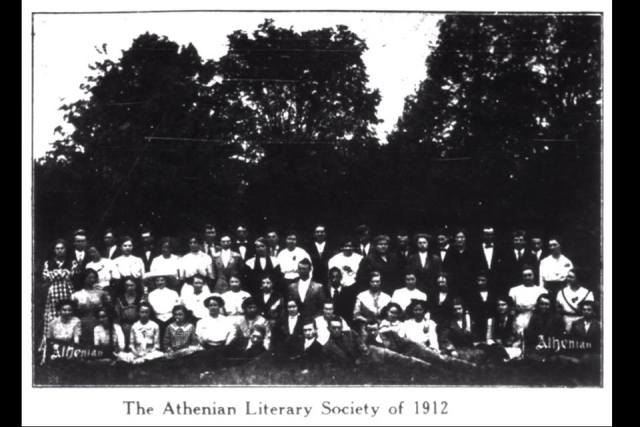
This image from an issue of the Lawrence ‘Union’ is over a century old, and it shows one of the earliest literary societies at LCHS, the Athenian.

11024693_847295835360745_6316915804307921334_n

Photo credit: The Lawrence ‘Democrat.’

Posted in Uncategorized | Leave a comment

First Baptist Lawrenceburg Celebrates Three Decades on Springer Road

Congratulations to First Baptist Church of Lawrenceburg as they celebrate 31 years at their Springer Road location.

FBC Lawrenceburg was organized at the Opera House on the Public Square in 1896, and held its first baptism in Shoal Creek that May.

The church’s first sanctuary was built in 1898, at the corner of Columbia Avenue and Highway 64. That building was replaced by a larger sanctuary built at the corner of Mahr Avenue and West Gaines Street in 1927.

The current sanctuary on Springer Road was completed on this day in 1984.

Photo credit: First Baptist Church Lawrenceburg Facebook Page

Posted in Uncategorized | Leave a comment

The Day Lawrence County Woke Up in a Different Country

One-hundred-and-fifty-four years ago today, Lawrence Countians awoke in a different nation than the one in which they had gone to bed.

On June 8, 1861, Tennessee voters went to the polls to approve or disapprove of the legislature’s May decision to secede from the Union and join the Confederacy.

This referendum was a paradox in Lawrence County for a number of reasons. At the time the vote was held, Lawrence County’s first company of Confederate volunteers was in Camp Trousdale for basic training.

Not long after the legislature voted to secede from the Union on May 6, this company of volunteers, their families, and many of the people of Lawrenceburg, had gathered in what is now Ethridge, near the current location of Rick’s, and held a grand going-away feast with patriotic speeches and songs celebrating the new Confederacy. They had also been presented a new banner made by the ladies of the town to take into battle–an American flag, which had to be sent home when the company arrived at Camp Trousdale.

Another paradox concerning Lawrence County’s vote to secede from the Union is that, among those men training for Confederate service at the time of the secession referendum on June 8, at least one Lawrence County soldier voted against secession, despite having already been sworn into the service of the Confederacy.

At home, support for secession was relatively concrete. As one Unionist wrote many years after the Civil War ended, it was dangerous during that time to publicly express any pro-Union sentiments in Lawrence County. One man who voted against secession and let everyone know about it was threatened so often that he was forced to leave the county and join the Union army.

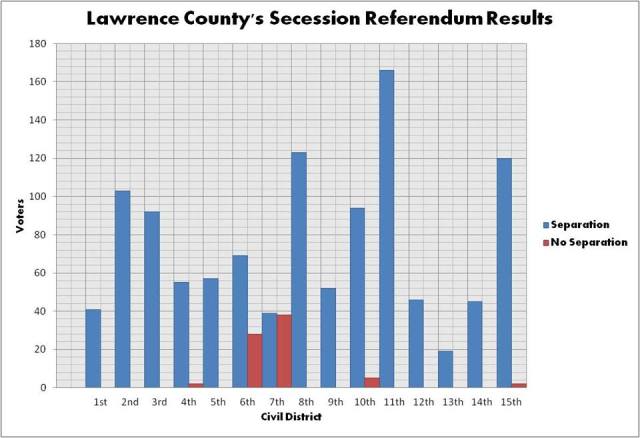
We are fortunate to still have the returns for that secession referendum–showing who showed up to vote, and how each district voted–preserved in the Lawrence County Archives. As this chart shows, most of Lawrence County’s civil districts voted unanimously to secede from the Union, with the strongest opposition to secession coming from the 6th and 7th civil districts, which was a swath of western Lawrence County covering roughly the area between West Point and Laurel Hill.

Overall, 2,240 Lawrence County men (94% of the electorate) voted in favor of secession on June 8, 1861, while 139 (6% of the electorate) voted against it.

10256960_839145309509131_7585489913747295189_n

Posted in Uncategorized | Leave a comment

Is This the Oldest Image of Lawrenceburg?

This woodcut of the Public Square in Lawrenceburg may be one of the oldest images of the city in existence. Although the picture’s origin is unclear, it has made appearances in several books about local history.

The image is not dated, but it gives us several clues as to its possible age.

The Mexican War Monument is shown in the foreground, with the county’s first permanent courthouse standing behind it. Absent from the courthouse is the bell-tower on the roof placed there after the Fire of 1898. But the fact that the courthouse stands a full three stories tells us that this image was created after 1850, when court minutes indicate that the third story was added to the building by the local masonic lodge.

This gives us a date range of between 1850 and 1898. If you take a closer look at the image, you can see details in the dress of the people there that give us yet another clue. The bustles on the dresses of the ladies are of a style which makes me think that this picture probably dates from the 1870s or 1880s. I could be wrong, as I am not an expert in historic clothing, but that is my best guess.

Regardless of the exact age of the image, it is a real treasure, and I hope you enjoy it as much as I do!

11390088_832770750146587_4291507493145293036_n

Photo Credit: Lawrence County Historical Society

Posted in Uncategorized | Leave a comment

Labor of Love: The Birth of Lawrence County High School

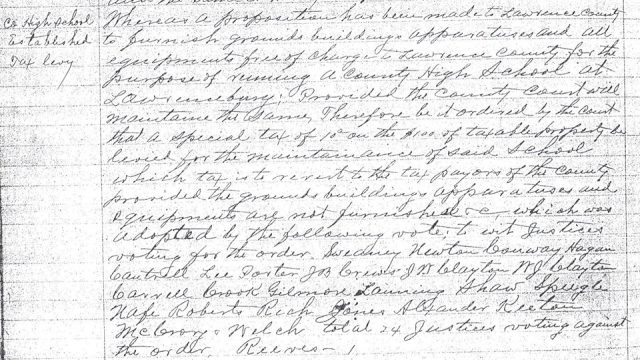
If schools had birth certificates, this is what Lawrence County High School’s would look like.

On January 6, 1908, the County Court of Lawrence County voted 24-to-1 to establish a government-funded, tuition-free high school in Lawrenceburg for the students of Lawrence County.

LCHS was not the first secondary school in the county’s history; previous institutions of higher learning had existed in the county, but they had all been private schools which charged tuition. Those schools all shared a similar fate in that they all eventually ceased operation due to financial constraints.

The creation of LCHS was a labor of love for a dedicated group of individuals, all of whom shared what was then the radical notion that the county’s children, regardless of class or condition, deserved a quality education and a chance at a bright future.

When the county court voted to levy a tax to pay for the operating costs of the new school, it was the result of many months of hard work and action by some of the county’s most noteworthy people, including James D. Vaughan (the father of Southern Gospel music), J.H. Stribling, and Professor E.O. Coffman.

The text of the entry (found in Lawrence County Court Clerk Minutes Vol. T, page 28) reads as follows:

“Co High School
Established
Tax Levy

Whereas a proposition has been made to Lawrence County
to furnish grounds, buildings, apparatuses, and all
equipments free of charge to Lawrence County for the
purpose of running a County High School at
Lawrenceburg; Provided the County Court will
maintain the same, Therefore be it ordered by the court
that a special tax of 10 c on the $1.00 of taxable property be
levied for the maintenance of said School
which tax is to revert to the taxpayers of the County
provided the grounds, buildings, apparatuses, and
equipments are not furnished &c which was
adopted by the following vote, to wit Justices
voting for the order: Sweaney, Newton, Conway, Hagan
Cautrell, Lee, Porter, J.B. Crews, J.W. Clayton, W.J. Clayton
Carrell, Crook, Gilmore, Lanning, Shaw, Speegle,
Nafe, Roberts, Rich, Jones, Alexander, Keeton,
McCrory & Welch total 24. Justices voting against
the order, Reeves – 1.”

1506589_829797087110620_7315627258870257841_n

Posted in Uncategorized | Leave a comment

The Deerfield-Ethridge Tornado of 1995

Today (May 18) is the 20th anniversary of the 1995 Deerfield-Ethridge Tornado.

On May 18, 1995, an F-4 tornado cut a huge, 29-mile path of destruction across Piney, Deerfield, Brace, and Ethridge, killing three and injuring 32.

The massive twister damaged or destroyed fifty houses and a dozen house trailers in Lawrence County. First responders had to temporarily shut down a full 1/3 of Lawrence County’s roads in the aftermath of the storm. Ethridge Elementary School was opened as a shelter to those left homeless by the tornado.

The same system of thunderstorms which spawned the Lawrence County tornado was responsible for the 5th largest tornado outbreak in Middle Tennessee history, with at least 14 other confirmed tornadoes in Middle Tennessee that day. These pictures are of the home of Doug and Martha Alley in Deerfield.

Their home–which was pushed from its foundation by the May 18 tornado and later had to be demolished–was one of the dozens of Lawrence County homes that suffered extensive damage from the tornado.

Photos from the collection of Clint Alley

Posted in Uncategorized | 3 Comments