The Deerfield School Basketball Teams of 1936

In the days when each community had its own school, there was no lack of ballgames–or friendly community rivalry–in Lawrence County.

This picture shows the Deerfield School basketball teams of 1936.

From left, first row: Coach T.D. Rayfield, Edith Clayton Kidd, Virginia West Boyd, Virginia Whitehead Shivers.

Second row: Emona Burks Whitehead, Gwendolyn Bradley Peirson, Olen Clanton, Nettie West Barnett, U.V. Pennington George, Hillard Thigpen, Earnestine Kennedy Thornton.

Third row: Euell Burks, Auis Truitt Baker, Neal James, Pearline Dixon Methvin, Travis Orton, and Coach Emma Beard.

11165313_828347680588894_968509568059324848_n

Posted in Uncategorized | Leave a comment

Old Ladder 2

Thanks to Ben Carpenter, one of our Alabama readers, for sending us these great photos.

This antique fire truck once belonged to the Lawrenceburg Fire Department, but is currently sitting in a field between Mt. Hope, Alabama and Moulton, Alabama.

Expert sources tell me that this particular fire engine was once known as ‘Old Ladder 2,’ and that it is a 1953 model.

Photo Credit: Ben Carpenter


Posted in Uncategorized | Leave a comment

The Lawrenceburg Postmaster Who Was Fired by the President

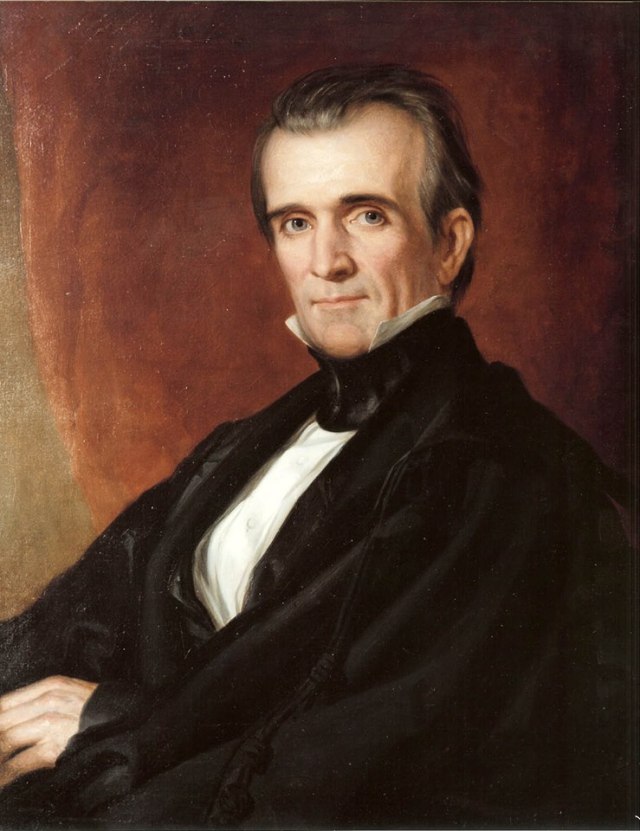
A few months ago, I mentioned a local legend concerning President James K. Polk’s squabble with a local postmaster. Tonight, I have an update about the validity of that legend.

Polk was no stranger to Lawrence County. Although he lived in Columbia, he was admitted as a practicing attorney at the Lawrence County Court of Pleas and Quarter Sessions on October 2, 1820, and over the next two decades, his vocation brought him frequently to court in Lawrenceburg.

The story goes that, when Polk was elected President of the United States in 1844, one of his first official acts as president was to fire Stephanus Busby, the postmaster of Lawrenceburg, because the two were somehow political enemies, or because Busby had somehow insulted Polk at one time.

The old legend, it is said, is particularly popular among Busby’s descendants.

As it turns out, the legend is probably true.

Polk took the oath of office as president of the United States on a stormy March 4, 1845. By April 19, just a month-and-a-half after Polk’s inauguration, Roberson D. Parish had replaced Stephanus Busby as the postmaster of Lawrenceburg, a job which Busby had held since 1839.

But there’s more.

On February 18, 1844, Polk was in Lawrenceburg for court. While he was there, he wrote a letter to two political allies in Nashville, instructing them to publish some particular speeches in the Nashville ‘Union’ as soon as possible. Nothing very unusual for a politician gearing up for a presidential race.

What was unusual about Polk’s letter on that day is that he added a postscript which said:

“P.S. There being a Whig Post master here & my hand-writing being known as well as my face, I will send this, under cover to Genl. Armstrong. J.K.P.”

This small note tucked away in Polk’s personal correspondence validates the fact that Polk was certainly distrustful of Busby, whose political leanings were apparently so passionate that Polk suspected him of losing or destroying mail to hurt Polk’s chances of election.

In fact, Polk was so suspicious of Busby that he had to get someone else to address the envelope, and he had to have it sent to a proxy recipient simply to ensure its delivery.

Having to go to such extraordinary lengths to get his mail through no doubt stuck with Polk, so we should not be surprised that a new postmaster was appointed for Lawrenceburg so quickly after Polk’s inauguration.

10410652_825883094168686_6993037299055421115_n

Posted in Uncategorized | Leave a comment

Raash Sowell: The Freed Slave Who Wasn’t Afraid of the Klan

It took a lot of guts for a black man to stand up to the Klan in the uncertain days of Reconstruction. But that’s exactly what one of Lawrence County’s newly-freed slaves did in the late 1860s.

Reverend Payton Sowell (1849-1932) was a frequent writer for the Lawrence ‘Democrat.’ His editorials were almost always reminiscent of olden times and people who had passed away or moved away. Today, Reverend Sowell’s editorials are a treasure trove of information for local historians, as they preserve stories of Lawrence County’s early days that would have otherwise disappeared with the passing of Sowell’s generation.

One such story, published in the ‘Democrat’ on January 17, 1917, recalled several tales of Raash Sowell, one of the Sowell family’s former slaves, with whom Payton maintained a lifelong friendship.

When the Klan first organized in Lawrence County, which probably happened sometime in 1866, Raash had only been a free man for a brief time, and he still lived with the Sowell family on what Payton called “the old home place.”

Still, Raash was not afraid of the Klan. He frequently told anyone who would listen, “If the Klan comes to see me, I will tell them to pull that rag from their faces and show who they are.”

One night the Klan decided to pay Raash a visit. Payton, who would have been a teenager at the time, recalled the scene at his home place. He said that “their horses seemed tall as elephants…they looked weird and frightful with high hats and faces hidden behind masks.”

The men rode up to Raash’s door and called him out. Although Payton could see that Raash was clearly afraid, Raash neither ran nor hid, but stood his ground with dignity and faced the men hidden behind their masks.

What happened next was a common Klan scare tactic. One of the riders asked Raash to bring him a bucket of water. When he did, the rider drank the entire bucket at one gulp (a similar incident recorded in Pulaski at about the same time revealed that the secret to this trick was that the rider had a rubber bucket or bladder of some sort hidden beneath his robe, and the dumping of the water into that container made it seem as though he had drunk the entire thing in one gulp).

The rider ominously said, “That is the first drink of water I have had since I was killed at the Battle of Shiloh,” in an attempt to reinforce the idea that the Klan was composed of the ghosts of Confederate soldiers killed in action during the Civil War.

Payton says that before the riders disappeared into the woods, they called Raash aside and “spoke something to him in slow, solemn tones.”

Although Raash was shaken by this encounter, and never would tell anyone what they said to him, Raash did not let his fear get the best of him, and he did not let the fools hidden behind their masks win. He rarely spoke of the Klan after that encounter, but he also didn’t run or allow them to scare him off. In fact, not long afterward, Raash “set up housekeeping on the ridge not far from Crawfish Creek” and became a landlord in his own right.

Raash’s victory was a dignified, well-lived life as a free man with a good sense of humor and a kind heart. Payton wrote that Raash always “bowed his head and gave thanks over his food before eating,” and that Raash would always come to hear Payton preach when Payton’s itinerary brought him to Pleasant Grove Church, waiting until the end of the service to approach him and say, “God bless you, Patus.”

Posted in Uncategorized | Leave a comment

Murray Ohio Scholarships

Murray Ohio not only employed thousands of people from Lawrence and surrounding counties, it also helped many local students pay for college.

In addition to the massive amount of scholarship money the company awarded to Lawrence County’s students, the company also donated money directly to the financial aid office of the University of North Alabama, which usually paid tuition for a semester for two or three students at that university.

How many of you were recipients of Murray scholarships? If you were, tell us what you are doing now!

Posted in Uncategorized | 1 Comment

Minutes of the Lawrence County Association of Baptists 1934

Readers, for your enjoyment, here is a bit of Lawrence County’s religious history. This booklet belonged to Alta Alley of Deerfield, and contains the Lawrence County Baptist Association’s 1934 minutes from its annual meeting at Park Grove Baptist Church. Do you recognize any of the names in the booklet?

Posted in Uncategorized | Leave a comment

The Forgotten F-5

Today (April 16) is the 17th anniversary of the ‘Forgotten F-5,’ so-called because the Nashville tornadoes of the same day overshadowed reports of the storm on major news networks.

The storm that tore through Lawrence County on April 16, 1998 produced the only recorded F-5 tornado in Tennessee history. The path taken by the 1998 tornado was very similar to the F-4 tornado of May 18, 1995. Both storms ravaged Deerfield and Ethridge.

The 1998 tornado was over a mile wide at some points and caused damage to over 100 homes in Lawrence County, including over two dozen homes destroyed. Between Lawrence, Wayne, and Maury counties, more than 150 homes were destroyed by the storm. Three people were killed by the tornado in Wayne County.

This video was shot by Doug Alley of Deerfield, whose family was watching the storm from their back yard, which was about a mile and a half from where the funnel appears here. The broken trees in the foreground are remnants of damage done by the 1995 tornado, which destroyed the Alley family’s house.

The year 1998 was a meteorologically active year for Lawrence County. Tornadic winds swept through the northern end of the county earlier that spring, and a later storm produced a severe hail storm that did a great deal of damage to area homes and vehicles. That July, a massive flood of Shoal Creek killed 2, injured 20, and damaged or destroyed 122 homes across Lawrence County.

Posted in Uncategorized | Leave a comment

In Loving Memory of Coach Aaron McCroskey

We wish to extend our condolences to the family of one of Lawrence County’s finest gentlemen, Coach Aaron McCroskey. Coach McCroskey passed away this morning.

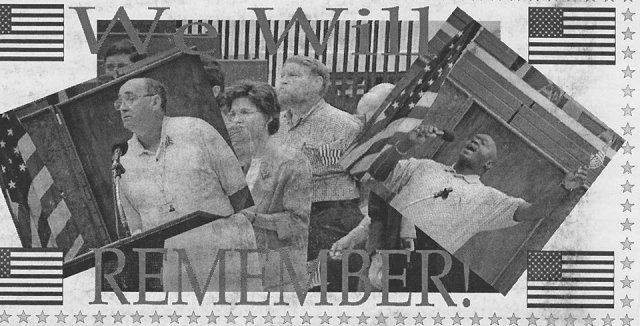
Coach McCroskey’s ministry as a teacher, coach, and pastor touched the lives of many local people, and, as can be seen in this collage from the September 2001 edition of the Lawrence County High School ‘Wildcat,’ his rich singing voice expressed the shared patriotism of our community in the days following the September 11 attacks. In this photo, he is singing Lee Greenwood’s ‘God Bless the USA’ at the patriotic assembly held at LCHS on September 12, 2001.

His congregation, Solid Rock Worship Center, announced the following funeral arrangements via Facebook this afternoon:

Visitation will be Friday, April 10 at Neal Funeral Home from 3-8 p.m., and Funeral Services will be Saturday, April 11 at 2:00 p.m. at Mars Hill.

11138535_1581842935433975_3151395961607963796_n

Posted in Uncategorized | Leave a comment

A Teacher In-service From 1912

Our great Lawrence County teachers will appreciate this.

Did you know that Lawrence County teachers have been attending teacher in-service programs for well over a century?

And that they used to occur on Saturday mornings?

And that they often required teachers to read hundreds of pages in textbooks in preparation for group discussion?

And all of that was on top of the regular work required by their course-loads, which for most of them involved teaching multiple grades in one room.

This article from the February 28, 1912 edition of the Lawrence ‘Democrat’ describes what was planned for a March 1912 meeting of the Lawrence County Teachers Association. The Teachers Association at that time was reading through the books of the Teachers Reading Circle Course.

The Teachers Reading Circle was a professional development organization which provided teachers with the opportunity to continue learning about the latest developments in their field.

For that March 1912 meeting, high school teachers were scheduled to arrive at the courthouse at 8:30 on a Saturday morning to discuss readings from books about high school education. Primary school teachers were scheduled to meet at 10:00 that morning to discuss the first five chapters of a book called ‘Standards of Education With Some Consideration of their Relation to Industrial Training’ by Arthur Henry Chamberlain.

In the 1908 edition of Chamberlain’s book, the first five chapters were 129 pages long, and they were entitled:

“The Aim of Education”
“The Elementary Curriculum: Its Motive and Content”
“Industrial Training: Its Aim and Scope”
“The Meaning of Correlation”
“The Basis of Ethical Training”

For the full 1908 edition of this book, please follow this link:

https://tinyurl.com/y5yralnq

While the meeting was not mandatory for all teachers, as modern in-service days are, the superintendent at the time “urged” all teachers to attend, and I find it hard to believe that he wasn’t keeping track of those who chose not to attend.

11139785_807673795989616_9000341158882489049_n

From the Lawrence ‘Democrat.’

Posted in Uncategorized | Leave a comment

The Secret in the Cave Just West of Lawrenceburg

Have you ever found an arrowhead?

Almost ninety years ago, one Lawrence Countian found an arrowhead with quite a tale to tell.

According to the ‘Lawrence News,’ during the week of April 19, 1926, local man Webster Pearl went into the mouth of a collapsed cave on the south side of Crowson Creek near Lawrenceburg, just a “short distance” from the Crowson Mill.

In the mouth of the cave, Pearl discovered a deer skeleton with a flint arrowhead lodged in the spine, indicating that the animal had probably been killed by Indians.

Although Pearl was not sure how the deer had come to die in the cave, he estimated from the location of its injuries that it had not gotten there under its own power, and he reckoned that the Indians must have left it there.

The ‘News’ goes on to say that a hill just above the cave had yielded a lot of flints and arrowheads, indicating that the cave and the surrounding area had probably once served as an Indian encampment.

Posted in Uncategorized | Leave a comment