Soil Survey Map of Lawrence County From 1904

For your enjoyment, here is a detailed 111-year-old map of Lawrence County.

This soil survey map was created in 1904 by the United States Department of Agriculture. For the details of that survey, have a look at the official government publication here:

https://tinyurl.com/yyawsw28

Please note that some of what this document says about the early history of Lawrence County in those first pages contains some inaccuracies.

The Soil Report details what kinds of soil were found in which parts of the county, and what kinds of crops grew well in those types of soil. It also points out interesting statistics, such as the average size of farms in Lawrence County in 1900 was 127.2 acres, and at that time, more than 3/4 of the county was forested.

For a version of the map that allows you to zoom in and out on specific points, please follow this link:

https://tinyurl.com/yxuztnb2

11075290_800312350059094_5736473562340742794_n

Source: United States Department of Agriculture

Posted in Uncategorized | Leave a comment

Living on Amish Time?

Did you remember to set your clocks forward last night?

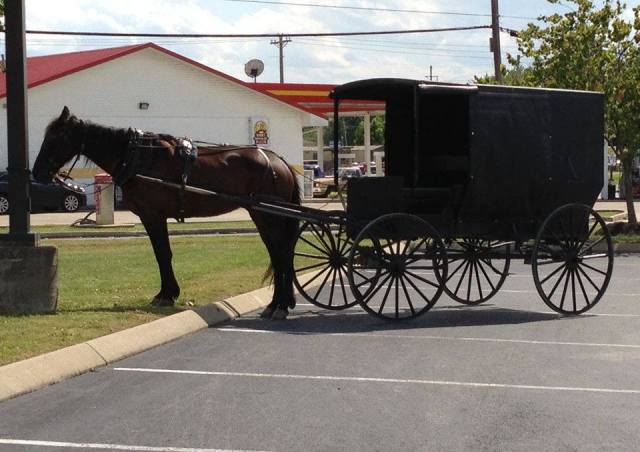
You might be surprised to know that almost 4% of Lawrence County’s population chose not to. In fact, in some neighborhoods in northern Lawrence County right now, it’s still an hour earlier than it is in the rest of the county.

Lawrence County’s Old Order Amish people do not observe daylight saving time. The Amish view the practice of setting clocks forward as a modern contrivance that skews the natural order of things.

Some Amish people refer to daylight saving time as ‘English time’ or ‘fast time,’ and to standard time as ‘slow time.’

10981654_792361627520833_7154955456628642483_n

Photo Credit: Clint Alley

Posted in Uncategorized | Leave a comment

A Different Kind of Rebel Flag

Have you ever pictured the first company of Confederate soldiers leaving Lawrenceburg at the beginning of the Civil War in the spring of 1861? If you have, you probably imagined that they marched off to war beneath the first national Confederate flag, representing the new southern nation that they were off to defend.

If so, you would be wrong.

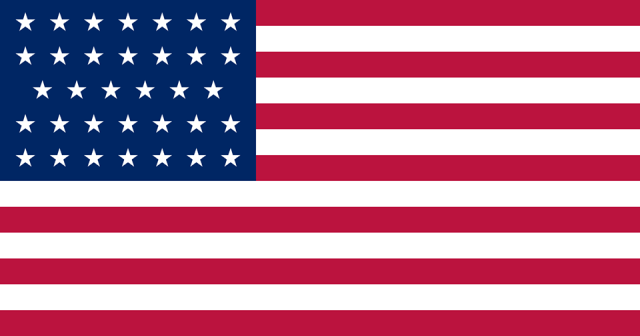
According to Lieutenant John Hildreth–as quoted in an article in the Lawrence ‘Democrat,’ written sometime in the mid-1910s–when the first Confederate troops left Lawrenceburg to serve in the Civil War in 1861, the community indeed made and donated a flag to them, but it was not a Confederate flag.

Despite the company’s clear allegiance to the new Confederacy, Hildreth said that the company flag under which they marched off to war was the Stars and Stripes of the United States.

There are several possible reasons for this confusing footnote in local history. One is that, when the first Confederate troops left Lawrenceburg for training, Tennessee still had not formally seceded from the Union. The state’s voters had rejected secession in a special referendum on February 9.

It wasn’t until May 6, after the Union bombardment of Fort Sumter and Lincoln’s subsequent call for troops, that Tennessee’s legislature passed a resolution to secede from the Union, pending another referendum. That referendum was held on June 8, when the people of Tennessee voted 2-to-1 in favor of secession, making Tennessee the last state to secede.

Meanwhile, in the month-long interlude between the legislature’s resolution and the referendum, Lawrence County men began going to war. Lawrenceburg’s first company of Confederate soldiers left in May, before the state had officially joined the Confederacy. The men who joined the company actually voted on the issue on June 8 while in camp (interestingly enough, Hildreth said that he voted against secession both times, even when in training to join the Confederate army; regardless, he served the South faithfully throughout the entire war).

It is possible, in the confusion surrounding Tennessee’s official status, that the people of Lawrenceburg had no clue what kind of flag to send off to war with their sons, so they may have arrived at the decision by virtue of it being the only flag they knew.

Another explanation may be that the pattern for the new Confederate flag had not yet been seen in Lawrenceburg at the time that the company left for war, and the people of the community again fell back on the only flag design they knew.

The Stars and Stripes flag was presented to the Confederate company in Lawrenceburg with “a beautiful address” by 18-year-old Lily Bentley, who no doubt helped stitch it together. The cloth for the flag was purchased b Flovel Wilson, the owner of the Laurel Hill Cotton Mill.

Whatever the cause for the mismatched flag, the company did not march beneath the flag for long. As it was clear that flying the flag of the Union would cause great confusion on the battlefield, the company commander, Captain Benjamin F. Matthews, sent the flag home to his family after the company was officially mustered into the service of the Confederacy on August 7, 1861.

Although Hildreth did not say whether the company ever got another flag from home, he did describe the company’s first uniforms. To the best of his memory, the company was comprised of about 80 men when it left Lawrenceburg. They were outfitted with uniforms made of “beautiful” gray jean cloth, which he believed had been produced at one of the textile mills between Lawrenceburg and Florence, but which other sources say was produced at the Laurel Hill Cotton Mill.

Hildreth, who was a tailor, cut the uniforms for the men, himself. With “two sewing machines and 20 Southern Lawrence County ladies,” he was able to present the uniforms to the company in just two weeks.

10425066_783978765025786_3984880551416296848_n

Posted in Uncategorized | 5 Comments

Wisdom From the Over-80 Club

For many years, the ‘Democrat-Union’ had a program known as the ‘Over-80 Club,’ where people who were over 80 years of age could get a free subscription to the paper for life if they submitted a brief autobiography.

Most of these autobiographies are collected in the books ‘In Their Own Words’ and ‘In Their Own Words 2,’ compiled by Hazel Myhan and for sale at the Lawrence County Archives.

One of the most humorous autobiographies came from George M. Mattox, who joined the club in the early 1970s. An exceprt of his Over-80 Club autobiography is as follows:

“My name is George M. Mattox. I was born in Cullman, Ala. on October 5, 1891…

“I reckon me and my old gal have done a pretty good job. We got 30 cents in money we haven’t spent. We bought land in Lawrence County in May, 1920, and the fall of December 5, 1920, we landed in Lawrence County with the little we had.

“We cleared this land and made a farm of it. We have been married for 56 years. We have never argued in our lives, but sometimes you could hear us reasoning things for a quarter of a mile.

“I am in excellent health and could work all day. I have the majority of my farm sowed down and black angus walking all over it.

“I learned ten or twelve years ago that I could take it easy and live off the interest I owed.”

Posted in Uncategorized | Leave a comment

Catholic, Baptist Churches in Lawrence County Share Birthday

Happy birthday to two Lawrence County churches!

On this day in 1872, Sacred Heart Catholic Church of Loretto was founded.

And on this day in 1896, First Baptist Church of Lawrenceburg was organized in the Opera House on the Lawrenceburg Public Square.

These two churches have played important roles in the development of their respective communities, and they are two of the reasons that Lawrence County is a great place to live.

Happy 143rd birthday, Sacred Heart Loretto! And happy 119th birthday, First Baptist Lawrenceburg! May you both continue to serve Christ and the people of Lawrence County for centuries to come!

Posted in Uncategorized | Leave a comment

Murray First Attracted By Friendliness of Lawrenceburg

Bicycle and lawnmower manufacturer Murray Ohio was the largest local employer that our area has ever known. Practically everyone in Lawrence County had a relative who worked at the plant in its local five-decade history, and the plant’s presence in Lawrenceburg undeniably shifted the fortunes of our community for the better.

But have you ever stopped to ask why Murray chose Lawrence County?

They almost didn’t.

But one thing changed their minds.

According to a 1986 ‘Times Daily’ interview with Murray executive Cromer Smotherman, Murray made the decision to relocate from Ohio in 1955 due to increasing competition from other manufacturers near their Cleveland plant.

After making the decision to relocate, Murray hired the Fantus Company of Chicago to advise them on potential places for relocation. Fantus examined several criteria, including utility costs and available manpower. Fantus chose five communities in Middle Tennessee for Murray’s consideration.

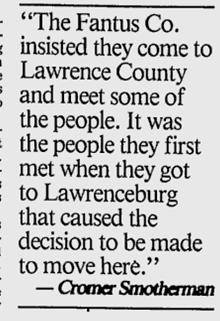
Lawrenceburg was the last community on their list, and by the time the Murray officials had seen the first four communities, most of them had decided to skip Lawrenceburg in favor of one of the other places. But the Fantus Company insisted that the Murray officials come to Lawrenceburg and meet some of the people.

And although Lawrence County was not as competitive in other areas as the other four communities, it was the people of Lawrence County who changed Murray’s mind.

Although the city officials who met the Murray men had no idea what company they represented, they went out of their way to show them hospitality, and the people of the county made them feel very welcome. Not long after, the decision was made to relocate the Murray plant to Lawrenceburg, and the rest is history.

The hospitality, friendliness, and civic-mindedness of the citizenry of Lawrence County helped bring about the largest economic boom our county has ever known, one which completely altered the course of our area’s future.

As Cromer Smotherman said, “It was the people they first met when they got to Lawrenceburg that caused the decision to be made to move here.”

On a personal note, I (Clint Alley) encourage you to do as our parents and grandparents did; take pride in your hometown, and go out of your way to brag on the good things about it. You never know who might be listening, and what good might come from telling the world that you are proud to be from Lawrence County, Tennessee.

10574384_773858586037804_789998304690551708_n

Photo Credit: Florence ‘Times Daily’

Posted in Uncategorized | Leave a comment

These Veterans of 1812 Were Still Living in Lawrence County 70 Years Later

The War of 1812 is commonly referred to as our ‘Second War of Independence’ because it was the second time the United States defeated the British. And, years after the smoke finally cleared, many of its veterans called Lawrence County home.

In 1883, the Secretary of the Interior compiled a list of people who were drawing pensions from the United States government for military service. While the great majority of these pensioners were disabled Union veterans of the Civil War (Confederate pensioners were not counted, as they were ineligible for Federal pensions), some of the pensioners named on the roll were still drawing pensions for services rendered in the War of 1812 and the Mexican War, respectively.

In Lawrence County, 30 pensioners were counted in 1883. Among these, 3 men were recognized as War of 1812 veterans, and 10 women were recognized as widows of War of 1812 veterans. The rest were probably all disabled Civil War veterans of the Union army and Union widows.

The three War of 1812 veterans still living in Lawrence County in 1883 were William Pollock of Henryville, Robert B. Williams of Lawrenceburg, and David Adkinson of Wayland Springs, all of whom were born in the 1790s.

Pollock served in Colonel Robert Steele’s 4th Regiment of West Tennessee Militia, in the company commanded by Captain James Shinault. Pollock’s regiment was raised to serve in the Creek War, and spent a great deal of their service guarding wagon trains of supplies and building boats to transport supplies down the Coosa River.

Robert B. Williams served in the 1st Regiment of West Tennessee Militia, commanded by Colonel Philip Pipkin. Williams was elected as one of the sergeants of his company, and later promoted to quartermaster sergeant. The 1st Regiment, like the 4th Regiment, was raised to fight against the Red Stick Creeks in the Creek War, but, according to the Tennessee State Library and Archives, the 1st Regiment spent the duration of the conflict garrisoning 4 forts near Mobile, where they were ravaged by disease and desertion.

David Adkinson served in the 5th Regiment of East Tennessee Militia, commanded by Colonel Edwin Booth. This regiment was organized at Knoxville and ordered to the vicinity around Mobile to protect the area against any Indian or British attacks. Adkinson was mustered into service on November 13, 1814, in Rhea County, Tennessee and was discharged on May 13, 1815 at Kingston, Tennessee, completing the six-month term of enlistment that was required of most militia companies.

The names and addresses of the widows of War of 1812 veterans still living in Lawrence County in 1883 were as follows:

Martha Broadway, Fall River
Polly Pennington, Henryville
Martha Hail, Knob Creek
Sally Adkinson, Lawrenceburg
Elizabeth Counce, Lawrenceburg
Martha Blair, Lawrenceburg
Mary Oglesbay, Lawrenceburg
Elizabeth A. Gibson, Lawrenceburg
Sina Eakin, Lawrenceburg
Rebecca Newton, Pleasant Point

For their service, the veterans and widows named above received pension payments of $8.00 per month from the Federal government, which would be the equivalent of around $200 per month today.

10177497_772454252844904_7223316022962227737_n

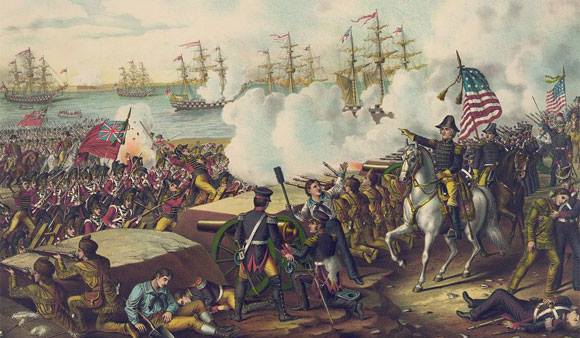
Artist’s rendering of the Battle of New Orleans

Posted in Uncategorized | 1 Comment

The Coldest Day Lawrence County Has Ever Know

It’s been a little chilly out today, but it’s mild outside compared to what it was 49 years ago today. On January 30, 1966, Lawrence County reached its record low temperature of -14 degrees Farenheit.

Posted in Uncategorized | Leave a comment

The Bridges of Lawrence County

Lawrence County is a land of many creeks, so it should come as no surprise that the county is also home to 195 bridges.

According to the Tennessee Department of Transportation, the oldest operating bridges in Lawrence County are 2 concrete tee-beam bridges and 2 concrete culverts on Pulaski Highway, just east of Lawrenceburg, all of which were built in 1929.

The iconic old steel truss bridge which crosses Crowson Creek on the Old Waynesboro Highway, across from the entrance of David Crockett State Park in Lawrenceburg, was built in 1933.

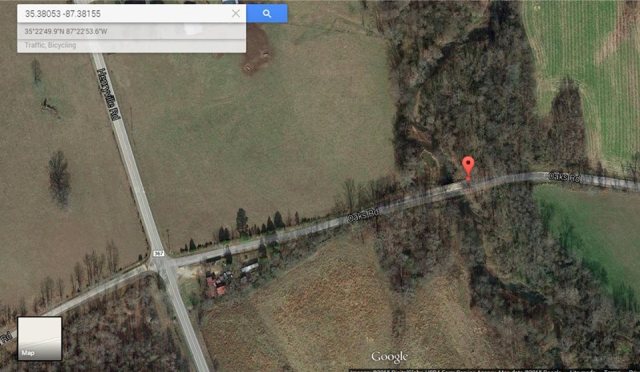
Of Lawrence County’s many bridges, only one is currently rated as structurally deficient by the State of Tennessee (as of its inspection of June 10, 2013). Bridge number 500A1150001, where Oaks Road crosses the West Fork of the Buffalo River, just southeast of Henryville, and just east of the intersection of Oaks Road and Henryville Road, was given a sufficiency rating of 45.4 by the Tennessee Department of Transportation. This bridge was built in 1984 of prestressed concrete.

The Oaks Road bridge’s location is marked by the red balloon on this map.

However, state officials assure us that a bridge’s structural deficiency rating is no cause for panic. As TDOT spokeswoman Heather Jensen told reporters from WSMV-TV, “Just because a bridge is structurally deficient doesn’t mean it’s unsafe.”

1604615_768166516607011_9099966609255199887_n

Source: Google Earth

Posted in Uncategorized | Leave a comment

The Battle of Fairside Park: An Early Reenactment in Lawrenceburg

Did you know that one of Lawrence County’s earliest recorded battle reenactments occurred in front of the old grand stand at Rotary Park, more than 85 years ago?

When we think of reenacting today, we are probably more likely to think of Civil War reenactments, where modern men dress in Civil War-era clothing, fire reproduction Civil War weaponry, and display Civil War-era military tactics.

On November 11, 1927, however, a different kind of reenactment happened in Lawrenceburg.

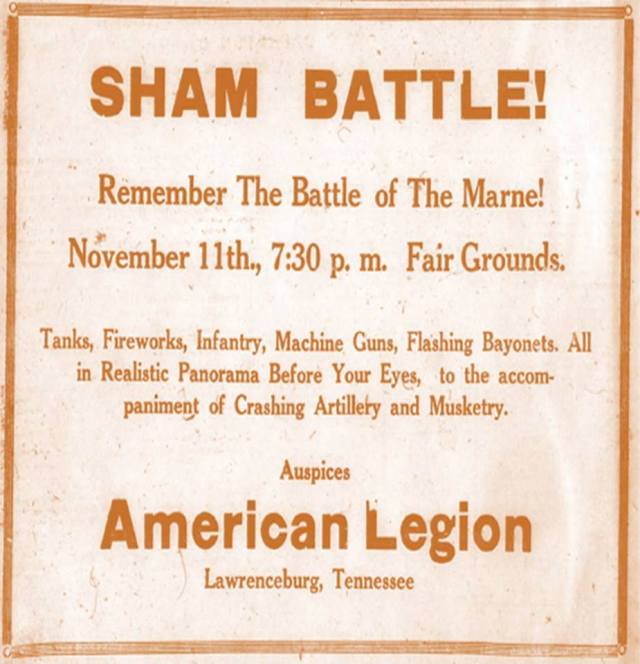
That day, as part of the Armistice Day celebrations marking the ninth anniversary of the end of World War I, the local American Legion sponsored a “sham battle,” or reenactment of the Battle of the Marne. As the event was sponsored by the American Legion, no doubt many of the participants of the reenactment were World War I veterans, themselves.

As this ad says, the reenactment included “tanks, fireworks, infantry, machine guns, flashing bayonets…to the accompaniment of crashing artillery and musketry.” The event was watched by a huge crowd that the Lawrence ‘Democrat’ said “packed and jammed the big grand stand at the fair grounds.”

10896963_764999276923735_4274843489311531362_n

Source: Lawrence ‘Democrat.’

Posted in Uncategorized | Leave a comment