How The Democrat-Union Got Its Name

Have you ever wondered why Lawrence County’s oldest newspaper is called the ‘Democrat-Union?’ And what connection does James D. Vaughan, the father of Southern Gospel music, have to the name of the paper?

The answer is that it was once two separate and distinct newspapers. In late 1925, the owner of the Lawrence ‘Democrat’ purchased the “plant and business” of the Lawrence ‘Union,’ both of which had served Lawrence County since the 1880s. The reason? James D. Vaughan, the father of Southern Gospel music, was publishing a rival newspaper at the time known as the Lawrence ‘News.’

In their farewell editorial on December 23, 1925, Charles T. Crawford and Joe Schade, the respective owners of the ‘Democrat’ and the ‘Union,’ explained that they had arranged the merger because they felt that the businesses and people of Lawrence County had been unnecessarily financially burdened by the existence of three newspapers, and that by merging the papers, they believed they could strengthen the community.

Although, according to Schade and Crawford, they both lost money in their quest to help the community. In their own words, “….the facts are that Mr. Schade sold the plant and business for less than it was worth, and Mr. Crawford bought something that he did not need, and at a price consequently that he could not well afford to pay, simply in order to lessen the burden of three papers.”

And so, eighty-nine years ago this month, on January 13, 1926, the first issue of the paper was published under its new name of ‘Democrat-Union.’ This image shows the first time the new name was used on the paper’s masthead.

8996_764049750352021_7002161220977163659_n

The first issue of the newly-named ‘Democrat-Union.’

Posted in Uncategorized | Leave a comment

You’ll Be Amazed By What They Found Hidden Upstairs In This Old Movie Theater

Have a look at what the staff of WDXE Radio found upstairs at their station!

The WDXE station is located in the old Princess Theatre building on the Lawrenceburg Public Square. The 500-seat capacity Princess Theatre was Lawrenceburg’s prime motion picture venue until the 1,200-seat Crockett Theater opened its doors on North Military Street on September 13, 1950.

This paper was probably used to identify shipments of movie reels in transit. The fragments of tape in this photo are from the Vaughan Printing Office, which stood just a few yards away from the Princess, on the site of the old Suntrust building which currently houses the James D. Vaughan Southern Gospel Museum. Vaughan operated a diversified media empire from that location, including a singing school, a printing office, one of the first radio stations in Tennessee, and one of the South’s first independent record labels.

Thanks for sharing this awesome treasure with us, WDXE!

10906046_1559306450993382_6119421855082225699_n

Photo source: WDXE Radio Facebook Page

Posted in Uncategorized | Leave a comment

When Most of Lawrence County’s Men Were in Uniform

According to an early-20th-century estimate found in the Lawrence ‘Democrat,’ around 1,600 Lawrence County men volunteered to serve in the Confederate army in “home organizations” in 1861.

In addition to the young men who marched off to war from Lawrence County to serve in the regular Confederate Army, this number probably also included older men who volunteered to serve in the militia-style home guard groups of “minutemen” which were organized in each civil district in the first months after Tennessee’s secession from the Union.

These home guard units were generally manned by men whose age or infirmity prohibited them from serving in the regular army. They were like paramilitary neighborhood watch organizations. While it is possible that they may have drilled once or twice, they probably saw very little combat, if any, and most home guard units probably dissolved after Union forces gained control of Tennessee in early 1862.

While the newspaper excerpt in question cites no source for its estimate–and it appears in an advertisement urging young men to join the Army during World War I as their fathers had joined the Confederate army in 1861–I calculated what percentage of Lawrence County’s 1860 population would have been in service to the Confederacy during that first year of war if the number was accurate.

Regardless of the type of unit volunteered for, that number indicates that at least 17% of Lawrence County’s total population and a whopping 40% of its white male population was in uniform at the outset of the Civil War. While we are not given an estimate of the ages of those volunteers, if that number is accurate, it would account for 92% of Lawrence County’s men aged 15-50.

If that same proportion of men were to volunteer for military service today, it would mean that more than 7,100 men from Lawrence County would be in uniform.

10931009_762403030516693_195508393193407939_n

Posted in Uncategorized | Leave a comment

The Missing Flag of Sacred Heart School

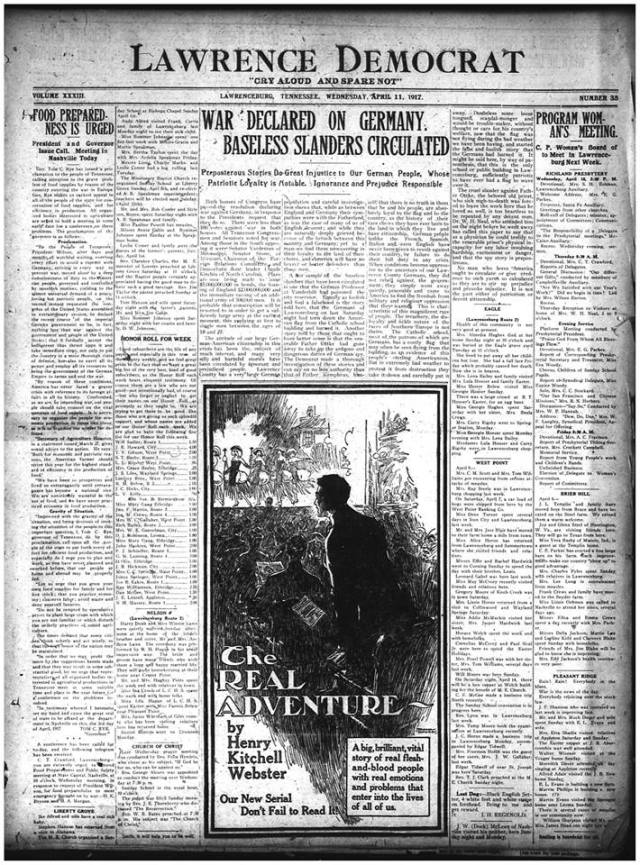
Did Lawrenceburg’s German Catholics tear down the American flag flying above Sacred Heart School in Lawrenceburg and burn it in the yard when the United States declared war on Germany in 1917?

No, they certainly did not.

But unfortunately, that did not stop that rumor–and many others just as malicious–from spreading rapidly through the county when the United States entered World War I.

At that time, Sacred Heart School of Lawrenceburg owned a very large, very beautiful, and very expensive American flag, which flew from the school. Interestingly enough, the Lawrence ‘Democrat’ reported that Sacred Heart School was the first public building in Lawrence County to ever fly the American flag–apparently even predating the court house!

To protect the flag from the elements, it was the habit of school officials to take it down during inclement weather. Such was the case on April 7, 1917. As is normal for our area in the springtime, several bands of thunderstorms had pummeled Lawrence County that day, and school officials took the flag indoors to protect it.

Unfortunately for school officials, their timing could not have been worse. The day before they removed the flag, the United States had declared war on Germany, marking our nation’s entry into World War I. Some of the town’s non-German population noticed that the flag was gone, and as Sacred Heart Church and Sacred Heart School had been founded by German immigrants, the false rumor spread that the town’s German inhabitants had torn the flag from its pole and burned it in response to the United States’s declaration of war on Germany.

In addition to the rumor regarding Sacred Heart School’s flag, it was whispered about town that Father Ottke, an elderly and kind-hearted old German priest, had left Lawrenceburg in order to be a German spy. However, in addition to being the victim of ignorance and xenophobia, Father Ottke, like the school officials, was probably also the victim of bad timing. He had left Lawrenceburg about the time that war was declared on Germany, but, as Dr. Neal told the ‘Democrat,’ Father Ottke had left town for his health, as he was far too old and feeble to be a spy for anyone.

Contrary to these idle rumors, Lawrence County’s German population remained, on the whole, extremely loyal to the United States throughout both world wars.

The Lawrence ‘Democrat’ had harsh words for those who perpetuated such rumors against the county’s German population: “No man who loves America ought to circulate or give credence to such yarns so calculated as they are to stir up prejudice and provoke injustice. It is not the part either of patriotism or decent citizenship.”

10917335_761675213922808_8884890600923985967_n

Posted in Uncategorized | Leave a comment

Baby it Was Cold Outside

This 1914 advertisement from George Brothers Dry Goods in Lawrenceburg seems especially fitting for this week! Bundle up and stay warm, Lawrence County!

10922777_760103480746648_522092108011370987_n

Posted in Uncategorized | Leave a comment

Merry Amish Christmas!

Merry Christmas? For most of Lawrence County’s Amish people, today, January 6, is Christmas!

With some 1,500 adherents, Lawrence County is home to one of the largest Old Order Amish communities in the South. The Old Order Amish observe some holidays that the rest of us may not celebrate. One of those holidays is Old Christmas.

When European nations began switching from the Julian calendar to the Gregorian calendar in the 16th century, 11 days were lost to make up for discrepancies in the old system. At that time, some felt that it was sacrilegious to move the celebration of Christ’s birth, and those people continued to celebrate Christmas on January 6, as it fell on the old lunar calendar.

Lawrence County’s Old Order Amish continue this centuries-old tradition. Today, those who celebrate Old Christmas in Lawrence County will awaken early and fast from breakfast. They will then spend time praying and reading the Bible with their immediate family. Around noon, the fast is broken and they will eat a meal together, oftentimes while visiting with extended family members.

Although traditionally no gifts are exchanged during Old Christmas, it is permissible for Amish teachers to give some candy to their students for the occasion.

Merry Old Christmas, Lawrence County!

10922808_759364280820568_3584738893158584890_n

Posted in Uncategorized | 1 Comment

This Local Doctor Was a Real-Life Dr. Quinn: Medicine Woman

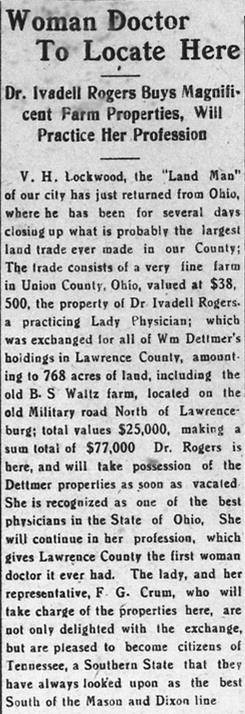
A century ago, Lawrenceburg got its very own version of Dr. Quinn: Medicine Woman in Dr. Ivadell Rogers.

As can be seen from this front-page story from the March 4, 1914 edition of the Lawrence ‘Democrat,’ Dr. Rogers, who came here that spring, was Lawrence County’s first female doctor.

An 1898 graduate of the Eclectic Medical Institute of Cincinnati, Dr. Rogers was a well-respected physician in her own region when she decided to relocate to Lawrence County that spring.

Eclectic medicine was a movement that was extremely popular in the United States in the mid-to-late 19th century. It relied heavily on botanical and herbal remedies, many of which were learned from Native Americans in the late 18th century and taught from one physician to another. Its preference for herbal remedies over the older traditions of bleeding and mercury-based remedies made eclectic medicine a forerunner to modern homeopathic treatments.

To give you an idea of how Dr. Rogers practiced medicine, she reported to the North American Journal of Homeopathy in 1920 that she successfully treated a 70-year-old woman who had contracted erysipelas. Dr. Rogers’s primary treatment in this case was apis, which is dried and powdered honey bees. Dr. Rogers also treated the patient with “full strength iodine” and “ichthyol combined with flexible collodion.” Dr. Rogers recorded the treatment as a “good success.”

Dr. Rogers’s expertise as a physician was well-established among traditional physicians as well as practitioners of eclectic medicine. In 1907, Dr. Rogers was elected the chief of staff of the Delaware County (Ohio) Medical Society, which was comprised of every doctor in that county. Her position as such was recognized by the Ohio State Medical Journal.

Dr. Rogers did not stay in Lawrence County for very long. From the large farm north of town mentioned in this article, she moved to the W.H. Neal House on Pulaski Street in Lawrenceburg in 1916 (the house is still standing to this day, just east of the railroad, on the north side of the street). Dr. Rogers sold the house in 1917, and by 1920, she had moved to Pryor, Oklahoma.

Despite her brief residence in Lawrence County, Dr. Rogers was here long enough to shatter barriers that had been in place since the county’s founding. The city’s welcome to Dr. Rogers as a serious practitioner speaks well to the progressive attitude of Lawrence Countians of that period.

10906024_756449564445373_5902651863779129815_n

Posted in Uncategorized | Leave a comment

The Lawrenceburg Square A Century Ago

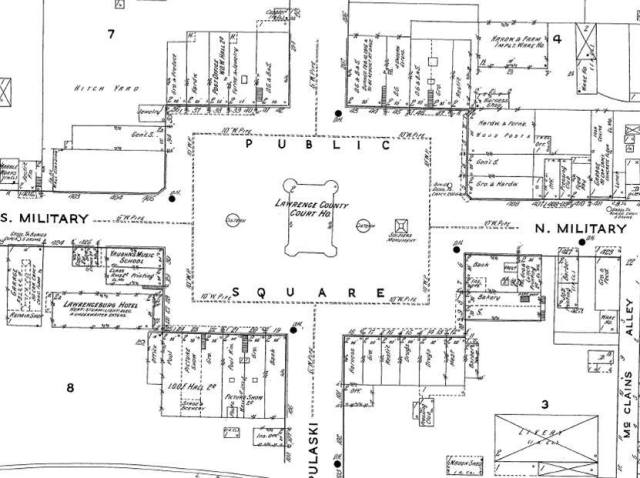
The following is a portion of an article called ‘Around the Square, 1918-1922,’ by Mrs. Docia Spann Richardson (many of you may remember our previous posts about Mrs. Richardson, as she was the second woman to vote in Lawrenceburg’s history).

The article was published in the ‘Democrat-Union’ on May 7, 1981, and it contains Mrs. Richardson’s reminiscences of what the Lawrenceburg Public Square looked like in the year immediately following World War I. The image attached is an insurance map of the Square drawn in 1916. Many of the businesses mentioned in the article appear on the map.

“…Beginning at the corner of Pulaski Street (north side) and the Square was Bell’s Harness Shop. George Bell and son made and sold harness. North of Bell’s was a grocery store–Allgood and Anderson’s.

Next to the grocery, according to Raleigh Vernon Beckham, a Mr. Hass had a jewelry store. Adjacent to it was the Crowder-Beckham-Finley drug store, and next door the three Stockard brothers–Dr. Tom, Dr. Charles, and Parkes–operated a drug store. In the corner, R.W. Caldwell had a men’s and boys’ ready-to-wear shop called the Toggery.

A small barber shop was attached to the building just around the corner from The Toggery. It was open both to the Square and to a large hitch yard that was adjacent to this northwest corner of the Square.

In the first building directly on the Square, just around the inside corner from The Toggery, was Jim Giles’ office. He bought and sold cotton, and later he and Mrs. Giles opened a ready-to-wear and piece goods store at this location.

I cannot remember who was in business next door, but I do recall that W.S. Dustin and James T. Dunn had an office somewhere along here. They sold insurance.

(Prior to 1918, possibly around 1914, a large auditorium was located on the second floor of the building now occupied by White’s Department Store. On its stage local high school societies–the Atheneans and the Striblings–would present variety shows, such as lively debates and oratorical contests. Only young men participated in those activities; the young women presented recitations and choral numbers.)

The First National Bank was on the corner. J.H. Stribling was president and continued this post until his death in the early 1950s. James T. Dunn, James E. Spence, and Villard Richardson were some of the early cashiers.

On the second floor of this building was several offices. Among them was that of H.D. Derrick, attorney. His secretary was Miss Lurline Freemon, who was considered to be the best legal secretary around. The office of Robert B. Williams was adjacent to Derrick’s, and next to it was the office of Jerome Boynton and Warren Short, realtors.

Across North Military Street, on the corner, Tom S. Springer had a grocery store. Next to it was A.B. Sidowey’s Department Store.

Adjoinging it was M. Richardson Hardware Co. The store’s slogan was “Everything for the home and farm.” The writer of this article was assistant bookkeeper and stenographer with the firm at this time.

At about this time, probably in 1919, Kuhn’s opened its doors as Lawrenceburg’s first “5-10-25” store. To the south of Kuhn’s, Alec George had a general merchandise store.

Next to George’s was Comer’s Dry Goods, with J.F. Comer as owner and manager. Will Harvey and Elizabeth Bell North were clerks. (Later, in 1925, C.W. Moore, Sr. and sons C.W. Jr., and James Y. went into business at that location; the latter is still in business there.)

At that time Sherman Kelly had a store on the corner of the Square and Waterloo Street. He sold ready to wear and piece goods. When Kelly retired, A.B. Sidowey moved his business to this place. Two of the clerks were Mary Gaither and John Hendrix. (Later, Kuhn’s moved to this location, and for many years the Hovelmeir sisters, Kate and Annie managed the store with great dedication and efficiency.)

Dr. J.W. Danley had his offices on the second floor of this building. He was a general practitioner as well as an ophthalmologist. His wife, genial and personable “Miss Nettie,” joined him and Ed McNeal, receptionist, as assistant.

Memory fails me with respect to the building across Waterloo Street on the corner. It is likely that several businesses were in and out of that building. Next door, to the south, was McClanahan & Wall, funeral directors.

At this time, the Post Office was on the west side of the Square, next to McClanahan & Wall. Inside, the walls were plastered, painted white. Long desks, about three feet high, were placed along the walls for the convenience of patrons, and above them dates were inscribed.

Locke and Webb Hardware adjoined the Post Office, and in the corner was Dwiggins’ Grocery, owned by S.M. Dwiggins. When the owner’s health failed, Dolph Clayton bought the business and operated a flourishing grocery store until his health forced his retirement.

Another large hitch yard opened onto the Square at this point. Just around this inside corner, in a small frame building, Miss Eula McAdams had a millinery shop. Next door, Mr. and Mrs. W.R. Lewis had the Racket, selling such items as china, cut glass, crystal, silver and figurines.

At that time there were two buildings where the parks-Belk store is now located; C.W. Moore, Jr., recalls that Locke and Webb sold heavy farm equipment in the one next to the corner building, where the Stockard brothers had a drug store. Stanley Tinin, Sr., was the pharmacist.

On the second floor was, to the best of my knowledge, the first hospital in Lawrenceburg and possibly in Lawrence County. Dr. W.P. Bowen was the surgeon and Miss Bessie Keeling the nurse. When this building burned, Bowen went to another city and the drug store was moved to the east side of the Square as has been mentioned earlier.

Across South Military Street, the rudiments of vocal music was taught at Vaughan’s School of Music. A print shop published gospel song books, featuring shaped notes. Each year, a new book was published.

The east part of this building (which later became the Coffee Shop, an extension of the Lawrenceburg Hotel) served as headquarters for the Lawrence News, a weekly newspaper published by James D. Vaughan from 1919 until it was discontinued in 1938.

In 1922, Vaughan founded radio station WOAN, the first radio station in Tennessee. The broadcasting room was over the print shop.

Farther east, adjacent to the Vaughan building, was the Lawrenceburg Hotel, owned and operated by Mrs. Dora Robertson. A two-story porch ran the length of the front of the building, and hotel guests enjoyed sitting out on summer evenings, just talking and watching the comings and goings around the Square.

At that time the dining room was in the main building, back of the lobby. Waiters would bring in large trays of food in small individual bowls and platters. Mrs. Robertson served simple wholesome foods such as beans, cabbage, and potatoes, and for dessert, mostly fruit cobblers.

In the corner, Dr. Bill Gallaher had an office. Adjacent to it was Mrs. Flora Harvey’s tea room. Her hot chocolate was a special treat for us young ladies who worked in the various stores and offices around the Square.

Louis Rhulander notes that around 1922, this building housed Tripp’s Pool Room.

Next door was the Jitney, which showed silent movies, and at times presented local musicians, one of whom was Harry Gilmore. Movie stars appearing on the Jitney’s silent screen included Mary Pickford, Douglas Fairbanks, and Pearl White. Lurline Freemon comments that she and her friends never missed an installment of “the Perils of Pauline.” Other entertainment featured traveling groups such as “The Lyceum,” which presented musical programs.

A grocery store was next to the Jitney. It was owned by Jim Crews and carried what then was an up-to-date line: staples, vegetables, some fruit, but no fresh meat since that was before the time of proper refrigeration.

Upstairs, over the grocery store, were law offices. Tom Helton specialized in researching deeds, and W.H. (Bid) Lindsey was a trial lawyer.

Another poolroom was next door to the grocery, and directly north of the poolroom was a café owned by Taylor Bentley. When he left to open a general store just beyond the Shoal Creek bridge on the Waynesboro Highway, C.A. Freemon and his nephew Oscar opened a funeral parlor and furniture store there.

The Lawrence Bank and Trust Company had been on the corner of the Square and Pulaski Street since 1909, having vacated the building on the corner of the Square and south Military bought by James D. Vaughan. One of the bank officials was Hart Phillips, who built the big frame house on the northwest corner of Pulaski Street and Locust Avenue (U.S. Highway 43).

The Square of sixty years ago was the business center of the community. And although today’s square is beautiful with its corner plantings and brick walkways, the old Square had its own uniqueness and appeal.”

10897847_755675147856148_6533762149782596558_n

Posted in Uncategorized | 1 Comment

The Big Freeze: The Ice Storm of 1947 and the Blizzard of 1964

Happy New Year, Lawrence County! It’s cold and mild outside tonight, but the New Year holiday marks two very memorable weather anniversaries in Lawrence County history which were anything but mild. On New Year’s Day 1947, Lawrence County was struck by a massive ice storm.

Although electricity at that time was mostly limited to those who lived in or near town, the electrical lines snapped under the weight of the ice, much as they did in the 1994 ice storm.

During the 1947 storm, the old water tank north of the square in Lawrenceburg went completely dry, depriving the city of running water. As roads iced over, some motorists were stranded in their cars overnight.

The ice storm created an especially dire situation at the Lawrence County Hospital, where the nurses successfully cared for 20 patients and several newborn babies without any heat, water, or electricity. Miraculously, despite the extreme conditions, the county escaped the 1947 ice storm with no reported casualties. Damages were estimated at around $25,000 (with inflation, that would be damages to the tune of around a quarter-million dollars today).

Seventeen years later, Lawrence County endured similarly frigid conditions on New Year’s Day. On January 1, 1964, Lawrence County rang in the new year with a new single-day snowfall record, one which still stands to this day. A major winter storm dumped 16 inches of snow on our area, with some drifts, according to Joe Baxter, the official county weather observer, reaching a depth of nearly 3 feet.

Although the heavy snowfall shuttered many businesses for the duration of the week, and many New Year’s Eve party-goers were forced to spend the night at the homes of their hosts, Lawrence County once again braved the storm with no reported injuries or fatalities.

Lawrenceburg resident Ellen Kerr was a senior in high school during the 1947 storm. She recalls that the city was littered with the shattered branches of trees, so much so that the streets were full of limbs and ice, and no one could move about with any ease at all until it began to thaw. Have you heard any stories of the 1947 ice storm? Do you remember the 1964 blizzard? Let us know in a comment, and everyone please have a safe, happy, and prosperous new year!

Posted in Uncategorized | 1 Comment

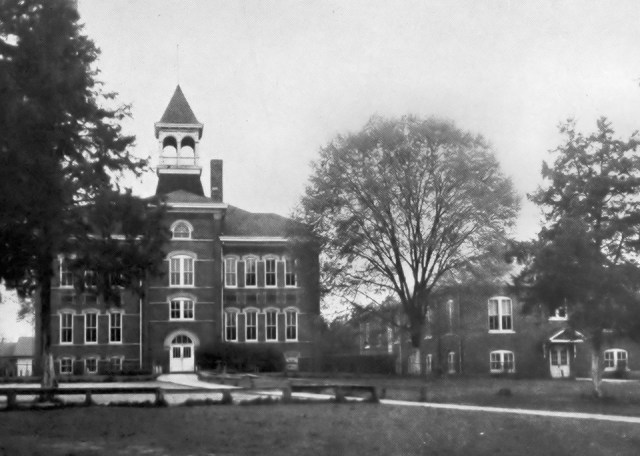
‘Finest in the State:’ The Legacy of Lawrence County High School

The following editorial by Irl Cloud, about Lawrence County High School, appeared on the front page of the Lawrence ‘Democrat’ on February 14, 1912. Our county is still blessed with hard-working, professional educators.

“…[Lawrenceburg] is inhabited by intelligent and progressive people who are enthusiastic as to the success and welfare of their schools. They assist and encourage the progress of all school movements in every possible way.

Lawrenceburg has ten churches of the various denominations, and there are no saloons. The town is equipped with a splendid system of electric lights and water works, supplying the town with pure free stone water and splendid lights.

The High School building is regarded by many prominent school men as one of the finest County High School buildings in the state. It is built of brick and trimmed with Kentucky stone; it is three stories high, and of modern architectural design, and has all the equipment of an up to date high school.

The laudable aim of both town people and the faculty is to develop the moral, as well as the intellectual natures of every boy and girl entrusted to their care.

The advancement of the present High School has been remarkable. It was organized in September of 1908 with an enrollment of twenty seven students, Prof. D.C. Stunkard with a corp of able and energetic assistants has continued the work and brought it to its present prominence. The High School at present has an enrollment of about two hundred fifty, second only in number to the largest County High School in the state and equal to any in morality and efficiency. Without undue arrogance we may hope that in the near future our High School will make Lawrenceburg the Athens of Tennessee.”

10882375_753133181443678_3688430662231150291_n

Posted in Uncategorized | Leave a comment