Ambush in the Fog: the Fight at Sugar Creek

Merry Christmas from Lawrence County History Trivia!

This week marks the 150th anniversary of General Nathan Bedford Forrest’s final battles in the State of Tennessee. His final engagement in Tennessee occurred in Lawrence County, on Sugar Creek, near the town of Appleton.

After the devastating Confederate defeat at Nashville in December 1864, the Army of Tennessee beat a hasty retreat into Alabama. General Hood ordered Forrest to act as the army’s rear-guard in order to keep it from being destroyed by pursuing Federal forces. On Christmas night, 1864, after a day of fighting south of Pulaski, Forrest’s men encamped at Sugar Creek. The next day, December 26, a heavy fog enshrouded the area, giving a tactical advantage to Forrest’s waiting Confederates. Forrest halted the Federal advance at Sugar Creek, and his men pursued the fleeing yankees from the battlefield for two miles before returning to their position on the creek. Here is Forrest’s account of the engagement, from the ‘Official Record of the War of the Rebellion.’

“I halted my command at Sugar Creek, where it encamped during the night.

On the morning of the 26th the enemy commenced advancing, driving back General Ross’s pickets. Owing to the dense fog he could not see the temporary fortifications which the infantry had thrown up and behind which they were secreted. The enemy therefore advanced to within fifty paces of these works, when a volley was opened upon him, causing the wildest confusion. Two mounted regiments of Ross’ brigade and Ector’s and Granbury’s brigades of infantry were ordered to charge upon the discomfited foe, which was done, producing a complete rout. The enemy was pursued for two miles, but showing no disposition to give battle my troops were ordered back. In this engagement [the Federals] sustained a loss of about 150 in killed and wounded; many prisoners and horses were captured and about 400 horses killed. I held this position for two hours, but the enemy showing no disposition to renew the attack, and fearing he might attempt a flank movement in the dense fog, I resumed the march, after leaving a picket with orders to remain until 4 o’clock. The enemy made no further attack between Sugar Creek and Tennessee River, which stream I crossed on the evening of the 27th of December.”


9484_750094618414201_553036172794898928_n

Posted in Uncategorized | Leave a comment

Direct-Dial Phones Come to Lawrenceburg

Do you remember having to ask the operator to connect your phone call, ‘Andy Griffith Show’-style?

On this day 47 years ago, that became a thing of the past in the city of Lawrenceburg.

On December 17, 1967, direct-dial telephones first went into operation in Lawrenceburg.

What are some of your favorite telephone memories?

10847843_745423812214615_6893663803714670341_n

Posted in Uncategorized | Leave a comment

What’s In a Name? Communities of Lawrence County

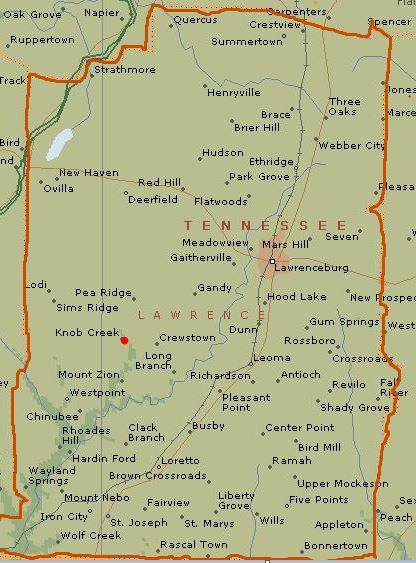
Lawrence County has a rich tradition of interesting place names. Some community names such as Barnesville, Henryville, Bonnertown, and Alexander Springs were named after individuals or families who lived in those areas.

Other community names were inspired by Biblical places, such as Mars Hill, Mount Zion, Ramah, Antioch, and Mt. Nebo. The names of St. Joseph and St. Mary’s were inspired by Biblical characters who are also Catholic saints.

But some of our county’s place names are a bit more unusual.

We have mentioned before that Revilo, in southeastern Lawrence County, is ‘Oliver’ spelled backwards, after the Oliver double-shoveled plow.

It is said by some locals that Copperas Branch, the name of both a creek and a road east of Leoma, was named for the great number of copperhead snakes that live in and around the creek.

Insurance Bluff is the name of a 200-foot drop near West Point, so-named because many vehicles have been pushed from the top of the bluff’s steep ledge to the creek below in order for the owner to collect insurance money. Many wrecked cars remain at the bottom of the bluff, today.

According to Mrs. Ethel Young Benson, the community of Marcella Falls was named for Marcella Paine, the daughter of an attorney from Columbia who, during a bout of ill health, acted as governess for the children of A.O. Williams in the years before the Civil War. Williams, who operated one of the cotton mills at the base of the massive waterfalls, liked the name, and decided to name the falls after her.

Leoma, according to ‘The Heritage of Lawrence County, Tennessee,’ was named after the the daughter of a railroad clerk when the post office was reestablished in the place in 1911. Prior names of the community were ‘Dean Switch’ and ‘Shade.’

What is your favorite unique place name in Lawrence County? If you have heard where the name of a place originated, please let us know in a comment.

10421277_739380956152234_988927478186494283_n

Posted in Uncategorized | 1 Comment

Eyewitness to Carnage: Sam Watkins at the Battle of Franklin

Just a few days after fighting their way through Lawrence County in the fall of 1864, the Confederate Army of Tennessee suffered a horrific loss of manpower and leadership at Franklin, Tennessee.

November 30 is the 150th anniversary of the Battle of Franklin. Sam Watkins, a Confederate infantryman from Maury County, had this to say about it in his book ‘Co Aytch:’

“Kind reader, right here my pen, and courage, and ability fail me. I shrink from butchery. Would to God I could tear the page from these memoirs and from my own memory. It is the blackest page in the history of the war of the Lost Cause. It was the bloodiest battle of modern times in any war. It was the finishing stroke to the independence of the Southern Confederacy. I was there. I saw it. My flesh trembles, and creeps, and crawls when I think of it to-day. My heart almost ceases to beat at the horrid recollection. Would to God that I had never witnessed such a scene!

“I cannot describe it. It beggars description. I will not attempt to describe it. I could not. The death-angel was there to gather its last harvest. It was the grand coronation of death. Would that I could turn the page. But I feel, though I did so, that page would still be there, teeming with its scenes of horror and blood. I can only tell of what I saw.”

It should be noted that Watkins was a participant in every major campaign of the Army of Tennessee during the Civil War, and yet even as a battle-hardened veteran, Watkins remembered the Battle of Franklin as especially horrific.

To read Watkins’s memories of Franklin–and the rest of the War–follow this link:

https://tinyurl.com/yyhdmfsh

10478196_736357989787864_3534013387619462564_n

Posted in Uncategorized | Leave a comment

Co. Aytch at Franklin

Just a few days after fighting their way through Lawrence County in the fall of 1864, the Confederate Army of Tennessee suffered a horrific loss of manpower and leadership at Franklin, Tennessee.

November 30 is the 150th anniversary of the Battle of Franklin. Sam Watkins, a Confederate infantryman from Maury County, had this to say about it in his book ‘Co Aytch:’

“Kind reader, right here my pen, and courage, and ability fail me. I shrink from butchery. Would to God I could tear the page from these memoirs and from my own memory. It is the blackest page in the history of the war of the Lost Cause. It was the bloodiest battle of modern times in any war. It was the finishing stroke to the independence of the Southern Confederacy. I was there. I saw it. My flesh trembles, and creeps, and crawls when I think of it to-day. My heart almost ceases to beat at the horrid recollection. Would to God that I had never witnessed such a scene! 

“I cannot describe it. It beggars description. I will not attempt to describe it. I could not. The death-angel was there to gather its last harvest. It was the grand coronation of death. Would that I could turn the page. But I feel, though I did so, that page would still be there, teeming with its scenes of horror and blood. I can only tell of what I saw.”

It should be noted that Watkins was a participant in every major campaign of the Army of Tennessee during the Civil War, and yet even as a battle-hardened veteran, Watkins remembered the Battle of Franklin as especially horrific.

To read Watkins’s memories of Franklin–and the rest of the War–follow this link:

http://books.google.com/books?id=HyhCAAAAIAAJ&printsec=frontcover&dq=co.+aytch&hl=en&sa=X&ei=TOB7VMCpBYGnNv2ahHA&ved=0CCYQ6AEwAA#v=onepage&q&f=false

Posted in Uncategorized | Tagged , , , , | Leave a comment

Thanksgiving 1879 in Lawrenceburg, Tennessee

Happy Thanksgiving!

I hope you all are having a pleasant holiday, surrounded by those you love, and with plenty to eat. We all have much to be thankful for! But did you know, that, in the county’s early days, the Thanksgiving holiday had less to do with family, food, and shopping, and was instead observed more by community gatherings and interdenominational public worship services?

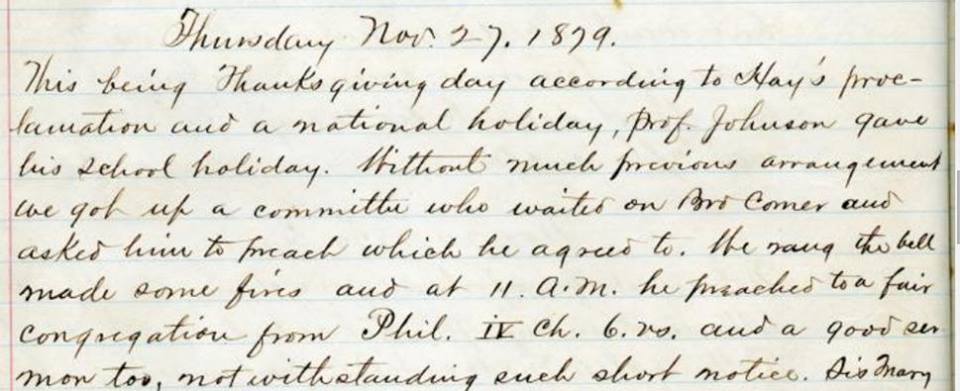
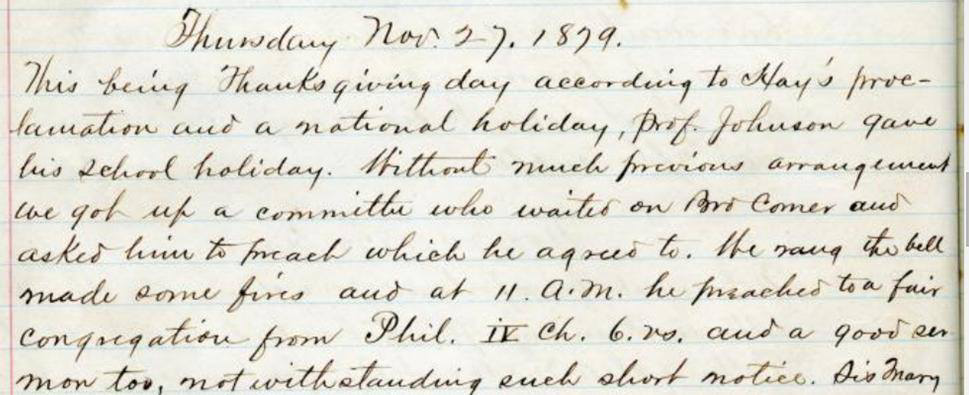
As can be seen in this entry from the journal of William T. Nixon, Thanksgiving 1879, which happened exactly 135 years ago today, was observed with short notice by the people of Lawrenceburg. Students were excused from school, and a group of leading citizens organized an impromptu public worship service, which was probably held at either the Cumberland Presbyterian Church on South Military Street or First Methodist Church on Waterloo Street, although Nixon does not specify where the service took place.

To prepare for the worship service, the men warmed the church by building fires in the church’s stoves, and rang the church bell to let the community know that a special service was about to be held. With practically no notice, Bro. Comer agreed to preach a special Thanksgiving sermon to the crowd. His sermon text was Philippians 4:6, which says: “Be careful for nothing; but in every thing by prayer and supplication with thanksgiving let your requests be made known unto God.” (King James Version).

10401352_734774696612860_2898790140896941223_n

Excerpt from the Journal of W.T. Nixon, 1879


Posted in Uncategorized | Leave a comment

Happy Thanksgiving, 1879 Style

Happy Thanksgiving!

I hope you all are having a pleasant holiday, surrounded by those you love, and with plenty to eat. We all have much to be thankful for! But did you know, that, in the county’s early days, the Thanksgiving holiday had less to do with family, food, and shopping, and was instead observed more by community gatherings and interdenominational public worship services?

As can be seen in this entry from the journal of William T. Nixon, Thanksgiving 1879, which happened exactly 135 years ago today, was observed with short notice by the people of Lawrenceburg. Students were excused from school, and a group of leading citizens organized an impromptu public worship service, which was probably held at either the Cumberland Presbyterian Church on South Military Street or First Methodist Church on Waterloo Street, although Nixon does not specify where the service took place.

To prepare for the worship service, the men warmed the church by building fires in the church’s stoves, and rang the church bell to let the community know that a special service was about to be held. With practically no notice, Bro. Comer agreed to preach a special Thanksgiving sermon to the crowd. His sermon text was Philippians 4:6, which says: “Be careful for nothing; but in every thing by prayer and supplication with thanksgiving let your requests be made known unto God.” (King James Version).

Posted in Uncategorized | Leave a comment

One More Book Update

Hello friends! As I have mentioned before, a few things have interfered with me meeting my deadline for finishing ‘Lawrence County History Trivia’ the book, including working overtime on end-of-the-year projects for work, writing a term paper for grad school, and taking my wife to multiple doctor’s appointments as we prepare to welcome our first child to the world. 

The good news is, our programs at work are winding down, I made a 90 on the evil 20-page term paper, and my firstborn child (who is due any day now) is healthy and growing, and could possibly tip the scales at 8 or 9 pounds when she is born!

Here is a preview of the first 40 pages or so of the book, so you can see how it will be formatted. As you can see from some of the gaping blank spaces, I am still wrestling with the images to make them behave. I expect it to be around 300 pages in length when it’s finished, it will be for sale both via Amazon and some physical locations around the county, and I will immediately announce its price and availability here the second it is ready for purchase.

In the meantime, the great local historian Bobby Alford has finished his highly-anticipated book about women in Lawrence County history, and I encourage you to check it out! Copies of Mr. Alford’s books are available at the Lawrence County Archives.

Thanks,

Clint

Posted in Uncategorized | Leave a comment

Forrest’s Charge at Summertown

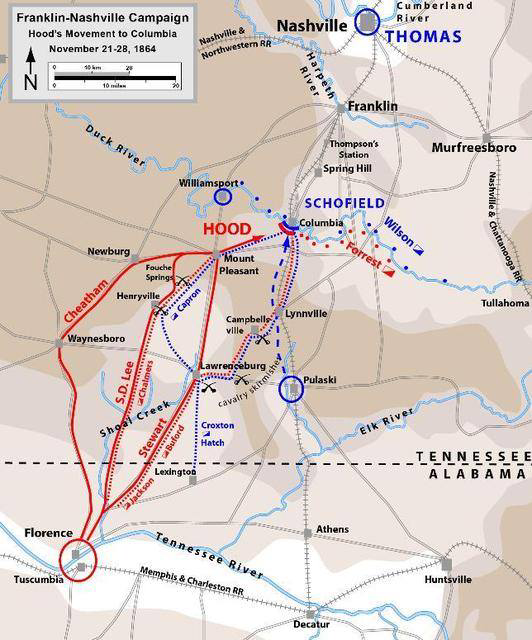
To continue with our observance of the 150th anniversary of the Army of Tennessee’s push into Lawrence County, here is General Nathan Bedford Forrest’s account of this weekend’s actions at Henryville and Summertown (Summertown is referred to in his account as Foust’s Springs or Fouche Springs, as it was not yet an established community in 1864). At Summertown, Forrest, himself, accompanied only by his escort, charged Union cavalrymen and forced their retreat toward Mt. Pleasant.

“I bivouacked my command at Shoal Creek [near modern St. Florian, Alabama] until the morning of the 21st, when, in obedience to orders from General Hood, I commenced a forward movement. My command consisted of three divisions–Chalmers’, Buford’s, and Jackson’s. I ordered Brigadier-General Chalmers to advance via West Point, Kelly’s Forge, Henryville, and Mount Pleasant. Brigadier-Generals Buford and Jackson were ordered to move up the military road to Lawrenceburg, and thence southeastward in the direction of Pulaski. Both these divisions had several engagements with the enemy, and were almost constantly skirmishing with him, but drove him in every encounter.

At Henryville, Brigadier-General Chalmers developed the enemy’s cavalry and captured forty-five prisoners. At Fouche Springs the enemy made another stand. I ordered General Chalmers to throw forward Rucker’s brigade and to keep up a slight skirmish with the enemy until I could gain his rear. I ordered Lieutenant-Colonel Kelley to move by the left flank and join me in rear of the enemy. Taking my escort with me I moved rapidly to the rear. Lieutenant-Colonel Kelley being prevented from joining me as I had expected, I made the charge upon the enemy with my escort alone, producing a perfect stampede, capturing about 50 prisoners, 20 horses, and 1 ambulance. It was now near night, and I placed my escort in ambush. Colonel Rucker pressed upon the enemy, and as they rushed into the ambuscade my escort fired into them, producing the wildest confusion. I ordered Colonel Rucker to rest his command until 1 a.m., when the march was renewed toward Mount Pleasant…”

–‘Official Record of the War of the Rebellion’, Series 1, Vol. 45, Part I, pg. 752.

Forrest’s men provided a screen for advancing Confederate infantry. His men were probably at ease moving through the backroads of western Lawrence County because many of the cavalrymen under his command were actually from Lawrence County. According to local tradition, Hood Road in Deerfield was one of the roads used by the Army of Tennessee in their push toward Nashville 150 years ago this weekend. The road is named in honor of Confederate commander General John Bell Hood.

Posted in Uncategorized | Tagged , , , | Leave a comment

Lawrence County in the Civil War: Hood’s Return

On this weekend 150 years ago, Lawrence County was directly in the center of the Confederate re-invasion of Tennessee known as the Nashville Campaign. 

Launching from Florence, the Army of Tennessee, commanded by General John Bell Hood, split into three main branches. The westernmost branch (Cheatham’s Corps) moved towards Waynesboro, the central branch (Stephen D. Lee’s Corps) moved towards the Turnpike in western Lawrence County, where General Nathan Bedford Forrest was personally engaged in battles at Henryville and Summertown on the 22nd (more about those tomorrow), and the easternmost branch (Stewart’s Corps) traveled north on the Military Road, going east after coming into Lawrenceburg, and sweeping north through Campbellsville. 

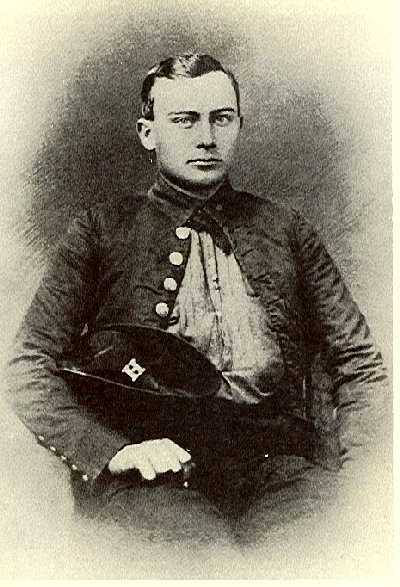
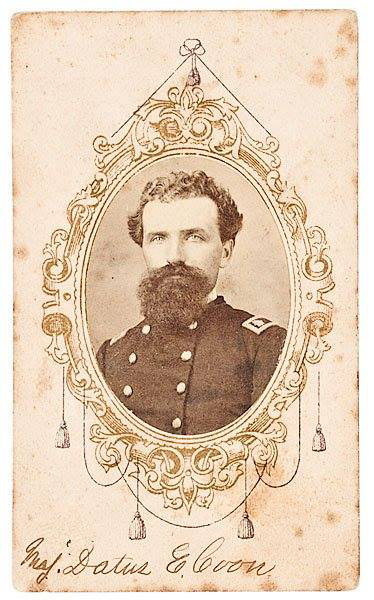
Vastly-outnumbered Union scouting parties skirmished with Confederate troops throughout their push northward. One of the commanders of those Union forces was Colonel Datus E. Coon (pictured here). On the night of November 21, 1864, Coon’s troopers camped in Lawrenceburg.

While battling each other, the two armies also had to battle a late-November snowstorm. Coon reported to his superiors that the night of November 21, when his men camped in Lawrenceburg, the weather “was cold, and much snow fell during the afternoon and night following.”

Most of the combat in Lawrence County during the Nashville Campaign occurred on November 22-23, 1864. Stay tuned for more about those actions tomorrow, on their 150th anniversary.

Posted in Uncategorized | Leave a comment